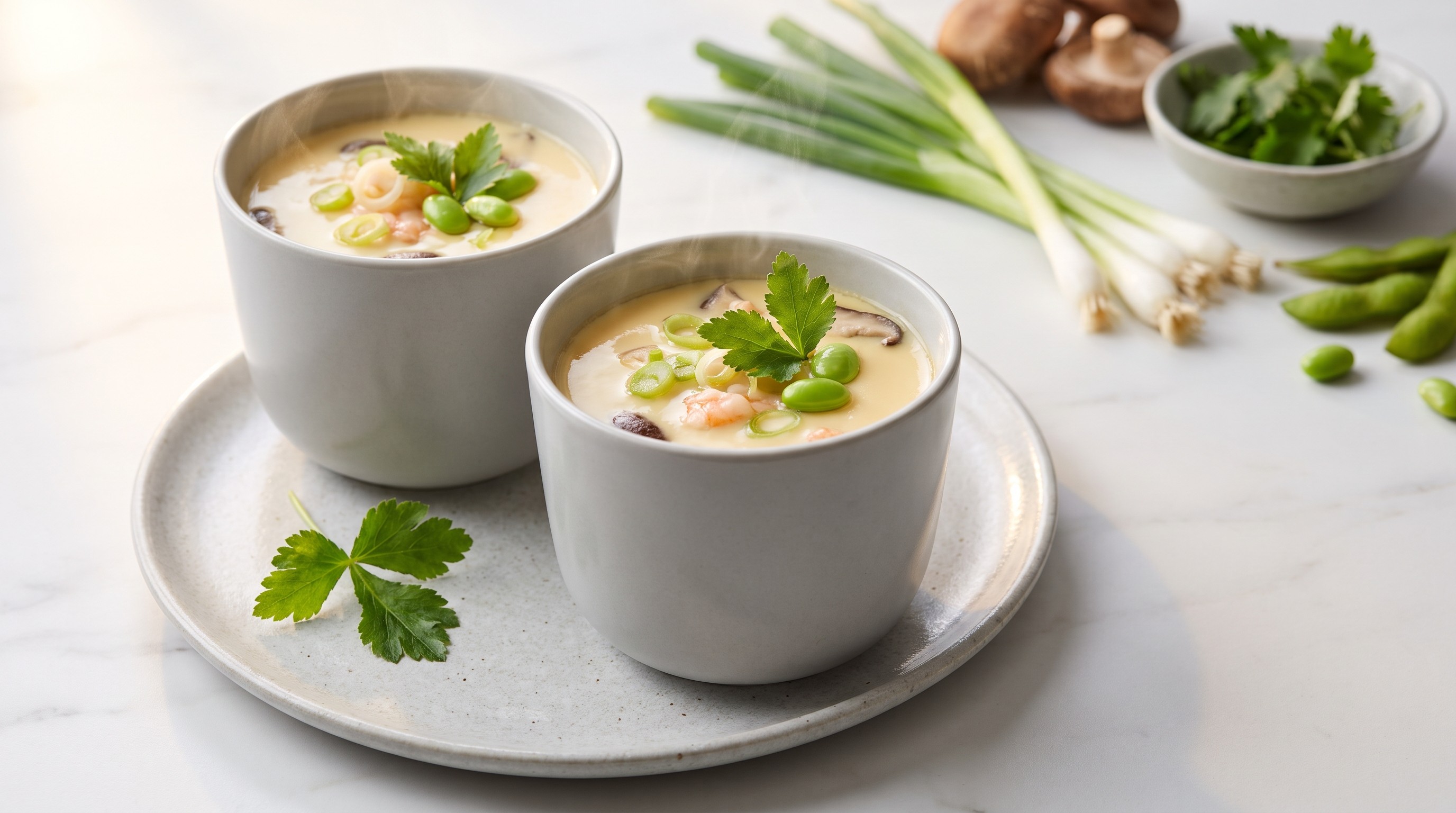
Chawanmushi (Japanese Steamed Egg Custard)
Silky Japanese steamed egg custard with tender chicken, prawns, and shiitake mushrooms — a naturally low-glycemic, protein-rich bowl ready in 25 minutes.
Chawanmushi is one of those rare dishes that needs no adaptation to fit a blood-sugar-friendly lifestyle — it arrives that way by design. A trembling custard of eggs and dashi broth cradles bites of chicken thigh, plump prawns, earthy shiitake, and bright edamame. With virtually no starch or sugar, the glycemic load per serving is negligible, making it an ideal starter or light main for anyone managing glucose levels.
The beauty of chawanmushi lies in its macronutrient profile. Eggs provide sustained-release protein and healthy fats that blunt any glucose response, while dashi stock — made from kelp and bonito — contributes deep umami without a single gram of carbohydrate. The chicken and prawns add another layer of satiating protein, and shiitake mushrooms bring beta-glucan fibre that has been shown to support healthy blood sugar metabolism. Even the small amount of mirin used here adds less than two grams of sugar per serving, a trace amount buffered by the dish's substantial protein and fat content.
For optimal blood sugar management, serve chawanmushi at the start of a meal. Research consistently shows that consuming protein and vegetables before carbohydrates dramatically flattens the post-meal glucose curve. Pair it with a small side of lightly dressed greens or pickled vegetables, and you have a first course that primes your metabolism beautifully for whatever follows. The gentle steaming technique keeps the custard silky rather than rubbery — low heat and patience are all it asks in return.
Blood Sugar Impact
Very minimal blood sugar impact expected. With a glycemic load of just 2.5 and a low GI of 36, this protein-rich egg custard will produce a slow, gentle rise in blood glucose and provide stable energy for 3-4 hours.
Blood Sugar Tips
- ✓ Enjoy the chawanmushi as a starter before any carbohydrate-containing dishes to leverage the protein and fat content for slowing gastric emptying.
- ✓ Pair with a small side of fibrous vegetables like a seaweed salad or pickled vegetables to add extra fiber and further blunt any minor glucose response.
- ✓ Be mindful of the mirin quantity when preparing — mirin contains sugar, so using a light hand or substituting with a splash of dry sake keeps the already-low glycemic load in check.
🥗 Ingredients
- 80 g Chicken thigh
- 4 pcs Prawn
- 3 pcs Shiitake mushroom
- 2 tbsp Edamame
- 4 pcs Egg
- 400 ml Dashi stock
- 2 tsp Mirin
- 2 tsp Light soy sauce
- 0.25 tsp Salt
- 1 pcs Spring onion
- 2.8 oz Chicken thigh
- 4 pcs Prawn
- 3 pcs Shiitake mushroom
- 2 tbsp Edamame
- 4 pcs Egg
- 1.7 cups Dashi stock
- 2 tsp Mirin
- 2 tsp Light soy sauce
- 0.25 tsp Salt
- 1 pcs Spring onion
👨🍳 Instructions
- 1
Prepare the fillings: dice the chicken thigh into small 1 cm cubes, peel and devein the prawns, and slice the shiitake caps thinly after removing the stems. Set all the prepared ingredients aside along with the shelled edamame.
- 2
Crack the eggs into a mixing bowl and stir them gently with chopsticks or a fork using a slow folding motion. The goal is to combine the yolks and whites without incorporating air — a frothy mixture will produce an uneven, pockmarked custard rather than a smooth one.
- 3
Add the dashi stock, mirin, light soy sauce, and a pinch of salt to the eggs. Stir slowly until everything is evenly blended. The ratio of egg to dashi is roughly 1:2, which gives the custard its characteristic delicate wobble.
- 4
Divide the chicken pieces, prawns, shiitake slices, and edamame equally between two deep heatproof bowls or 400 ml ramekins, arranging them in a single layer across the bottom.
- 5
Pour the egg-dashi mixture through a fine-mesh sieve directly over the fillings, splitting it evenly between the two bowls. The straining step removes any chalazae and lumps, ensuring the custard sets perfectly smooth. Use a spoon to lift away any tiny bubbles sitting on the surface.
- 6
Cover each bowl tightly with aluminium foil to prevent condensation from dripping onto the custard. Bring water to a rolling boil in a steamer, then place the bowls inside. Immediately lower the heat to the gentlest simmer you can maintain — high heat causes bubbles inside the custard and ruins the silky texture.
- 7
Steam on low heat for 15 minutes without lifting the lid. The custard is ready when it wobbles gently like set jelly if you tap the side of the bowl. If you insert a thin skewer into the centre, the liquid that seeps out should be clear, not cloudy. If it still looks underset, steam for another 2 minutes and check again.
- 8
Carefully remove the bowls from the steamer, peel off the foil, and scatter the thinly sliced spring onion over each custard. Serve immediately while the chawanmushi is still hot — it is best enjoyed with a small spoon, eaten slowly to appreciate the silky texture and clean umami flavour.
📊 Nutrition Per Serving
| Per Serving | Whole Dish | |
|---|---|---|
| Calories | 306 | 612 |
| Carbs | 7g | 14g |
| Sugars | 4g | 7g |
| Added Sugars | 1g | 2g |
| Natural Sugars | 3g | 5g |
| Protein | 31g | 61g |
| Fat | 17g | 35g |
| Saturated Fat | 5g | 10g |
| Unsaturated Fat | 11g | 23g |
| Fiber | 2g | 3g |
| Soluble Fiber | 0g | 1g |
| Insoluble Fiber | 1g | 2g |
| Sodium | 1104mg | 2209mg |
Predicted Glucose Response
What if you...
Estimated model — individual responses vary. Not medical advice.
🔄 Lower GI Swaps
Mirin contains approximately 14 g of sugar per tablespoon. While the 2 tsp used here contribute less than 2 g of sugar per serving, swapping to sake with a touch of stevia or dry sherry eliminates even this small sugar contribution while preserving the subtle sweetness that balances the savoury custard.
Light soy sauce is already low-glycemic, so this swap is optional. Tamari offers a similar umami depth with no gluten. Coconut aminos provide a slightly milder, sweeter flavour and are lower in sodium, though they contain slightly more sugar per serving (about 1 g per teaspoon) than tamari — still negligible in this quantity but worth noting for those closely tracking carbohydrate intake.
🔬 The Science Behind This Recipe
Why This Recipe Loves Your Blood Sugar
Chawanmushi is essentially a savoury protein custard with almost zero glycemic impact. Each serving delivers roughly 20 g of complete protein from eggs, chicken, and prawns, paired with healthy fats from the egg yolks — a combination that triggers minimal insulin secretion and keeps blood glucose remarkably stable.
The dashi broth base is the secret weapon: it contributes intense umami flavour from glutamate-rich kombu and inosinic acid in bonito flakes, yet contains virtually no carbohydrates at all. This means the liquid volume of the dish adds satisfaction and fullness without adding any glucose load.
Shiitake mushrooms contribute soluble beta-glucan fibre, a type of polysaccharide that research has shown can improve insulin sensitivity and slow the absorption of any co-consumed carbohydrates. The edamame adds a small amount of complex carbohydrate buffered by its own protein and fibre content, keeping the overall glycemic load at a negligible 2.5 per serving.
The only notable sugar source is the 2 teaspoons of mirin, which contributes less than 2 g of sugar per serving — a trace amount that is effectively neutralised by the dish's high protein-to-carbohydrate ratio. Eating protein before carbohydrates has been shown in clinical studies to reduce post-meal glucose spikes by up to 40%, making chawanmushi an ideal first course.
Related recipes
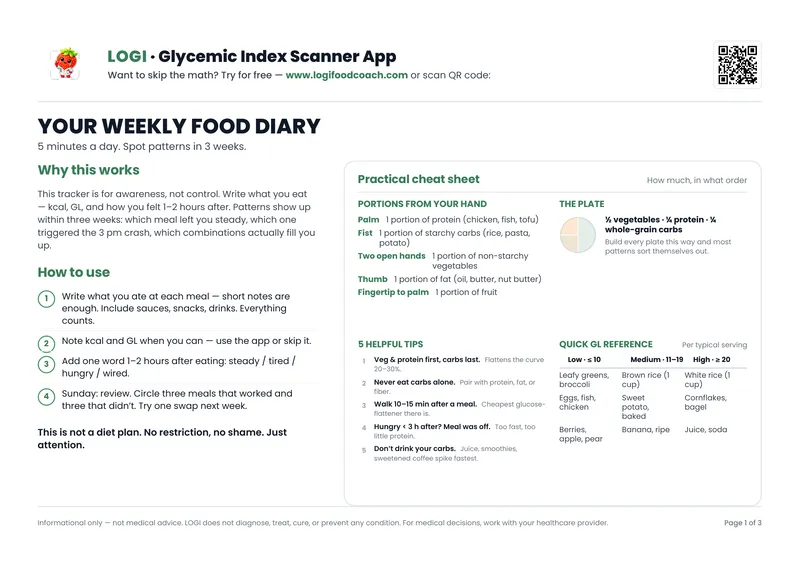
Free PDF — 3 pages
Your Weekly Food Journal
Track meals, glycemic load & mood. Spot patterns in 3 weeks.
No spam. Unsubscribe anytime.