Pancakes à la banane et à l'avoine adaptés à la glycémie
Des pancakes complets naturellement sucrés à la banane. Leur teneur élevée en fibres et en protéines aide à maintenir une glycémie stable tout au long de la matinée.
Ces pancakes riches en nutriments combinent la puissance des céréales complètes avec un sucre naturel pour créer un petit-déjeuner qui favorise une glycémie stable. Les flocons d'avoine à l'ancienne apportent des fibres solubles qui ralentissent l'absorption du glucose, tandis que la farine de blé complet ajoute des fibres et des nutriments supplémentaires que la farine blanche ne contient pas. La banane apporte une douceur naturelle, ce qui nous permet de limiter les sucres ajoutés.
Ce qui rend ces pancakes particulièrement adaptés à la glycémie, c'est la combinaison de glucides complexes, de protéines provenant de l'œuf et du yaourt, et de bonnes graisses de l'huile de canola. Cet équilibre des macronutriments aide à prévenir les pics de glucose rapides associés aux pancakes traditionnels à base de farine raffinée. La cannelle ajoute plus qu'une simple saveur — des études suggèrent qu'elle pourrait améliorer la sensibilité à l'insuline.
NOTE GLYCÉMIQUE IMPORTANTE : Cette recette contient de petites quantités de cassonade (IG ~65-68) et de farine tout usage (IG ~75) pour la texture et le goût. Pour un contrôle optimal de la glycémie, utilisez des bananes légèrement moins mûres (plus jaunes que tachetées de brun, IG ~51 contre ~62 pour les très mûres), et envisagez fortement les substitutions à IG plus bas proposées ci-dessous. La combinaison d'avoine, de farine de blé complet, de protéines et de graisses aide à modérer la réponse glycémique globale, mais le contrôle des portions reste essentiel.
Pour un contrôle glycémique optimal, accompagnez ces pancakes d'une source de protéines comme du yaourt grec ou des œufs, et pensez à manger d'abord une petite poignée de noix. Les flocons d'avoine riches en fibres ont un index glycémique bas d'environ 55, ce qui en fait un excellent choix pour une énergie durable sans les montagnes russes de la glycémie. Chaque portion correspond à 3 pancakes moyens (environ 10 cm de diamètre).
Impact sur la glycémie
Impact modéré sur la glycémie avec une charge glycémique de 28,1 et un IG de 52. Attendez-vous à une élévation progressive de la glycémie sur 1 à 2 heures avec une énergie durant 2 à 3 heures, bien que la combinaison de farines raffinées et de cassonade provoquera un pic plus prononcé que les alternatives à base d'aliments complets.
Conseils glycémie
- ✓ Ajoutez une source de protéines comme du yaourt grec, des œufs ou du beurre de fruits à coque en accompagnement pour ralentir l'absorption du glucose et prolonger la satiété
- ✓ Mangez une petite poignée de fruits à coque ou de graines avant les pancakes pour apporter des graisses et des fibres qui atténueront la réponse glycémique
- ✓ Faites une marche de 10 à 15 minutes après avoir mangé pour aider les muscles à absorber le glucose et réduire le pic post-repas
🥗 Ingrédients
- 0.5 cup flocons d'avoine à l'ancienne
- 1 cup eau chaude
- 2 tbsp huile de colza
- 2 tbsp cassonade
- 0.5 cup farine complète
- 0.5 cup farine blanche
- 1.5 tsp levure chimique
- 0.25 tsp bicarbonate de soude
- 0.25 tsp sel
- 0.25 tsp cannelle moulue
- 0.5 cup lait écrémé
- 0.25 cup yaourt nature 0%
- 1 pcs banane mûre, écrasée
- 1 pcs gros œuf
- 0.5 cup flocons d'avoine à l'ancienne
- 1 cup eau chaude
- 2 tbsp huile de colza
- 2 tbsp cassonade
- 0.5 cup farine complète
- 0.5 cup farine blanche
- 1.5 tsp levure chimique
- 0.25 tsp bicarbonate de soude
- 0.25 tsp sel
- 0.25 tsp cannelle moulue
- 0.5 cup lait écrémé
- 0.25 cup yaourt nature 0%
- 1 pcs banane mûre, écrasée
- 1 pcs gros œuf
👨🍳 Instructions
- 1
Versez de l'eau chaude sur les flocons d'avoine dans un grand bol et laissez-les tremper pendant 2 minutes jusqu'à ce qu'ils deviennent tendres et crémeux. Incorporez l'huile de canola et la cassonade, puis mettez le mélange de côté pour qu'il refroidisse quelques minutes pendant que vous préparez les ingrédients secs.
- 2
Fouettez ensemble les deux farines, la levure chimique, le bicarbonate de soude, le sel et la cannelle moulue dans un bol moyen séparé jusqu'à ce que le tout soit bien mélangé. Cela garantit que les agents levants sont répartis uniformément dans le mélange de farine.
- 3
Ajoutez le lait écrémé, le yaourt et la banane écrasée au mélange d'avoine refroidi, en remuant jusqu'à ce que tout soit bien incorporé. Cassez l'œuf et battez-le soigneusement dans les ingrédients humides jusqu'à ce qu'il n'y ait plus de traces.
- 4
Versez le mélange de farine dans le mélange d'avoine humide et mélangez délicatement avec une spatule ou une cuillère en bois. Mélangez juste assez pour humidifier les ingrédients secs — quelques petits grumeaux sont acceptables et trop mélanger donnera des pancakes durs.
- 5
Chauffez une plaque ou une grande poêle antiadhésive à feu moyen. Une fois la surface chaude, vaporisez légèrement d'huile si nécessaire. Versez environ 1/4 tasse de pâte sur la plaque pour chaque pancake, en les espaçant d'environ 5 cm.
- 6
Faites cuire les pancakes sans y toucher pendant 2 à 2,5 minutes jusqu'à ce que de petites bulles se forment sur toute la surface et que les bords semblent pris et légèrement dorés. C'est le signal qu'ils sont prêts à être retournés.
- 7
Utilisez une large spatule pour retourner chaque pancake avec précaution et faites cuire pendant 2 à 3 minutes supplémentaires sur le deuxième côté jusqu'à ce qu'ils soient dorés et cuits à cœur. Transférez les pancakes terminés dans une assiette chaude et répétez avec le reste de la pâte, en ajustant le feu si nécessaire pour éviter de brûler.
- 8
Servez les pancakes chauds, idéalement avec une garniture riche en protéines comme du yaourt grec ou une petite quantité de beurre de noix. Pour un meilleur contrôle de la glycémie, mangez-les avec des œufs ou après avoir consommé des légumes ou des noix pour ralentir davantage l'absorption du glucose. Chaque portion correspond à 3 pancakes moyens.
📊 Nutrition par portion
| Par portion | Plat entier | |
|---|---|---|
| Calories | 299 | 1194 |
| Glucides | 45g | 182g |
| Sucres | 12g | 49g |
| Sucres ajoutés | 6g | 24g |
| Sucres naturels | 6g | 24g |
| Protéines | 9g | 35g |
| Lipides | 10g | 40g |
| Graisses saturées | 1g | 6g |
| Graisses insaturées | 9g | 34g |
| Fibres | 4g | 16g |
| Fibres solubles | 1g | 5g |
| Fibres insolubles | 3g | 11g |
| Sodium | 447mg | 1788mg |
Réponse glycémique prédite
Et si vous...
Modèle estimé — les réponses individuelles varient. Pas un avis médical.
🔄 Alternatives à faible IG
La cassonade a un index glycémique modéré à élevé qui peut provoquer une élévation de la glycémie. L'érythritol et le fruit du moine apportent de la douceur sans affecter la glycémie, ce qui les rend idéaux pour la gestion de la glycémie. Le sirop d'érable pur, bien que restant un sucre, a un IG plus bas que la cassonade et contient des minéraux bénéfiques, bien qu'il doive être utilisé avec parcimonie. Se fier uniquement à la douceur naturelle de la banane est l'option ayant le moins d'impact.
La farine tout usage est une céréale raffinée avec un index glycémique élevé qui provoque des pics de glycémie rapides. La farine d'amande a un IG pratiquement nul et ajoute des protéines et de bonnes graisses qui stabilisent davantage la glycémie. Utiliser de la farine de blé complet supplémentaire maintient la texture tout en abaissant l'IG global. La combinaison farine de coco-farine d'avoine offre un maximum de fibres et l'impact glycémique le plus bas, bien qu'elle puisse légèrement modifier la texture.
La maturité de la banane affecte considérablement l'impact glycémique — les bananes moins mûres contiennent plus d'amidon résistant et ont un IG d'environ 51 contre 60-62 pour les bananes très mûres. La compote de pommes non sucrée apporte une humidité et une douceur naturelle similaires avec un IG plus bas. La patate douce écrasée offre une texture et une douceur comparables avec des nutriments supplémentaires et une réponse glycémique plus basse, ce qui en fait une excellente alternative adaptée à la glycémie.
Bien que le lait écrémé ait un IG modéré d'environ 32, les laits végétaux non sucrés comme le lait d'amande n'ont pratiquement aucun impact glycémique en raison de leur teneur minimale en glucides. Le lait de soja non sucré apporte des protéines supplémentaires qui aident à stabiliser la glycémie tout en maintenant un IG bas. Ces substitutions réduisent la charge glucidique globale de la recette sans compromettre la texture.
La cassonade fait encore monter le glucose rapidement ; les édulcorants à IG plus bas sont préférables.
🔬 La science derrière cette recette
La nature adaptée à la glycémie de ces pancakes provient de leur combinaison stratégique de macronutriments et de fibres. Les flocons d'avoine à l'ancienne contiennent du bêta-glucane, une fibre soluble qui forme une substance gélatineuse dans votre tube digestif, ralentissant physiquement l'absorption du glucose dans votre circulation sanguine. Cela entraîne une augmentation plus progressive de la glycémie par rapport aux pancakes aux céréales raffinées. La farine de blé complet apporte des fibres supplémentaires et a un index glycémique plus bas (environ 69) que la farine tout usage (environ 75), bien que les deux soient encore des ingrédients à IG modéré. Les protéines de l'œuf et du yaourt grec ralentissent davantage la digestion et aident à stabiliser la glycémie en déclenchant une réponse insulinique plus mesurée. Les bonnes graisses de l'huile de canola contribuent également à cet effet ralentisseur. La cannelle contient des composés bioactifs qui peuvent améliorer la sensibilité à l'insuline en aidant les cellules à répondre plus efficacement aux signaux d'insuline. Cependant, il est important de noter que cette recette contient de la cassonade (IG ~65-68) et de la farine tout usage, qui vont élever la réponse glycémique globale. Utiliser les substitutions suggérées — érythritol ou édulcorant au fruit du moine au lieu de la cassonade, et farine d'amande au lieu de la farine tout usage — peut réduire considérablement l'impact glycémique. La maturité de la banane compte beaucoup : une banane légèrement moins mûre a un IG d'environ 51, tandis qu'une banane trop mûre peut atteindre 62 ou plus à mesure que l'amidon résistant se transforme en sucres simples pendant le mûrissement. La combinaison de ces ingrédients crée une réponse glycémique plus équilibrée que les pancakes traditionnels, mais le contrôle des portions et l'association avec des protéines supplémentaires restent des stratégies importantes pour une gestion optimale de la glycémie.
Recettes similaires
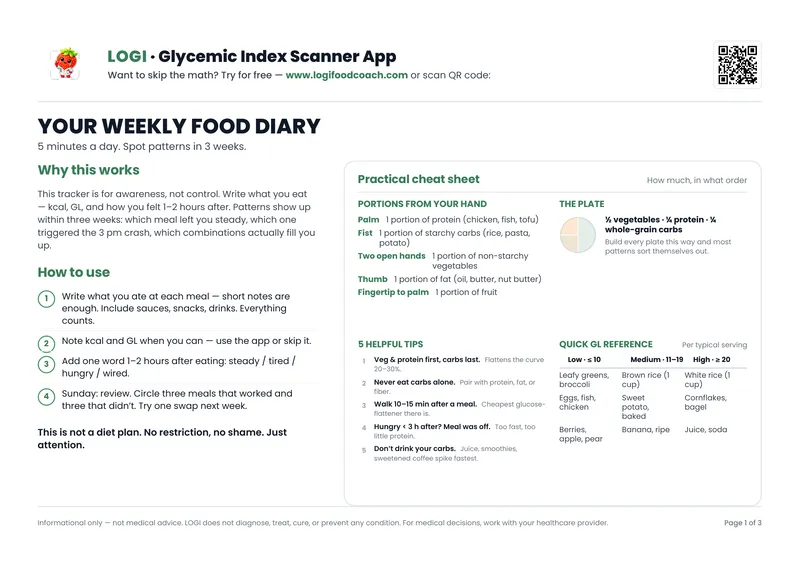
PDF gratuit — 3 pages
Ton journal alimentaire
Note tes repas, charge glycémique et humeur. Repère les tendances en 3 semaines.
Pas de spam. Désinscription à tout moment.