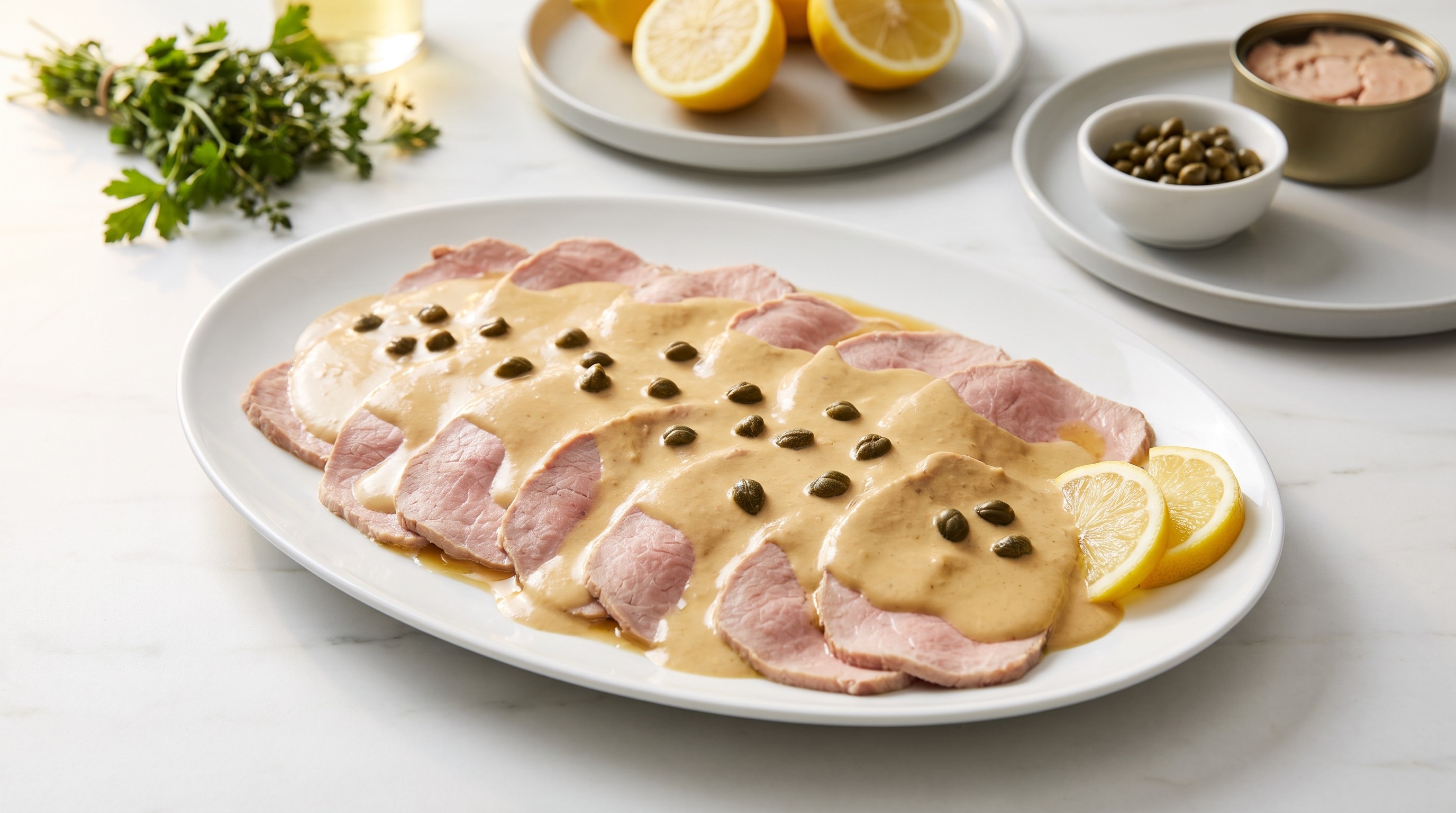
Vitello Tonnato
Cold poached veal draped in a creamy tuna-caper sauce — a Piedmontese classic that is naturally almost zero-carb and ideal for steady blood sugar.
Vitello tonnato is one of those rare dishes that needs no low-glycemic makeover at all. Built entirely on high-quality protein from veal and tuna, healthy fats from olive oil and egg yolk, and bright pops of flavour from capers, anchovies, and lemon, the entire plate registers a near-zero glycemic load. It is proof that eating for stable blood sugar never has to mean giving up elegance.
The technique is gentle and forgiving: veal top round simmers in an aromatic broth just until it reaches a rosy 65 °C at the centre, then rests in its own liquid until perfectly cool and sliceable. While the meat chills, the tonnato sauce comes together in seconds — canned tuna, anchovies, capers, egg yolk, and olive oil whizzed into a savoury, pourable cream. The finished dish is served cold, making it an ideal make-ahead centrepiece for warm-weather meals.
From a blood-sugar perspective, the combination of protein and fat slows gastric emptying and keeps post-meal glucose virtually flat. Pair it with a side of leafy greens or grilled courgettes dressed in the same lemon and olive oil to add fibre without raising the glycemic load. Eating the vegetables first, followed by the protein-rich veal and sauce, further blunts any glucose response — though with a dish this low in carbohydrate, the effect is already minimal. An outstanding choice for anyone managing insulin sensitivity or simply seeking a satisfying, blood-sugar-friendly Italian meal.
Blood Sugar Impact
Very minimal blood sugar impact expected. With a glycemic load of just 2.5 and an estimated GI of 23, this protein-and-fat-rich dish will produce a nearly flat glucose response, providing stable energy for 4-5 hours.
Blood Sugar Tips
- ✓ Serve alongside a generous portion of non-starchy vegetables like a mixed green salad or grilled zucchini to add fiber and further blunt any minor glucose response.
- ✓ If serving with bread or polenta on the side (common in Italian tradition), eat the veal and vegetables first to slow gastric emptying before introducing any starchy accompaniment.
- ✓ A short 10-15 minute walk after the meal will enhance insulin sensitivity and help clear any modest rise in blood glucose.
🥗 Ingredients
- 350 g Veal top round
- 100 g Canned tuna in olive oil
- 4 pcs Anchovy fillet
- 2 tbsp Caper
- 1 pcs Egg yolk
- 2 tbsp Extra-virgin olive oil
- 1 pcs Lemon
- 1 pcs Celery stalk
- 1 pcs Carrot
- 0.5 pcs Onion
- 1 pcs Bay leaf
- 1 tsp Fine salt
- 12.3 oz Veal top round
- 3.5 oz Canned tuna in olive oil
- 4 pcs Anchovy fillet
- 2 tbsp Caper
- 1 pcs Egg yolk
- 2 tbsp Extra-virgin olive oil
- 1 pcs Lemon
- 1 pcs Celery stalk
- 1 pcs Carrot
- 0.5 pcs Onion
- 1 pcs Bay leaf
- 1 tsp Fine salt
👨🍳 Instructions
- 1
Roughly chop the celery stalk, carrot, and onion half. Add them to a medium pot along with the bay leaf and fine salt. Pour in 1.5 litres of cold water.
- 2
Set the pot over medium heat and bring the liquid to a gentle simmer. This should take about 5 minutes — you want small bubbles rising lazily, not a rolling boil.
- 3
Carefully lower the whole piece of veal into the simmering broth. Turn the heat down so the surface barely trembles and poach for about 25 minutes, until an instant-read thermometer inserted into the thickest part reads 65 °C (149 °F).
- 4
Remove the pot from the heat and leave the veal to cool completely in the poaching liquid. Allow at least 1 hour at room temperature, or transfer the pot to the refrigerator for up to 24 hours. Cooling in the liquid keeps the meat moist and tender.
- 5
While the veal cools, prepare the tonnato sauce. In a tall, narrow container, combine the drained tuna, anchovy fillets, half the capers, the egg yolk, extra-virgin olive oil, and the juice of half the lemon.
- 6
Blend the mixture with an immersion blender until completely smooth and pourable. If the sauce feels too thick, thin it with 1–2 tablespoons of the reserved poaching liquid. Taste and adjust the salt and lemon to your liking.
- 7
Lift the cooled veal from the liquid and pat it dry. Using a sharp knife, slice it against the grain as thinly as possible — aim for 3 mm or less. Arrange the slices in overlapping rows across a serving platter.
- 8
Spoon the tonnato sauce generously over the veal, letting it flow between and around the slices. Scatter the remaining whole capers on top and serve with the lemon wedges on the side.
📊 Nutrition Per Serving
| Per Serving | Whole Dish | |
|---|---|---|
| Calories | 305 | 610 |
| Carbs | 11g | 22g |
| Sugars | 4g | 8g |
| Natural Sugars | 4g | 8g |
| Protein | 18g | 35g |
| Fat | 22g | 44g |
| Saturated Fat | 4g | 7g |
| Unsaturated Fat | 18g | 36g |
| Fiber | 3g | 7g |
| Soluble Fiber | 1g | 2g |
| Insoluble Fiber | 2g | 4g |
| Sodium | 1955mg | 3911mg |
Predicted Glucose Response
What if you...
Estimated model — individual responses vary. Not medical advice.
🔄 Lower GI Swaps
Cooked carrots have a moderate GI (~47), which is the highest among this dish's vegetables. Celeriac (GI ~35), fennel, and celery all provide aromatic depth to the poaching liquid with a lower glycemic index and less sugar per serving.
While egg yolk has minimal carbs on its own, replacing it with avocado or silken tofu in the tonnato sauce adds soluble fiber and plant protein, which help slow glucose absorption from the overall meal and further reduce the glycemic load of the dish.
Onion contains moderate natural sugars that caramelize during cooking, slightly raising its effective GI. Leek greens and chives deliver a similar allium flavor with fewer sugars per serving, keeping the glycemic load minimal.
🔬 The Science Behind This Recipe
Why This Recipe Works for Blood Sugar
Vitello Tonnato is a masterclass in blood sugar-friendly eating, and the science comes down to one simple fact: this dish is built almost entirely from protein and healthy fats, with virtually no carbohydrates to spike your glucose. Veal top round is a lean, protein-rich cut that triggers minimal insulin response, while the tuna packed in olive oil delivers a powerful combination of protein and monounsaturated fats. Together, these ingredients slow digestion and keep your blood sugar on a steady, even keel rather than sending it on a roller coaster ride.
The numbers tell the story clearly. With a Glycemic Index of just 23 and a Glycemic Load of only 2.5 per serving, this dish sits firmly in the "low" category on both scales. Remember, Glycemic Load is what really matters on your plate — it accounts for how much carbohydrate you're actually eating, not just how fast a food raises blood sugar in theory. A dish this rich in protein from the veal and tuna, healthy fats from the olive oil and egg yolk, and savory depth from the anchovies and capers simply doesn't contain enough carbohydrate to move the needle.
Here's a practical tip to make this dish work even harder for you: serve it alongside a generous green salad dressed with extra virgin olive oil and eat the vegetables first. The fiber from the greens creates a gentle buffer in your digestive system, so any carbohydrates from side dishes you eat afterward are absorbed more gradually. A short 15-minute walk after the meal can further help your muscles pull glucose from your bloodstream naturally. Vitello Tonnato proves that eating for steady blood sugar doesn't mean sacrificing flavor — it means leaning into satisfying, whole-food ingredients that keep you nourished and energized for hours.
Related recipes
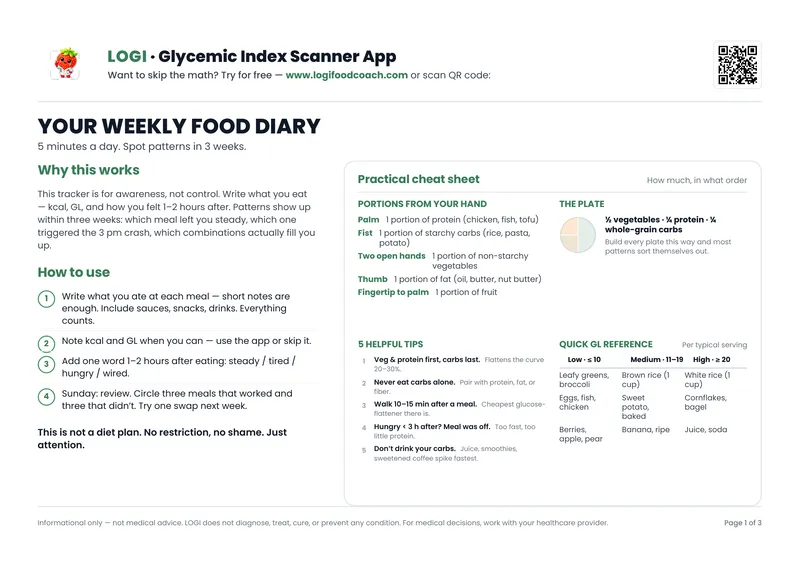
Free PDF — 3 pages
Your Weekly Food Journal
Track meals, glycemic load & mood. Spot patterns in 3 weeks.
No spam. Unsubscribe anytime.