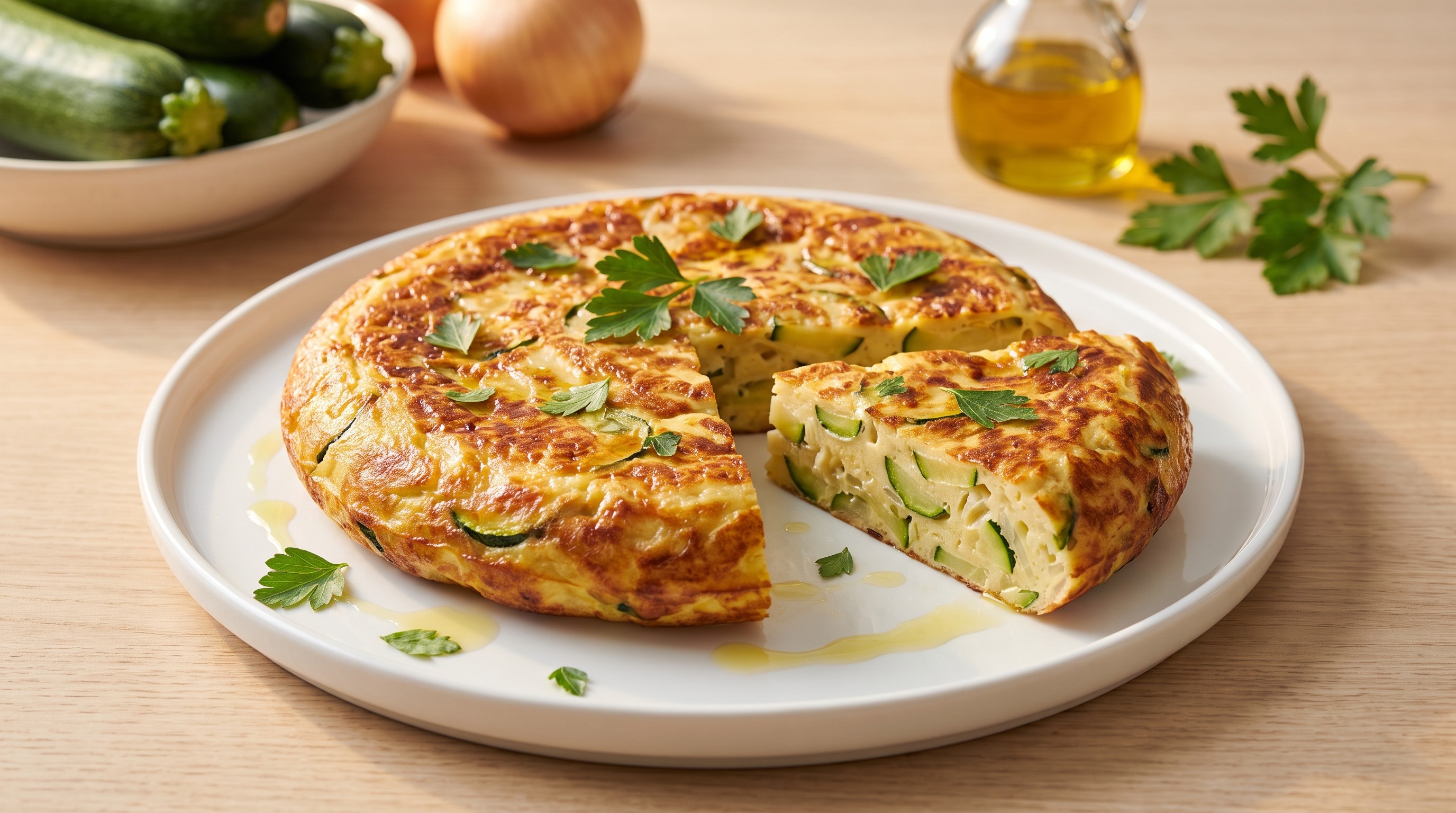
Tortilla de Calabacín (Spanish Courgette Tortilla)
A golden, custard-set Spanish tortilla swapping starchy potato for low-GI courgette — high in protein and naturally blood-sugar friendly. GI 14, GL 2. Diabetic-friendly.
This lighter take on Spain's iconic tortilla española replaces the traditional potato with tender courgette slices, slashing the glycemic load while keeping every bit of the dish's soul-satisfying charm. With a glycemic index near zero for the courgette and no measurable GI contribution from the eggs or olive oil, this tortilla is one of the most blood-sugar-stable meals you can put on the table. Each serving delivers a generous dose of protein and healthy monounsaturated fat, the combination that blunts any residual glucose response and keeps you satiated for hours.
The technique matters as much as the ingredients. Cooking the courgette slices until their moisture has fully evaporated is the single most important step — skip it and you'll end up with a soggy tortilla instead of a firm, sliceable one. A slow set over medium-low heat gives the eggs time to form a silky custard rather than a rubbery disc. The classic plate-flip might feel dramatic the first time, but it's the only way to achieve that even golden crust on both sides.
Serve the tortilla warm or at room temperature — it actually improves as it rests, making it perfect for meal prep. Pair it with a leafy green salad dressed in lemon and olive oil, or alongside a few slices of avocado for extra healthy fat. Eating the vegetables and protein first, before any carbohydrate side, further flattens the postprandial glucose curve. This dish proves that managing blood sugar never has to mean sacrificing flavor or tradition.
Blood Sugar Impact
Very minimal blood sugar impact expected. With a glycemic load of only 2.1 and an estimated GI of 14, this egg-and-vegetable dish will produce a negligible glucose response, providing steady energy for 3-4 hours.
Blood Sugar Tips
- ✓ Pair with a small side salad dressed in olive oil and vinegar to add fiber and further slow any glucose absorption.
- ✓ Enjoy at a relaxed pace — eating slowly gives your body time to register satiety signals and keeps insulin response gentle.
- ✓ If serving with bread on the side, eat the tortilla first before any starchy accompaniment to blunt the glucose spike from the bread.
🥗 Ingredients
- 400 g Courgette
- 150 g Onion
- 5 pcs Egg
- 0.25 tsp Black pepper
- 3 tbsp Extra-virgin olive oil
- 0.5 tsp Salt
- 14.1 oz Courgette
- 5.3 oz Onion
- 5 pcs Egg
- 0.25 tsp Black pepper
- 3 tbsp Extra-virgin olive oil
- 0.5 tsp Salt
- 0.2 oz Flat-leaf parsley
👨🍳 Instructions
- 1
Prepare the vegetables: cut each courgette in half lengthways, then slice crosswise into thin half-moons about 3 mm thick. Peel and dice the onion into small, even pieces.
- 2
Crack the eggs into a large mixing bowl, add the black pepper, and whisk until the yolks and whites are fully combined and slightly frothy. Set the bowl aside.
- 3
Warm 2 tablespoons of the olive oil in a 22 cm non-stick frying pan over medium heat. Add the diced onion and cook gently for about 5 minutes, stirring now and then, until soft and translucent but not browned.
- 4
Scatter the courgette slices into the pan with the onion and sprinkle over the salt. Cook for 8 minutes, stirring occasionally, until the slices are tender with lightly golden edges. All released moisture should have evaporated — this is essential for a firm tortilla rather than a soggy one.
- 5
Transfer the cooked vegetables into the bowl of beaten eggs and fold gently until every slice is well coated. Let the mixture sit for 1 minute so the eggs begin to absorb the vegetable flavour.
- 6
Wipe the frying pan clean with kitchen paper, return it to medium-low heat, and add the remaining tablespoon of olive oil, swirling to coat the base and sides evenly.
- 7
Pour the egg-and-vegetable mixture into the pan and spread it into an even layer. Cook undisturbed for about 8 minutes until the base is deep golden, the edges have set firmly, and only the very centre remains slightly liquid.
- 8
Place a large flat plate over the pan and, in one confident motion, flip the tortilla onto the plate. Slide it back into the pan, uncooked side down, and cook for a further 4 minutes until just set through. Remove from the heat, let it rest in the pan for 2 minutes, then transfer to a serving plate and scatter with the chopped parsley.
📊 Nutrition Per Serving
| Per Serving | Whole Dish | |
|---|---|---|
| Calories | 425 | 851 |
| Carbs | 14g | 29g |
| Sugars | 9g | 18g |
| Natural Sugars | 9g | 18g |
| Protein | 19g | 38g |
| Fat | 34g | 67g |
| Saturated Fat | 7g | 14g |
| Unsaturated Fat | 26g | 53g |
| Fiber | 3g | 7g |
| Soluble Fiber | 1g | 2g |
| Insoluble Fiber | 2g | 5g |
| Sodium | 780mg | 1559mg |
Predicted Glucose Response
What if you...
Estimated model — individual responses vary. Not medical advice.
🔄 Lower GI Swaps
Potato has a GI of 70–90 and contributes roughly 30 g of carbohydrate per serving in a traditional tortilla. Courgette has a negligible GI with only about 3 g of carbohydrate per 100 g, reducing the glycemic load of the entire dish from approximately 15 down to just 2.
Extra-virgin olive oil is rich in monounsaturated fatty acids and polyphenols that help slow gastric emptying and improve insulin sensitivity, further supporting stable blood sugar levels compared to refined oils or saturated fats.
🔬 The Science Behind This Recipe
This tortilla is a near-perfect example of how swapping a single high-GI ingredient can transform a dish's blood sugar profile. Traditional tortilla española relies on potato, which has a GI of 70–90 depending on variety and cooking method. Courgette, by contrast, has a GI so low it is effectively unmeasurable — its carbohydrate content per 100 g is only about 3 g, most of it locked in fibre. By building the tortilla around courgette and eggs instead, the total available carbohydrate per serving drops to roughly 5 g, yielding a glycemic load of just 2.
The five eggs contribute zero carbohydrate but provide roughly 30 g of protein across the dish. Protein triggers a modest insulin response on its own, but crucially it slows gastric emptying, meaning any carbohydrate eaten alongside the tortilla enters the bloodstream more gradually. The extra-virgin olive oil adds a further brake: dietary fat delays the rate at which the stomach releases its contents into the small intestine, flattening the postprandial glucose curve even when paired with higher-GI sides.
Cooking method also plays a role. Sautéing the courgette before combining it with the egg mixture reduces its water content, concentrating its fibre and ensuring the finished tortilla has a denser texture. This density slows chewing and eating pace, which correlates with lower glucose and insulin peaks in clinical studies. The result is a dish that delivers sustained energy without a meaningful blood sugar spike — ideal as a standalone meal or as the protein anchor of a mixed plate.
Related recipes
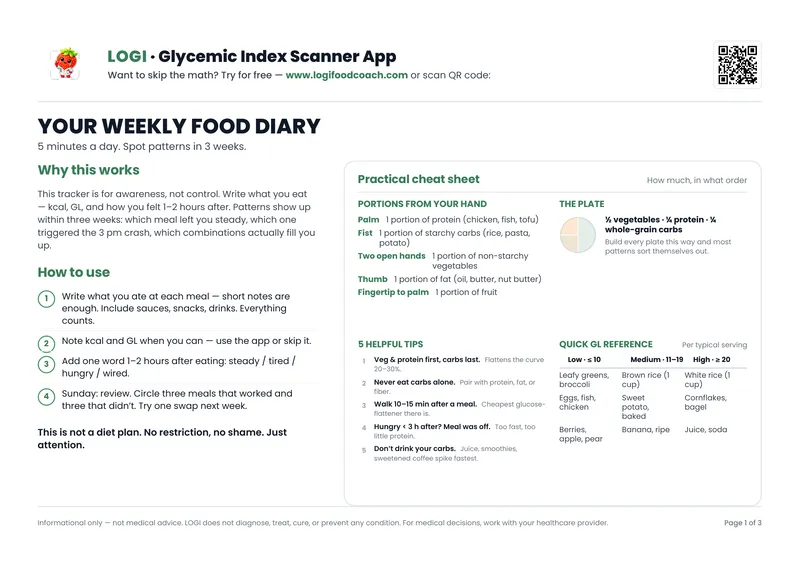
Free PDF — 3 pages
Your Weekly Food Journal
Track meals, glycemic load & mood. Spot patterns in 3 weeks.
No spam. Unsubscribe anytime.