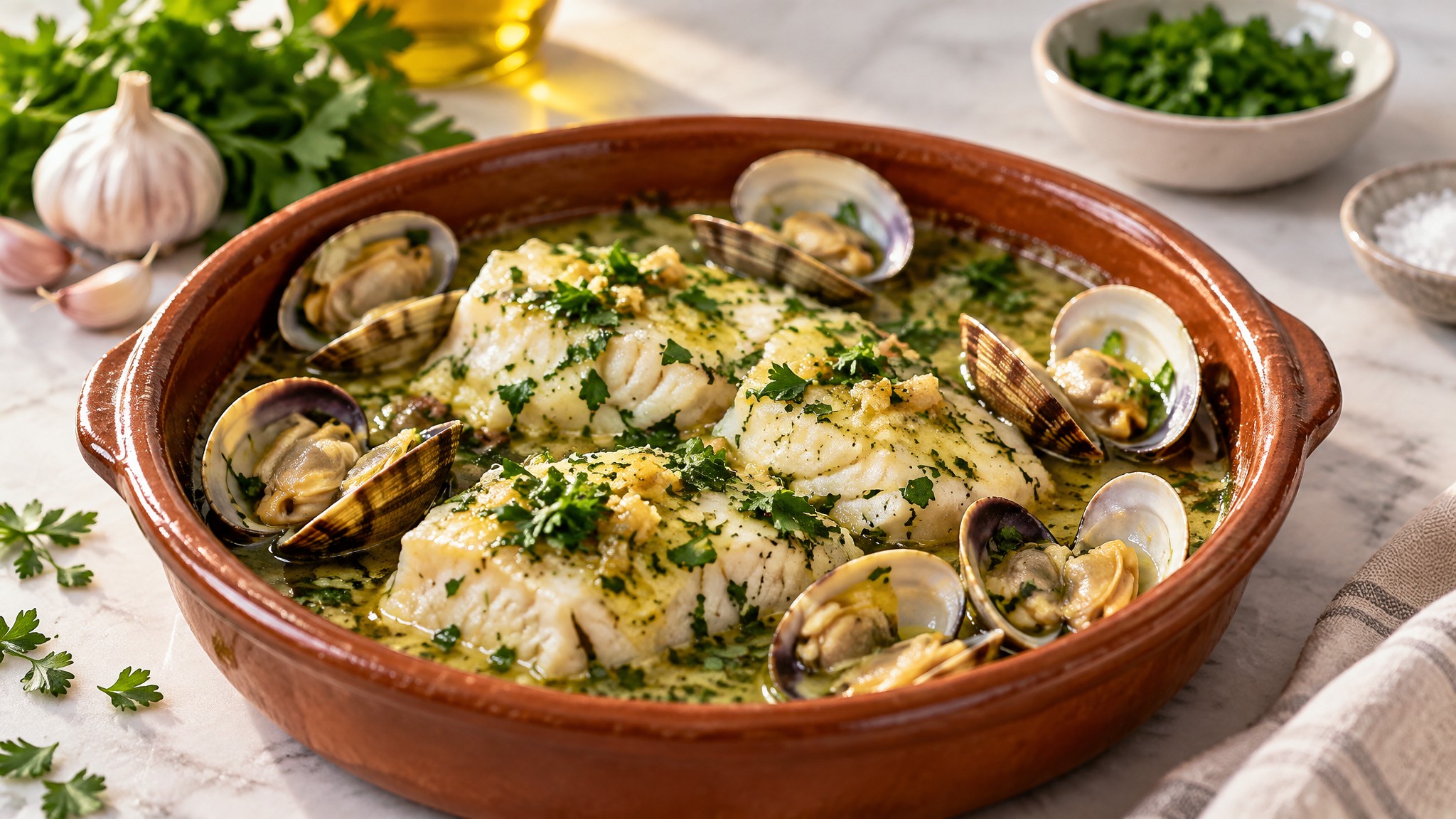
Low-GI Merluza en Salsa Verde with Clams (Flour-Free)
Basque hake and clams in a glossy garlic-parsley sauce. Instead of flour, you swirl the pan to thicken it. Lean protein and olive oil, with a very low glycemic load, ready in 22 minutes.
Merluza en salsa verde is a classic of the Basque coast: tender hake and briny clams in a bright green sauce of garlic, parsley, white wine and olive oil. The traditional recipe thickens the sauce with a spoon of wheat flour. This version leaves the flour out and uses an old Basque technique instead. You cook skin-on hake skin side up and gently move the pan in small circles. Gelatin from the fish skin binds with the extra-virgin olive oil and stock, much like a pil-pil emulsion. The result is a silky, glossy sauce that clings to the fish, with no added starch. Keep the skin on: skinless fillets still taste great, but the sauce will be thinner.
This main course is very gentle on blood sugar. Each serving has about 160-180 g of hake and 150 g of clams in the shell, so it is almost all protein and has practically no carbohydrate. Extra-virgin olive oil adds monounsaturated fat, which slows stomach emptying and softens the glucose rise from anything else on the plate. Garlic and parsley add plenty of flavour for very little carbohydrate. You only need about 60 ml of bone-dry white wine for the whole pan, and most of its alcohol cooks off. Removing the refined flour takes out the only high-GI ingredient in the original dish. The glycemic load is close to zero.
In Spain this dish usually comes with crusty white bread for mopping up the sauce, and that one habit can raise the meal's glycemic load sharply. Choose sides that soak up the sauce without the spike: steamed green beans, roasted asparagus, sautéed spinach, cauliflower purée or a small portion of white beans. If you really want bread, have one small slice of dense whole-grain or sourdough rye after your vegetables and fish. Eating vegetables first, then protein and fat, is a simple way to flatten your glucose curve. The dish makes a light, satisfying dinner that keeps you full for hours. This recipe supports blood-sugar-friendly eating, but it does not replace individual advice from your doctor or dietitian.
Blood Sugar Impact
Minimal impact: the dish is almost all lean protein and healthy fat, with only trace carbs from garlic, parsley and wine, so blood sugar should stay flat and energy steady for 3-4 hours.
Blood Sugar Tips
- ✓ Serve with non-starchy sides like steamed green beans, asparagus or a leafy salad rather than bread or white potatoes, so the meal stays low-glycemic.
- ✓ If you want bread to soak up the salsa verde, keep it to a small slice of whole-grain sourdough and eat it after the fish and vegetables.
- ✓ Use homemade or low-sodium fish stock with no added starch or sugar, and take a 10-15 minute walk after the meal to support glucose control.
🥗 Ingredients
- 2 pcs Hake fillet
- 0.5 tsp Sea salt
- 300 g Clams
- 4 pcs Garlic
- 30 g Flat-leaf parsley
- 2 tbsp Extra-virgin olive oil
- 0.25 cup Dry white wine
- 0.5 cup Fish stock
- 2 pcs Hake fillet
- 0.5 tsp Sea salt
- 10.6 oz Clams
- 4 pcs Garlic
- 1.1 oz Flat-leaf parsley
- 2 tbsp Extra-virgin olive oil
- 0.25 cup Dry white wine
- 0.5 cup Fish stock
👨🍳 Instructions
- 1
Use 2 skin-on hake fillets of about 160-180 g each, one per serving. Keep the skin on, because its gelatin is what thickens the sauce. Pat the fillets very dry on both sides with paper towels. Sprinkle the sea salt (½ tsp) over both sides and leave the fish at room temperature for about 5 minutes while you prepare everything else.
- 2
Rinse the clams (300 g in the shell) under cold running water and scrub the shells clean. Tap any open clams and throw away any that don't close. Finely chop the 4 garlic cloves and the parsley (30 g), then split the parsley into two equal piles.
- 3
Pour the extra-virgin olive oil (2 tbsp) into a wide sauté pan or clay cazuela over low heat. Add the garlic and cook gently for about 2 minutes, stirring now and then, until it smells fragrant and is just turning pale gold. Don't let it brown or the sauce will taste bitter.
- 4
Add the bone-dry white wine (¼ cup, about 60 ml) and let it bubble for about 1 minute to cook off most of the alcohol. Pour in the fish stock (½ cup, about 120 ml), add the first half of the parsley and simmer for 1 more minute.
- 5
Lay the hake fillets in the pan skin side up. For the next 4 minutes, hold the handle and keep moving the pan gently in small circles. As the skin releases its gelatin, the oil and stock come together into a thick, glossy green sauce, with no flour needed. With skinless fillets, the sauce will stay looser. Swirl a little longer and accept a lighter texture.
- 6
Carefully turn the fillets skin side down and scatter the clams around them. Cover the pan and cook for about 4 minutes, until the clams have opened and the hake flakes easily. Throw away any clams that stay shut.
- 7
Take off the lid and give the pan one last gentle swirl to bring the sauce back together. Sprinkle the rest of the parsley over the top and serve straight from the pan. Instead of white bread, serve with steamed green beans, asparagus, sautéed greens or a small spoonful of white beans to soak up the sauce. For the gentlest glucose response, eat a green salad or your vegetables first.
📊 Nutrition Per Serving
| Per Serving | Whole Dish | |
|---|---|---|
| Calories | 392 | 784 |
| Carbs | 9g | 19g |
| Sugars | 0g | 1g |
| Natural Sugars | 0g | 1g |
| Protein | 47g | 94g |
| Fat | 16g | 32g |
| Saturated Fat | 2g | 5g |
| Unsaturated Fat | 13g | 26g |
| Fiber | 1g | 1g |
| Soluble Fiber | 0g | 0g |
| Insoluble Fiber | 0g | 1g |
| Sodium | 1010mg | 2020mg |
Predicted Glucose Response
What if you...
Estimated model — individual responses vary. Not medical advice.
🔄 Lower GI Swaps
Refined flour is fast-digesting, high-GI starch. Swirling the pan thickens the sauce naturally with no added carbohydrate. A pinch of ground almonds gives skinless fillets some body with minimal carbs.
White baguette is high-GI and would sharply raise the glycemic load of an otherwise near-zero-carb meal. Fibre-rich vegetables and legumes soak up the sauce with a far gentler glucose response.
Sweeter wines add residual sugar. A small amount of bone-dry wine, mostly simmered off, adds acidity with only trace carbohydrate. Stock with lemon gives similar brightness with no sugar or alcohol.
Many commercial stocks and bouillon cubes contain maltodextrin or modified starch, which are high-GI fillers. Homemade or clean-label stock keeps the dish's glycemic load near zero.
Extra-virgin olive oil is recommended because its natural compounds help stabilise the pil-pil-style emulsion and add heart-healthy monounsaturated fat. Avocado oil has a similar fat profile and no effect on blood sugar, but the sauce may be slightly less glossy and stable.
All are lean, essentially carb-free shellfish, so the glycemic profile stays the same. Use whichever is freshest or easiest to find.
🔬 The Science Behind This Recipe
The glycemic index (GI) measures how quickly a food's available carbohydrate raises blood glucose compared with pure glucose. It is only meaningful for foods with a real amount of carbohydrate, usually at least 10-15 g per serving. This dish has well under 3 g of available carbohydrate per serving, almost all from garlic, parsley and the small splash of wine. A precise GI number would be misleading here, so we rate it as negligible or not applicable. The figure that matters is glycemic load, which combines carbohydrate quantity with quality. Here it is very low, close to zero per serving.
The main change from the traditional recipe is dropping the wheat flour used to thicken the sauce. Refined flour is quickly digested starch. Instead, the sauce is thickened by an emulsion: when you swirl skin-on hake in warm oil and stock, collagen-derived gelatin from the skin coats tiny droplets of olive oil and keeps them suspended. This is the same principle behind Basque pil-pil. Extra-virgin olive oil works especially well because its natural compounds help stabilise the emulsion. Its monounsaturated fat also slows stomach emptying, which softens the glucose rise from any carbohydrate eaten in the same meal.
Protein and fat also help with satiety and steady energy. The 160-180 g of hake per serving, plus the clams, gives roughly 35-40 g of protein. Protein stimulates hormones such as GLP-1 that signal fullness and help regulate glucose after the meal. Because the dish itself has almost no carbohydrate, its effect on your blood sugar depends mostly on what you serve with it. A large portion of white bread or white rice could raise the glycemic load of the whole meal sharply. Non-starchy vegetables, eaten first, keep the meal blood-sugar friendly.
Related recipes
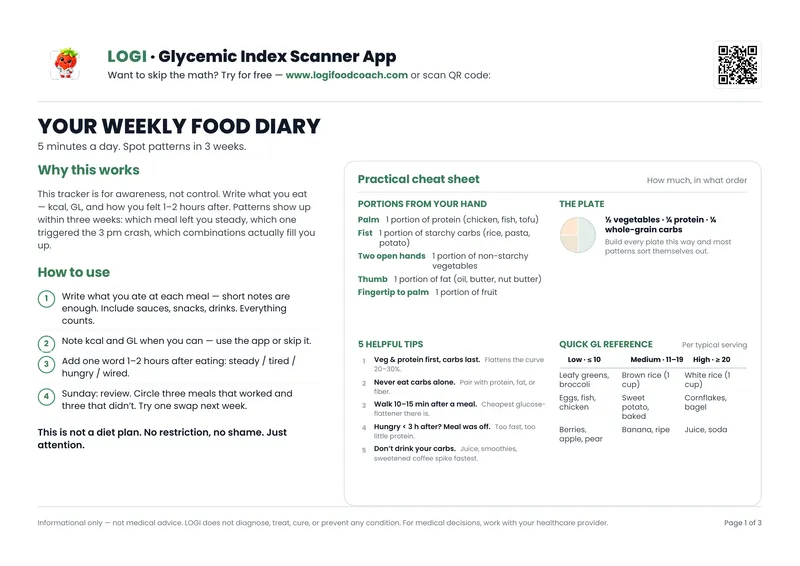
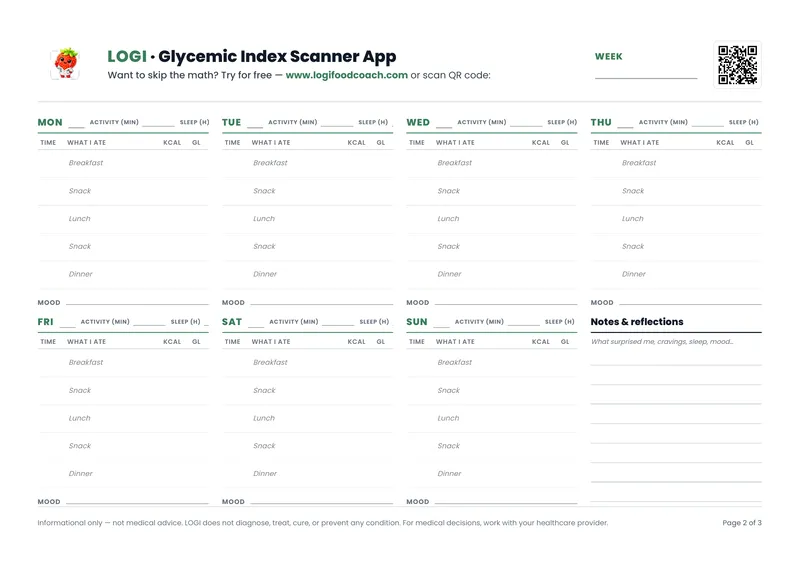
Free PDF — 3 pages
Your Weekly Food Journal
Track meals, glycemic load & mood. Spot patterns in 3 weeks.
No spam. Unsubscribe anytime.