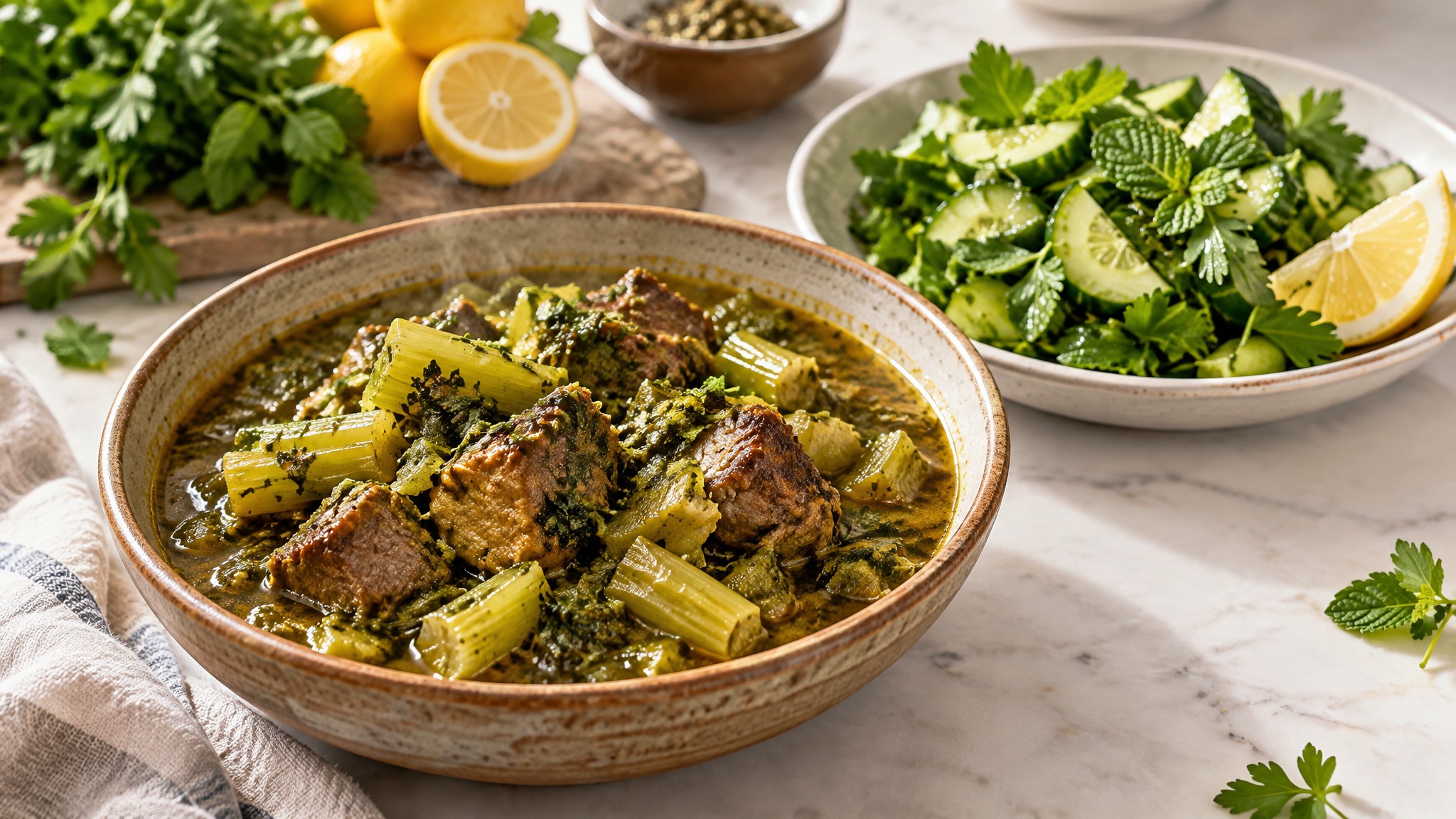
Lamb and Celery Khoresh with Fresh Herb Salad
Tangy Persian-style lamb and celery stew, rich with fried parsley, mint and lemon, served with a crisp cucumber herb salad instead of rice for steady blood sugar.
Khoresh karafs is one of the great Persian home-cooked stews. Tender lamb and celery simmer slowly in a golden turmeric broth until the celery is soft and the sauce is bright with lemon. What makes it special is the herbs. A generous handful of parsley and mint is fried with the celery until it darkens and smells fragrant, which gives the stew its deep, green, slightly sour flavour. This version keeps every part of that character: the browned onion, the seared lamb, the fried herbs and the squeeze of lemon at the end.
The traditional plate comes with a large mound of white rice, a high-GI starch that can send blood sugar up fast. Here a crisp cucumber salad takes its place, tossed with fresh parsley and mint leaves, lemon and a little olive oil. The meal stays built on protein, healthy fat and fibre-rich vegetables, with almost no fast-acting carbohydrate, so the glucose response should be gentle. Lamb gives you plenty of protein that keeps you full, celery and herbs add fibre and polyphenols, and the lemon juice adds acidity, which some research links to a slower rise in blood sugar after a meal.
For the best results, start with a few forkfuls of the cucumber salad before moving on to the stew. Eating vegetables first is a simple habit that can help flatten the post-meal glucose curve. If you want something to mop up the sauce, a small portion of cooked lentils, a slice of whole-grain sourdough, or cauliflower rice all fit well and keep the GI low. The stew tastes even better the next day, so it is easy to make ahead for a quick, blood-sugar-friendly dinner.
Blood Sugar Impact
Very little effect on blood sugar. With a GL of 2.8 and lots of protein and fat from the lamb and olive oil, expect a slow, flat glucose curve and steady energy for 4-5 hours.
Blood Sugar Tips
- ✓ Khoresh is usually served over white rice, which would raise the glycemic load a lot. Eat it on its own, with a small portion of cooled basmati, or over cauliflower rice.
- ✓ Eat the fresh herb salad first. Its fiber can help slow the absorption of any carbs that follow.
- ✓ Take a 10-15 minute walk after eating, especially if you add rice or bread.
🥗 Ingredients
- 2 tbsp Olive oil
- 1 pcs Onion
- 300 g Lamb leg
- 1 tsp Ground turmeric
- 0.5 tsp Ground black pepper
- 400 ml Water
- 0.75 tsp Salt
- 5 pcs Celery
- 50 g Flat-leaf parsley
- 20 g Mint
- 2 tbsp Lemon juice
- 1 pcs Cucumber
- 2 tbsp Olive oil
- 1 pcs Onion
- 10.6 oz Lamb leg
- 1 tsp Ground turmeric
- 0.5 tsp Ground black pepper
- 1.7 cups Water
- 0.75 tsp Salt
- 5 pcs Celery
- 1.8 oz Flat-leaf parsley
- 0.7 oz Mint
- 2 tbsp Lemon juice
- 1 pcs Cucumber
👨🍳 Instructions
- 1
Warm 15 g (1 tbsp) of the olive oil in a heavy-bottomed pot over medium-high heat. Add the diced onion and cook for about 6 minutes, stirring often, until soft and golden.
- 2
Add the lamb cubes, turmeric and black pepper. Sear for about 5 minutes, turning the pieces so most sides brown and the spices coat the meat.
- 3
Pour in the 400 ml (1 2/3 cups) of water and add half of the salt. Bring to a boil, then cover, lower the heat and simmer gently for 20 minutes so the lamb starts to soften.
- 4
While the lamb simmers, heat 10 g (2 tsp) of olive oil in a frying pan over medium heat. Fry the celery for 5 minutes. Add the 35 g chopped parsley and 12 g chopped mint and fry for 3 more minutes, stirring, until the herbs turn dark green and smell fragrant.
- 5
Stir the fried celery and herbs into the pot. Simmer uncovered for about 15 minutes, until the celery is tender and the sauce has cooked down by roughly a third.
- 6
Take the stew off the heat and stir in 20 g (about 1 1/3 tbsp) of lemon juice. Taste and add more of the remaining salt if needed, keeping a pinch back for the salad.
- 7
For the salad, toss the cucumber half-moons with the remaining 15 g parsley leaves and 8 g mint leaves, 10 g (2 tsp) lemon juice, the last 5 g (1 tsp) olive oil and a pinch of salt.
- 8
Serve the salad right away next to the hot stew. Eat a few bites of the salad first: starting with vegetables helps keep the rise in blood sugar after the meal gentle.
📊 Nutrition Per Serving
| Per Serving | Whole Dish | |
|---|---|---|
| Calories | 514 | 1027 |
| Carbs | 16g | 31g |
| Sugars | 6g | 11g |
| Natural Sugars | 6g | 11g |
| Protein | 34g | 68g |
| Fat | 37g | 75g |
| Saturated Fat | 12g | 23g |
| Unsaturated Fat | 24g | 48g |
| Fiber | 5g | 10g |
| Soluble Fiber | 2g | 3g |
| Insoluble Fiber | 3g | 7g |
| Sodium | 1056mg | 2113mg |
Predicted Glucose Response
What if you...
Estimated model — individual responses vary. Not medical advice.
🔄 Lower GI Swaps
Onion is the main source of carbohydrate in this dish, and long braising caramelizes its sugars. Using a smaller amount of shallot, or swapping in leek greens or fennel, keeps the savory base while lowering total carbs and the glycemic load.
Bone broth adds protein and gelatin with almost no carbohydrate. Extra protein in the meal slows stomach emptying and evens out the blood sugar response, and it adds depth without needing more onion or other carb-heavy flavor builders.
Trimmed shoulder stays tender in a long braise, so you don't need starchy sides to make the dish filling. Lentils have a low GI (about 30) and their soluble fiber and resistant starch lower the glycemic load of the whole meal, including any rice or bread served with it.
Vinegar's acetic acid has been shown to blunt the rise in blood sugar after a meal by slowing stomach emptying and improving glucose uptake. Dried lime is traditional in khoresh and adds strong sourness with almost no sugar.
Purslane, radish and arugula are almost carb-free. They add fiber, polyphenols and volume to the salad, so the herb salad does more to slow carb absorption from anything served alongside, like rice or flatbread.
🔬 The Science Behind This Recipe
Why This Khoresh Is Easy on Your Blood Sugar
This Persian stew has a very low glycemic load of 2.8 per serving and an estimated GI of 18, which puts it among the gentlest meals for blood sugar. The reason is simple: most of the dish is lamb, celery and herbs, not starch. Lamb leg is rich in protein and contains almost no carbohydrate, so it barely affects glucose on its own. Protein also slows how fast your stomach empties. That means any carbs in the meal reach your bloodstream slowly and steadily instead of all at once. Celery and onion add fiber, which forms a gentle "mesh" in your gut that slows sugar absorption even more.
Olive oil adds another layer of support. Healthy fats slow digestion and help you feel full for longer, so you are less likely to want a sugary snack later. Turmeric and black pepper bring warmth and flavor without adding any carbs. Black pepper also helps your body absorb more of turmeric's natural plant compounds. GI tells you how quickly a food raises blood sugar. Glycemic load goes further, because it also counts how much carbohydrate you actually eat. A food with a moderate GI can still have a small effect if the portion of carbs is small, and that is exactly why this recipe scores so low.
To get the most out of your meal, start with the fresh herb salad, then eat the lamb and celery. Save any rice or bread for last. If you serve this with rice, keep the portion modest and let the protein-rich stew do the heavy lifting. Finally, try a relaxed 10–15 minute walk after eating. Moving your muscles helps them use glucose from your meal, which is a simple habit that works well alongside a smart recipe like this one.
Related recipes
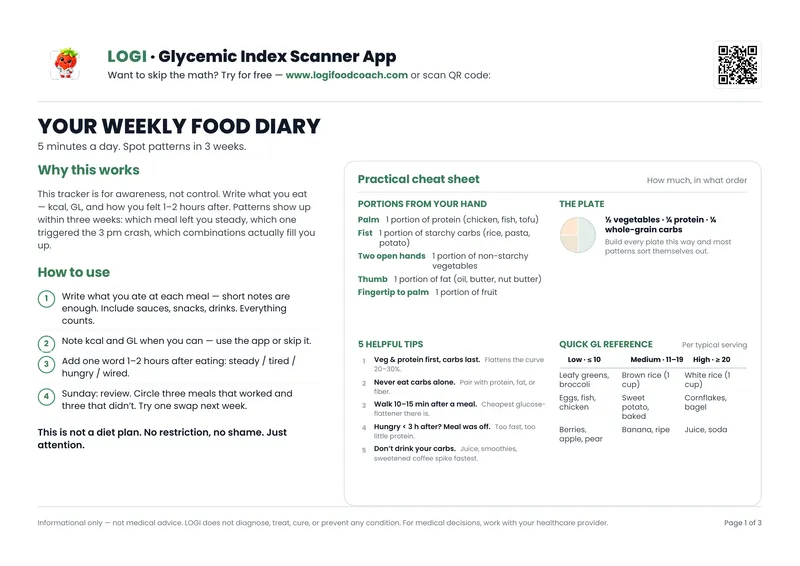
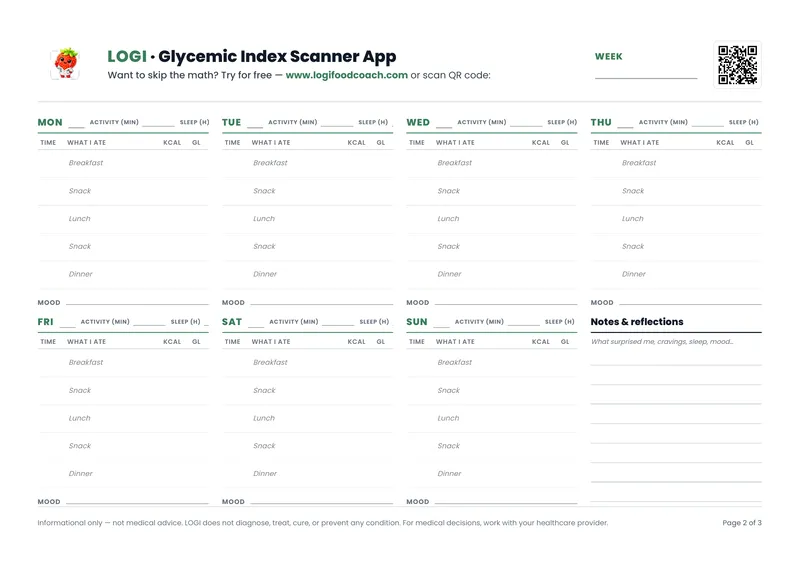
Free PDF — 3 pages
Your Weekly Food Journal
Track meals, glycemic load & mood. Spot patterns in 3 weeks.
No spam. Unsubscribe anytime.