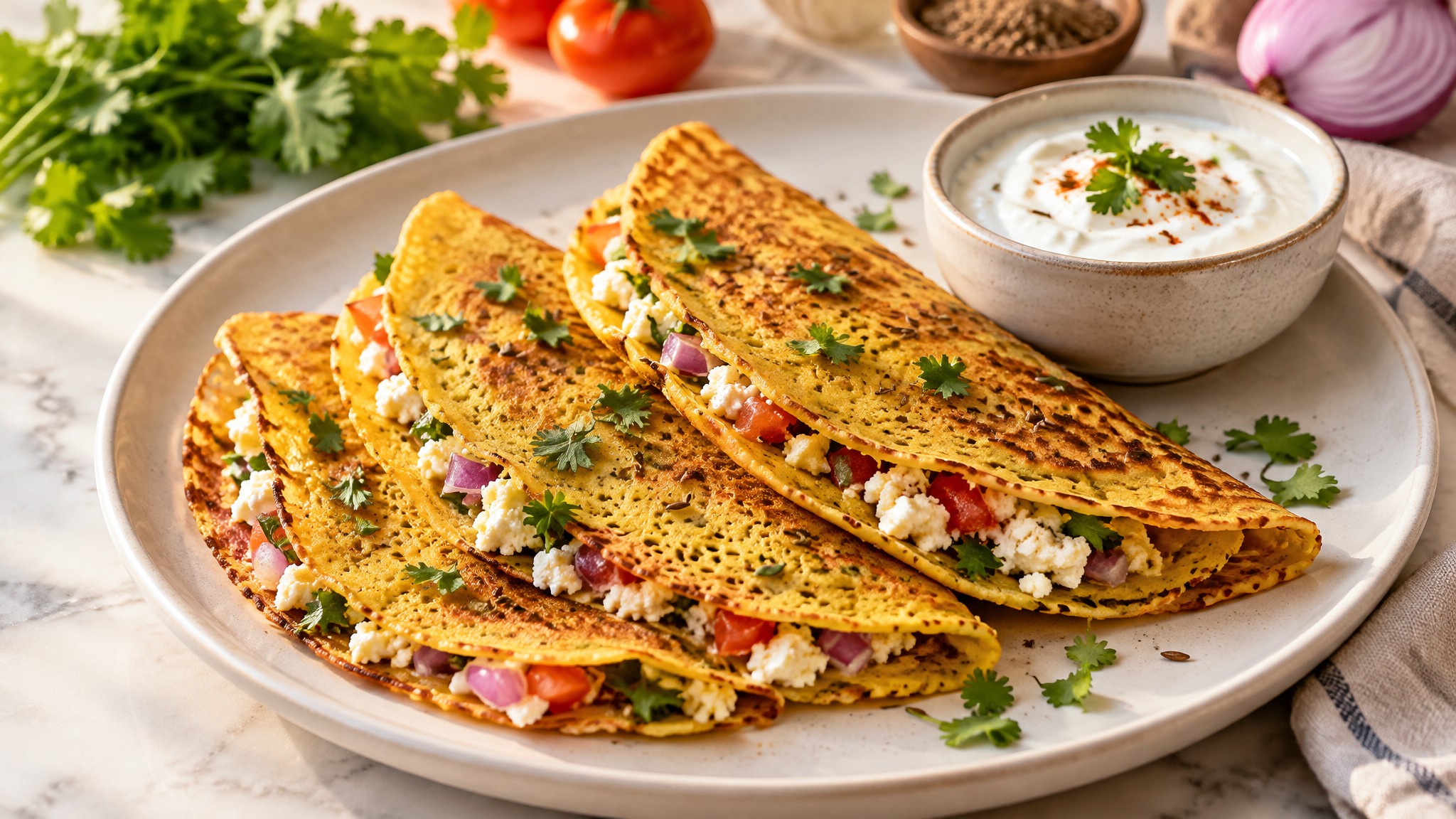
Moong Dal Chilla with Paneer Filling
Protein-rich moong dal crêpes folded around herby paneer, onion and tomato — a flourless North Indian breakfast that keeps blood sugar steady all morning.
Moong dal chilla is a savoury North Indian breakfast pancake made from split yellow mung beans instead of flour. The soaked dal is blended with fresh ginger, green chilli and coriander into a thin, pourable batter, then cooked into lacy crêpes on a hot pan. Each one is folded around crumbled paneer, crisp red onion and diced tomato. You need 3 hours of hands-off soaking, and the cooking takes about 30 minutes. That makes it a good make-ahead weekend breakfast or a light dinner.
The batter is what makes this dish good for blood sugar. Split moong dal is a legume with a glycemic index of around 30-40. It has a lot of plant protein and soluble fiber, so its starch digests slowly and glucose reaches the bloodstream gradually instead of all at once. Wheat-based pancakes and white-flour dosas are often high-GI and digest quickly. Here there is no refined flour at all. The paneer and greek yogurt add more protein and some fat, both of which slow stomach emptying and blunt the glucose response further. There are no added sugars, and none of the ingredients is ultra-processed.
To get the most from it, start the meal with a few spoonfuls of greek yogurt or a small side of cucumber and tomato before the chillas. Eating protein and vegetables first helps soften the post-meal glucose curve. Serve the chillas hot, with green chutney or extra chopped chilli if you like heat. Skip sweetened chutneys and fruit juice alongside them. A cup of unsweetened masala chai or water goes well with them. If you do want something starchy, keep it small and eat it last, after the chillas.
Blood Sugar Impact
Low, gradual impact. The protein and fiber in the moong dal and the fat and protein in the paneer slow how fast glucose is absorbed, so you can expect stable energy for about 3-4 hours without a sharp spike.
Blood Sugar Tips
- ✓ Eat the chilla with a side of non-starchy vegetables or a cucumber-mint raita, and start with the vegetables to slow digestion further.
- ✓ Don't serve it with sweet chutneys, ketchup or extra rotis. Choose a green chutney or plain yogurt instead to keep the glycemic load low.
- ✓ Take a 10-15 minute walk after eating to help your muscles use glucose and blunt any post-meal rise.
🥗 Ingredients
- 120 g Split yellow moong dal
- 10 pcs Ginger
- 1 pcs Green chilli
- 15 g Coriander
- 120 ml Water
- 0.5 tsp Salt
- 1 tsp Cumin seeds
- 100 g Paneer
- 40 g Red onion
- 60 g Tomato
- 2 tsp Vegetable oil
- 100 g Greek yogurt
- 4.2 oz Split yellow moong dal
- 10 pcs Ginger
- 1 pcs Green chilli
- 0.5 oz Coriander
- 8 tbsp Water
- 0.5 tsp Salt
- 1 tsp Cumin seeds
- 3.5 oz Paneer
- 1.4 oz Red onion
- 2.1 oz Tomato
- 2 tsp Vegetable oil
- 3.5 oz Greek yogurt
👨🍳 Instructions
- 1
Drain the moong dal after its 3-hour soak and put it in a blender with the ginger, green chilli, half the chopped coriander, the water and the salt. Blend until completely smooth. The batter should pour easily, like a thin crêpe batter. Stir in the cumin seeds by hand.
- 2
Make the filling. In a bowl, toss the crumbled paneer with the finely chopped red onion, the diced tomato and the rest of the coriander until evenly mixed.
- 3
Set a non-stick or cast-iron pan over medium heat and brush the surface with a thin film of oil. When the pan is hot, pour in a ladle of batter (about 60 g / 2 oz). Use the back of the ladle to spread it quickly in circles from the centre outward into a thin round about 18 cm (7 in) across.
- 4
Cook for about 2 minutes, until the top no longer looks wet and the edges start to lift from the pan. Drizzle a few drops of oil around the rim, flip the chilla, and cook the second side for 1 minute.
- 5
Spoon one-sixth of the paneer filling over one half of the chilla. Fold the other half over to enclose it and slide it onto a warm plate.
- 6
Lightly oil the pan again and repeat with the remaining batter and filling until you have 6 filled chillas, 3 per person.
- 7
Serve right away while hot, with the greek yogurt on the side. For a gentler blood sugar response, eat a few spoonfuls of yogurt first, then the chillas.
📊 Nutrition Per Serving
| Per Serving | Whole Dish | |
|---|---|---|
| Calories | 454 | 907 |
| Carbs | 45g | 90g |
| Sugars | 9g | 18g |
| Natural Sugars | 9g | 18g |
| Protein | 29g | 58g |
| Fat | 19g | 37g |
| Saturated Fat | 8g | 16g |
| Unsaturated Fat | 11g | 21g |
| Fiber | 11g | 22g |
| Soluble Fiber | 3g | 7g |
| Insoluble Fiber | 8g | 15g |
| Sodium | 628mg | 1255mg |
Predicted Glucose Response
What if you...
Estimated model — individual responses vary. Not medical advice.
🔄 Lower GI Swaps
Split, hulled yellow moong dal is the main carbohydrate source here, and hulling removes fiber, which lets the starch digest faster. Whole green moong keeps its skin, so it has more fiber and resistant starch and a lower GI. Sprouting it lowers the available starch further. Replacing part of the dal with besan plus flaxseed, or with paneer or tofu, cuts the net carbs per chilla and adds protein, fat and soluble fiber. That lowers the recipe's overall glycemic load.
Red onion has more natural sugar than leafy or watery vegetables. Spring onion greens, spinach or zucchini keep the flavor and moisture but have almost no glycemic load. They also add fiber, which slows how quickly the dal starch is absorbed.
Tomatoes are already low-GI, but bell peppers, cucumber and mushrooms have even fewer available carbs per serving. They bulk up the filling with vegetables, which lowers the glycemic load per portion.
Mustard oil and avocado oil are high in monounsaturated fat, which is linked to better insulin sensitivity and slows stomach emptying, so the dal's glucose is released more gradually. A small amount of ghee has a similar effect on digestion speed and adds traditional flavor.
Full-fat, unsweetened or strained yogurt has less lactose and more protein and fat than low-fat or flavored versions. Eating it with the chilla blunts the meal's blood-sugar spike.
🔬 The Science Behind This Recipe
Why Moong Dal Chilla Works for Steady Blood Sugar
This chilla is built on moong dal, the split yellow mung bean. Legumes like moong digest slowly because they combine plant protein, fiber and a type of starch your body breaks down gradually. Soaking and grinding the dal into batter keeps all of that, so the carbohydrates enter your bloodstream at a gentle pace instead of all at once. The result is an estimated glycemic index (GI) of about 23, which is firmly in the low range. The paneer filling adds protein and fat. Both slow down how quickly your stomach empties, which softens the rise in blood sugar even more and keeps you full longer.
GI only tells you how quickly a food's carbs raise blood sugar. Glycemic Load (GL) also counts how much carbohydrate is in your serving. At 10.5 per serving, this dish sits right at the line between low and moderate GL, so portion size makes a real difference. One serving with plenty of vegetables keeps the meal balanced, while doubling up raises the total carb load. Ginger, chili peppers and cilantro add a lot of flavor with almost no carbohydrates, so the batter tastes great without needing anything sweet or starchy.
Tips for a gentler glucose curve: - Eat in order: Start with a side of cucumber salad or sautéed greens, then eat the chilla. Fiber eaten first helps slow digestion of what follows. - Pair smartly: Serve with plain yogurt or a mint-coconut chutney rather than sweet ketchup, white bread or sugary chai. - Move afterward: A relaxed 10–15 minute walk after eating helps your muscles use glucose from the meal.
Small habits like these, paired with fiber-rich meals like this one, add up to steadier energy through the day.
Related recipes
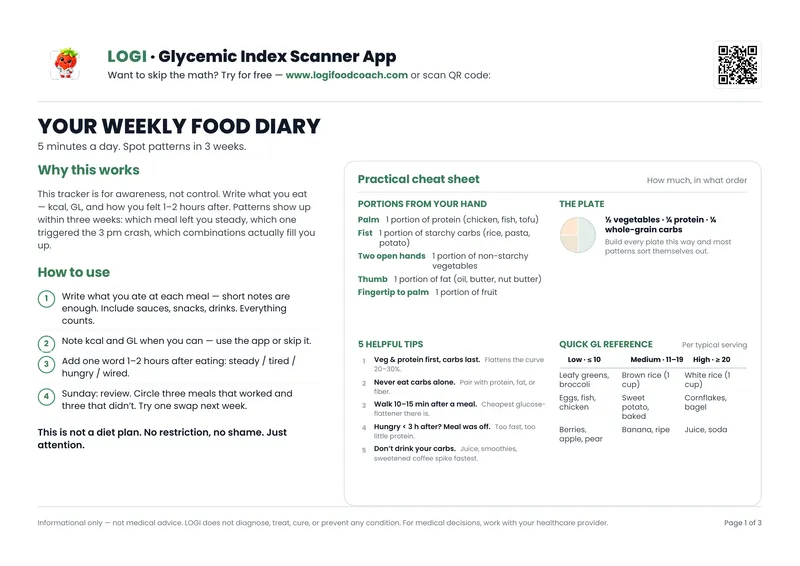
Free PDF — 3 pages
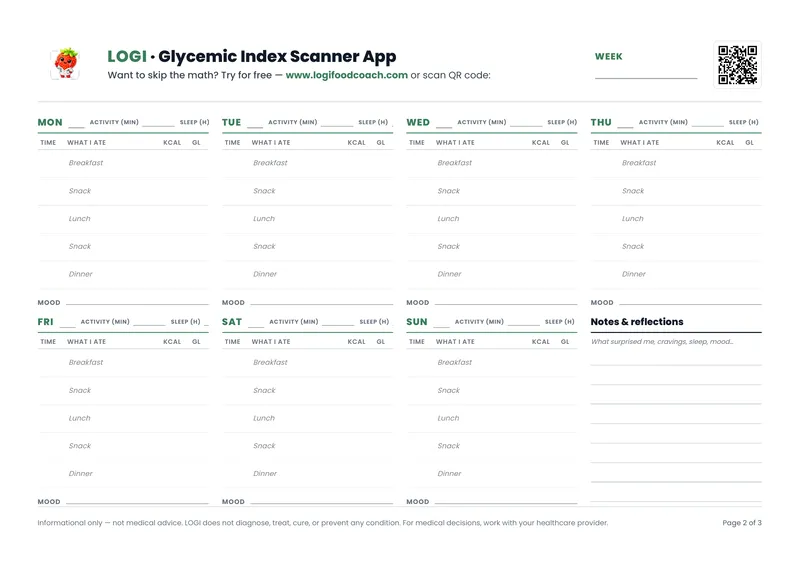
Your Weekly Food Journal
Track meals, glycemic load & mood. Spot patterns in 3 weeks.
No spam. Unsubscribe anytime.