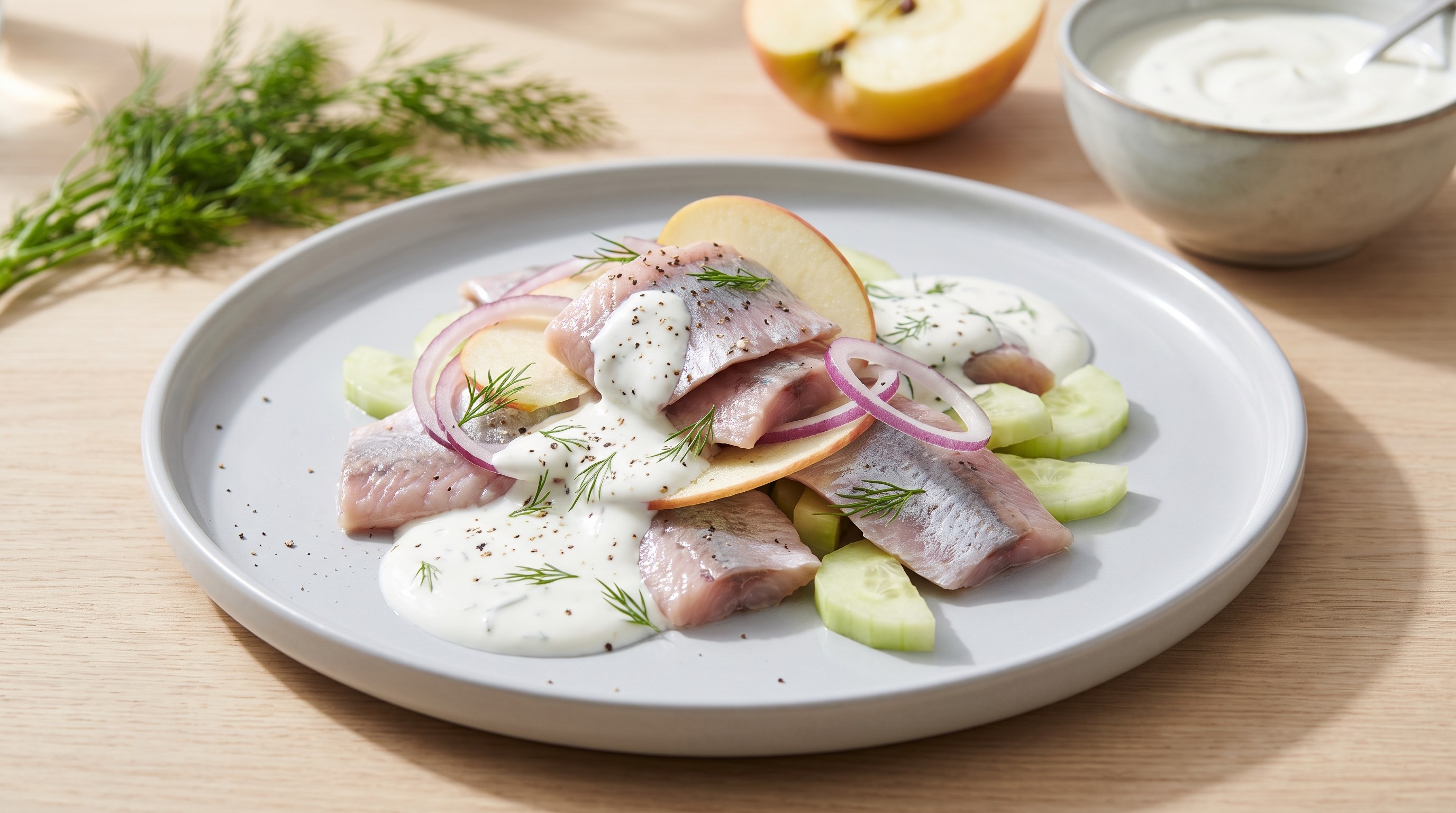
Matjes nach Hausfrauenart (Pickled Herring with Apple and Sour Cream)
Briny matjes herring meets crisp apple and tangy sour cream in this no-cook German classic — naturally low-glycemic, rich in omega-3s, and ready in just 15 minutes.
Matjes nach Hausfrauenart — literally "housewife-style herring" — is one of Germany's most cherished cold suppers, and it happens to be a near-perfect meal for blood sugar stability. The star is matjes herring, a young, lightly brined fillet packed with protein and omega-3 fatty acids. Combined with full-fat sour cream and Dijon mustard, the dish delivers a generous dose of healthy fats that slow gastric emptying and blunt any glucose response from the accompanying fruit and vegetables.
The single apple in this recipe provides natural sweetness and satisfying crunch without posing a glycemic concern. Whole apple has a low GI of roughly 36, and the fibre in its flesh further moderates sugar absorption. Tart varieties like Braeburn or Granny Smith are ideal: they bring acidity that complements the brine of the herring while keeping fructose modest. A splash of white wine vinegar does double duty — it prevents the apple from browning and contributes acetic acid, which studies have linked to improved post-meal insulin sensitivity.
This is a no-cook, assemble-and-serve dish that comes together in fifteen minutes. Serve it as a light dinner with a slice of dense, seeded rye bread (GI ~41) or alongside a leafy green salad for extra fibre. For optimal blood sugar management, eat the vegetables and herring first, finishing with any bread on the side. The combination of protein, fat, fibre, and vinegar makes this one of the most blood-sugar-friendly traditional dishes you can put on the table.
Blood Sugar Impact
Very low blood sugar impact expected. With a glycemic load of 6.7 and GI of 26, the protein-rich herring, fat from sour cream, and acetic acid from the white wine vinegar all work together to slow glucose absorption, resulting in a gentle, steady rise and stable energy for 3-4 hours.
Blood Sugar Tips
- ✓ The vinegar in this dish already helps blunt glucose response — enjoy the dressing generously rather than draining it off.
- ✓ Eat the herring and cucumber portions before the apple pieces to front-load protein and fiber ahead of the meal's primary sugar source.
- ✓ If serving with bread on the side (traditional in Germany), choose a dense whole-grain rye and limit to one thin slice to keep the glycemic load low.
🥗 Ingredients
- 1 pcs Apple
- 1 tbsp White wine vinegar
- 1 pcs Red onion
- 0.5 pcs Cucumber
- 200 g Sour cream
- 2 tsp Dijon mustard
- 3 tbsp Dill
- 0.25 tsp Salt
- 0.25 tsp Black pepper
- 250 g Matjes herring fillet
- 1 pcs Apple
- 1 tbsp White wine vinegar
- 1 pcs Red onion
- 0.5 pcs Cucumber
- 7.1 oz Sour cream
- 2 tsp Dijon mustard
- 3 tbsp Dill
- 0.25 tsp Salt
- 0.25 tsp Black pepper
- 8.8 oz Matjes herring fillet
👨🍳 Instructions
- 1
Quarter and core the apple, then cut each quarter into thin half-moon slices. Place the slices in a mixing bowl and toss them with the white wine vinegar straight away — the acid keeps the fruit from browning and adds a subtle tang that pairs beautifully with the herring.
- 2
Peel the red onion, cut it in half through the root, and slice each half into thin rings. Halve the cucumber lengthwise, then cut it crosswise into thin half-moons. Add the onion rings and cucumber slices to the bowl with the apple and toss gently to combine.
- 3
Roughly chop the fresh dill. Set aside about half of it for the final garnish.
- 4
In a separate bowl, combine the sour cream, Dijon mustard, the reserved half of the chopped dill, salt, and black pepper. Whisk until the dressing is completely smooth and evenly seasoned. Taste and adjust salt or mustard to your preference.
- 5
Remove the matjes herring fillets from their brine and lay them on a double layer of kitchen paper. Pat them thoroughly dry on both sides — this prevents the brine from diluting the sour cream dressing. Slice each fillet on the bias into three or four bite-sized pieces.
- 6
Divide the herring pieces between two serving plates, arranging them loosely in the centre. Scatter the apple, onion, and cucumber mixture over and around the fish, letting some pieces rest on top of the herring.
- 7
Spoon the sour cream dressing generously over each plate, letting it cascade over the herring and vegetables. Finish with the remaining chopped dill and a fresh grind of black pepper. Serve immediately, or refrigerate for up to 30 minutes to let the flavours meld.
📊 Nutrition Per Serving
| Per Serving | Whole Dish | |
|---|---|---|
| Calories | 556 | 1111 |
| Carbs | 26g | 51g |
| Sugars | 15g | 31g |
| Natural Sugars | 15g | 31g |
| Protein | 23g | 46g |
| Fat | 42g | 84g |
| Saturated Fat | 15g | 30g |
| Unsaturated Fat | 24g | 49g |
| Fiber | 4g | 8g |
| Soluble Fiber | 1g | 2g |
| Insoluble Fiber | 3g | 5g |
| Sodium | 1906mg | 3813mg |
Predicted Glucose Response
What if you...
Estimated model — individual responses vary. Not medical advice.
🔄 Lower GI Swaps
Apple is the primary glycemic contributor in this dish. Granny Smith apples have a lower GI (~34) than sweeter varieties (~40–44) due to higher malic acid and lower sugar content. Under-ripe pear has a GI around 33. For the lowest possible impact, jicama or kohlrabi replicate the crisp texture with negligible sugar and a GI under 20.
While sour cream is already low-GI, full-fat Greek yogurt provides significantly more protein (~10 g vs ~3 g per 100 g), which further blunts post-meal glucose spikes. Crème fraîche has a slightly higher fat-to-carb ratio than sour cream, marginally lowering glycemic load. Adding tahini boosts healthy fats and fiber, both of which slow gastric emptying and glucose absorption.
All vinegars blunt blood sugar, but studies show apple cider vinegar with the mother may reduce post-meal glucose by up to 20–30% due to its higher acetic acid concentration and residual polyphenols. Adding lemon juice alongside any vinegar further slows starch digestion via additional organic acids, compounding the glucose-lowering effect.
Red onion has a GI around 10 and is already low-impact, but shallots contain more quercetin and allicin, both linked to improved insulin sensitivity. Spring onions have even fewer carbohydrates per serving (~4 g vs ~8 g per 100 g), slightly reducing the dish's overall glycemic load while maintaining the sharp allium flavor the recipe needs.
🔬 The Science Behind This Recipe
Here's the science explainer section:
---
Why This Recipe Works for Your Blood Sugar
This classic German herring dish is a naturally blood-sugar-friendly meal, and the magic lies in how its ingredients work together. The pickled herring itself is packed with protein and healthy fats — two nutrients that significantly slow down the rate at which glucose enters your bloodstream. When you eat protein and fat alongside any carbohydrate, they act like a gentle brake, giving your body more time to process sugars steadily rather than in a sudden rush. The sour cream adds another layer of fat that reinforces this buffering effect, making the entire meal digest more gradually.
Then there's the white wine vinegar — one of the most studied everyday ingredients for blood sugar management. Research suggests that the acetic acid in vinegar can slow the breakdown of starches and improve how your body responds to glucose after a meal. In this recipe, the vinegar does double duty: it both preserves the herring and helps blunt any sugar response from the apple. Speaking of the apple, while fruit does contain natural sugars, apples are also rich in soluble fiber (especially pectin), which forms a gel-like substance during digestion that slows sugar absorption. Paired with the vinegar, onion, and cucumber — all low-sugar, fiber-containing vegetables — the apple's sugars are absorbed gently rather than all at once.
With a glycemic load of just 6.7 per serving, this dish falls well into the "low" category. Remember, glycemic load accounts for both the *type* and *amount* of carbohydrate you're actually eating — it's the more practical measure compared to glycemic index alone. To get even more out of this meal, try eating the cucumber and onion first, saving any bread accompaniment for last, and taking a short 10-15 minute walk afterward. These simple habits can further smooth out your body's glucose response, turning an already smart meal into an even smarter one.
Related recipes
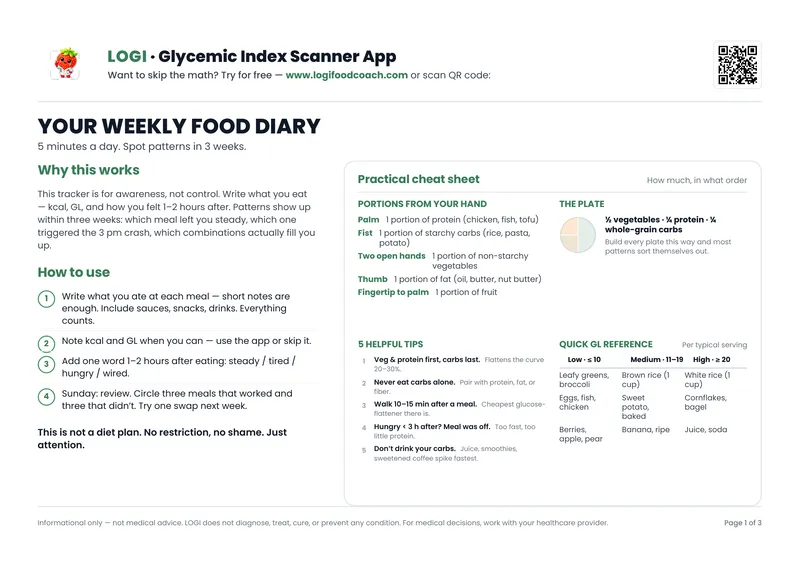
Free PDF — 3 pages
Your Weekly Food Journal
Track meals, glycemic load & mood. Spot patterns in 3 weeks.
No spam. Unsubscribe anytime.