Low-GI Pad Kra Pao with Fried Egg & Cauliflower Rice
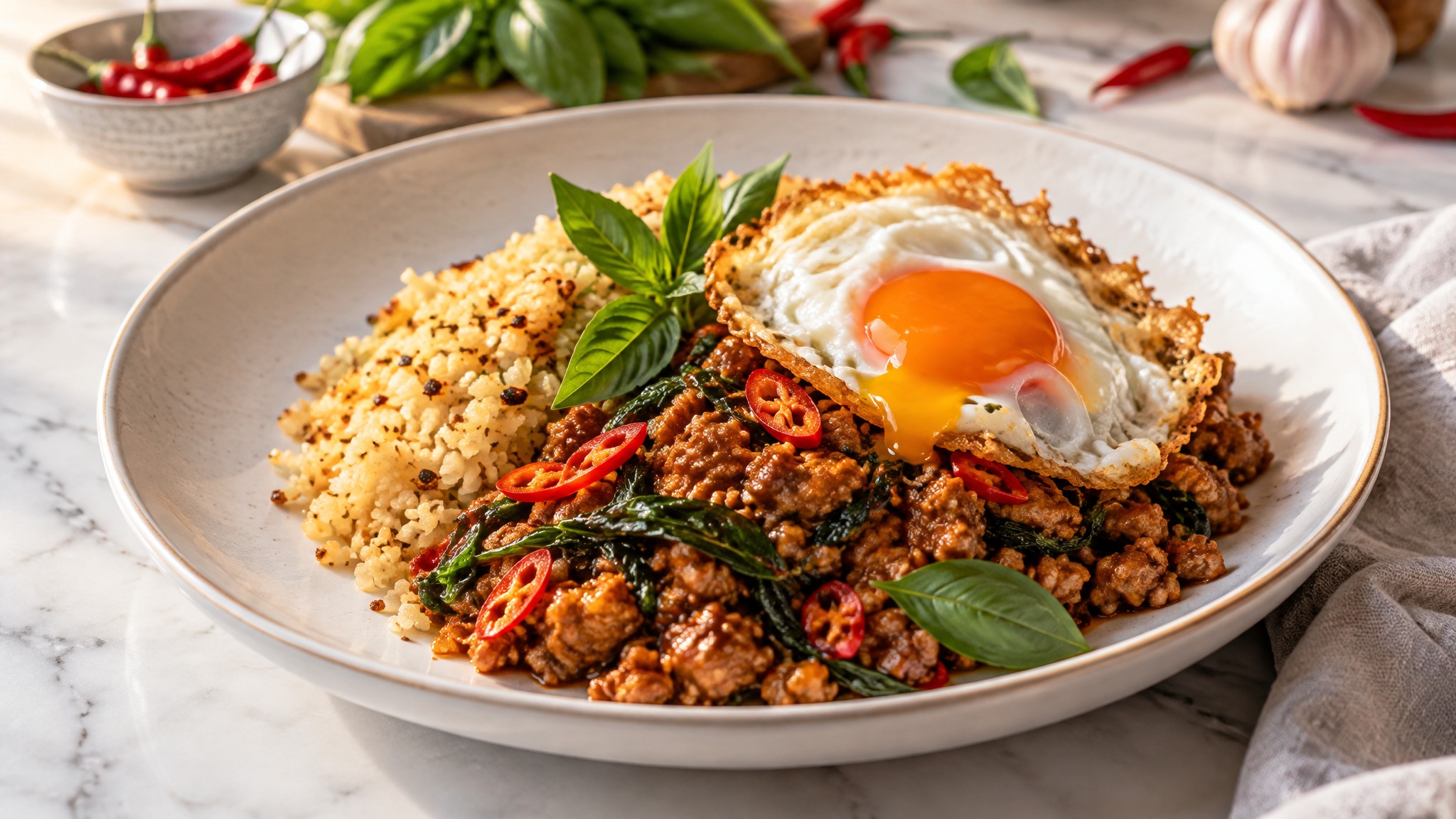
Fiery Thai pad kra pao with garlicky minced chicken, peppery holy basil and a lacy fried egg over charred cauliflower rice. Big flavour, gentle on blood sugar.
Pad kra pao is one of Thailand's best-loved street-food dishes. Minced chicken is stir-fried hard over high heat with pounded garlic and bird's eye chilli, glazed with oyster, soy and fish sauce, and finished with a big handful of peppery holy basil. It comes topped with a fried egg whose whites turn brown, lacy and crisp at the edges while the yolk stays runny. This version keeps all of that heat and aroma. The one change is the base: the usual mound of jasmine rice becomes quickly stir-fried riced cauliflower, charred at the edges so it picks up some smoky wok flavour.
That swap matters for blood sugar. Jasmine rice is one of the highest-GI staples around, often scoring above 90, and on a typical kra pao plate it makes up most of the food. Cauliflower is non-starchy, high in fiber, very low in carbohydrate and has almost no effect on glucose. Chicken thigh and egg bring plenty of protein and fat, which slow digestion and keep you full for longer. Many traditional recipes add palm sugar to the sauce, but this version leaves it out completely. The sauces still add plenty of savoury depth for very little sugar. Regular oyster sauce does contain a small amount of sugar and starch, but one tablespoon spread across two plates is minor next to the protein and fiber around it. A sugar-free oyster sauce brings that down even further.
For the gentlest glucose response, start with a few forkfuls of the cauliflower rice and basil, then move on to the chicken and egg. Eating fiber first and protein alongside helps flatten the post-meal curve. If you want more vegetables, add a side of crisp cucumber slices or stir-fried green beans. If you'd like some grain, serve each plate with a small portion of about 50 g cooked basmati or brown rice (see the swaps for how that changes the glycemic load). Drink unsweetened iced tea or water instead of a sweet Thai iced tea. The whole dish takes about 25 minutes, so it works as a quick weeknight dinner or a filling lunch.
Blood Sugar Impact
Minimal impact. Swapping rice for cauliflower keeps the carbs very low, and the protein and fat from the chicken thigh and egg should give you steady energy for 3-4 hours.
Blood Sugar Tips
- ✓ Go easy on the oyster sauce, or use a sugar-free version. It's the main source of added sugar in this dish.
- ✓ Add extra non-starchy vegetables like green beans, Thai basil or bell peppers for more fiber, and eat them first.
- ✓ If you serve it with regular jasmine rice, keep the portion small and eat the protein and vegetables before the rice. A 10-minute walk after the meal also helps.
🥗 Ingredients
- 4 pcs Garlic
- 3 pcs Bird's eye chilli
- 2 tbsp Neutral oil
- 400 g Riced cauliflower
- 0.125 tsp Salt
- 2 pcs Egg
- 300 g Minced chicken
- 1 tbsp Oyster sauce
- 2 tsp Light soy sauce
- 1 tsp Fish sauce
- 30 g Holy basil
- 4 pcs Garlic
- 3 pcs Bird's eye chilli
- 2 tbsp Neutral oil
- 14.1 oz Riced cauliflower
- 0.125 tsp Salt
- 2 pcs Egg
- 10.6 oz Minced chicken
- 1 tbsp Oyster sauce
- 2 tsp Light soy sauce
- 1 tsp Fish sauce
- 1.1 oz Holy basil
👨🍳 Instructions
- 1
Put the peeled garlic cloves and bird's eye chillies in a mortar and pound to a rough, chunky paste. If you don't have a mortar, chop them together very finely on a board. Set aside.
- 2
Set a wok over high heat and add 1 tsp (5 ml) of the oil. When it's hot, add the riced cauliflower and the salt. Stir-fry for about 5 minutes, until the moisture has cooked off and some edges are lightly charred. Divide between two plates.
- 3
Pour the remaining 5 tsp (25 ml) of oil into the wok and heat until it shimmers. Crack in the eggs and fry for 2–3 minutes, tilting the wok and spooning hot oil over the whites, until the edges are brown, lacy and crisp but the yolks are still runny. Lift them out onto a plate.
- 4
Pour off the excess oil so about 1 tbsp (15 ml) is left in the wok. Add the garlic-chilli paste and stir for about 30 seconds, until fragrant but not burnt.
- 5
Add the minced chicken and stir-fry over high heat for about 5 minutes, pressing and breaking it into small pieces, until it's cooked through and browning in places.
- 6
Add the oyster sauce (sugar-free if you have it), light soy sauce, fish sauce and 2 tbsp (30 ml) water. Don't add any palm sugar or other sugar. Toss for about 1 minute, until the chicken is coated in a glossy glaze. Take the wok off the heat and fold in the holy basil until it has just wilted.
- 7
Spoon the basil chicken next to the cauliflower rice and put a crispy fried egg on each plate. For the gentlest blood sugar response, eat a few bites of the cauliflower and basil first, then the chicken and egg. Serve right away.
📊 Nutrition Per Serving
| Per Serving | Whole Dish | |
|---|---|---|
| Calories | 618 | 1236 |
| Carbs | 14g | 29g |
| Sugars | 5g | 10g |
| Added Sugars | 1g | 1g |
| Natural Sugars | 4g | 9g |
| Protein | 47g | 94g |
| Fat | 42g | 84g |
| Saturated Fat | 9g | 18g |
| Unsaturated Fat | 30g | 60g |
| Fiber | 4g | 9g |
| Soluble Fiber | 1g | 3g |
| Insoluble Fiber | 3g | 6g |
| Sodium | 1210mg | 2421mg |
Predicted Glucose Response
What if you...
Estimated model — individual responses vary. Not medical advice.
🔄 Lower GI Swaps
Jasmine rice has a very high GI (often above 90), and a typical serving can push the glycemic load of the dish past 30. Cauliflower rice keeps the estimated GL at about 2. If you want some grain, a small 50 g portion of cooked basmati or brown rice (GI around 50–60) adds roughly 12–14 g of carbohydrate and raises the GL per serving to an estimated 8–9. That's still in the low range, especially when you eat it with the protein, fat and fiber on the plate.
Regular oyster sauce contains added sugar and starch. The amount per serving is small, but a sugar-free version removes it almost entirely while keeping the savoury glaze.
Palm sugar is mostly sucrose and would add fast-acting sugar to the dish. Chilli, garlic and fish sauce carry plenty of flavour without it, and a zero-calorie sweetener gives the same balance with no glucose impact.
Holy basil can be hard to find outside Asian grocers. Thai sweet basil is the closest easy-to-find substitute, with a slightly sweeter, anise-like flavour. All basils are virtually carb-free, so the glycemic impact stays the same.
Pork is a classic kra pao option and keeps the protein and fat that slow digestion. Firm tofu or tempeh makes a plant-based version that is still high in protein and low in carbohydrate.
🔬 The Science Behind This Recipe
Most of the glycemic load in a classic pad kra pao comes from the jasmine rice, a high-GI staple that usually scores above 90 and makes up most of the plate. Replacing it with riced cauliflower takes out nearly all of the fast-digesting starch. Cauliflower is non-starchy, provides only about 3 g of net carbohydrate per 100 g, and its fiber slows digestion even further. The rest of the dish is built on protein and fat. Minced chicken thigh and eggs slow how quickly the stomach empties and help blunt any rise in glucose after the meal. The garlic, chilli and holy basil add plenty of flavour without adding carbohydrate. The only real source of sugar is the tablespoon of oyster sauce, which comes to roughly 2 g of sugar per serving with a regular brand and close to zero with a sugar-free one. No palm sugar is used. Based on standard values for these ingredients, we estimate the dish at a GI of about 13 and a glycemic load of about 2 per serving. These are calculated estimates, not lab-measured values, and individual responses can vary. Eating the cauliflower and basil first, then the chicken and egg, can help flatten the post-meal curve even more.
Related recipes
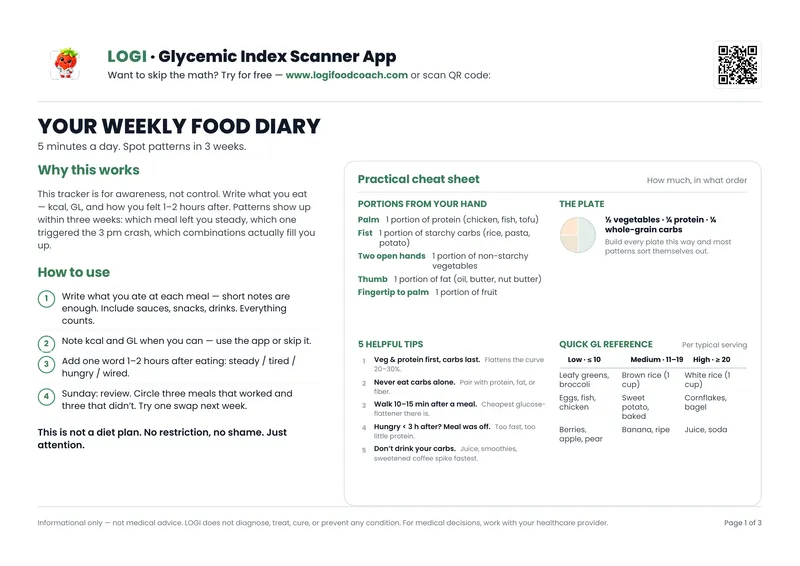
Free PDF — 3 pages
Your Weekly Food Journal
Track meals, glycemic load & mood. Spot patterns in 3 weeks.
No spam. Unsubscribe anytime.