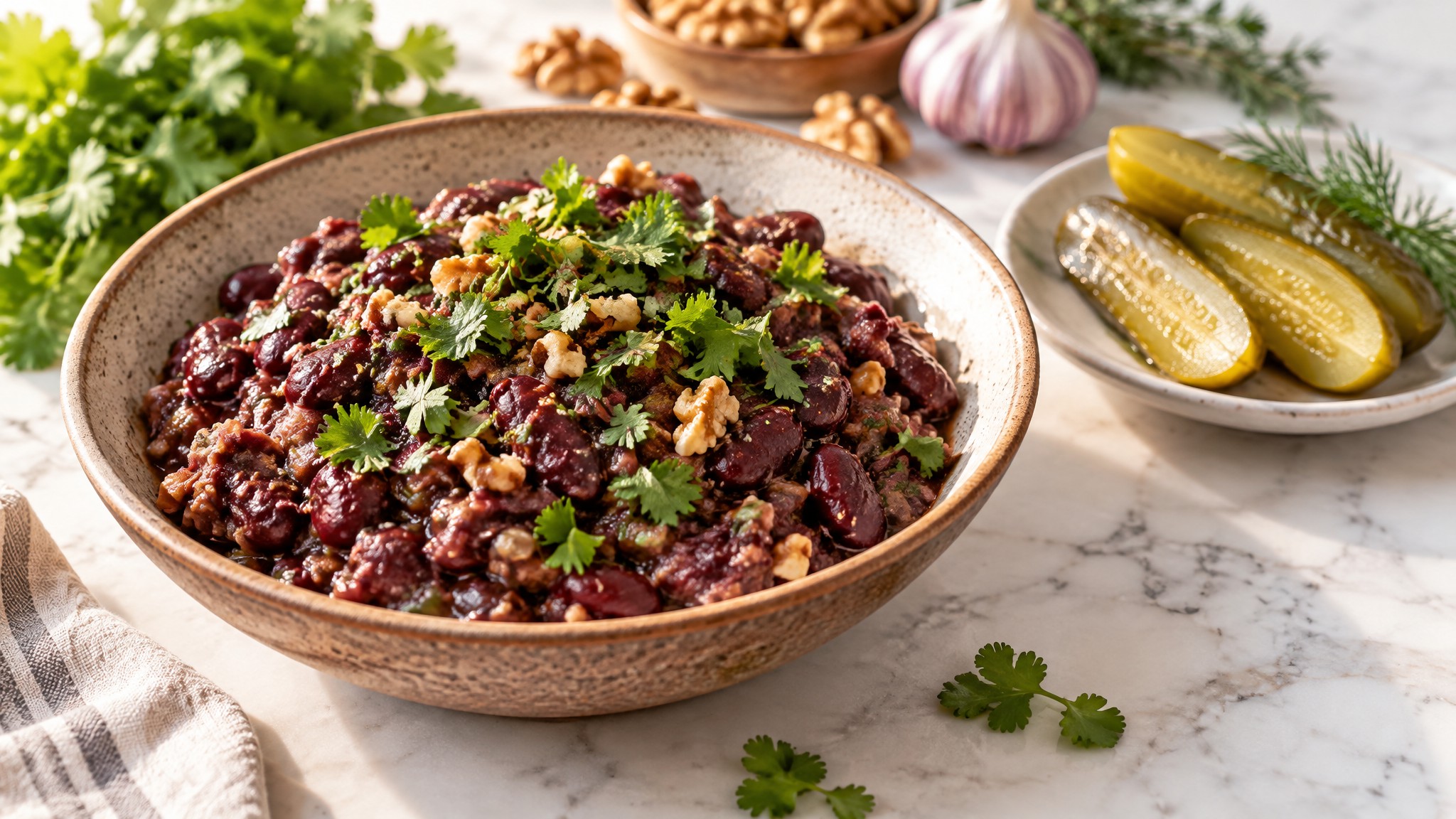
Low-GI Georgian Lobio with Walnuts and Pickles
Georgian red kidney beans simmered with golden onion, garlicky walnut paste, ground coriander and blue fenugreek (utskho suneli), served with crisp dill pickles. Beans cooked from dry give the gentlest, steadiest glucose response.
Lobio is one of Georgia's most-loved everyday dishes, and this version stays close to its roots. Red kidney beans are simmered with soft, golden onion, then partly crushed so the pot turns thick and creamy. At the end you stir in a coarse paste of walnuts, garlic and salt, along with ground coriander and blue fenugreek (utskho suneli, Trigonella caerulea). Blue fenugreek is a milder, more floral cousin of regular fenugreek seed and gives the beans their gentle, nutty Georgian smell. A splash of red wine vinegar sharpens the pot, and plenty of fresh coriander keeps it lively.
The recipe uses 480 g of cooked, drained red kidney beans for 2 servings, which is about 240 g or 1 1/3 cups of cooked beans per person. For the lowest glycemic response, cook them from dry: about 200 g of dried beans gives roughly 480 g cooked. Beans cooked from dry have a GI of around 25-30, while canned kidney beans often test at around 40-52 because commercial processing softens the starch. Canned beans still work for a quick weeknight version. Use two 400 g tins, drained and rinsed, and expect a somewhat higher glucose rise.
In Georgia, lobio usually comes with mchadi, a dense cornbread. Mchadi and white bread are higher-GI pairings that can push the meal's glycemic load up sharply, so keep them to a very small piece or leave them out. Here the lobio is served with sharp dill pickles and, ideally, a simple green salad or a fresh tomato and cucumber salad. If you want bread, choose one small slice of dense whole-grain rye or true sourdough. For the smoothest glucose curve, eat the salad or a few pickle slices first, then the lobio.
The dish is good warm or at room temperature and tastes even better the next day, so it works well for packed lunches. Pickles and salted walnut paste make it fairly salty. Choosing low-sodium pickles, rinsing canned beans and trimming the salt brings the sodium down to around 900 mg per serving.
Blood Sugar Impact
Low to moderate impact: kidney beans release their carbs slowly thanks to fiber and resistant starch, and walnuts and olive oil slow digestion further. Expect a gentle, gradual rise and steady energy for about 3-4 hours.
Blood Sugar Tips
- ✓ Cook dried kidney beans yourself or rinse canned ones, and cook them until tender but not mushy so more resistant starch stays intact.
- ✓ Eat it with a large non-starchy salad or greens, and skip white bread on the side (or pick a small portion of whole-grain bread) to keep the glycemic load low.
- ✓ Keep the vinegar and pickles in, since acidity can soften the after-meal glucose rise, and take a 10-15 minute walk after eating.
🥗 Ingredients
- 60 g Walnuts
- 2 pcs Garlic
- 0.75 tsp Salt
- 1 tbsp Olive oil
- 1 pcs Onion
- 1.5 tsp Ground coriander
- 1 tsp Blue fenugreek
- 480 g Red kidney beans
- 100 ml Water
- 1 tbsp Red wine vinegar
- 20 g Fresh coriander
- 2 pcs Dill pickle
- 2.1 oz Walnuts
- 2 pcs Garlic
- 0.75 tsp Salt
- 1 tbsp Olive oil
- 1 pcs Onion
- 1.5 tsp Ground coriander
- 1 tsp Blue fenugreek
- 1.1 lb Red kidney beans
- 7 tbsp Water
- 1 tbsp Red wine vinegar
- 0.7 oz Fresh coriander
- 2 pcs Dill pickle
👨🍳 Instructions
- 1
Bean prep (recommended: cook from dry, ahead of time; not included in the recipe times). Soak 200 g dried red kidney beans in plenty of cold water for 8-12 hours, then drain and rinse. Cover with fresh water in a pot and bring to a full, rolling boil. Boil hard for at least 10 minutes. This destroys phytohaemagglutinin, a natural toxin in raw kidney beans that slow cookers and low simmers do not break down. Then lower the heat and simmer for 45-60 minutes, until tender. Drain, keeping a little of the cooking liquid, and measure 480 g of cooked beans. Quick option: drain and rinse two 400 g tins of red kidney beans (about 480 g drained). They are already safe to eat but have a higher GI.
- 2
Put 60 g walnuts, 2 peeled garlic cloves and 1/2-3/4 tsp salt in a mortar or small food processor. Use the lower amount if your pickles are salty. Pound or pulse into a coarse, slightly damp paste with some texture left in it, then set aside.
- 3
Finely chop 1 medium onion. Warm 1 tbsp olive oil in a wide pan over medium heat. Add the onion and cook for about 8 minutes, stirring now and then, until soft and lightly golden.
- 4
Add 1 1/2 tsp ground coriander and 1 tsp ground blue fenugreek (utskho suneli). Stir for about 30 seconds, just until fragrant, and don't let the spices burn. If you only have whole coriander seeds, toast them briefly in a dry pan and grind them finely before adding. Don't swap in regular fenugreek seed one-for-one, because it is much more bitter.
- 5
Add the 480 g of cooked, drained kidney beans and 250 ml water (or bean cooking liquid). Bring to a gentle simmer and cook for 8 minutes. As they cook, crush about a third of the beans against the side of the pan with the back of a spoon to thicken the sauce.
- 6
Stir in the walnut paste and 1 tbsp red wine vinegar. Cook for about 2 minutes more, stirring, until the lobio is thick and creamy. Add a splash of water if it gets too stiff. Taste and adjust the salt only after tasting, since the walnut paste is already seasoned.
- 7
Take the pan off the heat. Roughly chop a small bunch of fresh coriander (about 20 g) and fold in about two-thirds of it.
- 8
Halve 2 medium dill pickles (low-sodium if possible, or give them a quick rinse) lengthwise. Spoon the lobio into 2 bowls, about 240 g of beans per serving, and scatter the rest of the coriander on top. Serve warm or at room temperature with the pickles and a green or tomato-cucumber salad. Eat the salad or a few bites of pickle first to help soften the glucose response. If you add bread, keep it to one small slice of dense whole-grain rye or sourdough rather than mchadi or white bread.
📊 Nutrition Per Serving
| Per Serving | Whole Dish | |
|---|---|---|
| Calories | 623 | 1247 |
| Carbs | 72g | 144g |
| Sugars | 8g | 15g |
| Added Sugars | 1g | 1g |
| Natural Sugars | 7g | 14g |
| Protein | 27g | 55g |
| Fat | 28g | 57g |
| Saturated Fat | 3g | 6g |
| Unsaturated Fat | 25g | 49g |
| Fiber | 21g | 41g |
| Soluble Fiber | 6g | 12g |
| Insoluble Fiber | 14g | 29g |
| Sodium | 1405mg | 2810mg |
Predicted Glucose Response
What if you...
Estimated model — individual responses vary. Not medical advice.
🔄 Lower GI Swaps
Beans cooked from dry have a GI of about 25-30, compared with about 40-52 for canned beans, which keeps the glycemic load near 12 instead of about 20 per serving.
Maize cornbread and white bread are high-GI and can push the meal's glycemic load up sharply. Fiber-rich salads or a small portion of dense whole-grain bread keep blood sugar steadier. If you do serve mchadi, keep it to a very small piece and eat it last.
Blue fenugreek is the authentic Georgian spice and is milder and more floral. Regular fenugreek seed is much more bitter. If you must use it, use only about 1/4 tsp ground.
Cuts several hundred milligrams of sodium per serving while keeping the vinegar acidity that helps blunt the post-meal glucose rise.
This is a different dish rather than a like-for-like swap. Green beans have far fewer carbs and much less protein and fiber per serving, so the glycemic load drops to very low, but the meal is less filling. Add eggs, extra walnuts or another protein to keep it satisfying.
🔬 The Science Behind This Recipe
Glycemic info per serving (1/2 recipe, about 240 g cooked beans): estimated GI is about 28 when the beans are cooked from dry. Glycemic load is about 12, which is low. Per serving, the beans provide roughly 38 g of available carbohydrate, and onion and walnuts add about 5 g more, for about 43 g in total. At a GI of about 28 that gives a GL of about 12. If you use canned kidney beans, the GI rises to roughly 40-50 and the GL to about 17-22 per serving, which is moderate. That is why cooking from dry is recommended.
Kidney beans digest slowly because their starch is packed inside intact cell walls, alongside plenty of soluble fiber, resistant starch and protein. Walnuts and olive oil add fat and extra fiber, which slow how quickly the stomach empties. Vinegar, both in the pot and from the pickles, has been linked to a smaller rise in blood sugar after a meal. Eating a salad or pickles first ('veggies first') can soften the curve further. Starchy sides like mchadi (cornbread) or white bread have a much higher GI and add fast-digesting carbs, so they can easily double the meal's glycemic load.
Sodium: with 3/4 tsp salt, regular dill pickles and unrinsed canned beans, a serving can reach about 1,500-1,800 mg sodium. With 1/2 tsp salt, beans cooked from dry or rinsed, and low-sodium pickles, it drops to roughly 800-1,000 mg per serving.
Expected blood sugar impact: a gentle, gradual rise and steady energy for about 3-4 hours.
Related recipes
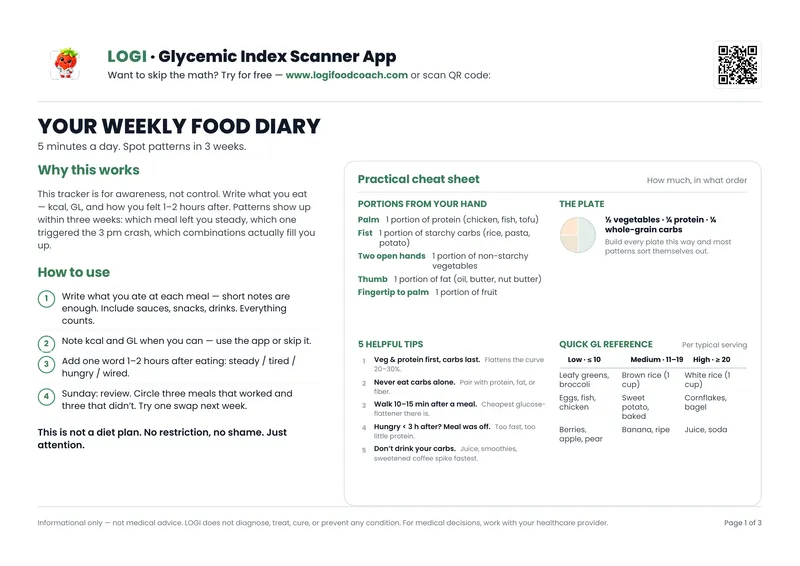
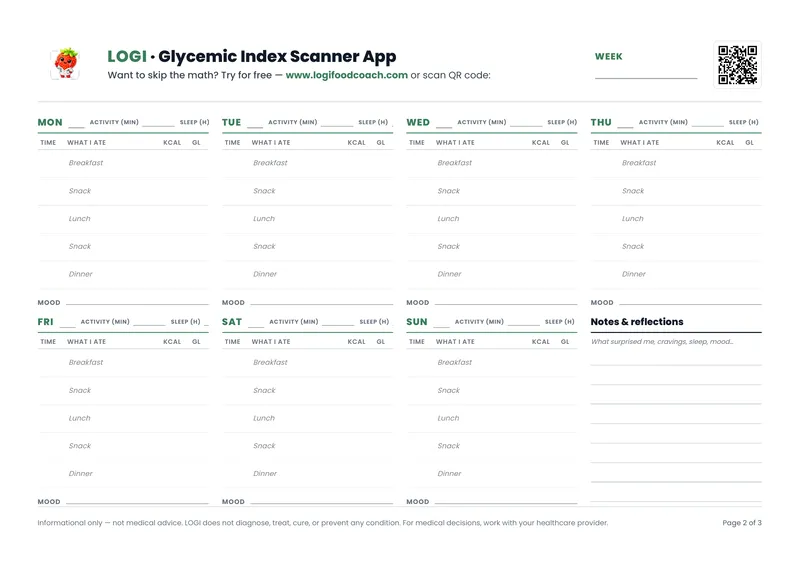
Free PDF — 3 pages
Your Weekly Food Journal
Track meals, glycemic load & mood. Spot patterns in 3 weeks.
No spam. Unsubscribe anytime.