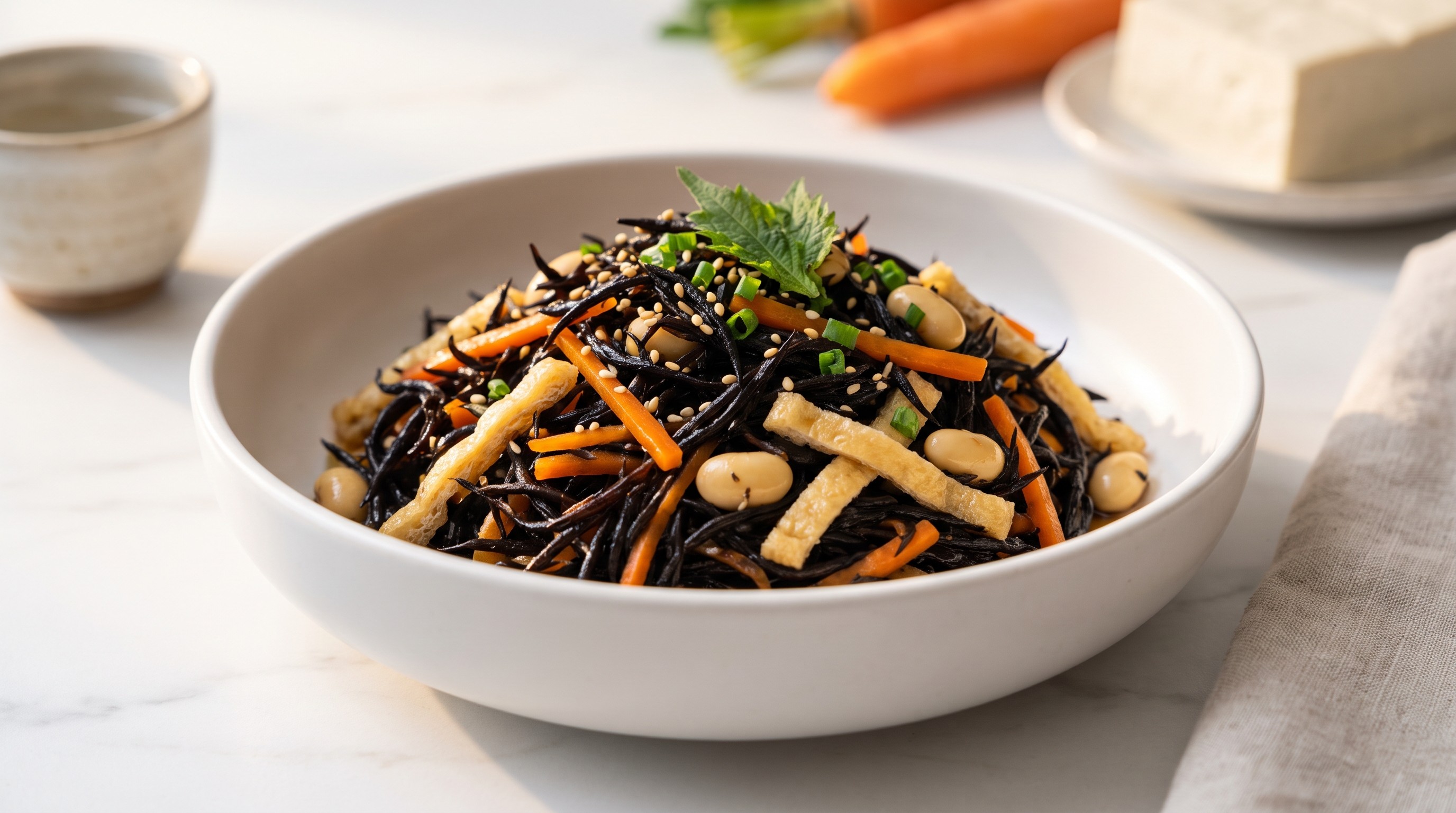
Hijiki no Nimono with Tofu and Soy Beans
Sugar-free simmered hijiki seaweed with fried tofu, soy beans, and carrot in umami-rich dashi — a fibre-packed Japanese side that keeps blood sugar steady.
Hijiki no nimono is a quietly nourishing staple of Japanese home cooking, and it happens to be one of the most blood-sugar-friendly dishes you can make. Dried hijiki seaweed is braised with matchstick carrot, plump soy beans, and strips of fried tofu (aburaage) in a savoury dashi broth seasoned with soy sauce and a restrained splash of mirin. Unlike most traditional versions, this recipe skips the tablespoon of white sugar entirely — the natural sweetness of slowly simmered carrot and the subtle caramel edge of mirin fill the gap without any glucose spike.
Every main ingredient in this dish sits firmly in the low-glycemic range. Hijiki seaweed is virtually carbohydrate-free and loaded with soluble fibre that forms a gel in the gut, physically slowing the absorption of glucose from anything eaten alongside it. Soy beans have a GI of roughly 15 and deliver plant protein plus resistant starch, both proven to flatten post-meal blood sugar curves. Carrot, despite its reputation, has a GI of only 39 when eaten whole and its fibre matrix remains intact in matchstick form. Aburaage adds protein and healthy fats that further slow gastric emptying.
Serve this nimono as a make-ahead side dish — it tastes even better the next day once the flavours have deepened. Pair it with grilled fish or a bowl of brown rice and steamed greens for a complete low-glycemic meal. For optimal blood sugar management, eat a few bites of the hijiki and vegetables before starting any starchy component; the fibre and protein prime your digestive system to handle carbohydrates more gradually.
Blood Sugar Impact
Very low blood sugar impact expected. The combination of high-fiber hijiki seaweed, protein-rich tofu and soybeans, and healthy fats from sesame oil results in a very low GI of 33 and GL of 9, promoting stable blood sugar and sustained energy for 3-4 hours.
Blood Sugar Tips
- ✓ Eat the hijiki seaweed and vegetables first to maximize the fiber-first effect, which slows glucose absorption from the mirin and carrots.
- ✓ Keep portion sizes of mirin modest when preparing this dish, as mirin contains sugars that can add to glycemic load if used heavily.
- ✓ Pair this dish with a side of raw or lightly pickled vegetables (like daikon or cucumber) to add extra fiber and volume without raising blood sugar.
🥗 Ingredients
- 30 g Dried hijiki seaweed
- 200 g Carrot
- 240 g Soy beans
- 80 g Fried tofu pouch
- 200 ml Dashi stock
- 2 tbsp Soy sauce
- 1 tbsp Mirin
- 1 tbsp Toasted sesame oil
- 1 tsp White sesame seeds
- 1.1 oz Dried hijiki seaweed
- 7.1 oz Carrot
- 8.5 oz Soy beans
- 2.8 oz Fried tofu pouch
- 14 tbsp Dashi stock
- 2 tbsp Soy sauce
- 1 tbsp Mirin
- 1 tbsp Toasted sesame oil
- 1 tsp White sesame seeds
👨🍳 Instructions
- 1
Place the dried hijiki in a large bowl and cover generously with cold water. Leave to soak for 20 minutes until the seaweed has softened and expanded to roughly five times its dry volume. Drain through a fine-mesh sieve, pressing firmly with the back of a spoon to squeeze out as much water as possible.
- 2
While the hijiki soaks, peel the carrot and slice it into thin matchsticks about 4 cm long. Keeping the pieces fine ensures they cook evenly and release their natural sweetness into the broth.
- 3
Place the fried tofu pouches in a colander and pour a kettle of boiling water over them on both sides. This removes excess surface oil and helps the tofu absorb the braising liquid. Once cool enough to handle, cut the sheets into thin strips roughly the same width as the carrot matchsticks.
- 4
Tip the canned soy beans into a sieve, rinse under cold running water, and shake dry. Set aside with the prepared tofu strips.
- 5
Heat the toasted sesame oil in a wide, shallow pan or deep skillet over medium heat. Once the oil shimmers, add the carrot matchsticks and drained hijiki. Stir-fry for about 3 minutes, tossing frequently, until the carrot just begins to soften and the hijiki is evenly coated in the fragrant oil.
- 6
Add the soy beans and tofu strips to the pan. Pour in the dashi stock, soy sauce, and mirin. Stir everything together once and bring the liquid to a gentle simmer over medium heat.
- 7
Lower the heat and let the mixture simmer uncovered for 15 minutes, stirring every few minutes to prevent sticking. The dish is ready when nearly all the liquid has been absorbed and the hijiki looks dark, glossy, and richly coated. If the pan dries out too quickly, add a splash of water and continue simmering.
- 8
Remove from the heat and transfer to a serving dish. Scatter the sesame seeds over the top. Serve warm or let it cool to room temperature — the flavours deepen as it sits, making this an ideal make-ahead side dish. For best blood sugar results, eat this fibre-rich dish at the start of your meal before any starchy accompaniment.
📊 Nutrition Per Serving
| Per Serving | Whole Dish | |
|---|---|---|
| Calories | 430 | 860 |
| Carbs | 27g | 54g |
| Sugars | 10g | 19g |
| Added Sugars | 2g | 3g |
| Natural Sugars | 8g | 16g |
| Protein | 24g | 47g |
| Fat | 26g | 52g |
| Saturated Fat | 4g | 8g |
| Unsaturated Fat | 22g | 44g |
| Fiber | 11g | 21g |
| Soluble Fiber | 3g | 7g |
| Insoluble Fiber | 7g | 15g |
| Sodium | 1572mg | 3145mg |
Predicted Glucose Response
What if you...
Estimated model — individual responses vary. Not medical advice.
🔄 Lower GI Swaps
Mirin contains roughly 45% sugar and has a high glycemic index. Replacing it with a low- or zero-glycemic sweetener combined with a fermented base preserves the sweet-savory balance while virtually eliminating the sugar-driven blood glucose spike.
Cooked carrots have a moderate GI (around 39-49) and their natural sugars become more rapidly available after simmering. Daikon (GI ~21), konjac (GI ~0, almost pure glucomannan fiber), and green beans (GI ~15) all deliver texture and volume with significantly less blood sugar impact.
Canned soybeans often contain added sugar or glucose syrup in the brine, which raises their effective glycemic load. Home-cooked dried soybeans, unsweetened black soybeans, or edamame retain the same low-GI protein and fiber profile without hidden added sugars.
Some commercial soy sauces contain added sugars or caramel coloring that contribute a small glycemic load. Wheat-free tamari and low-sugar coconut aminos deliver equivalent umami depth with fewer hidden carbohydrates, keeping the overall glycemic load as low as possible.
🔬 The Science Behind This Recipe
Here is the science explainer section:
---
Why This Dish Is a Blood Sugar Winner
This traditional Japanese simmered dish is a masterclass in gentle, steady energy. With a glycemic index of just 33 and a glycemic load of 9.0 per serving, it sits firmly in the "low" category on both scales — meaning it's unlikely to cause the rapid blood sugar spikes and crashes that leave you feeling sluggish. But what makes it so friendly to your metabolism? It comes down to the powerful trio of fiber, protein, and healthy fats working together in every bite.
Soybeans are the star here. They're packed with both plant protein and soluble fiber, two nutrients that slow the rate at which sugars enter your bloodstream. Think of fiber as a gentle gatekeeper — it forms a gel-like barrier in your digestive tract that makes your body work a little harder (and a little longer) to absorb glucose. Aburaage, the fried tofu skin, adds a layer of healthy fat to the mix, which further slows digestion. When you combine protein, fat, and fiber in a single dish — as this recipe naturally does — they create a "buffer effect" that flattens your post-meal glucose curve. Hijiki seaweed contributes its own dose of minerals and soluble fiber, reinforcing that slow, steady absorption.
Here's a practical tip: if you're serving this alongside rice, eat the nimono first. Research suggests that eating vegetables, protein, and fats before carbohydrates can significantly reduce post-meal blood sugar rises. A short 10–15 minute walk after eating helps too, as your muscles use circulating glucose for fuel. And remember, glycemic load accounts for portion size — not just the type of carbohydrate — so a reasonable serving of this dish keeps your total glucose impact impressively low. It's a perfect example of how traditional food wisdom and modern nutrition science point in the same direction.
---
Word count: 277
This covers the key GI/GL science, highlights soybeans, aburaage, and hijiki as the focal ingredients, includes practical tips (food order, walking, portion awareness), and maintains an approachable, empowering tone throughout — no medical claims or jargon.
Related recipes

Free PDF — 3 pages
Your Weekly Food Journal
Track meals, glycemic load & mood. Spot patterns in 3 weeks.
No spam. Unsubscribe anytime.
