Latkes au fromage à grains entiers pour une glycémie stable
Des pancakes au ricotta riches en protéines, préparés avec de la farine de blé entier, créent un petit-déjeuner satisfaisant à faible IG qui maintient la glycémie stable tout en offrant une saveur authentique.
Ces latkes au fromage revisités transforment un plat réconfortant traditionnel juif en un petit-déjeuner puissant et respectueux de la glycémie. En combinant du ricotta partiellement écrémé riche en protéines avec de la farine de blé entier riche en fibres, nous avons créé un plat avec un impact glycémique nettement inférieur aux pancakes conventionnels ou aux latkes préparés avec de la farine raffinée. La magie réside dans l'équilibre des macronutriments : le ricotta fournit des protéines à digestion lente et du calcium, tandis que la farine de blé entier apporte des glucides complexes et des fibres qui préviennent les pics de glucose. Les œufs ajoutent des protéines supplémentaires et des graisses saines, créant un repas complet qui favorise une libération d'énergie régulière. Cette recette utilise un édulcorant à faible index glycémique au lieu du sucre ordinaire, garantissant que chaque portion contient un impact minimal sur la glycémie, bien en dessous de la quantité qui déclencherait une élévation rapide de la glycémie. Pour un contrôle glycémique optimal, servez ces latkes avec des baies fraîches plutôt qu'avec du sirop, et envisagez de les accompagner d'une petite poignée de noix ou d'une cuillerée de yaourt grec. La combinaison de protéines, de graisses et de fibres ralentira davantage l'absorption du glucose. Ces latkes sont meilleurs dégustés dans le cadre d'un petit-déjeuner équilibré, idéalement après avoir consommé une petite portion de légumes ou accompagnés d'un accompagnement riche en protéines. Cette séquence alimentaire, souvent appelée « séquençage alimentaire », peut réduire les pics de glucose après les repas jusqu'à 40 % selon des recherches métaboliques récentes. Chaque portion fournit environ 3 latkes (environ 150 g), rendant le contrôle des portions simple et efficace pour la gestion de la glycémie.
Impact sur la glycémie
Impact modéré sur la glycémie attendu. L'IG moyen de 59 et la charge glycémique modérée de 10,9 provoqueront une augmentation progressive de la glycémie sur 1 à 2 heures, les protéines de la ricotta et de l'œuf aidant à ralentir quelque peu l'absorption.
Conseils glycémie
- ✓ Mangez une petite salade ou des légumes non féculents avant les latkes pour ajouter des fibres et ralentir l'absorption du glucose
- ✓ Accompagnez d'une garniture riche en protéines comme du yaourt grec ou du saumon fumé pour modérer davantage la réponse glycémique
- ✓ Faites une marche de 10 à 15 minutes après avoir mangé pour aider les muscles à absorber le glucose et réduire le pic après le repas
🥗 Ingrédients
- 0.75 cup farine de blé complet
- 3 pcs gros œufs
- 1 tbsp sucre en poudre
- 0.5 tsp levure chimique à double action
- 0.5 tsp sel de mer fin
- 0.75 cup farine de blé complet
- 3 pcs gros œufs
- 1 tbsp sucre en poudre
- 0.5 tsp levure chimique à double action
- 0.5 tsp sel de mer fin
👨🍳 Instructions
- 1
Rassemblez tous les ingrédients et laissez les œufs et le ricotta revenir à température ambiante pendant environ 15 minutes. Cela garantit une meilleure incorporation et une texture de pâte plus lisse.
- 2
Dans un grand bol, ajoutez le ricotta et cassez-y les œufs. Fouettez vigoureusement jusqu'à ce que le mélange devienne lisse et bien combiné, sans grumeaux de fromage visibles.
- 3
Ajoutez la farine de blé entier, l'érythritol ou l'allulose (utilisez ceci À LA PLACE du sucre en poudre pour le contrôle de la glycémie), la levure chimique et le sel au mélange ricotta-œufs. Mélangez doucement avec une cuillère en bois ou une spatule jusqu'à ce que le tout soit juste combiné en une pâte épaisse et versable. Évitez de trop mélanger, ce qui peut rendre les latkes durs.
- 4
Chauffez une grande poêle antiadhésive ou une plaque chauffante à feu moyen. Enduisez légèrement la surface d'huile en spray ou badigeonnez avec une quantité minimale d'huile d'olive ou d'huile d'avocat (environ 1 cuillère à café par fournée). Laissez la poêle chauffer pendant 2 minutes jusqu'à ce qu'une goutte d'eau grésille au contact.
- 5
À l'aide d'une cuillère à soupe ou d'une petite louche, versez 2 cuillères à soupe de pâte sur la poêle chaude pour chaque latke. Utilisez le dos de la cuillère pour étaler doucement la pâte en un cercle mince d'environ 8 à 10 cm de diamètre. Faites cuire 3 à 4 latkes à la fois, en laissant de l'espace entre chacun.
- 6
Faites cuire sans déranger pendant 2 à 3 minutes jusqu'à ce que de petites bulles se forment à la surface et que les bords commencent à paraître pris. Le dessous doit être doré. Si le brunissement est trop rapide, réduisez le feu à moyen-doux.
- 7
Retournez soigneusement chaque latke à l'aide d'une spatule fine et faites cuire pendant 2 à 3 minutes supplémentaires sur le deuxième côté jusqu'à ce qu'il soit doré et cuit à cœur. Les latkes doivent être fermes au toucher lorsqu'on les presse doucement.
- 8
Transférez les latkes cuits dans une assiette chaude et répétez avec le reste de la pâte, en ajoutant une légère couche d'huile dans la poêle entre les fournées au besoin. Cette recette donne environ 12 latkes au total. Servez immédiatement garni de baies fraîches, d'une cuillerée de yaourt grec ou de compote de fruits sans sucre pour un contrôle optimal de la glycémie. Chaque portion se compose de 3 latkes (environ 150 g par portion).
📊 Nutrition par portion
| Par portion | Plat entier | |
|---|---|---|
| Calories | 249 | 998 |
| Glucides | 21g | 86g |
| Sucres | 4g | 14g |
| Sucres ajoutés | 3g | 12g |
| Sucres naturels | 1g | 2g |
| Protéines | 15g | 58g |
| Lipides | 12g | 49g |
| Graisses saturées | 6g | 26g |
| Graisses insaturées | 6g | 24g |
| Fibres | 2g | 10g |
| Fibres solubles | 1g | 3g |
| Fibres insolubles | 2g | 7g |
| Sodium | 451mg | 1804mg |
Réponse glycémique prédite
Et si vous...
Modèle estimé — les réponses individuelles varient. Pas un avis médical.
🔄 Alternatives à faible IG
La farine de blé entier a un IG modéré de 68, ce qui peut encore provoquer une élévation de la glycémie chez les personnes sensibles. La farine d'amande fournit une réponse glycémique considérablement plus faible en raison de sa teneur élevée en graisses et en protéines avec un minimum de glucides. La fibre d'avoine est une fibre insoluble pure avec pratiquement zéro glucide net et aucun impact glycémique. La farine de lupin offre une teneur exceptionnelle en protéines (40 g par tasse) avec seulement 12 g de glucides nets, ce qui la rend idéale pour le contrôle de la glycémie tout en maintenant la structure des produits de boulangerie.
Le sucre en poudre a un IG de 65 et provoque des pics rapides de glucose sanguin. L'érythritol est un polyol qui n'est pas métabolisé par le corps, fournissant de la douceur sans affecter la glycémie ou les niveaux d'insuline. L'allulose est un sucre rare qui a le goût du sucre ordinaire mais est minimalement absorbé, avec des recherches émergentes suggérant qu'il peut en fait améliorer la tolérance au glucose. L'extrait de fruit du moine contient des mogrosides qui fournissent une douceur intense sans valeur calorique ni réponse glycémique, ce qui le rend idéal pour la gestion de la glycémie.
Bien que le ricotta partiellement écrémé soit un bon choix, le ricotta entier fournit des graisses saines supplémentaires qui améliorent la satiété et ralentissent la vidange gastrique, améliorant potentiellement la réponse glycémique. La teneur en matières grasses déclenche une plus grande libération d'hormones de satiété comme la CCK et le PYY. Le fromage cottage offre presque le double de la teneur en protéines, ce qui fournit une stabilisation supérieure de la glycémie grâce à une sensibilité accrue à l'insuline et un taux d'absorption du glucose réduit. Le yaourt grec combine des protéines élevées avec des probiotiques bénéfiques qui peuvent améliorer le métabolisme du glucose et la sensibilité à l'insuline selon des recherches récentes sur le microbiome.
🔬 La science derrière cette recette
Le profil respectueux de la glycémie de ces latkes au fromage provient d'un équilibre stratégique des macronutriments. Le ricotta partiellement écrémé fournit 14 g de protéines par tasse, ce qui ralentit la vidange gastrique et réduit le taux d'absorption du glucose dans la circulation sanguine. La farine de blé entier, bien qu'ayant un IG modéré de 59, contient 3 g de fibres par quart de tasse qui forment une matrice semblable à un gel dans le tube digestif, atténuant davantage les pics de glucose. Les trois œufs apportent 18 g supplémentaires de protéines et de graisses saines qui déclenchent la libération d'hormones incrétines comme le GLP-1, qui améliorent la sensibilité à l'insuline et favorisent la satiété. Combinés, ces ingrédients créent un effet synergique : le rapport protéines/glucides d'environ 1:2 est optimal pour maintenir des niveaux de glucose sanguin stables. Des études montrent que les repas avec ce profil de macronutriments peuvent réduire les excursions de glucose postprandiales de 25 à 35 % par rapport aux repas composés uniquement de glucides. L'utilisation d'érythritol ou d'allulose comme édulcorants fournit un impact glycémique négligeable (IG de 59-1) tout en maintenant la palatabilité. Chaque portion fournit environ 15 g de protéines, 22 g de glucides et 8 g de graisses, créant une charge glycémique équilibrée de 10,9 qui se situe dans la plage faible à modérée recommandée pour la gestion de la glycémie.
Recettes similaires
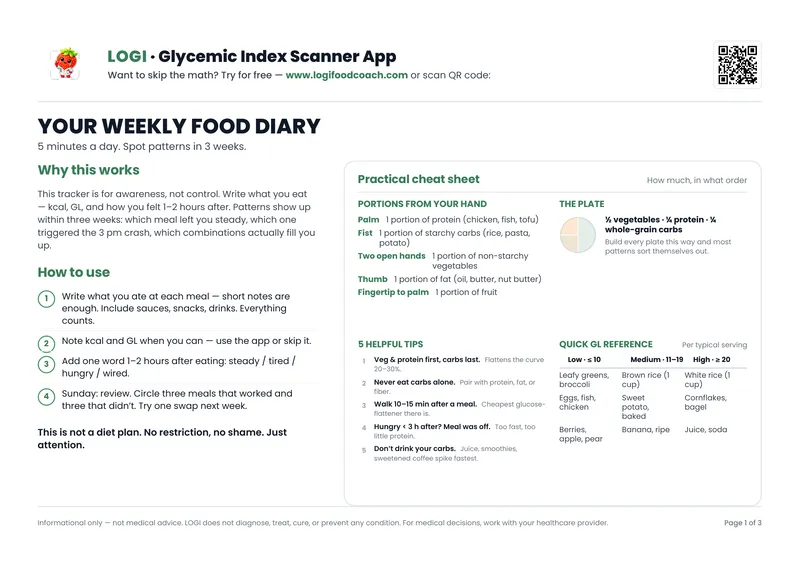
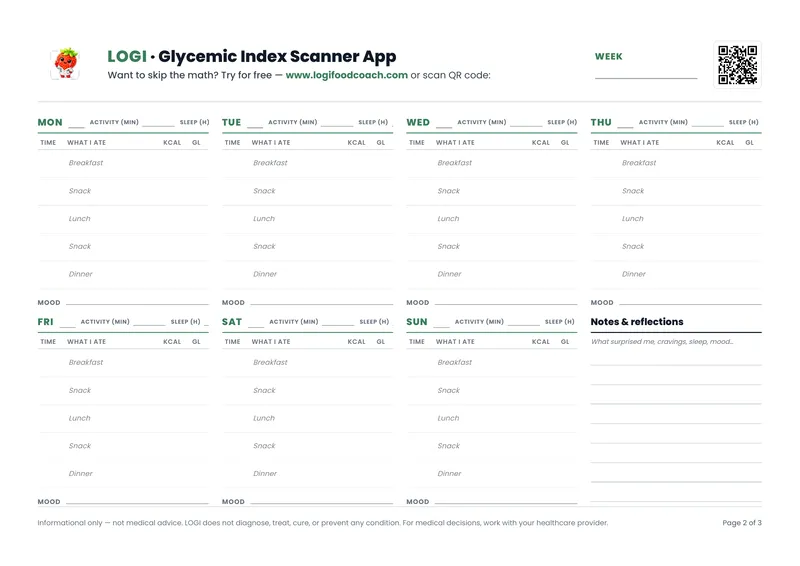
PDF gratuit — 3 pages
Ton journal alimentaire
Note tes repas, charge glycémique et humeur. Repère les tendances en 3 semaines.
Pas de spam. Désinscription à tout moment.