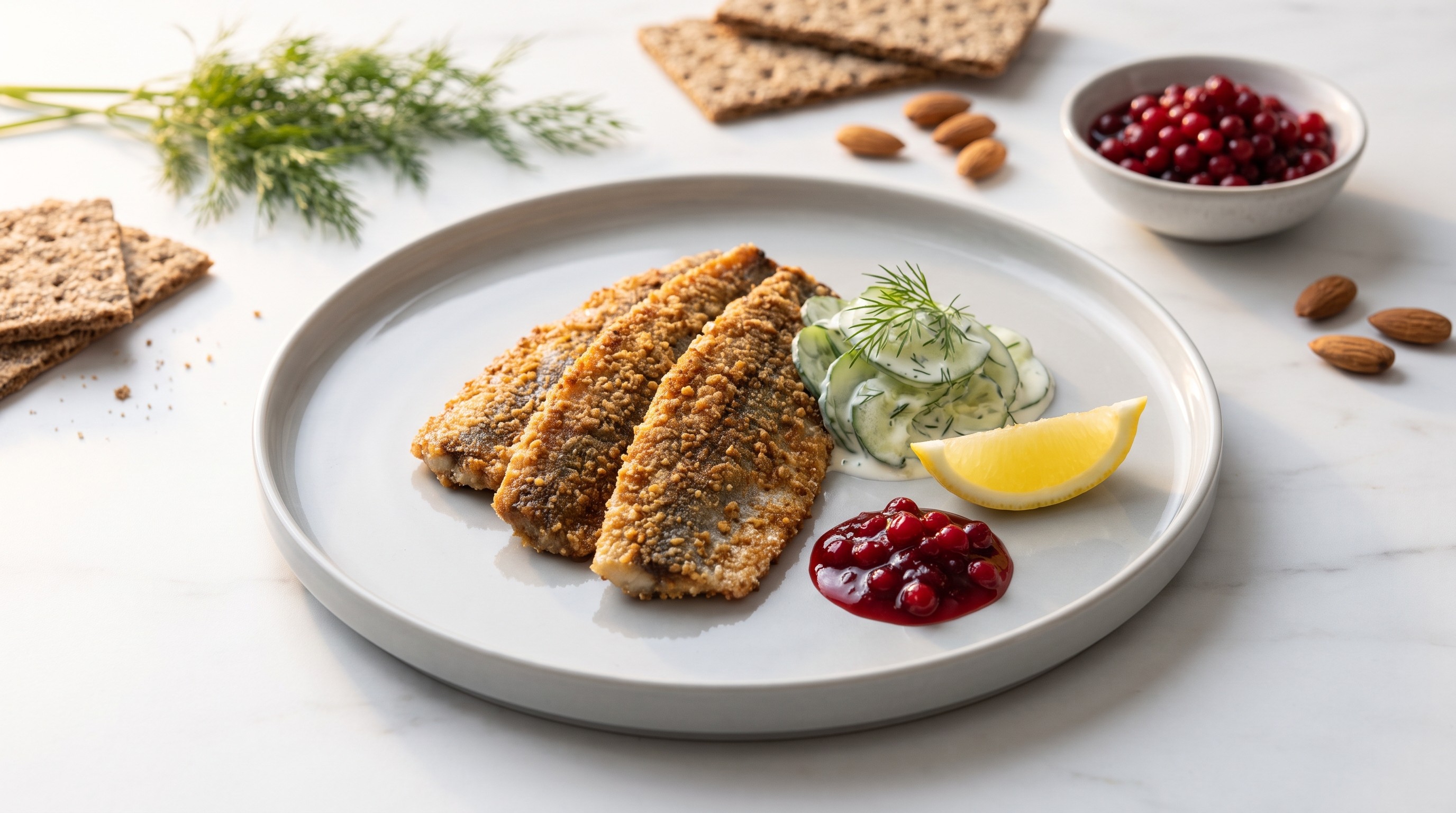
Stekt Strömming with Rye-Almond Crumb and Lingonberries
Crispy pan-fried Baltic herring in a low-GI rye-almond crust, served with cool cucumber-dill salad and tart lingonberries for steady blood sugar.
Stekt strömming is a beloved Swedish staple that proves blood-sugar-friendly eating never has to feel like a compromise. Tiny Baltic herring fillets are dredged in a blend of rye flour and almond flour — two flours that sit at the very bottom of the glycemic index — then pan-fried in foaming butter until the crust shatters at the first bite. The result is golden, aromatic, and deeply satisfying, with virtually no glucose spike to speak of.
The pairing here is intentional: a chilled crème fraîche cucumber salad adds hydration, fibre, and healthy fats that further slow any residual carbohydrate absorption, while a restrained spoonful of lingonberry preserves delivers the traditional sweet-tart contrast without overloading on sugar. Lingonberries are among the lowest-GI berries available, rich in polyphenols that research links to improved insulin sensitivity. A squeeze of fresh lemon at the table rounds out the plate with bright acidity.
For the best glycemic outcome, start your meal with the cucumber salad — eating vegetables before protein and fat has been shown to blunt post-meal glucose by up to 30 percent. The herring itself is an omega-3 powerhouse; its anti-inflammatory fatty acids support long-term metabolic health well beyond the single meal. This is weeknight cooking at its fastest: eighteen minutes from cutting board to plate, with ingredients simple enough to keep on rotation.
Blood Sugar Impact
Low-to-moderate impact expected. The low GI (42) and moderate glycemic load (14.1) combined with high protein from herring, healthy fats from butter and crème fraîche, and the slow-digesting rye-almond crumb should produce a gentle, gradual blood sugar rise with stable energy for 3-4 hours.
Blood Sugar Tips
- ✓ Eat the cucumber-dill salad first — starting with raw vegetables slows gastric emptying and blunts the glucose response from the rye crumb coating.
- ✓ Keep the butter used for frying moderate rather than excessive; the fat already in the herring and crème fraîche is sufficient to slow carbohydrate absorption without adding unnecessary calories.
- ✓ Take a 10-15 minute walk after the meal to further flatten any post-prandial rise from the rye flour coating.
🥗 Ingredients
- 200 g Cucumber
- 8 g Dill
- 60 g Crème fraîche
- 4 g Salt
- 30 g Rye flour
- 25 g Almond flour
- 2 g Black pepper
- 1 pcs Egg
- 320 g Baltic herring fillet
- 25 g Butter
- 2 pcs Lemon wedge
- 7.1 oz Cucumber
- 0.3 oz Dill
- 2.1 oz Crème fraîche
- 0.1 oz Salt
- 1.1 oz Rye flour
- 0.9 oz Almond flour
- 0.1 oz Black pepper
- 1 pcs Egg
- 11.3 oz Baltic herring fillet
- 0.9 oz Butter
- 2.1 oz Lingonberry preserves
- 2 pcs Lemon wedge
👨🍳 Instructions
- 1
Slice the cucumber into thin rounds and place them in a mixing bowl. Add the roughly chopped dill, crème fraîche, and a small pinch of salt. Fold everything together gently until the cucumber is evenly coated, then cover and refrigerate while you prepare the herring.
- 2
Combine the rye flour, almond flour, remaining salt, and black pepper on a wide plate or shallow dish. Stir with a fork until the mixture is uniform — the almond flour adds healthy fats and keeps the glycemic load of the coating very low.
- 3
Crack the egg into a shallow bowl and beat it lightly with a fork. Lay the herring fillets on a double layer of paper towel and pat them thoroughly dry on both sides — dry fish is the key to a crust that stays crisp.
- 4
Working one fillet at a time, dip it into the beaten egg, let any excess drip back into the bowl, then lay it in the flour mixture. Press the coating firmly onto both sides so it adheres in an even layer. Set the dredged fillets on a clean plate.
- 5
Place a large non-stick skillet over medium-high heat and add the butter. Let it melt completely and foam — once the foam begins to subside and the butter smells nutty, it is ready. Do not let it brown past a light golden colour.
- 6
Lay the coated fillets into the hot butter without overlapping. If the pan feels crowded, fry in two batches to maintain heat. Cook undisturbed for about 2 minutes per side until the crust turns deep golden and you can hear it crackling. Transfer to a warm plate lined with paper towel.
- 7
Divide the crispy herring fillets between two plates, arranging them slightly overlapping. Retrieve the cucumber salad from the refrigerator and spoon it alongside the fish. Add a generous tablespoon of lingonberry preserves to each plate and tuck a lemon wedge on the side.
- 8
Serve immediately while the crust is still audibly crisp. For the best blood-sugar response, eat a few forkfuls of the cucumber salad first — the fibre and fat from the crème fraîche help slow glucose absorption — then enjoy the herring and lingonberries together. Squeeze the lemon over the fish just before eating.
📊 Nutrition Per Serving
| Per Serving | Whole Dish | |
|---|---|---|
| Calories | 741 | 1481 |
| Carbs | 34g | 68g |
| Sugars | 16g | 32g |
| Added Sugars | 9g | 18g |
| Natural Sugars | 7g | 14g |
| Protein | 47g | 93g |
| Fat | 47g | 94g |
| Saturated Fat | 18g | 36g |
| Unsaturated Fat | 29g | 58g |
| Fiber | 5g | 10g |
| Soluble Fiber | 2g | 3g |
| Insoluble Fiber | 3g | 7g |
| Sodium | 3709mg | 7419mg |
Predicted Glucose Response
What if you...
Estimated model — individual responses vary. Not medical advice.
🔄 Lower GI Swaps
Commercial lingonberry sauce is typically 40-50% added sugar with a high GI (~65). Fresh lingonberries have minimal natural sugar and a very low GI (~25), dramatically reducing the glycemic load of the dish.
Rye flour has a moderate GI (~55-65) and is the main carbohydrate source in the crumb coating. Almond flour (GI ~1), flaxseed meal (GI ~1), and coconut flour (GI ~45) are all significantly lower in glycemic impact due to higher fiber and fat content and far fewer net carbs per serving.
While creme fraiche has a low GI, full-fat Greek yogurt and skyr offer substantially more protein per serving, which slows gastric emptying and blunts the overall postprandial glucose response of the meal, helping to lower the dish's effective glycemic load.
🔬 The Science Behind This Recipe
Why This Meal Works for Your Blood Sugar
This dish earns its low glycemic score thanks to a smart combination of ingredients that naturally slow down how quickly sugar enters your bloodstream. Rye flour is the star here — unlike refined wheat flour, rye is packed with soluble fiber that forms a gel-like barrier in your digestive system, physically slowing the breakdown of starches into sugar. That's why rye-based foods consistently rank lower on the glycemic index than their wheat counterparts. With an estimated GI of just 42, this recipe sits comfortably in the "low" category, meaning it produces a gentle, gradual rise in blood sugar rather than a sharp spike.
The crème fraîche adds another layer of protection. Its combination of fat and protein triggers a slower emptying of your stomach, giving your body more time to process glucose in manageable waves instead of all at once. This is the principle behind pairing strategies — whenever you eat carbohydrates alongside fat or protein, you effectively blunt the glucose response. The cucumber and dill contribute almost no sugar themselves while adding fiber and volume, helping you feel satisfied without adding to the glycemic load.
Speaking of glycemic load, this recipe's score of 14.1 per serving tells a more complete story than GI alone. While GI measures how fast a food raises blood sugar, glycemic load accounts for how much carbohydrate you're actually eating. A GL under 10 is low and under 20 is moderate — so this dish lands in a comfortable moderate range. To get even more out of this meal, try eating the cucumber first, saving the rye crumb for last, and taking a short 10–15 minute walk afterward. These simple habits can reduce your post-meal glucose response by up to 30 percent, turning an already blood-sugar-friendly meal into an even gentler one.
Related recipes
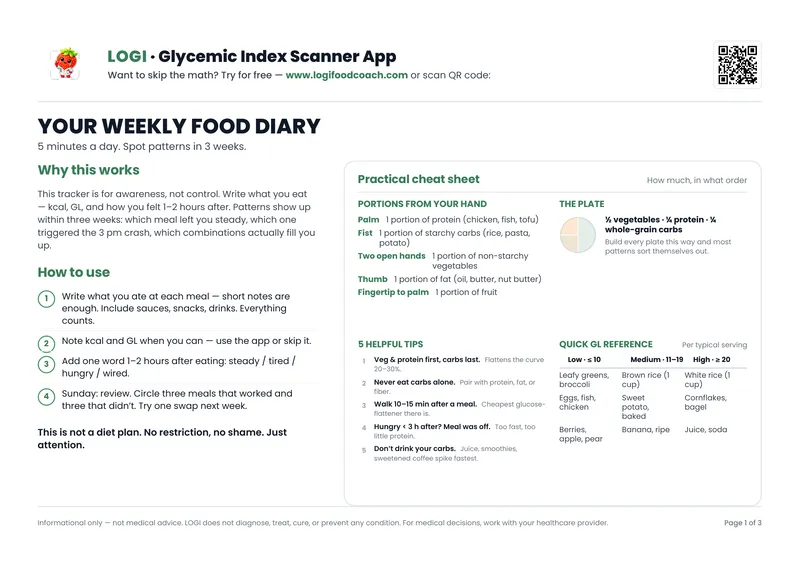
Free PDF — 3 pages
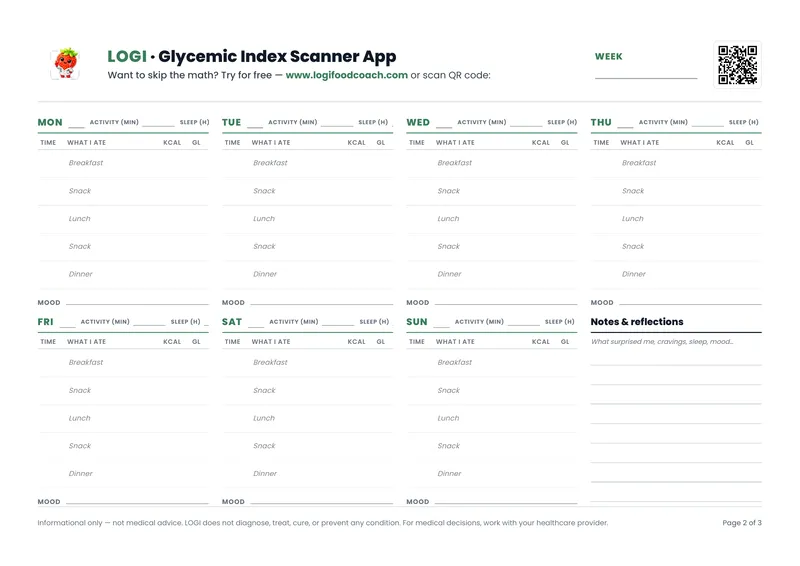
Your Weekly Food Journal
Track meals, glycemic load & mood. Spot patterns in 3 weeks.
No spam. Unsubscribe anytime.