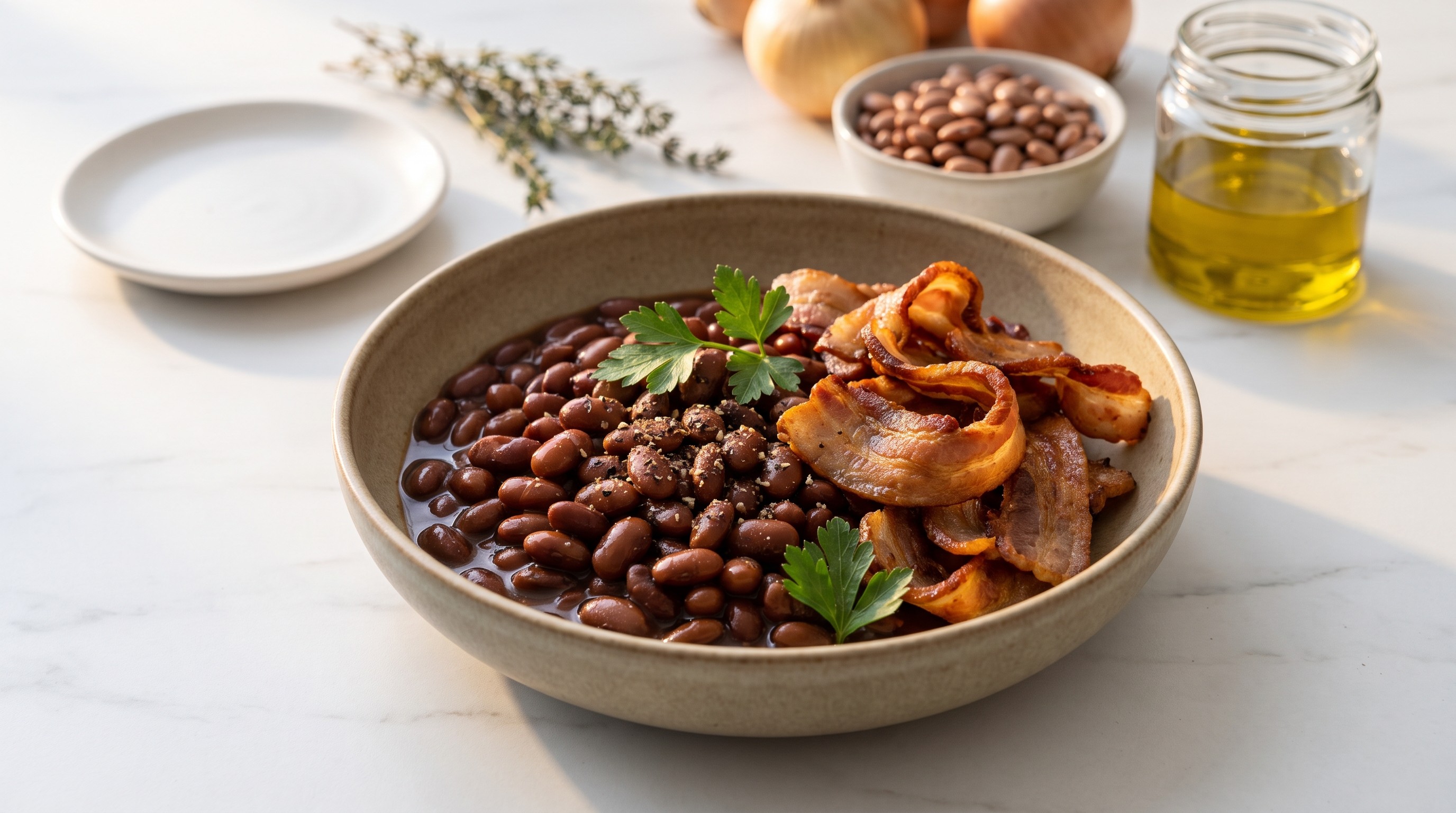
Low-GI Bruna Bönor med Stekt Fläsk
Swedish brown beans in a tangy sweet-sour sauce crowned with crispy pork belly — naturally low-GI, packed with soluble fibre, and steady on blood sugar.
Bruna bönor med stekt fläsk is one of Sweden's most beloved husmanskost dishes — humble home cooking that wraps you in comfort. Traditional versions lean on a heavy pour of dark syrup, sending blood sugar on a roller-coaster. This adaptation keeps the signature bitter-sweet character but slashes the sweetener to a single tablespoon of dark molasses, just enough for colour and depth without the glucose spike. The result is a dish that tastes authentic yet sits firmly in low-glycemic territory.
Brown beans are the nutritional hero here. With a glycemic index around 30–40 and a generous payload of soluble fibre, they form a gel-like matrix during digestion that slows glucose absorption to a steady trickle. Paired with rendered pork-belly fat and a knob of butter, the added lipids further blunt any post-meal rise. White wine vinegar delivers a second metabolic advantage: acetic acid has been shown to improve insulin sensitivity and flatten the glucose curve when consumed alongside carbohydrates. Together, the beans, fat, and acid create a textbook low-GI meal.
For the best blood-sugar outcome, serve the beans first and eat a few bites before the pork — fibre before protein is a well-studied sequencing trick that can reduce post-meal glucose by up to 30 percent. A side of lightly dressed bitter greens or a simple cucumber salad adds extra volume and micronutrients without raising the glycemic load. The dish reheats beautifully, and cold leftovers actually have a lower GI thanks to retrograde-resistant starch forming as the beans cool.
Blood Sugar Impact
Low impact expected — the combination of high-fiber beans (GI 34), protein and fat from pork belly, and the acetic acid in white wine vinegar all slow gastric emptying and glucose absorption, resulting in a gentle, sustained blood sugar rise with a moderate glycemic load of 12.1 per serving.
Blood Sugar Tips
- ✓ Serve with a side of non-starchy vegetables (e.g., a simple green salad or steamed broccoli) to add extra fiber and further blunt the glucose response.
- ✓ Take advantage of the vinegar already in the dish — if you enjoy it, add a splash more white wine vinegar to your portion, as 1-2 tablespoons of vinegar with a meal can reduce the postprandial glucose spike by up to 20-30%.
- ✓ Go easy on the dark molasses if adjusting the recipe, as it is the primary source of free sugars; keeping it modest preserves the dish's low-GI profile.
🥗 Ingredients
- 200 g Pork belly
- 480 g Brown beans
- 3 tbsp White wine vinegar
- 1 tbsp Dark molasses
- 1 pcs Bay leaf
- 100 ml Water
- 10 pcs Butter
- 0.5 tsp Salt
- 0.25 tsp Black pepper
- 7.1 oz Pork belly
- 1.1 lb Brown beans
- 3 tbsp White wine vinegar
- 1 tbsp Dark molasses
- 1 pcs Bay leaf
- 7 tbsp Water
- 10 pcs Butter
- 0.5 tsp Salt
- 0.25 tsp Black pepper
- 0.2 oz Flat-leaf parsley
👨🍳 Instructions
- 1
Place the pork belly strips in a large frying pan while it is still cold — starting from a cold pan lets the fat render slowly and evenly. Turn the heat to medium.
- 2
Cook the pork for 8 to 10 minutes, flipping the strips every couple of minutes, until they are deeply golden and crisp on both sides. The pan should hold a generous pool of rendered fat by this point.
- 3
Lift the crispy pork out with a slotted spoon and rest it on a plate lined with kitchen paper to drain. Leave all the rendered fat in the pan — it becomes the flavour base for the beans.
- 4
Drain and thoroughly rinse the brown beans under cold running water. Tip them into the pan with the pork fat and stir well so every bean is coated in a thin, glossy layer.
- 5
Pour in the white wine vinegar, dark molasses, and water. Drop in the bay leaf and stir gently to combine. Bring the liquid to a gentle simmer.
- 6
Let the beans cook uncovered at a low simmer for 12 to 15 minutes, stirring from time to time, until the liquid has reduced into a thin, glossy sauce that clings to the beans rather than pooling at the bottom.
- 7
Fish out and discard the bay leaf. Stir in the butter until it melts into the sauce, then season with salt and pepper. Taste and add a small splash of extra vinegar if the sweet-sour balance needs sharpening.
- 8
Divide the beans between two shallow bowls. Pile the crispy pork belly generously on top and finish with a scattering of roughly chopped parsley. Serve immediately while the pork is still crunchy.
📊 Nutrition Per Serving
| Per Serving | Whole Dish | |
|---|---|---|
| Calories | 789 | 1578 |
| Carbs | 36g | 71g |
| Sugars | 2g | 3g |
| Natural Sugars | 2g | 3g |
| Protein | 25g | 50g |
| Fat | 58g | 117g |
| Saturated Fat | 22g | 44g |
| Unsaturated Fat | 35g | 69g |
| Fiber | 12g | 25g |
| Soluble Fiber | 4g | 8g |
| Insoluble Fiber | 8g | 16g |
| Sodium | 1223mg | 2447mg |
Predicted Glucose Response
What if you...
Estimated model — individual responses vary. Not medical advice.
🔄 Lower GI Swaps
Canned beans have a significantly higher GI (52–65) than home-cooked dried beans (25–35) because the canning process breaks down resistant starch that otherwise slows glucose absorption. Black soybeans have an exceptionally low GI (~16) due to their high protein-to-carb ratio. Switching lowers the overall GL of the dish substantially.
Dark molasses has a moderate GI (~55) and is a concentrated sugar source. Yacon syrup (GI ~1) is rich in fructooligosaccharides that are not digested as glucose. Blackstrap molasses used at half the quantity delivers the same depth of flavor with less sugar load. Monk fruit provides sweetness with zero glycemic impact.
While butter itself has negligible carbohydrates, replacing it with monounsaturated-fat-rich oils like olive or avocado oil has been shown to improve overall postprandial glucose response and insulin sensitivity when consumed as part of a meal, helping to flatten the blood sugar curve from the other ingredients.
🔬 The Science Behind This Recipe
The Science Behind This Recipe
This classic Swedish dish is a surprisingly smart choice for steady blood sugar, and the secret starts with the beans. Beans are one of nature's best low-glycemic foods, with a GI typically between 25–40. They're packed with both soluble fiber and plant-based protein, which work together to slow down how quickly your body breaks down carbohydrates into glucose. Think of soluble fiber as a gentle speed bump in your digestive tract — it forms a gel-like barrier that makes sugar absorb gradually rather than flooding your bloodstream all at once. With a GI of just 34, this dish releases energy at a slow, steady pace rather than causing the sharp spike-and-crash cycle that leaves you tired and hungry an hour later.
The pork belly plays a key supporting role here. Its combination of protein and fat further slows gastric emptying — the rate at which food leaves your stomach. When carbohydrates are eaten alongside fat and protein (as they naturally are in this dish), the glucose response is significantly blunted compared to eating those same carbs alone. This is why pairing strategies matter so much: a bowl of beans on its own is already gentle on blood sugar, but adding the pork belly makes it even steadier. The white wine vinegar is another quiet hero — research has shown that acetic acid can improve insulin sensitivity and reduce post-meal glucose levels by slowing starch digestion.
What really tells the story here is the glycemic load of 12.1 per serving. While GI measures how fast a food raises blood sugar, glycemic load factors in how much carbohydrate you're actually eating — and that's what matters on your plate. A GL under 10 is low and above 20 is high, putting this dish comfortably in the moderate-low range. To make the most of it, try eating any vegetables on your plate first, saving the beans and bread for last, and taking a 10–15 minute walk after your meal — small habits that can meaningfully smooth out your glucose response.
Related recipes
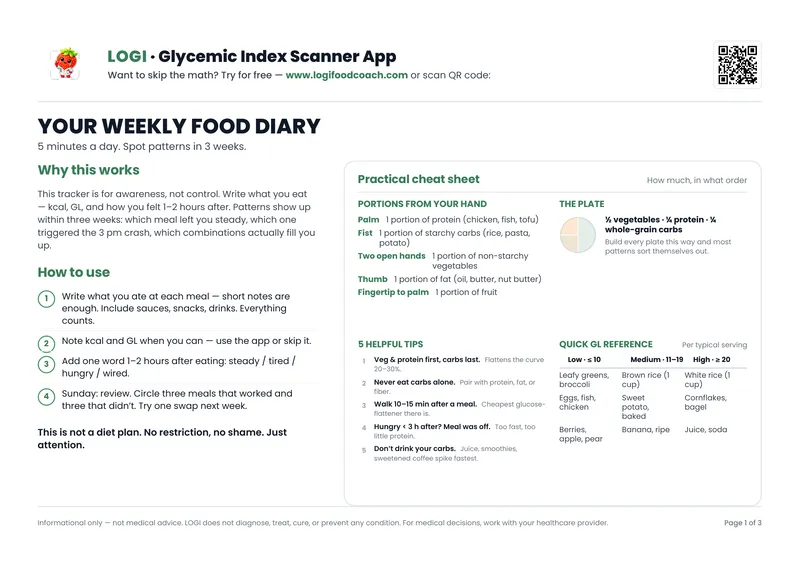
Free PDF — 3 pages
Your Weekly Food Journal
Track meals, glycemic load & mood. Spot patterns in 3 weeks.
No spam. Unsubscribe anytime.