Fiskegrateng uten Makaroni — Norwegian Fish and Dill Custard Gratin
Golden-topped Norwegian fish gratin where a silky egg custard replaces starchy macaroni — almost pure protein and fat for remarkably steady blood sugar.
Traditional Norwegian fiskegrateng is school-canteen comfort food, typically loaded with macaroni that sends blood glucose climbing. This clever rebuild strips out the pasta entirely and lets a savoury egg-and-milk custard do the work instead. The result is a dish that is almost entirely protein and healthy fat — two macronutrients that have virtually no direct impact on blood sugar — while preserving every bit of the creamy, golden-crusted appeal of the original.
Cod is a near-perfect protein for glycemic management: extremely lean, easy to digest, and rich in iodine and selenium. Paired with eggs, butter, and Gouda cheese, the fat content slows gastric emptying, which means any trace of lactose from the milk enters the bloodstream gradually rather than in a spike. Fresh dill and lemon juice add brightness without adding sugar, and leeks contribute gentle sweetness along with prebiotic fibre that supports a healthy gut microbiome — itself a factor in long-term insulin sensitivity.
For the best blood-sugar response, serve this gratin alongside a generous portion of non-starchy vegetables — a cucumber-and-tomato salad or steamed broccoli eaten first. Starting your meal with fibre and protein before any carbohydrate is one of the most effective meal-sequencing strategies for keeping glucose flat. This dish is ready in about forty minutes with minimal hands-on effort, making it an ideal weeknight dinner that is as kind to your schedule as it is to your metabolism.
Blood Sugar Impact
Very low blood sugar impact expected, with a glycemic load of only 2.6 and an estimated GI of 20. This high-protein, high-fat dish will promote stable blood sugar and sustained energy for 3-4 hours.
Blood Sugar Tips
- ✓ Start with the leeks and vegetables on your plate before the fish and custard to front-load fiber intake.
- ✓ Pair with a side salad dressed in vinegar or extra lemon juice — acidity further blunts any minor glucose response.
- ✓ Avoid pairing with bread or potatoes on the side; if you want a starch, choose a small portion of boiled new potatoes (cooled slightly to increase resistant starch).
🥗 Ingredients
- 300 g Cod fillet
- 1 pcs Leek
- 20 g Butter
- 3 pcs Egg
- 150 ml Whole milk
- 10 g Dill
- 40 g Gouda cheese
- 1 tbsp Lemon juice
- 0.75 tsp Salt
- 0.25 tsp White pepper
- 10.6 oz Cod fillet
- 1 pcs Leek
- 0.7 oz Butter
- 3 pcs Egg
- 10 tbsp Whole milk
- 0.4 oz Dill
- 1.4 oz Gouda cheese
- 1 tbsp Lemon juice
- 0.75 tsp Salt
- 0.25 tsp White pepper
👨🍳 Instructions
- 1
Heat the oven to 200 °C (390 °F) with a rack in the centre position. Take about a third of the butter and use it to grease the inside of a shallow ovenproof dish, roughly 20 × 15 cm (8 × 6 inches).
- 2
Split the leek in half lengthwise, then slice it crosswise into thin half-moons. Melt the remaining butter in a frying pan over medium heat, add the leek, and cook gently for about 4 minutes, stirring occasionally, until soft and translucent but without any colour. Spread the softened leek in an even layer across the bottom of the prepared dish.
- 3
Pat the cod fillets thoroughly dry with paper towels — removing surface moisture helps the custard set properly. Cut the fish into roughly 3 cm (1¼-inch) chunks and season them all over with the salt and white pepper.
- 4
Arrange the seasoned fish pieces in a single layer on top of the leeks, leaving small gaps between the chunks so the custard can flow around them.
- 5
Chop most of the dill, setting aside a few small sprigs for finishing. In a bowl, whisk together the eggs, milk, lemon juice, and chopped dill until the mixture is smooth and evenly combined.
- 6
Pour the custard slowly and evenly over the fish — the liquid should come about three-quarters of the way up the chunks. Scatter the coarsely grated Gouda over the surface in a single, even layer.
- 7
Place the dish in the oven and bake for 22–25 minutes. The gratin is done when the cheese topping is deep golden brown and the custard has set firmly around the edges while still showing a slight wobble in the very centre — it will continue to firm up as it rests.
- 8
Remove the dish from the oven and let it rest on a wire rack for 3 minutes. Scatter the reserved dill sprigs over the top and serve straight from the dish. For the best blood-sugar response, plate a portion of non-starchy vegetables alongside and eat them first before the gratin.
📊 Nutrition Per Serving
| Per Serving | Whole Dish | |
|---|---|---|
| Calories | 490 | 980 |
| Carbs | 13g | 26g |
| Sugars | 9g | 17g |
| Natural Sugars | 9g | 17g |
| Protein | 52g | 104g |
| Fat | 25g | 50g |
| Saturated Fat | 13g | 25g |
| Unsaturated Fat | 11g | 23g |
| Fiber | 1g | 2g |
| Soluble Fiber | 0g | 1g |
| Insoluble Fiber | 1g | 2g |
| Sodium | 1271mg | 2542mg |
Predicted Glucose Response
What if you...
Estimated model — individual responses vary. Not medical advice.
🔄 Lower GI Swaps
Whole milk contains lactose, a natural sugar (GI ~27-31) that contributes the bulk of this recipe's glycemic load. Unsweetened almond milk (GI ~25, near-zero carbs) or diluted heavy cream provides the custard texture with significantly fewer blood-sugar-raising carbohydrates per serving.
Leeks contain roughly 14 g carbohydrate per 100 g (GI ~15). Spinach (~1.4 g carbs/100 g, GI ~15), zucchini (~3.1 g carbs/100 g, GI ~15), and celery (~3 g carbs/100 g, GI ~15) all deliver far fewer total carbohydrates, lowering the glycemic load of the dish while still providing mild savory flavor in the gratin.
Gouda retains small amounts of residual milk sugar (~2 g carbs per 100 g). Long-aged cheeses like Parmesan (~0 g carbs/100 g) and sharp aged cheddar (~0.5 g carbs/100 g) have had nearly all lactose converted during aging, making their glycemic contribution effectively zero while still delivering a rich, golden gratin crust.
🔬 The Science Behind This Recipe
The Science Behind This Recipe
This Norwegian gratin is a naturally blood-sugar-friendly meal, and it comes down to what's *not* on the plate as much as what is. With no pasta, bread, or starchy fillers, the glycemic load clocks in at just 2.6 per serving — remarkably low. Glycemic load matters more than glycemic index alone because it accounts for how much carbohydrate you're actually eating, not just how fast a food raises blood sugar in theory. A tiny amount of a high-GI food can be harmless, while a mountain of a medium-GI food can cause a significant spike. Here, there's simply very little carbohydrate to spike anything.
Cod is the star player for steady blood sugar. It's almost pure protein with virtually no carbohydrates, and protein triggers a slow, measured insulin response rather than the sharp surge that starchy foods cause. When you combine that protein with the fat from butter, egg yolks, and whole milk, you create a meal that digests gradually — like a slow-release capsule instead of an instant hit. Fat slows gastric emptying, meaning nutrients trickle into your bloodstream over hours rather than flooding in all at once. The eggs pull double duty here, contributing both protein and healthy fats to this built-in buffering system.
Leeks are the quiet hero. As an allium vegetable, they provide prebiotic fiber that feeds beneficial gut bacteria and further slows digestion. If you're serving this gratin alongside any carbohydrate — a slice of sourdough bread, for instance — try eating a few bites of vegetables or salad first. Research suggests that eating fiber and protein before carbohydrates can reduce post-meal glucose spikes by up to 30–40%. A short 10-to-15-minute walk after dinner works beautifully too, helping your muscles absorb circulating glucose. This dish makes blood sugar management effortless — it's engineered by tradition to keep you satisfied and steady.
Related recipes
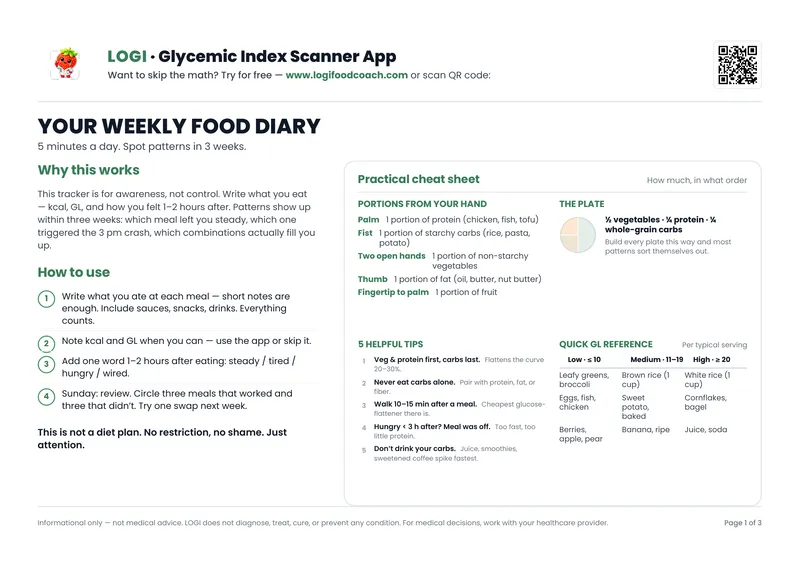
Free PDF — 3 pages
Your Weekly Food Journal
Track meals, glycemic load & mood. Spot patterns in 3 weeks.
No spam. Unsubscribe anytime.