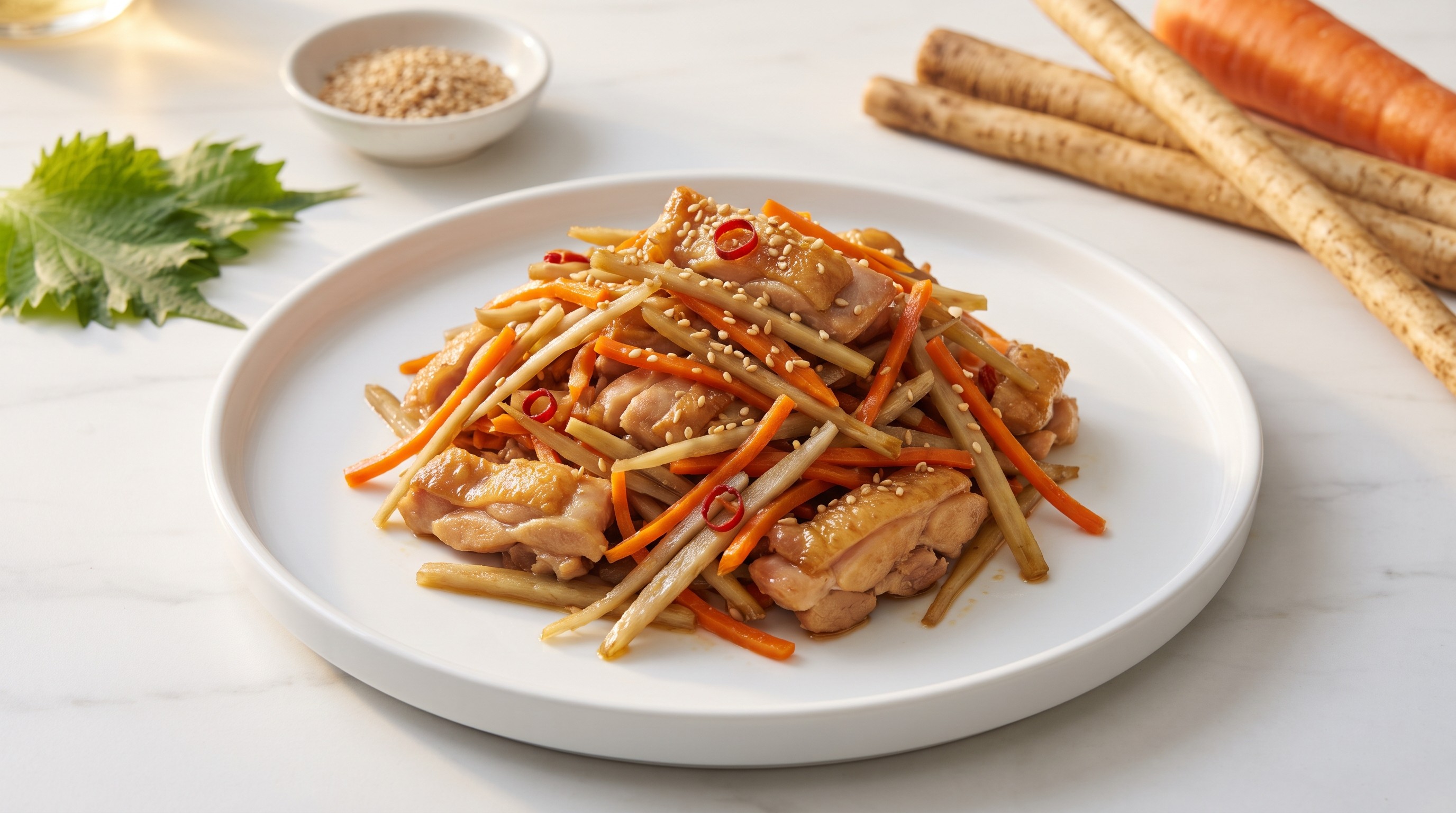
Kinpira Gobo with Chicken Thigh
Soy-glazed chicken thigh stir-fried with julienned burdock and carrot — packed with prebiotic inulin fibre for a blood-sugar-friendly Japanese dinner.
Kinpira gobo is one of Japan's most beloved home-cooked side dishes, built on the earthy crunch of burdock root braised with soy and sesame. This version promotes the classic accompaniment to a full dinner plate by adding sliced chicken thigh, whose protein and fat further slow glucose absorption and keep you satisfied for hours. Burdock root is the real star for blood sugar management: it is one of the richest natural sources of inulin, a soluble prebiotic fibre that resists digestion entirely and feeds beneficial gut bacteria instead of spiking glucose.
The traditional kinpira glaze relies on generous amounts of mirin and sugar to create its signature lacquer, but here the sweetener is dialled back to just two teaspoons of mirin — enough to round the edges of the soy sauce without any meaningful glycemic load. The natural sugars in the julienned carrot fill the sweetness gap beautifully once they caramelise over high heat. Sesame oil and toasted sesame seeds add healthy fats that further blunt any post-meal glucose rise.
For the best blood sugar response, serve this dish on its own or alongside a small portion of cauliflower rice rather than white rice. Eating the burdock and carrot first — before the chicken — gives the fibre a head start in your stomach, forming a gel-like barrier that slows the absorption of everything that follows. The entire meal comes together in under thirty minutes, making it an ideal weeknight option when you want something deeply flavourful without compromising your glycemic goals.
Blood Sugar Impact
Moderate, gradual blood sugar rise due to the low GI (40) and moderate glycemic load (16). Burdock root is rich in inulin fiber and the chicken thigh provides protein and fat, which together slow glucose absorption and support stable energy for 3-4 hours.
Blood Sugar Tips
- ✓ Eat the burdock and carrot first before the chicken to front-load fiber, which slows gastric emptying and blunts the glucose curve.
- ✓ Be mindful of mirin quantity — it contains sugars that contribute to the glycemic load; substituting part of it with rice vinegar can lower the GL without sacrificing flavor.
- ✓ Take a 10-15 minute walk after eating to enhance glucose uptake by muscles and further flatten any post-meal rise.
🥗 Ingredients
- 300 g Chicken thigh
- 300 g Burdock root
- 200 g Carrot
- 1 tbsp Sesame oil
- 1.5 tbsp Soy sauce
- 2 tsp Mirin
- 0.5 tsp Red chili flakes
- 1 tbsp Toasted sesame seeds
- 10.6 oz Chicken thigh
- 10.6 oz Burdock root
- 7.1 oz Carrot
- 1 tbsp Sesame oil
- 1.5 tbsp Soy sauce
- 2 tsp Mirin
- 0.5 tsp Red chili flakes
- 1 tbsp Toasted sesame seeds
👨🍳 Instructions
- 1
Scrub the burdock root thoroughly under cold running water, keeping the skin intact — it carries much of the earthy flavour and extra fibre. Cut the burdock into thin matchsticks roughly 5 cm long and transfer them straight into a bowl of cold water to stop them from oxidising and turning dark.
- 2
Peel the carrot and julienne it into matchsticks the same size as the burdock so everything cooks evenly. Set aside. Slice the chicken thigh across the grain into strips about 5 mm wide.
- 3
Place a large frying pan or wok over high heat and add the sesame oil. Once the oil shimmers and just begins to smoke, lay the chicken strips in a single layer and sear without moving for about 1–2 minutes until the underside turns golden.
- 4
Flip the chicken pieces and sear the other side for another 1–2 minutes until golden brown on both sides. Push the chicken to the edges of the pan to make room in the centre.
- 5
Drain the burdock well and shake off excess water. Add the burdock and carrot matchsticks to the centre of the pan and stir-fry over high heat for 3–4 minutes, tossing frequently. The vegetables should soften slightly but keep a pleasant firm bite.
- 6
Pour in the soy sauce and mirin, then sprinkle in the red chili flakes. Toss everything together so the chicken and vegetables are evenly coated in the sauce.
- 7
Continue cooking for about 2 minutes, stirring constantly, until the liquid reduces into a thin, glossy glaze that clings to every piece. The pan should be nearly dry with no pooling liquid remaining.
- 8
Remove the pan from the heat and scatter the toasted sesame seeds over the top. Toss once more and serve immediately. For the best blood sugar response, eat the burdock and carrot pieces first before the chicken.
📊 Nutrition Per Serving
| Per Serving | Whole Dish | |
|---|---|---|
| Calories | 609 | 1218 |
| Carbs | 40g | 79g |
| Sugars | 11g | 22g |
| Added Sugars | 1g | 2g |
| Natural Sugars | 10g | 20g |
| Protein | 40g | 80g |
| Fat | 33g | 65g |
| Saturated Fat | 8g | 15g |
| Unsaturated Fat | 22g | 44g |
| Fiber | 9g | 17g |
| Soluble Fiber | 3g | 5g |
| Insoluble Fiber | 6g | 12g |
| Sodium | 930mg | 1859mg |
Predicted Glucose Response
What if you...
Estimated model — individual responses vary. Not medical advice.
🔄 Lower GI Swaps
Burdock root has a moderate glycemic index (GI ~45) due to its starch content and contributes meaningfully to the dish's glycemic load. Daikon radish (GI ~15), celeriac (GI ~35), and jicama (GI ~30) all provide a similar crunchy, earthy root-vegetable texture with significantly fewer blood-sugar-raising carbohydrates per serving.
Mirin is essentially a sweet rice wine containing 40-50% sugar, giving it a very high glycemic index (GI ~70+). It is one of the largest hidden sugar contributors in this dish. Replacing it with rice vinegar or sake plus a zero-glycemic sweetener preserves the tangy-sweet glaze character while eliminating the blood sugar spike.
Cooked carrots have a moderate-to-high glycemic index (GI 55-65 when stir-fried) and their natural sugars caramelize during the kinpira sauté, concentrating their glycemic impact. Green beans (GI ~15), zucchini (GI ~15), and bell peppers (GI ~15) offer comparable color and crunch with a fraction of the glycemic load.
Standard soy sauce contains a small amount of residual sugars from wheat fermentation. Coconut aminos, while mildly sweet, has a lower glycemic index (GI ~35 vs. soy sauce's ~40-45) and pairs with the other swaps to further reduce the dish's overall glycemic load. The impact per serving is modest but contributes to cumulative reduction.
🔬 The Science Behind This Recipe
This dish is a masterclass in blood sugar-friendly cooking, and burdock root (gobo) is the star of the show. Burdock is rich in inulin, a type of soluble fiber that slows down how quickly your body breaks down and absorbs carbohydrates. Think of it like a natural speed bump for sugar entering your bloodstream — instead of a sharp spike, you get a gentle, gradual rise. Carrots add additional fiber to the mix, and while they sometimes get a bad reputation for their sweetness, the amount used here keeps the overall glycemic load at a moderate 16 per serving. That's an important distinction: glycemic load accounts for how much carbohydrate you're actually eating, not just how fast a food raises blood sugar in theory. A small portion of a higher-GI food can be perfectly manageable — it's the total load that matters most.
The chicken thigh brings both protein and healthy fat to the plate, two nutrients that work together to further slow digestion. When protein and fat arrive in your stomach alongside carbohydrates, they signal your body to take its time processing everything. Sesame oil adds another layer of beneficial fat, giving the dish that nutty richness while also helping to flatten your glucose curve. This combination of fiber, protein, and fat is exactly what nutritionists recommend for steady, sustained energy.
To get the most from this meal, try eating the burdock and carrots first before moving on to any rice or noodles you might serve alongside. A short 10–15 minute walk after eating can also help your muscles absorb glucose more efficiently. Small habits like these, paired with naturally balanced dishes like kinpira gobo, make managing your blood sugar feel effortless rather than restrictive.
Related recipes
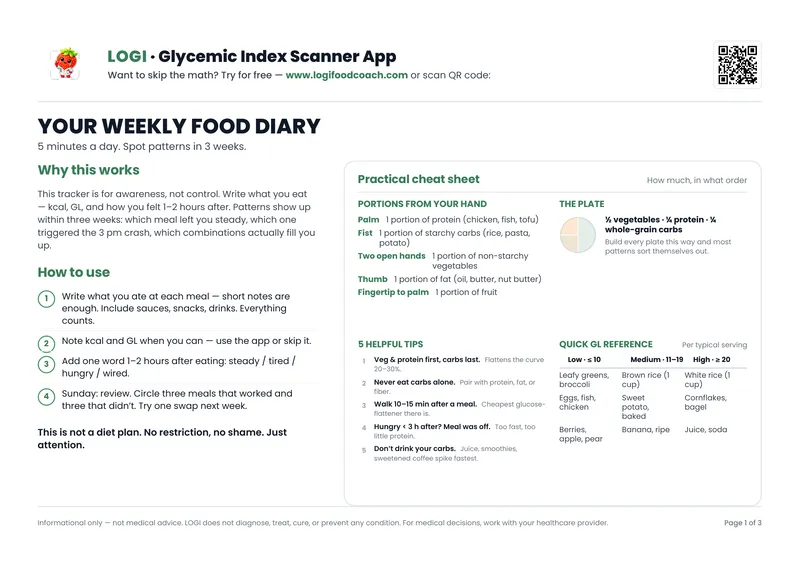
Free PDF — 3 pages
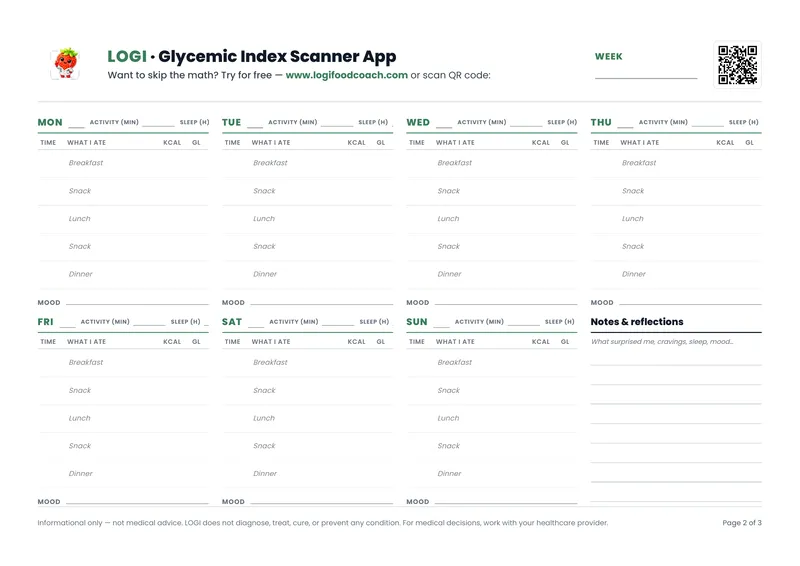
Your Weekly Food Journal
Track meals, glycemic load & mood. Spot patterns in 3 weeks.
No spam. Unsubscribe anytime.