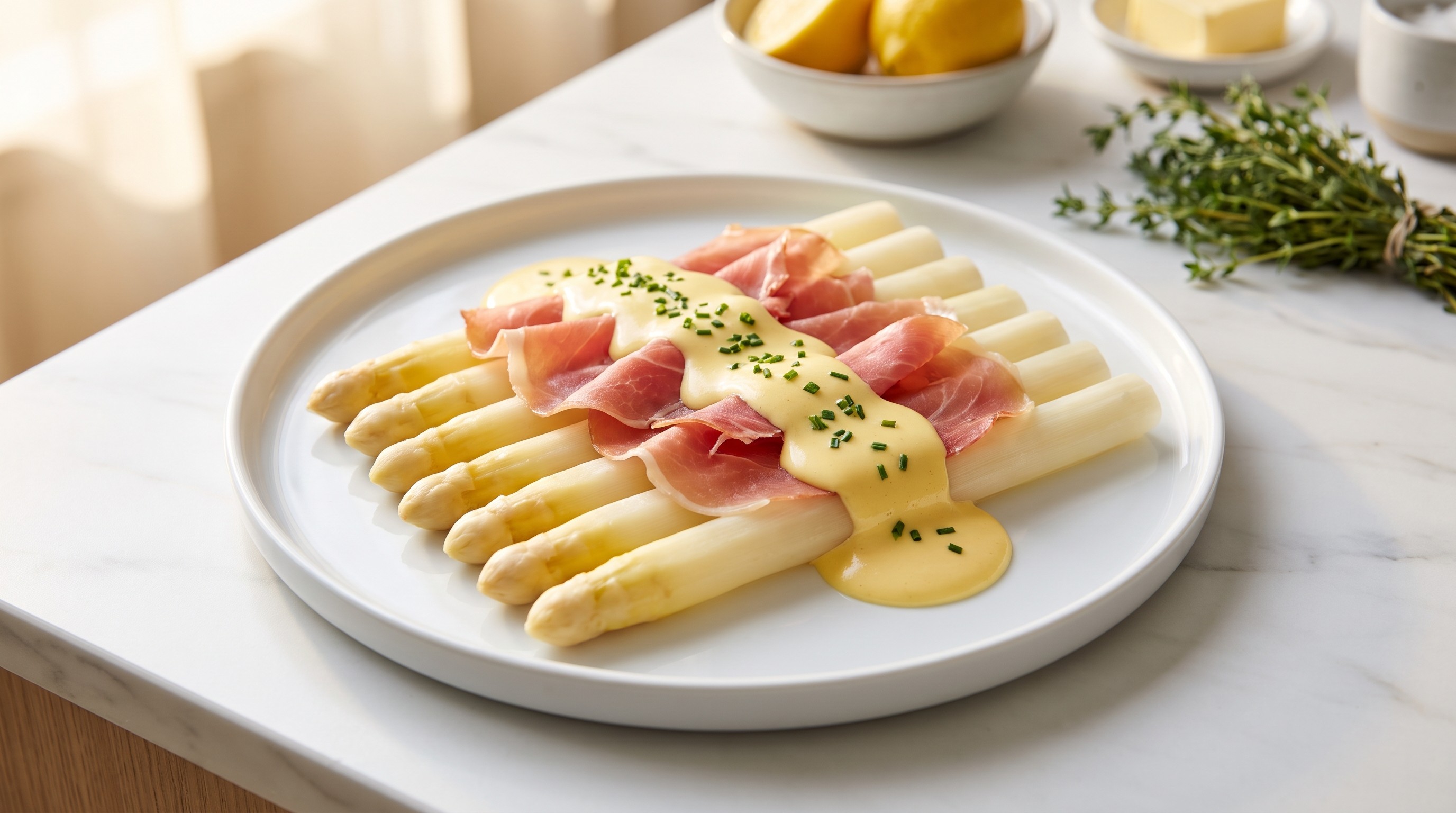
White Asparagus with Air-Dried Ham and Blender Hollandaise
Tender white asparagus draped with Schwarzwälder ham and a silky two-minute hollandaise — almost zero-carb, keeping blood sugar perfectly steady.
This classic German Spargelplatte is a naturally blood-sugar-friendly masterpiece. White asparagus, air-dried ham, and a rich blender hollandaise come together in under 25 minutes for an elegant plate that is nearly carb-free. Unlike the traditional version — which includes boiled potatoes — this streamlined take stays in deeply low-glycemic territory, delivering satisfaction through quality protein and healthy fats rather than starchy sides.
White asparagus is a nutritional standout for anyone monitoring glucose. With only about 3 g of net carbs per 100 g and a GI well below 20, it provides fibre, folate, and vitamins A and K without any measurable blood-sugar impact. The Schwarzwälder Schinken (Black Forest ham) contributes protein that further blunts any residual glucose response, while the butter-and-egg-yolk hollandaise adds satiating fat that slows gastric emptying — a proven mechanism for flattening post-meal glucose curves.
The tiny amount of sugar in the cooking water is a traditional German technique that softens any bitterness in the spears; virtually none of it is absorbed by the asparagus, and the cooking liquid is discarded. Finish the plate with a bright squeeze of lemon in the hollandaise and a scatter of fresh chives, and you have a meal that feels indulgent yet leaves your blood sugar virtually unchanged. For optimal glucose response, eat the asparagus spears first before the richer hollandaise and ham — vegetables before fat and protein is a well-studied sequencing strategy that minimises glucose spikes.
Blood Sugar Impact
Very minimal blood sugar impact expected. With a glycemic load of just 4.2 and a GI of 31, this protein-and-fat-rich dish built around low-carb asparagus should produce a flat, stable glucose response with sustained energy for 3-4 hours.
Blood Sugar Tips
- ✓ Start by eating the asparagus spears first — their fiber (especially inulin, a prebiotic) slows gastric emptying and blunts any minor glucose rise from the small amount of sugar used in cooking.
- ✓ Skip any bread basket or potato side that traditionally accompanies this dish — the meal is already satisfying thanks to the fat in hollandaise and protein in the ham, and adding starch would dramatically raise the glycemic load.
- ✓ Take a gentle 10-15 minute walk after eating to further flatten your glucose curve and enhance insulin sensitivity.
🥗 Ingredients
- 500 g White asparagus
- 4 g Salt
- 1 tsp Sugar
- 100 g Unsalted butter
- 2 pcs Egg yolk
- 1 tbsp Lemon juice
- 80 g Air-dried ham
- 5 g Chives
- 1.1 lb White asparagus
- 0.1 oz Salt
- 1 tsp Sugar
- 3.5 oz Unsalted butter
- 2 pcs Egg yolk
- 1 tbsp Lemon juice
- 2.8 oz Air-dried ham
- 0.2 oz Chives
👨🍳 Instructions
- 1
Using a vegetable peeler, peel each asparagus spear from just beneath the tip all the way down to the base in long, even strokes. Trim off the bottom 1–2 cm of each spear where the flesh is woody and fibrous.
- 2
Fill a wide, shallow pot with enough water to submerge the asparagus in a single layer. Bring the water to a rolling boil over high heat, then stir in the salt and sugar until dissolved.
- 3
Gently lower the asparagus spears into the pot in a flat layer. Reduce the heat to a gentle simmer and cook for 12–15 minutes, until a knife slides easily into the thickest part of a spear just below the tip. The asparagus should be tender but not mushy.
- 4
While the asparagus simmers, melt the butter in a small saucepan over medium heat. Allow it to become fully liquid and very hot — you should see gentle wisps of steam — but do not let it brown or foam excessively.
- 5
Place the egg yolks and lemon juice in a blender. Blend on medium speed for about 10 seconds until the yolks lighten slightly in colour.
- 6
With the blender still running, pour the hot melted butter through the opening in a thin, steady stream. Continue blending for approximately 30 seconds until the hollandaise emulsifies into a thick, pale-gold sauce. Season with a pinch of salt if desired.
- 7
Lift the asparagus from the pot with tongs and let it drain thoroughly on a clean kitchen towel or tilted plate for a moment — excess water will thin the hollandaise.
- 8
Divide the asparagus between two warmed plates. Drape the slices of air-dried ham alongside the spears, spoon the hollandaise generously over the asparagus, and finish with a scattering of freshly snipped chives. Serve immediately.
📊 Nutrition Per Serving
| Per Serving | Whole Dish | |
|---|---|---|
| Calories | 520 | 1039 |
| Carbs | 14g | 27g |
| Sugars | 7g | 13g |
| Added Sugars | 3g | 6g |
| Natural Sugars | 4g | 8g |
| Protein | 16g | 32g |
| Fat | 47g | 94g |
| Saturated Fat | 28g | 55g |
| Unsaturated Fat | 19g | 37g |
| Fiber | 5g | 11g |
| Soluble Fiber | 2g | 3g |
| Insoluble Fiber | 4g | 8g |
| Sodium | 1274mg | 2548mg |
Predicted Glucose Response
What if you...
Estimated model — individual responses vary. Not medical advice.
🔄 Lower GI Swaps
Although the sugar is used only in the cooking water and virtually none is absorbed by the asparagus, substituting with allulose, erythritol, or stevia eliminates even trace glycemic impact while still softening any bitterness in the white asparagus spears.
🔬 The Science Behind This Recipe
White asparagus is one of the most blood-sugar-friendly vegetables available, containing roughly 3 g of net carbohydrates per 100 g and carrying a glycemic index well below 20. Because the carbohydrate content is so low, even a generous 250 g serving contributes minimal glucose to the bloodstream. The fibre in asparagus further slows the absorption of what little sugar is present, creating a gentle, almost flat glucose curve after eating.
The hollandaise sauce plays a surprisingly helpful role in blood sugar management. Dietary fat — here from butter and egg yolks — slows gastric emptying, the rate at which food leaves the stomach and enters the small intestine. Research consistently shows that adding fat to a meal delays glucose absorption and reduces the post-meal blood sugar peak. The egg yolks also supply protein, which stimulates a modest insulin response that helps cells take up glucose more efficiently without causing a spike.
Air-dried ham contributes high-quality protein with virtually zero carbohydrates. Protein triggers the release of incretin hormones such as GLP-1, which enhance insulin secretion in a glucose-dependent manner — meaning they help only when blood sugar is elevated, avoiding hypoglycaemia. The combination of protein and fat alongside a very low-carb vegetable is one of the most effective meal compositions for keeping post-meal glucose stable. The tiny pinch of sugar in the cooking water is a traditional technique to reduce bitterness; nearly all of it remains in the discarded cooking liquid, contributing negligible glucose to the finished dish.
Related recipes
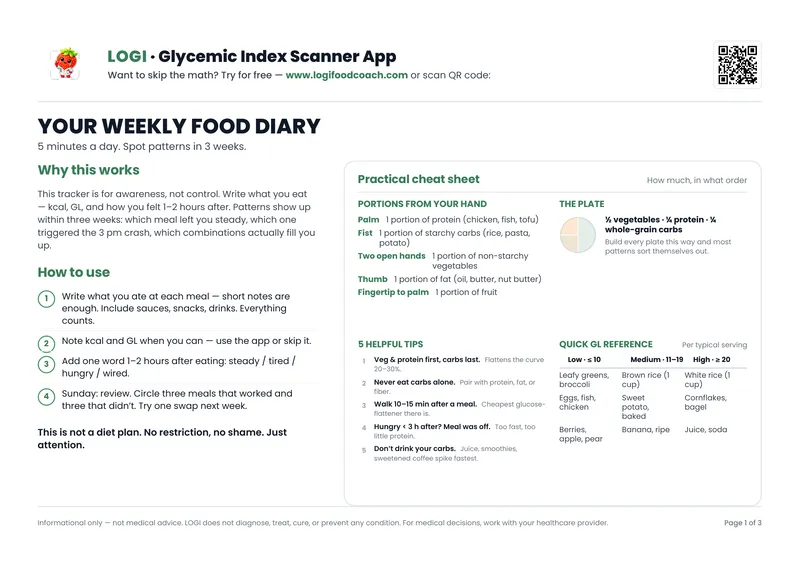
Free PDF — 3 pages
Your Weekly Food Journal
Track meals, glycemic load & mood. Spot patterns in 3 weeks.
No spam. Unsubscribe anytime.