Low-GI Beef Stroganoff with Celeriac Mash
Seared sirloin and golden mushrooms in a tangy sour cream-mustard sauce over buttery celeriac mash, a steady-glucose take on the classic.
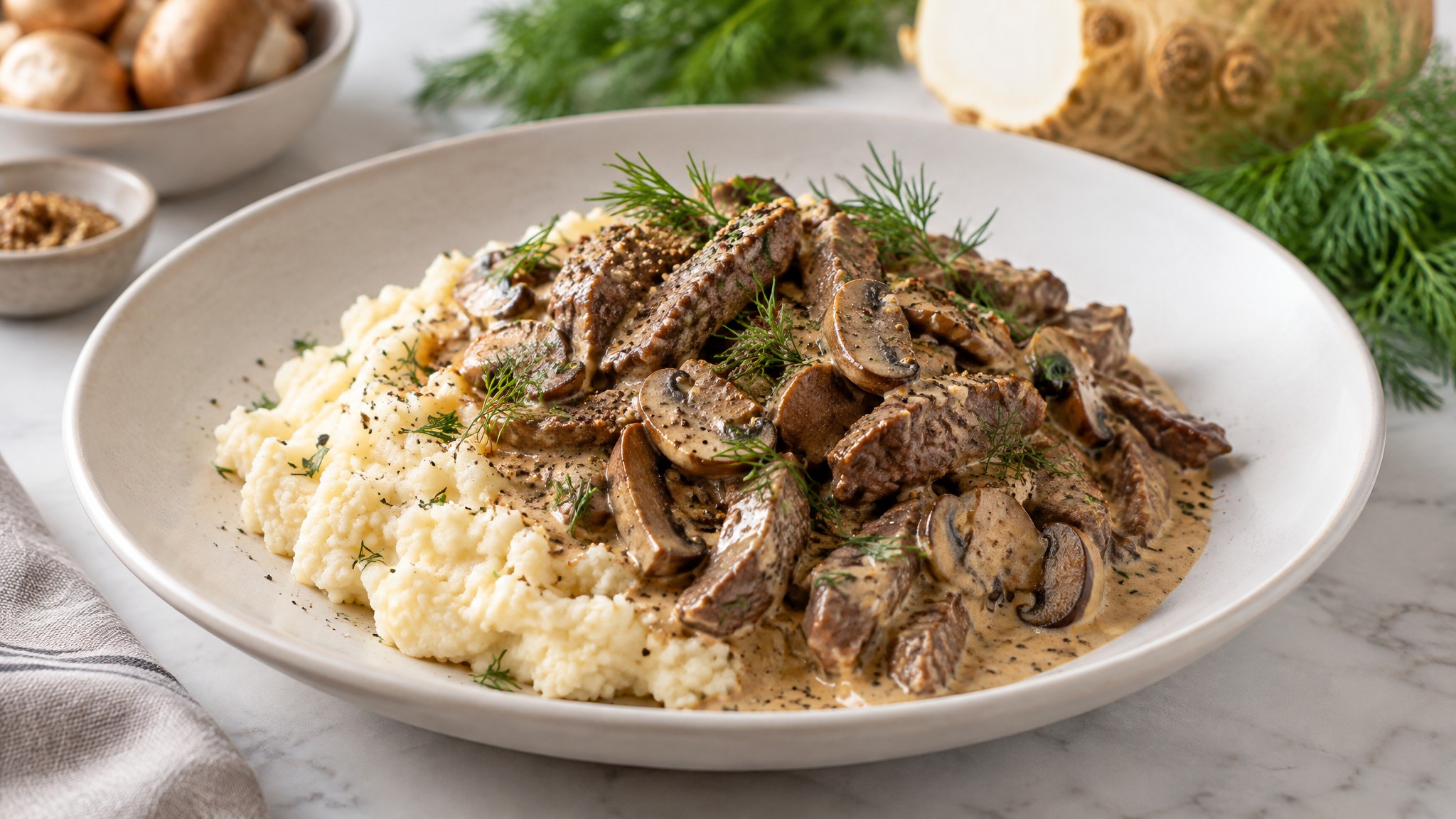
This beef stroganoff stays close to the Russian original. Thin strips of sirloin are seared hard and fast so they stay pink and tender. Onions and cremini mushrooms are cooked down until they turn deeply golden. Everything is then folded into a silky sauce of smetana-style sour cream and Dijon mustard and finished with a handful of fresh dill. The sauce has no flour or cornstarch; it is thickened only by the sour cream and the reduced mushroom juices. It is rich, tangy and savoury, and it comes together in about 40 minutes, so it works well for a weeknight dinner for two.
The big change is what sits under the sauce. Stroganoff usually comes with egg noodles or fried potatoes, and both are refined, starchy bases that can push blood sugar up quickly. Here they are replaced with a buttery celeriac mash. Celeriac has roughly half the carbohydrate of potato and more fibre per gram. Once it is mashed with a little butter it has the same soft texture that soaks up the sauce, with a gentle celery-and-hazelnut flavour. Each serving has about 250 g of celeriac and 150 g of sirloin. Together with the fat in full-fat sour cream and butter and the fibre from the mushrooms and onion, this protein slows digestion and helps flatten the glucose curve after the meal.
For even steadier blood sugar, start with a simple green salad or some steamed green beans dressed in olive oil and lemon, then move on to the stroganoff. Eating vegetables first and protein next tends to soften the response to whatever carbohydrate follows. If you really miss the noodles, a small portion of about 40 g (dry weight) of whole-grain or legume pasta, cooked al dente, is a reasonable compromise. Regular egg noodles would raise the glycemic load a lot. Bring the sour cream to room temperature before you start and never let the sauce boil, or it can split. If you want to stretch the dish without adding starch, double the mushrooms. They add bulk and plenty of umami while keeping the meal firmly in low-glycemic territory.
Blood Sugar Impact
Low impact expected: the sirloin, fats, and sour cream slow digestion, and swapping potato for celeriac keeps the carbs low, so blood sugar should rise only gently. Energy should stay steady for about 3-4 hours.
Blood Sugar Tips
- ✓ Eat some of the mushrooms and beef before the celeriac mash, so protein and fiber reach your stomach first and slow down carb absorption.
- ✓ Add a side of non-starchy greens, such as a green salad with vinegar dressing or steamed green beans, for extra fiber.
- ✓ Take a 10-15 minute walk after the meal to help your muscles use glucose, and skip adding bread, rice, or egg noodles to the plate.
🥗 Ingredients
- 500 g Celeriac
- 1 tsp Salt
- 300 g Beef sirloin
- 0.5 tsp Black pepper
- 2 tsp Olive oil
- 20 g Butter
- 1 pcs Onion
- 250 g Cremini mushroom
- 2 tsp Dijon mustard
- 120 g Sour cream
- 10 g Dill
- 1.1 lb Celeriac
- 1 tsp Salt
- 10.6 oz Beef sirloin
- 0.5 tsp Black pepper
- 2 tsp Olive oil
- 0.7 oz Butter
- 1 pcs Onion
- 8.8 oz Cremini mushroom
- 2 tsp Dijon mustard
- 4.2 oz Sour cream
- 0.4 oz Dill
👨🍳 Instructions
- 1
Peel the celeriac (500 g) with a sharp knife, removing all the knobbly skin and roots, and cut it into 2–3 cm (about 1 in) cubes. Peel and thinly slice the onion, slice the cremini mushrooms (250 g) about 5 mm thick, and finely chop 2 tbsp of fresh dill. Take 120 g of full-fat sour cream out of the fridge so it can come to room temperature.
- 2
Put the celeriac cubes in a saucepan and cover them with cold water. Add ½ tsp salt, bring to the boil and simmer for 15–18 minutes, until a knife slips through a cube with no resistance.
- 3
While the celeriac cooks, cut the sirloin (300 g, about 150 g per serving) across the grain into strips about 1 cm (½ in) thick. Pat the strips thoroughly dry with paper towels, then season them with ¼ tsp salt and the black pepper (½ tsp).
- 4
Heat the olive oil (2 tsp) in a large skillet over high heat until it shimmers. Lay the beef in a single layer and sear for about 1 minute per side, until browned outside but still pink inside. Work in two batches if needed so the pan is not crowded. Move the beef to a plate and keep any juices.
- 5
Lower the heat to medium and add 10 g of the butter and the sliced onion. Cook for about 4 minutes, stirring now and then, until softened. Add the mushrooms and the remaining ¼ tsp salt, spreading them out so they are not crowded. Use a wider pan or brown them in two batches if needed, because crowded mushrooms steam instead of browning. Cook for 6–8 minutes, until their liquid has cooked off and they are deeply browned. Good browning adds a lot of flavour, so you can use less onion if you prefer.
- 6
Drain the celeriac and set aside 60 ml (¼ cup) of the cooking water. Mash the celeriac with the remaining 10 g butter, adding a splash of the reserved water, until smooth and fluffy. Cover to keep warm.
- 7
Take the skillet off the heat and let it cool for a minute. Stir in 1 tbsp Dijon mustard, the room-temperature sour cream (120 g) and 2–3 tbsp of the reserved cooking water to make a creamy sauce. If you are using Greek yogurt instead of sour cream, it must go in off the heat like this, because yogurt curdles even faster than sour cream if it gets too hot. Return the beef and its juices to the pan.
- 8
Put the skillet back over low heat and warm through for 1–2 minutes, stirring gently. Do not let it simmer or boil, or the sour cream (or yogurt) may split. Taste and adjust the seasoning. Spoon the stroganoff over the celeriac mash and scatter with the chopped dill. For a gentler glucose response, serve after a green salad or a side of steamed green beans.
📊 Nutrition Per Serving
| Per Serving | Whole Dish | |
|---|---|---|
| Calories | 733 | 1465 |
| Carbs | 32g | 64g |
| Sugars | 8g | 17g |
| Natural Sugars | 8g | 17g |
| Protein | 47g | 94g |
| Fat | 47g | 94g |
| Saturated Fat | 21g | 42g |
| Unsaturated Fat | 26g | 52g |
| Fiber | 6g | 11g |
| Soluble Fiber | 2g | 3g |
| Insoluble Fiber | 4g | 8g |
| Sodium | 1588mg | 3176mg |
Predicted Glucose Response
What if you...
Estimated model — individual responses vary. Not medical advice.
🔄 Lower GI Swaps
Egg noodles and potatoes are refined, high-GI starches that would raise the glycemic load a lot. Celeriac has about half the carbohydrate of potato. A small portion of al dente whole-grain or legume pasta is a reasonable compromise because its higher fibre and protein slow digestion.
Cooking onions until deeply golden concentrates their natural sugars. Using half the onion and browning the mushrooms well keeps the savoury depth while trimming a few grams of carbohydrate.
Greek yogurt adds more protein and has slightly fewer carbohydrates. It curdles if it boils, so stir it in off the heat and only warm it gently. Crème fraîche is more heat-stable and adds richness with very little carbohydrate.
Flour and cornstarch are refined starches with a high GI. This recipe does not need them because the reduced pan juices and sour cream give a creamy sauce. If you want it thicker, a tiny amount of xanthan gum adds body with almost no digestible carbohydrate.
🔬 The Science Behind This Recipe
Classic stroganoff is served on egg noodles or potatoes, and both are dense, quickly digested starches that cause a sharp rise in blood sugar. Celeriac has a moderate glycemic index (about 35 when cooked, though some sources rate it higher), but it contains only about 7–9 g of carbohydrate per 100 g, compared with about 17 g in potato. Because glycemic load depends on both GI and the amount of carbohydrate eaten, the low carbohydrate density of celeriac matters most. At about 250 g of celeriac per serving, plus small contributions from the onion, mushrooms and sour cream, each serving has roughly 25–30 g of carbohydrate. That gives an estimated glycemic load of about 11 per serving (estimated GI 35, GI rating: low). The sauce contains no flour or cornstarch, so there is no hidden starch. About 150 g of sirloin per serving provides plenty of protein, and the fat from the sour cream and butter slows gastric emptying, so glucose from the meal enters the bloodstream gradually. Cooking the onion until golden concentrates its natural sugars slightly, but at one onion shared between two people the effect on glycemic load is negligible. Mushrooms add bulk, fibre and umami for very little carbohydrate. Eating a non-starchy side such as salad or green beans first adds fibre and volume, which can further reduce the after-meal glucose peak. Expected result: a gentle rise in blood sugar and steady energy for about 3–4 hours.
Related recipes

Free PDF — 3 pages
Your Weekly Food Journal
Track meals, glycemic load & mood. Spot patterns in 3 weeks.
No spam. Unsubscribe anytime.