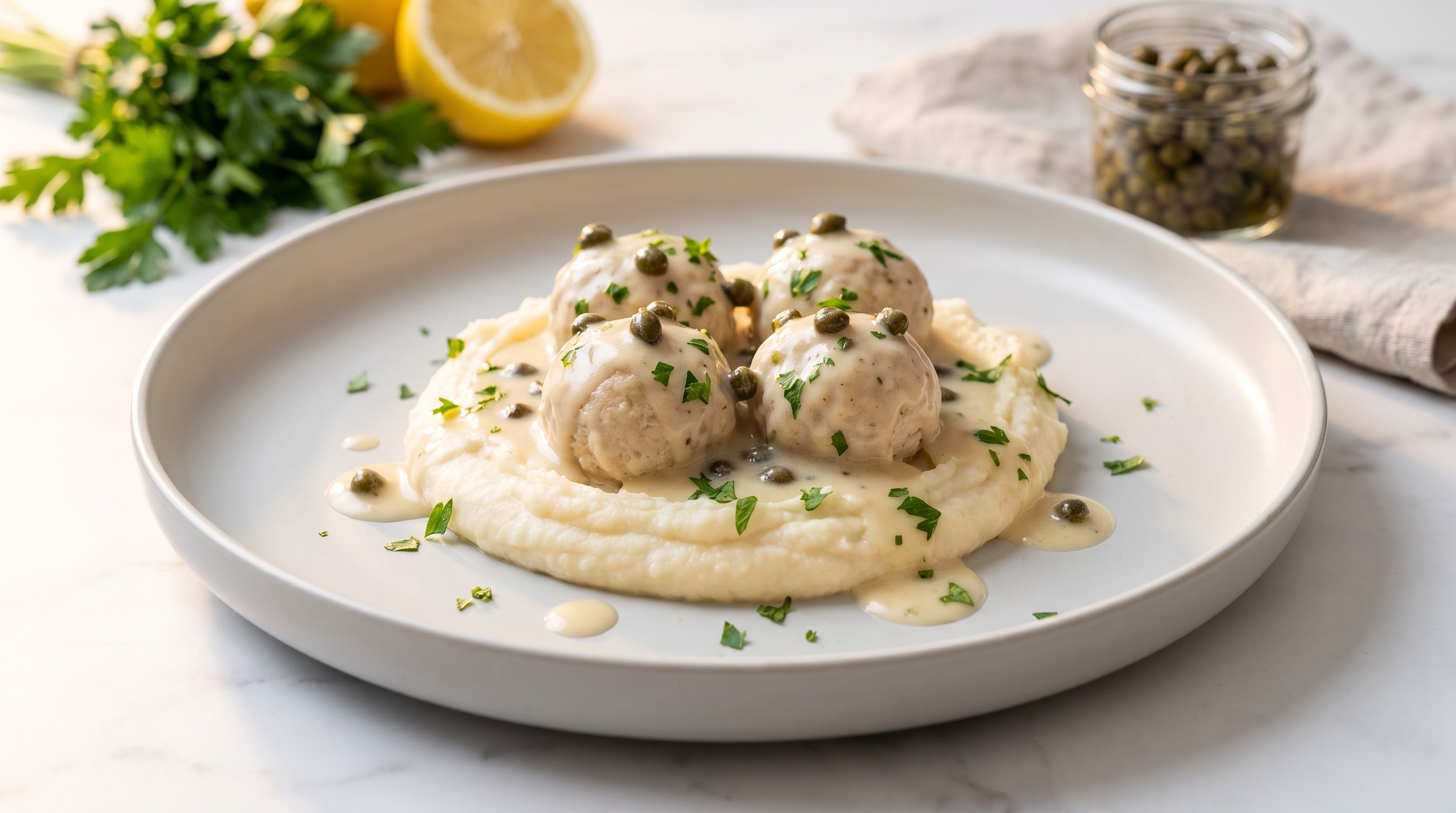
Königsberger Klopse in Caper Cream Sauce with Celeriac Mash
Tender pork meatballs poached in spiced broth, draped in a tangy caper-cream sauce and served over silky celeriac mash — low-GI German comfort food.
This faithful low-glycemic take on Königsberger Klopse — East Prussia's iconic meatball dish — preserves every defining flavour while sidestepping the glucose spikes hidden in the classic recipe. Almond meal replaces the traditional wheat-bread binder in the meatballs, a simple cream reduction takes the place of the flour-thickened roux, and celeriac mash stands in for boiled potatoes. Those three swaps eliminate the dish's main high-GI ingredients without sacrificing its soul: the savoury anchovy depth, the bright pop of capers and lemon, and the warming hum of allspice.
Celeriac is the star substitute here. With a glycemic index around 35 compared to roughly 78 for boiled potatoes, it delivers a similar creamy, starchy comfort while releasing glucose far more slowly. The generous fat from pork, butter, and cream further blunts the blood-sugar response, and the protein-rich meatballs ensure sustained satiety. For optimal glucose management, eat a few spoonfuls of the celeriac mash on its own before adding meatballs and sauce — the fibre-first approach primes your digestive system for a flatter post-meal curve.
Ready in 40 minutes and yielding two generous portions, this is weeknight-friendly comfort food that keeps blood sugar steady. Pair it with a small side salad dressed in vinegar to further moderate the glycemic response, and consider saving half a portion for a next-day lunch — reheated starches develop resistant starch, which lowers their effective GI even further.
Blood Sugar Impact
Very low blood sugar impact expected. With a glycemic load of 8.2 and GI of 37, the high protein from pork and egg combined with the fiber-rich celeriac mash (a smart low-GI swap for potato) and healthy fats from almond meal will produce a slow, gentle glucose rise and stable energy for 3-4 hours.
Blood Sugar Tips
- ✓ Eat the celeriac mash first — its fiber will form a gel-like layer in your stomach that slows absorption of everything that follows.
- ✓ Take a 10-15 minute walk after the meal to activate glucose uptake by your muscles and blunt any modest rise from the celeriac.
- ✓ Avoid drinking sugary beverages alongside this otherwise well-balanced low-glycemic meal — water, sparkling water, or unsweetened tea will preserve its excellent blood sugar profile.
🥗 Ingredients
- 300 g Celeriac
- 300 g Ground pork
- 1 pcs Egg
- 20 g Almond meal
- 30 g Onion
- 8 g Anchovy paste
- 4 g Salt
- 1 pcs Bay leaf
- 1 g Ground allspice
- 20 g Butter
- 150 g Heavy cream
- 20 g Capers
- 15 g Lemon juice
- 10 g Dijon mustard
- 5 g Parsley
- 10.6 oz Celeriac
- 10.6 oz Ground pork
- 1 pcs Egg
- 0.7 oz Almond meal
- 1.1 oz Onion
- 0.3 oz Anchovy paste
- 0.1 oz Salt
- 0.0 oz Ground white pepper
- 1 pcs Bay leaf
- 0.0 oz Ground allspice
- 0.7 oz Butter
- 5.3 oz Heavy cream
- 0.7 oz Capers
- 0.5 oz Lemon juice
- 0.4 oz Dijon mustard
- 0.2 oz Parsley
👨🍳 Instructions
- 1
Peel the celeriac, cut it into roughly 2 cm cubes, and place them in a medium saucepan. Cover with cold water, season with a pinch of salt, and set over high heat. Once boiling, lower the heat and simmer until the pieces are completely fork-tender, about 15 minutes.
- 2
While the celeriac simmers, prepare the meatball mixture. In a mixing bowl, combine the ground pork, egg, almond meal, finely grated onion, anchovy paste, a pinch of salt, and white pepper. Stir gently until everything is just incorporated — overworking the mixture will make the meatballs tough.
- 3
Dampen your hands with cold water and shape the mixture into 8 evenly sized balls. Wetting your hands prevents sticking and gives the meatballs a smoother surface, which helps them hold together during poaching.
- 4
Bring 700 ml of water to a gentle simmer in a wide saucepan. Add the bay leaf and ground allspice. Carefully lower the meatballs into the liquid one at a time. Keep the heat low so the surface barely trembles — a rolling boil will break the meatballs apart. Poach for 12 minutes without stirring.
- 5
When the celeriac is tender, drain it thoroughly and return it to the warm pot. Add the butter and mash until smooth and creamy, using a potato masher or fork. Season with salt and a touch of white pepper, then cover the pot and set it aside to stay warm.
- 6
Lift the poached meatballs out of the broth with a slotted spoon and set them on a plate. Strain 200 ml of the poaching liquid through a fine sieve into a clean saucepan, discarding the bay leaf and any sediment. Pour in the heavy cream, raise the heat to medium-high, and let the sauce reduce for 6 to 8 minutes, stirring occasionally, until it thickens enough to coat the back of a spoon.
- 7
Remove the pan from the heat and stir in the drained capers, lemon juice, and Dijon mustard. Return the meatballs to the sauce, set the pan back over low heat, and warm everything through for 2 minutes, spooning the sauce over the meatballs as they heat.
- 8
Divide the celeriac mash between two warmed plates, creating a shallow well in the centre. Arrange four meatballs on each plate, spoon the caper cream sauce generously over the top, and finish with a scattering of freshly chopped parsley. Serve immediately.
📊 Nutrition Per Serving
| Per Serving | Whole Dish | |
|---|---|---|
| Calories | 896 | 1792 |
| Carbs | 22g | 44g |
| Sugars | 7g | 15g |
| Natural Sugars | 7g | 15g |
| Protein | 36g | 71g |
| Fat | 75g | 150g |
| Saturated Fat | 35g | 70g |
| Unsaturated Fat | 39g | 78g |
| Fiber | 10g | 20g |
| Soluble Fiber | 3g | 6g |
| Insoluble Fiber | 7g | 14g |
| Sodium | 1300mg | 2601mg |
Predicted Glucose Response
What if you...
Estimated model — individual responses vary. Not medical advice.
🔄 Lower GI Swaps
Celeriac has a moderate GI (~35) and ~7g net carbs per 100g. Cauliflower (GI ~15, ~3g net carbs) makes an equally creamy mash with roughly half the glycemic load. Kohlrabi and broccoli stems are similarly low-GI alternatives that mash well.
While almond meal is already low-GI, ground flaxseed and chia seeds are richer in soluble fiber, which forms a gel that slows gastric emptying and blunts the overall postprandial glucose spike from the meal.
Butter and these oils are all essentially zero-GI, but extra virgin olive oil contains oleic acid and polyphenols shown to improve postprandial insulin sensitivity and moderate the blood sugar response of the entire meal.
Heavy cream is very low-GI but contributes minimal protein. Full-fat Greek yogurt adds protein that further slows glucose absorption while keeping the sauce creamy. Sour cream and coconut cream are similarly low-GI with a thicker texture that can reduce the total volume needed.
🔬 The Science Behind This Recipe
Here's the science explainer section:
---
Why This Meal Is a Blood Sugar Winner
The star swap in this dish is celeriac standing in for traditional potatoes. While a serving of mashed potatoes can send your blood sugar on a roller coaster, celeriac contains roughly a quarter of the carbohydrates and is packed with fiber. That fiber acts like a natural speed bump in your digestive system — it slows the rate at which sugars enter your bloodstream, giving your body time to process them steadily rather than all at once. With an estimated GI of just 37 and a glycemic load of 8.2 per serving, this meal sits comfortably in the "low" category on both scales. And here's an important distinction: glycemic load accounts for the actual amount of carbohydrates on your plate, not just how quickly a food raises blood sugar. A small glycemic load means your body simply has less glucose to deal with overall — that's why portion-aware metrics like GL matter even more than GI alone.
The pork meatballs, bound with egg and almond meal instead of traditional breadcrumbs, create a powerful blood-sugar-buffering trio. Protein from the pork and egg slows gastric emptying — the rate at which food leaves your stomach — keeping you fuller longer and flattening the post-meal glucose curve. Almond meal adds healthy fats and extra fiber while eliminating the refined flour that typically spikes blood sugar in classic recipes. Together, these ingredients ensure that the small amount of carbohydrate in this dish is absorbed gradually.
To get even more from this meal, try a simple trick: eat a few bites of vegetables or salad before diving into the celeriac mash. Research suggests that eating fiber and protein before carbohydrates can reduce post-meal glucose spikes by up to 30–40%. A short 10–15 minute walk after eating works wonders too — your muscles soak up circulating glucose, naturally bringing levels down. Small habits, big impact.
Related recipes
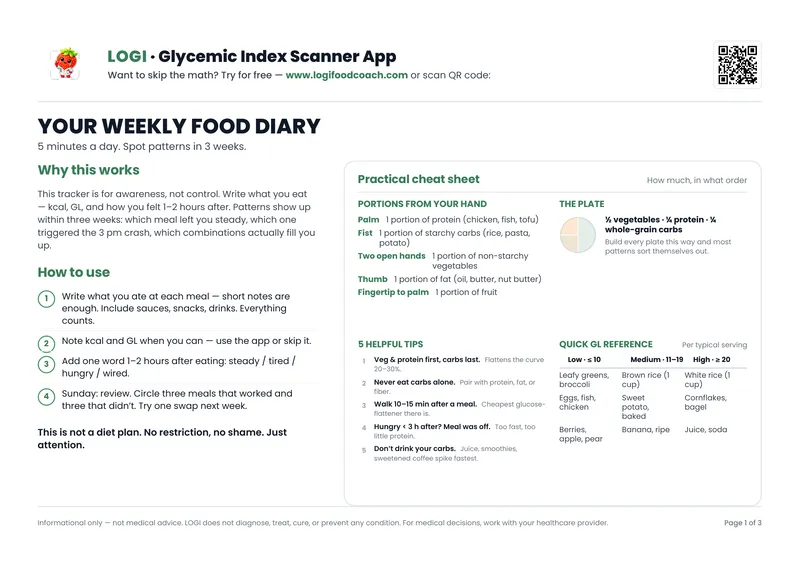
Free PDF — 3 pages
Your Weekly Food Journal
Track meals, glycemic load & mood. Spot patterns in 3 weeks.
No spam. Unsubscribe anytime.