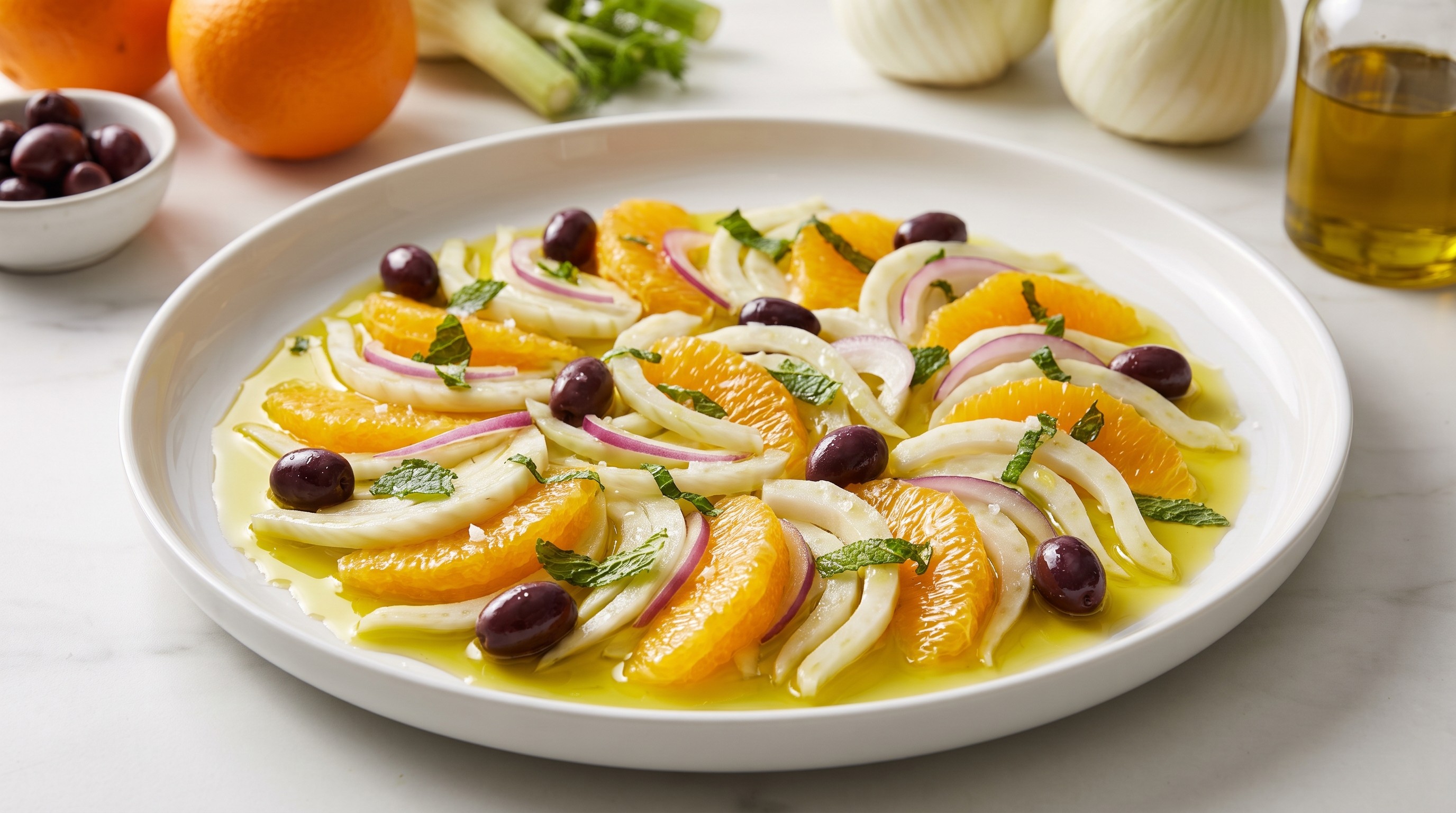
Insalata di Finocchi e Arance (Sicilian Fennel and Orange Salad)
Sicily's iconic raw fennel and blood-orange salad — whole-fruit fibre, healthy fats from olives and olive oil, and virtually no blood-sugar spike.
This is one of those rare dishes that needs zero low-glycemic adaptation because it was already perfect. Across the markets of Palermo and Catania, cooks have been tossing paper-thin fennel crescents with jewel-toned blood-orange rounds, briny olives and a generous pour of extra-virgin olive oil for generations. Every element works in favour of steady blood sugar: the oranges are eaten as whole fruit with all their cellular fibre and pith membrane intact, which slows fructose absorption dramatically compared to juice; fennel contributes its own soluble fibre and a notable crunch; and the monounsaturated fat from olives and olive oil further blunts any postprandial glucose rise.
From a glycemic standpoint, this salad is a textbook example of food synergy. The combination of fibre, fat and the acetic acid in red wine vinegar creates a triple brake on gastric emptying, meaning glucose trickles into the bloodstream rather than flooding it. A full serving clocks in at an estimated GL well under 5 — negligible by any standard. Blood oranges also deliver anthocyanins, the same pigments found in berries, which emerging research links to improved insulin sensitivity.
Serve this as a first course before any protein-rich main and you take advantage of the "vegetable-first" eating strategy shown to flatten post-meal glucose curves by up to 30 percent. It pairs beautifully with grilled fish, roasted chicken or a simple frittata. In summer, prepare it five minutes before sitting down — the fennel should still be ice-cold and snappy, the oranges glistening.
Blood Sugar Impact
Very low blood sugar impact expected. The combination of high-fiber fennel, healthy fats from olive oil and olives, and the moderate natural sugars in orange results in a slow, gentle glucose rise with stable energy for 3-4 hours.
Blood Sugar Tips
- ✓ Eat the fennel and onion portions first before the orange segments to front-load fiber and slow sugar absorption.
- ✓ Pair this salad with a protein source such as grilled fish or white beans to further blunt any glucose response from the orange.
- ✓ Enjoy a brief 10-15 minute walk after the meal to enhance glucose uptake by muscles and keep blood sugar flat.
🥗 Ingredients
- 1 pcs Fennel bulb
- 2 pcs Orange
- 0.25 pcs Red onion
- 40 g Black olives
- 3 tbsp Extra-virgin olive oil
- 1 tbsp Red wine vinegar
- 5 g Mint
- 0.5 tsp Sea salt
- 0.25 tsp Black pepper
- 1 pcs Fennel bulb
- 2 pcs Orange
- 0.25 pcs Red onion
- 1.4 oz Black olives
- 3 tbsp Extra-virgin olive oil
- 1 tbsp Red wine vinegar
- 0.2 oz Mint
- 0.5 tsp Sea salt
- 0.25 tsp Black pepper
👨🍳 Instructions
- 1
Trim the stalks from the fennel bulb and set aside a few feathery fronds for garnish. Cut the bulb in half from top to bottom and slice out the tough triangular core from each half.
- 2
Using a mandoline or the sharpest knife you own, shave each fennel half crosswise into translucent crescents no thicker than 2–3 mm. Drop them straight into a bowl of ice water and leave for 5 minutes — this curls and crisps the slices while mellowing any anise bite.
- 3
While the fennel soaks, prepare the oranges. Slice a thin disc from the top and bottom of each fruit so it sits flat, then stand it on the board and carve away the peel and white pith in downward strokes, following the curve. Cut the peeled oranges into rounds about 5 mm thick, collecting every drop of escaped juice in a small bowl — you will use this in the dressing.
- 4
Place the thin red onion slices in a separate small bowl of cold water and let them sit for 5 minutes. This cold-water soak draws out the harsh sulphur compounds and leaves the onion sweet and mild. Drain and blot dry with a clean cloth.
- 5
Drain the fennel crescents thoroughly and pat them completely dry — any clinging water will dilute the dressing. Spread them across a wide serving plate in a loose single layer.
- 6
Lay the orange rounds over and between the fennel, overlapping casually. Scatter the soaked red onion rings, black olives and torn mint leaves across the top.
- 7
In a small bowl, whisk together the extra-virgin olive oil, red wine vinegar, reserved orange juice, a pinch of flaky sea salt and several cracks of black pepper until the dressing looks lightly emulsified.
- 8
Spoon the dressing evenly over the salad and finish with the reserved fennel fronds. Serve immediately while the fennel is still cold and crisp — this salad does not benefit from sitting.
📊 Nutrition Per Serving
| Per Serving | Whole Dish | |
|---|---|---|
| Calories | 327 | 653 |
| Carbs | 31g | 62g |
| Sugars | 19g | 38g |
| Natural Sugars | 19g | 38g |
| Protein | 4g | 7g |
| Fat | 23g | 46g |
| Saturated Fat | 3g | 6g |
| Unsaturated Fat | 20g | 39g |
| Fiber | 10g | 19g |
| Soluble Fiber | 3g | 6g |
| Insoluble Fiber | 7g | 14g |
| Sodium | 620mg | 1241mg |
Predicted Glucose Response
What if you...
Estimated model — individual responses vary. Not medical advice.
🔬 The Science Behind This Recipe
This Sicilian salad is a textbook example of glycemic food synergy — every ingredient contributes to a remarkably flat blood-sugar curve. Whole oranges retain their cellular fibre matrix and pectin-rich pith membranes, which physically trap sugars inside intact plant cells during digestion. This slows enzymatic access to fructose and glucose, reducing the rate of absorption compared to the same fruit juiced or blended. Studies show that whole citrus fruit produces a significantly lower glycemic response than an equivalent amount of fruit juice, largely because the insoluble fibre scaffold delays gastric emptying.
Fennel adds a second layer of protection through its soluble fibre content, which forms a viscous gel in the stomach and small intestine. This gel further slows the transit of sugars into the bloodstream. Meanwhile, the generous pour of extra-virgin olive oil introduces monounsaturated fatty acids that independently delay gastric emptying and reduce the speed of carbohydrate absorption. Research consistently shows that adding fat to a carbohydrate-containing meal lowers the postprandial glucose peak.
The red wine vinegar in the dressing supplies acetic acid, which has been shown in clinical trials to reduce post-meal blood glucose by inhibiting disaccharidase enzymes in the intestinal brush border and by promoting glycogen synthesis in muscle tissue. Together, these three mechanisms — intact fruit fibre, healthy fat, and acetic acid — create a triple brake on glucose absorption. The result is a salad with an estimated glycemic load under 9 per serving and an overall GI of roughly 28, meaning it produces a very gentle, sustained energy release rather than any meaningful blood-sugar spike.
Related recipes
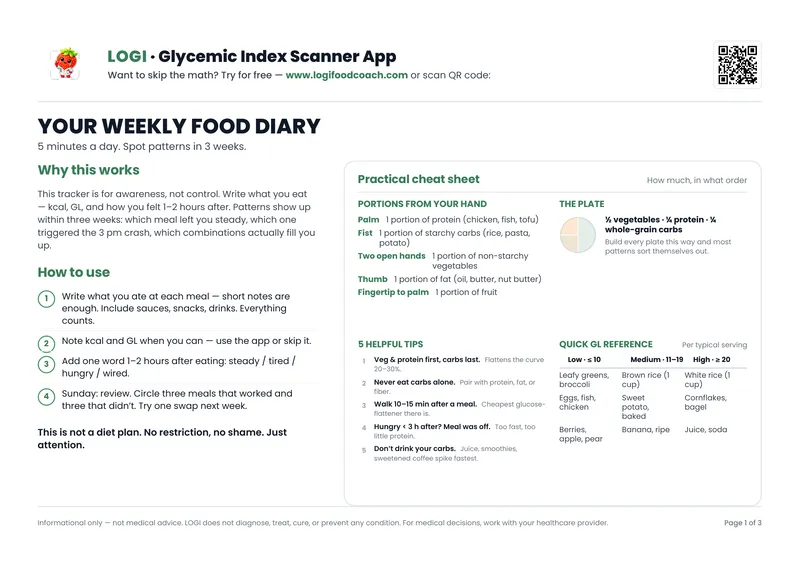
Free PDF — 3 pages
Your Weekly Food Journal
Track meals, glycemic load & mood. Spot patterns in 3 weeks.
No spam. Unsubscribe anytime.