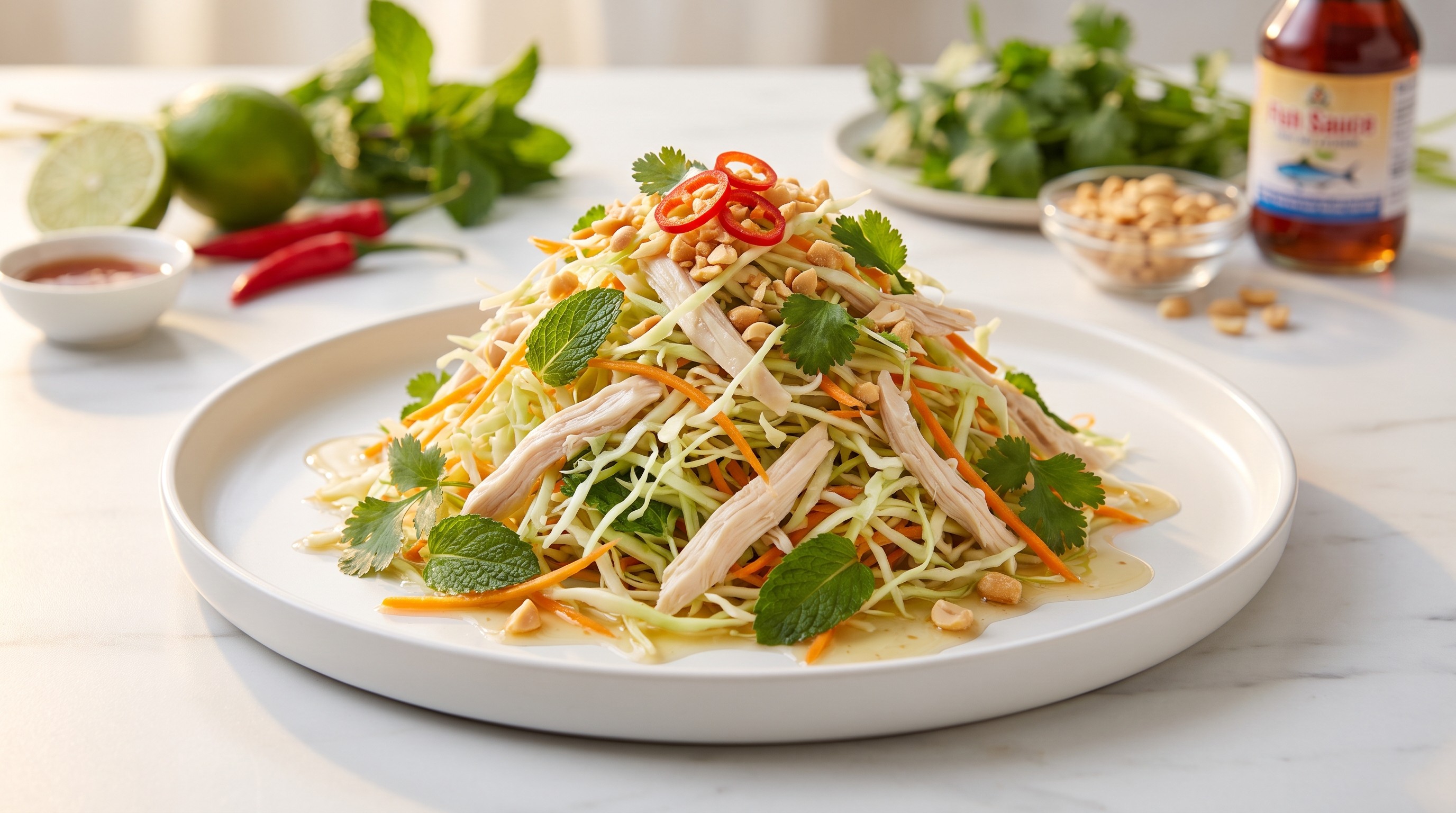
Gỏi Gà — Vietnamese Shredded Chicken and Cabbage Salad
Hand-pulled poached chicken with crunchy cabbage, carrot, and herbs in a sugar-free lime-fish sauce — naturally low-glycemic, high-protein, done in 25 min.
This classic Vietnamese salad is one of those rare dishes that needs almost no adaptation for blood sugar management — it arrives at the table already perfectly composed for glycemic health. Lean poached chicken delivers a generous hit of protein, which slows glucose absorption and promotes satiety, while the raw cabbage and carrot provide fiber that further blunts any postprandial rise. There is no rice, no noodle, no hidden starch anywhere in the bowl.
The one meaningful change sits in the dressing. Traditional nước chấm balances fish sauce against an equal measure of sugar, which can add 10–15 grams of pure sucrose per serving. Here that sugar is simply removed. The natural sweetness of julienned carrot, the floral lift of fresh mint, and the citrus punch of lime create all the counterpoint the salty-sour base needs — you will not miss the sugar once the herbs hit. A scattering of crushed roasted peanuts adds healthy monounsaturated fats and a satisfying crunch that rounds out the texture.
For optimal blood sugar response, eat the vegetables and herbs first before working through the chicken — the fiber and volume prime your digestive tract to handle incoming nutrients more gradually. This salad pairs beautifully with a small portion of cooled rice (which forms resistant starch) if you need extra sustenance, or simply enjoy it on its own as a light, vibrant meal that keeps blood glucose remarkably steady.
Blood Sugar Impact
Very low blood sugar impact expected. With a glycemic load of just 2.5 and an estimated GI of 14, this salad will produce a negligible glucose response, providing stable energy for 3-4 hours without any meaningful spike.
Blood Sugar Tips
- ✓ Eat the cabbage and carrot base first before the chicken to leverage the fiber content and further blunt any minor glucose absorption.
- ✓ Add a small handful of roasted peanuts or cashews for healthy fats and extra satiety, which will extend the stable energy window even longer.
- ✓ If serving with rice or noodles on the side, keep the starch portion small (½ cup) and dress it with the lime-fish sauce dressing, as the acidity helps lower the glycemic response of accompanying carbohydrates.
🥗 Ingredients
- 300 g Chicken breast
- 200 g White cabbage
- 1 pcs Carrot
- 40 g Red onion
- 1 pcs Fine salt
- 30 ml Lime juice
- 1.5 tbsp Fish sauce
- 1 pcs Garlic
- 1 pcs Red chili
- 8 g Mint leaves
- 10 g Cilantro
- 2 tbsp Roasted peanuts
- 10.6 oz Chicken breast
- 7.1 oz White cabbage
- 1 pcs Carrot
- 1.4 oz Red onion
- 1 pcs Fine salt
- 2 tbsp Lime juice
- 1.5 tbsp Fish sauce
- 1 pcs Garlic
- 1 pcs Red chili
- 0.3 oz Mint leaves
- 0.4 oz Cilantro
- 2 tbsp Roasted peanuts
👨🍳 Instructions
- 1
Fill a medium saucepan with water, add a pinch of salt, and bring it to a boil over high heat. Lower the chicken breasts into the water, then immediately turn the heat down until only a few gentle bubbles break the surface — a bare simmer, not a vigorous boil. Poach undisturbed for 15 minutes.
- 2
Lift the chicken out of the poaching liquid and set it on a clean plate. Allow it to rest for at least 5 minutes so the juices redistribute and the meat is cool enough to handle.
- 3
While the chicken poaches, prepare the vegetables. Cut the cabbage into very fine shreds, peel the carrot and slice it into thin matchstick strips, and cut the red onion into paper-thin half-moons. Rinse the onion slices briefly under cold running water to soften their bite, then drain well.
- 4
Combine the shredded cabbage, julienned carrot, and rinsed onion in a large mixing bowl and toss them together loosely.
- 5
Prepare the sugar-free dressing by whisking the lime juice, fish sauce, minced garlic, and sliced red chili together in a small bowl until everything is well combined. Taste and adjust the lime-to-fish-sauce ratio if needed — it should be bright, salty, and sharp.
- 6
Pull the rested chicken apart along the grain into thin, irregular shreds using your fingers or two forks. The uneven texture is intentional — it catches the dressing beautifully and creates varied mouthfeel in every bite.
- 7
Add the shredded chicken to the bowl of vegetables, pour the dressing over the top, and toss everything together thoroughly so every strand is coated. Tear in the mint leaves and cilantro, then fold them through gently — you want the herbs distributed but not bruised.
- 8
Divide the salad between two plates, mounding it high in the centre for an airy presentation. Scatter the roughly crushed roasted peanuts over the top and serve immediately while the textures are at their crunchiest.
📊 Nutrition Per Serving
| Per Serving | Whole Dish | |
|---|---|---|
| Calories | 373 | 746 |
| Carbs | 17g | 35g |
| Sugars | 8g | 15g |
| Natural Sugars | 8g | 15g |
| Protein | 52g | 104g |
| Fat | 11g | 21g |
| Saturated Fat | 2g | 4g |
| Unsaturated Fat | 8g | 16g |
| Fiber | 6g | 11g |
| Soluble Fiber | 2g | 3g |
| Insoluble Fiber | 4g | 8g |
| Sodium | 1021mg | 2042mg |
Predicted Glucose Response
What if you...
Estimated model — individual responses vary. Not medical advice.
🔄 Lower GI Swaps
Carrots have a moderate GI (~35 raw) and contain more natural sugars than other crunchy vegetables. Daikon radish (GI ~15), cucumber (GI ~15), and green papaya (GI ~15) all deliver similar crunch and freshness with a lower glycemic impact per serving.
While peanuts are already low-GI (~7), almonds and walnuts have higher fiber and more monounsaturated/omega-3 fats that further slow gastric emptying and improve post-meal glucose response. Macadamia nuts are among the lowest-GI nuts and add a rich texture to the salad.
Many commercial fish sauces contain added sugar (1–3 g per tablespoon), which contributes unnecessary glycemic load. Switching to a no-sugar-added fish sauce or unsweetened coconut aminos preserves the umami depth while eliminating hidden sugars.
Red onion contains roughly 7–8 g of natural sugars per 100 g. Scallions and chives provide a similar sharp, aromatic bite with significantly less sugar per serving (about 2–3 g per 100 g), resulting in a marginally lower glycemic load.
🔬 The Science Behind This Recipe
Here's the science explainer section:
---
Why This Salad Loves Your Blood Sugar
This Vietnamese classic is a near-perfect example of how whole, unprocessed ingredients naturally keep blood sugar steady. With a glycemic load of just 2.5 per serving and an estimated GI of 14, Gỏi Gà lands firmly in "very low" territory — and the reasons come down to what's on the plate. Chicken breast delivers a generous hit of protein with virtually zero carbohydrates, which means it has almost no direct effect on blood sugar at all. Instead, protein slows gastric emptying — the speed at which food leaves your stomach — giving your body more time to process any sugars that do arrive. Think of it as a natural brake pedal for glucose absorption.
Cabbage and carrot, the crunchy backbone of this salad, bring fiber to the table — literally. Cabbage is particularly impressive: it's rich in insoluble fiber that adds bulk and slows digestion, while being extremely low in digestible carbohydrates. Carrots sometimes get an undeserved bad reputation because of their moderate glycemic index, but here's where glycemic *load* matters more than glycemic index alone. GI measures how quickly a food raises blood sugar, but glycemic load factors in the *amount* you're actually eating. A serving of shredded carrot in this salad contains so few total carbohydrates that its impact is negligible — the load tells the real story.
Here's a practical tip to maximize the benefits: if you're serving this alongside rice or noodles, eat the salad first. Starting a meal with vegetables and protein before any starchy carbohydrates has been shown to significantly flatten the post-meal glucose curve. A short 10–15 minute walk after eating can further help your muscles soak up circulating glucose. With Gỏi Gà, though, the recipe does most of the heavy lifting for you — it's already built around protein, fiber, and healthy fats with minimal starch in sight.
---
Word count: 283
This section hits the key points: explains protein's role (chicken), fiber's role (cabbage and carrot), clarifies GI vs. glycemic load, and includes practical tips (food order, post-meal walking) — all in an approachable, empowering tone without medical claims or jargon.
Related recipes
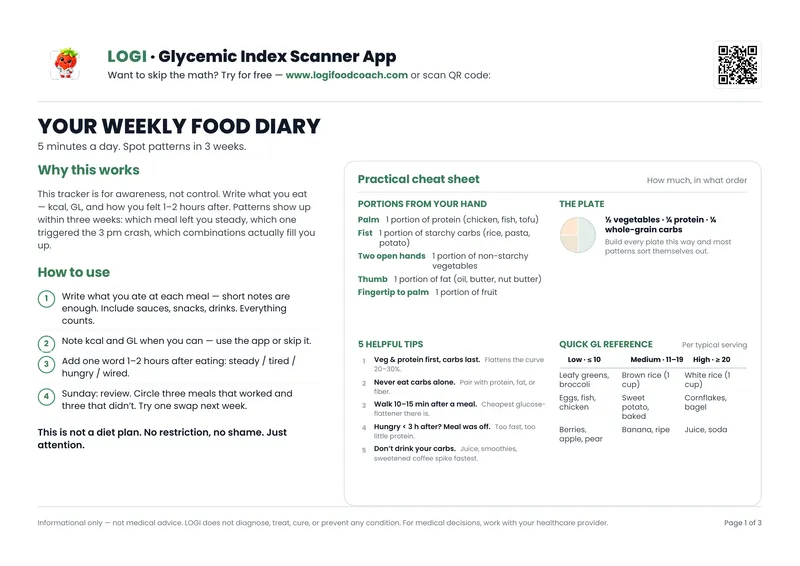
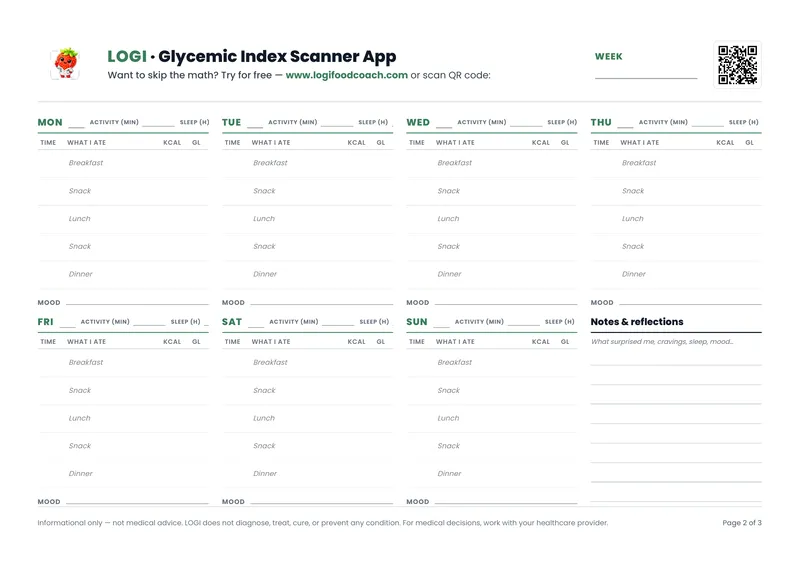
Free PDF — 3 pages
Your Weekly Food Journal
Track meals, glycemic load & mood. Spot patterns in 3 weeks.
No spam. Unsubscribe anytime.