PCOS Diet Apps: 7 Compared, and What the Guidelines Actually Say
Every PCOS diet app is selling the same promise with a different noun in front of it: the anti-inflammatory one, the insulin-resistance one, the low-glycemic one, the seed-cycling one. They cannot all be right, and the international guideline says something inconvenient about all of them at once.
This page compares seven apps that try to handle the food side of PCOS — LOGI, Cysterhood, PCOS Pal, PCOS Polly, Insara, MyBody and Carb Manager — with MyFitnessPal as the free baseline. I work on LOGI, so I have a stake in the answer; the deal is that every app here gets a real “what is not good”, ours first and longest, and where a competitor does something better than us it is written.
Short version: if you want a coach and a community, Cysterhood is the biggest and by far the most expensive. If you want structured lessons about food, PCOS Pal teaches best. If you want your insulin resistance and your symptoms in the same app, Insara is built for exactly that pairing. If you want to know what a specific plate does to your blood sugar, that is glycemic load and LOGI is the only app here that computes it at the meal level. If you have no money, MyFitnessPal free plus a decent recipe site beats every paid app you cannot afford to keep.
Read this before you pay for a PCOS diet
The 2023 International Evidence-Based Guideline for PCOS — developed by dozens of professional bodies across seventy-plus countries — states that there is no evidence supporting one type of diet composition over another for PCOS, whether the outcome is weight, metabolism, hormones, fertility or mood. Its recommendation is sustainable healthy eating adjusted to what you will actually keep doing.
That does not mean food is irrelevant. It means the specific diet brand is much less important than adherence, and any app whose pitch is “the PCOS diet” is ahead of the evidence.
On low-glycemic eating in particular, which is what our own app is built around: several studies suggest a lower-glycemic diet modestly improves metabolic and reproductive markers in PCOS, but when trials match calories between groups, most of the difference disappears. Our honest position is that lowering glycemic load is a reasonable, measurable, evidence-informed thing to act on — and that we cannot claim it beats the alternatives, because the data does not say that.
One more: insulin resistance is very common in PCOS, with estimates ranging from about a third of cases to the large majority and rising with body weight, but it is not universal and the guideline explicitly says routine insulin assays should not be used in ordinary care. If nobody has ordered your labs, do not go chasing a HOMA-IR number — including in our app, which has a tracker for it.
What a PCOS food app has to do
- Work at the level of a meal, not a food list. “Avoid high-GI foods” collapses the moment you eat two things at once.
- Not be secretly keto. Low carbohydrate is one approach; it is not the only one, and it makes lentils, oats, yoghurt and fruit look like failures.
- Survive a bad week. PCOS appetite and energy are not constant. An app that treats a bad week as broken streaks loses you in month two.
- Let you evaluate it before paying. Almost none of them do. This is the clearest pattern in the category.
- Speak your language. Recipes are the part of a health app you read with your hands full.
The 7 apps
1. LOGI — meal-level glycemic load, and nothing else about PCOS
Link: App Store · Google Play · logifoodcoach.com
What it does: photograph or type a meal and get its estimated glycemic load, macros, a predicted three-hour blood sugar curve and specific swaps. Builds one-to-fourteen-day low-glycemic-load meal plans for one to six people, four meals a day. Optional HOMA-IR tracking, PDF export for a doctor. English, Polish, German, Spanish, French, Italian.
What is good: it is the only app in this comparison that computes glycemic load for the plate rather than looking up the glycemic index of ingredients. If insulin resistance is the part of your PCOS you are trying to move, that is the number that corresponds to it. The household-sized planner is unique here — nothing else scales a plan past one person. It is the cheapest yearly plan in the comparison.
What is not good, at length: we are not a PCOS app. No cycle tracking, no symptom logging, no community, no coaching, no content about hair, skin, fertility or mood. Every other app on this page understands more about PCOS than we do; we understand more about the plate. Our HOMA-IR feature sits uneasily with a guideline that says not to test insulin routinely. The meal planner is behind a hard paywall, so the main feature cannot be evaluated free, and the weekly plan is poor value against the yearly one. The photo estimate is a model — cluttered plates get misread.
Best for: the food and insulin side, alongside whatever PCOS app you already use.
Pricing: $2.99/week, $39.99/year, 7-day trial.
2. Cysterhood — coach, community, and the highest price in the category
Link: available in the App Store
What it does: a diet-and-workout programme with a large community, built by a registered dietitian who has PCOS and a certified trainer.
What is good: the dietitian credential is real and checkable, which is rarer here than it should be. The community is the largest of any app in this comparison and, for a condition where people routinely feel dismissed, that is a genuine clinical-adjacent benefit rather than a marketing one. Workouts and food sit in one place.
What is not good: roughly $28–30 a month, or somewhere between $150 and $215 a year depending on which offer you are shown — several times the price of anything else here. English only. It advocates a particular dietary position in a field where the guideline says no position has been proven superior. The store version has not had a major update since 2024.
Best for: someone who wants a coach and a crowd, and can afford both.
Pricing: about $28–30/month, roughly $150–215/year.
3. PCOS Pal — the best teaching, with an unverifiable credential
Link: available in the App Store
What it does: sequenced education lessons about PCOS, meal plans, a food scanner and tracking.
What is good: the lesson structure is the best learning design in this list — short, ordered, and far less overwhelming than a content library you are expected to browse. Having plans and a scanner in the same product is convenient.
What is not good: the app says its lessons were reviewed by an OB/GYN and an endocrinologist but does not name them, and we could not verify the claim; an unnamed reviewer is a marketing line, not a credential. Pricing is aggressive and inconsistent — weekly from about $4, monthly around $20, yearly around $70, lifetime offers between roughly $69 and $199 — which is a pattern designed to catch people at the moment of highest motivation. English only. Similar names exist on iOS and Android from different publishers; check the developer.
Best for: someone who wants to learn the material, not just log against it.
Pricing: see above; confirm the tier you are offered.
4. PCOS Polly — modern, active, and behind a wall
Link: available in the App Store
What it does: food, symptom and cycle logging with habit tracking; the most frequently updated PCOS-specific app we found, with releases through 2026.
What is good: it is well built and genuinely maintained, which distinguishes it from several better-known names here. Built by someone with the condition.
What is not good: onboarding is free and then everything is not — you cannot meaningfully evaluate it before subscribing. No named clinical or dietetic review that we could find. English only. Pricing varies by offer: roughly $10–20 a month, $60–80 a year. On food specifically it is a logger, not an analyser: it records what you ate, it does not tell you what it did.
Best for: someone who wants one current, well-made logging app and will pay to find out.
Pricing: roughly $10–20/month, $60–80/year.
5. Insara (formerly Lilli Health) — insulin resistance and symptoms in one place
Link: insara.com
What it does: meal planning and education built around insulin resistance and PCOS together, plus symptom tracking (weight, mood, skin, hair) and cycle tracking.
What is good: this is the closest thing in the category to a product that treats PCOS as a metabolic and hormonal picture at once. If your insulin resistance and your symptoms move together — and for many people they do — having them in the same app is worth more than any single feature.
What is not good: no meal-level glycemic load, no glucose prediction, no lab tracking. So it plans, and it records symptoms, but nothing closes the loop between a meal and its effect. English only. And a search-results warning: the well-ranking “top 10 insulin resistance apps” article that puts Insara at number one is published by Insara.
Best for: PCOS where the symptom picture matters as much as the plate.
Pricing: free tier, then $14.99/month or $155.99/year.
6. MyBody — the multilingual generalist
Link: available in the App Store and Google Play
What it does: calorie, weight and habit tracking from a diabetes-and-weight-loss company, with a PCOS course among its content programmes.
What is good: the widest language coverage of any app in this comparison — English, French, German, Italian, Norwegian, Polish and Spanish, confirmed on the store listing. For a Polish or Italian reader, that alone eliminates most of the alternatives. Actively developed.
What is not good: PCOS is a course inside a generic tracker, not the product. The food database is thin next to a dedicated one, and logging is more work than it should be. Pricing is poor value and confusingly tiered: around $33 for one month, around $66 for twelve, with several mid-length options that are worse than either end.
Best for: a non-English speaker who wants one tracker and treats the PCOS course as a bonus.
Pricing: around $33/month, around $66/year.
7. Carb Manager — not a PCOS app, used as one constantly
Link: carbmanager.com
What it does: net-carb and macro tracking, keto-first, with the largest recipe library in this comparison and an active community.
What is good: the recipe library is enormous, the free tier is real and usable, and about $40 a year is fair. Plenty of people with PCOS do well on low-carb and this is the best-built app for it.
What is not good: net carbohydrates and glycemic load are not the same question, and for PCOS the difference matters. Legumes, oats, plain yoghurt and most fruit score badly here and well on glycemic load, and the guideline gives you no reason to cut them. There is per-ingredient glycemic index data but no meal-level glycemic load. iOS listing is English only.
Best for: someone who has already chosen low-carb and wants the best tool for it.
Pricing: free tier; premium around $40/year.
The free baseline: MyFitnessPal, twenty languages, an enormous database, a genuinely usable free tier — and zero glycemic index or glycemic load functionality, ever. It is the fastest way to find out what you actually eat. It will not tell you what it does to you.
Comparison table
| LOGI | Cysterhood | PCOS Pal | PCOS Polly | Insara | MyBody | Carb Manager | |
|---|---|---|---|---|---|---|---|
| Meal-level glycemic load | Yes | No | No | No | No | No | No |
| Predicted glucose curve | Yes | No | No | No | No | No | No |
| Photo meal scan | Yes | No | Yes | No | No | No | Limited |
| Meal plans | Yes, 1–6 people | Yes | Yes | No | Yes | No | Partial |
| Recipe library | Curated | Moderate | Moderate | Small | Moderate | Small | Largest |
| Symptom / cycle tracking | No | Yes | Yes | Yes | Yes | Partial | No |
| Community | No | Large | No | No | No | No | Yes |
| Named clinical authorship | No | RD founder | Claimed, unverified | Not found | Not found | No | No |
| Languages | 6 | 1 | 1 | 1 | 1 | 7 | 1 |
| Usable free tier | 10 scans | No | No | No | Yes | No | Yes |
| Yearly | $39.99 | ~$150–215 | ~$70 | ~$60–80 | $155.99 | ~$66 | ~$40 |
Which one for which situation
“I want to understand what a meal does to my blood sugar.” LOGI. Nothing else here computes it at the plate level, and this is the one thing we are unambiguously best at.
“My symptoms and my eating are tangled together.” Insara. It is the only app here designed around that pairing.
“I want a coach and people who understand.” Cysterhood, if you can afford it. It is expensive and it is the biggest.
“I want to learn the material properly.” PCOS Pal for the lessons, and treat the meal plans as secondary.
“I speak Polish, Italian, German, French or Spanish.” MyBody or LOGI. Everything else in this comparison is English only, and that is not a small consideration when you are reading a recipe at 19:00.
“Low-carb is already working for me.” Carb Manager, and ignore anyone who tells you to stop something that works.
“I have no budget.” MyFitnessPal free for two weeks to see your baseline, then decide. A subscription you cancel in month two teaches you nothing.
What the category still gets wrong, us included
Everyone claims a diet and the guideline says nobody has one. Including us. We build around glycemic load because it is measurable and actionable, not because it has been shown to beat the alternatives for PCOS.
Credentials are mostly vibes. One app here has a checkable named dietitian; one claims unnamed doctors; the rest have nothing. In a condition this poorly served by primary care, that is a bigger failure than any missing feature.
Nobody joins the cycle to the food. Appetite, insulin sensitivity and adherence all move with the cycle, and not one app in this comparison — ours least of all — uses that. The obvious product is a tracker that knows where you are in your cycle and what your meals are doing. It does not exist yet.
The free tier is a trailer. Five of the seven apps here gate the feature you would use to judge them.
What to try this week
- Log five days honestly in whatever free tool you already have. Do not change anything yet.
- Pick the one meal that repeats most often — usually breakfast — and find out what it does.
- Change that one meal and keep everything else the same.
- Give it three weeks before deciding whether the app earned its price.
One meal changed and kept beats a perfect plan abandoned in a fortnight.
Download LOGI on the App Store — Get LOGI on Google Play — More on logifoodcoach.com
Related recipes

Low-Glycemic Mexican Bean and Egg Salad Bowl
A protein-packed Mexican-inspired salad featuring fiber-rich beans, creamy avocado, and perfectly soft-boiled eggs that keeps blood sugar stable for hours.

Blood Sugar-Friendly Tofu and Bean Chili
A protein-packed vegetarian chili featuring tofu and fiber-rich beans that helps maintain steady blood sugar levels while delivering bold, satisfying flavors.

Herb-Crusted Grilled Salmon with Lemon Pepper
Perfectly grilled salmon with aromatic herbs delivers omega-3s and protein without spiking blood sugar—ideal for balanced glucose management.
Take control of your blood sugar
Scan your meals, track glycemic load, and see your patterns — all in one app.
Start Free Trial →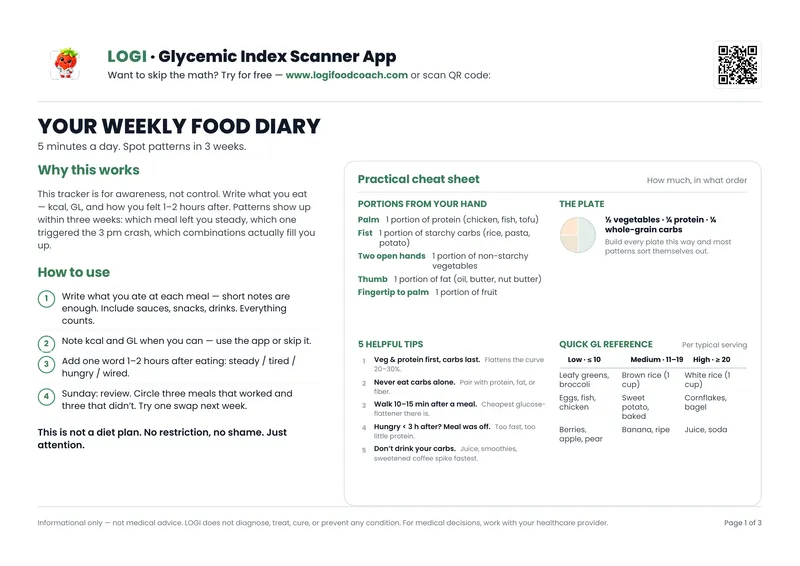
Free PDF — 3 pages
Your Weekly Food Journal
Track meals, glycemic load & mood. Spot patterns in 3 weeks.
No spam. Unsubscribe anytime.