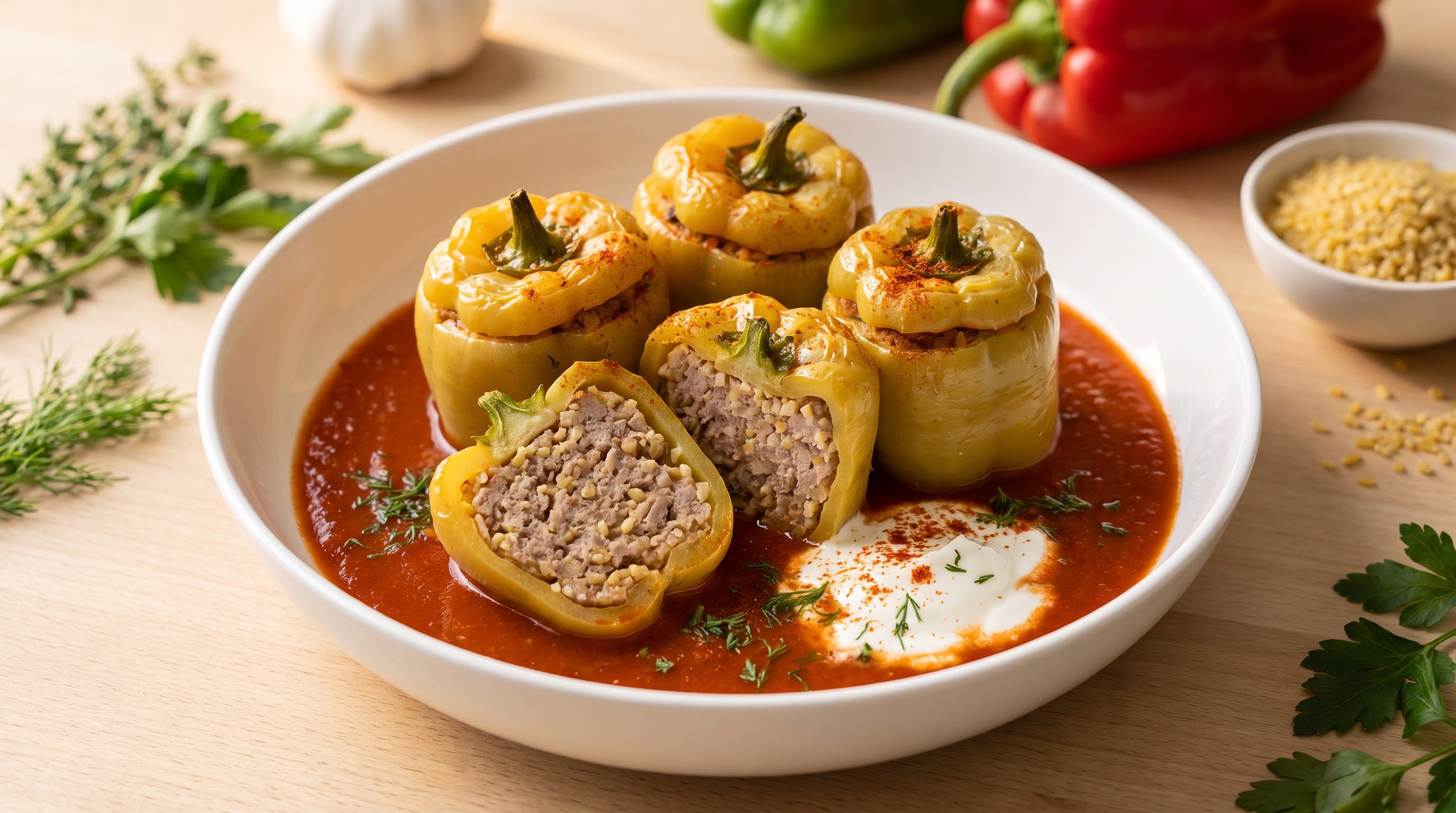
Töltött Paprika with Bulgur
Hungarian stuffed peppers reimagined with bulgur wheat instead of white rice — more fiber, slower glucose release, and all the paprika-rich comfort you crave.
Töltött paprika is one of Hungary's most soul-warming dishes — plump bell peppers brimming with seasoned pork, simmered until meltingly tender in a glossy paprika-tomato sauce. The traditional version uses white rice as the binder, but this adaptation swaps it for fine bulgur wheat, which sits comfortably in the low-GI range (around 48) compared to white rice (73). Bulgur's intact bran layer slows digestion, delivering a gentler blood sugar curve without sacrificing the cohesive, satisfying texture the filling needs.
The peppers themselves are a smart choice for blood sugar management. Rich in fiber and vitamin C, bell peppers have a GI so low they barely register on the scale. Paired with protein-rich pork and the healthy fats from olive oil and egg, this dish naturally creates the trifecta that slows gastric emptying: fiber, protein, and fat. The tomato passata contributes lycopene and keeps the overall glycemic load modest, while the sour cream garnish adds a cool, tangy counterpoint that also contributes a small dose of fat to further moderate glucose absorption.
For the best blood sugar response, consider eating a small green salad dressed with vinegar about ten minutes before this meal — the acetic acid has been shown to reduce post-meal glucose spikes. Serve the peppers with their sauce ladled generously and a cold dollop of sour cream melting into the heat. This is comfort food you can feel genuinely good about.
Blood Sugar Impact
Low blood sugar impact expected. With a GI of 25 and a moderate GL of 15.4, the combination of bulgur's intact fiber matrix, protein from pork and egg, and healthy fats from olive oil and sour cream will slow gastric emptying and produce a gradual, modest glucose rise over 2-3 hours.
Blood Sugar Tips
- ✓ Eat the bell pepper shell and any side vegetables first before the meat-bulgur filling — the fiber primes your gut to slow carbohydrate absorption.
- ✓ Keep the sour cream topping generous; its fat and protein further blunt the glucose response from the bulgur and tomato passata.
- ✓ Take a 10-15 minute walk after the meal to activate skeletal muscle glucose uptake and flatten any residual rise.
🥗 Ingredients
- 4 pcs Bell pepper
- 250 g Ground pork
- 60 g Fine bulgur wheat
- 1 pcs Onion
- 2 pcs Garlic
- 1 pcs Egg
- 1 tbsp Sweet paprika
- 400 g Tomato passata
- 1 tbsp Olive oil
- 2 tbsp Sour cream
- 0.5 tsp Salt
- 0.25 tsp Black pepper
- 4 pcs Bell pepper
- 8.8 oz Ground pork
- 2.1 oz Fine bulgur wheat
- 1 pcs Onion
- 2 pcs Garlic
- 1 pcs Egg
- 1 tbsp Sweet paprika
- 14.1 oz Tomato passata
- 1 tbsp Olive oil
- 2 tbsp Sour cream
- 0.5 tsp Salt
- 0.25 tsp Black pepper
👨🍳 Instructions
- 1
Place the fine bulgur in a small heatproof bowl and pour over 120 ml of boiling water. Cover tightly and set aside for 10 minutes until the grains have absorbed all the liquid and turned fluffy. Fluff with a fork and allow to cool slightly.
- 2
Warm the olive oil in a wide, heavy-bottomed pot with a lid over medium heat. Add the diced onion and cook, stirring occasionally, for about 4 minutes until softened and translucent. Stir in the minced garlic and cook for 1 minute until fragrant, then remove the pot from the heat and stir in half of the sweet paprika. Transfer this mixture to a bowl and let it cool for a couple of minutes.
- 3
In a large mixing bowl, combine the ground pork, hydrated bulgur, sautéed onion-garlic mixture, egg, salt, and black pepper. Use your hands to gently mix everything until just combined — avoid overworking the mixture, as this can make the filling tough and dense.
- 4
Slice the tops off each bell pepper and set the caps aside. Scoop out the seeds and white membranes from inside. Spoon the pork-bulgur filling into each pepper, packing it gently but firmly, and place the reserved caps back on top.
- 5
Stand the stuffed peppers upright in the same pot you used for the onion. Pour the tomato passata around the peppers, then add 100 ml of water and the remaining sweet paprika to the sauce. Give the liquid a gentle stir without disturbing the peppers.
- 6
Bring the sauce to a gentle simmer over medium heat, then reduce the heat to low and cover the pot. Cook for 35 minutes, checking once halfway through to ensure the sauce is bubbling gently. The peppers are ready when they are completely tender and yield easily when pressed with a spoon, and the pork filling is cooked through.
- 7
Carefully lift two stuffed peppers onto each plate using a slotted spoon or tongs. Ladle the paprika-tomato sauce generously over and around the peppers.
- 8
Top each serving with a cold spoonful of sour cream — let it sit on the hot sauce without stirring so it melts slowly into the dish as you eat. Serve immediately.
📊 Nutrition Per Serving
| Per Serving | Whole Dish | |
|---|---|---|
| Calories | 759 | 1519 |
| Carbs | 61g | 121g |
| Sugars | 25g | 50g |
| Natural Sugars | 25g | 50g |
| Protein | 36g | 72g |
| Fat | 41g | 82g |
| Saturated Fat | 13g | 26g |
| Unsaturated Fat | 27g | 54g |
| Fiber | 15g | 30g |
| Soluble Fiber | 4g | 9g |
| Insoluble Fiber | 10g | 21g |
| Sodium | 752mg | 1505mg |
Predicted Glucose Response
What if you...
Estimated model — individual responses vary. Not medical advice.
🔄 Lower GI Swaps
Bulgur has a moderate GI of ~48 and is the primary carbohydrate driver of this dish's GL. Cauliflower rice (GI ~15, nearly negligible carbs) drastically cuts GL. Hulled barley (GI ~25) retains a grain-like texture with one of the lowest GIs of any cereal. Konjac rice (GI ~0) contains virtually no digestible carbohydrate, making it the most aggressive GL reduction.
Passata is a smooth, fiber-stripped purée (GI ~35) that is absorbed relatively quickly. Fresh crushed tomatoes (GI ~15) retain their cell walls and fibre, slowing glucose release. Roasted bell pepper puree has an even lower GI and adds no extra sugar while keeping the saucy consistency the dish needs.
Sour cream is already low-GI (~14), but full-fat Greek yogurt (GI ~11) delivers roughly double the protein per serving, which further blunts postprandial glucose spikes by slowing gastric emptying. Crème fraîche has a similarly low GI with higher fat content, which also helps moderate the blood sugar response of the overall meal.
🔬 The Science Behind This Recipe
Here's the science explainer section:
---
Why This Recipe Works for Blood Sugar
Töltött Paprika is a naturally blood sugar-friendly dish, and the secret lies in how its ingredients complement each other. Bulgur wheat is one of the lowest-glycemic grains available — unlike white rice or couscous, bulgur retains its bran and germ, which means it's packed with fiber. That fiber acts like a slow-release valve: instead of flooding your bloodstream with glucose all at once, it lets sugar trickle in gradually. Paired with ground pork, which brings protein and fat to the table, your body has to work harder and longer to break down the meal. This one-two punch of fiber and protein is one of the most effective ways to flatten your post-meal glucose curve.
Bell peppers deserve their own spotlight here. They're mostly water and fiber with very few digestible carbohydrates, which means they add bulk and satisfaction to your plate without meaningfully raising blood sugar. They also serve as the perfect edible vessel — when you eat the pepper alongside the filling, you're naturally following the principle of pairing carbs with vegetables, protein, and fat rather than eating them in isolation.
With an estimated Glycemic Index of 25 and a Glycemic Load of 15.4 per serving, this dish sits comfortably in the low-to-moderate range. Remember, Glycemic Load matters more than GI alone because it accounts for how much carbohydrate you're actually eating — not just how fast it hits. A small amount of a higher-GI food can be gentler on blood sugar than a large bowl of something "low-GI." To get the most from this meal, try eating a few bites of the pepper shell first before digging into the filling, and consider a short 10–15 minute walk afterward. These small habits can reduce glucose spikes by up to 30%, turning an already smart meal into an even smarter one.
Related recipes

Free PDF — 3 pages
Your Weekly Food Journal
Track meals, glycemic load & mood. Spot patterns in 3 weeks.
No spam. Unsubscribe anytime.
