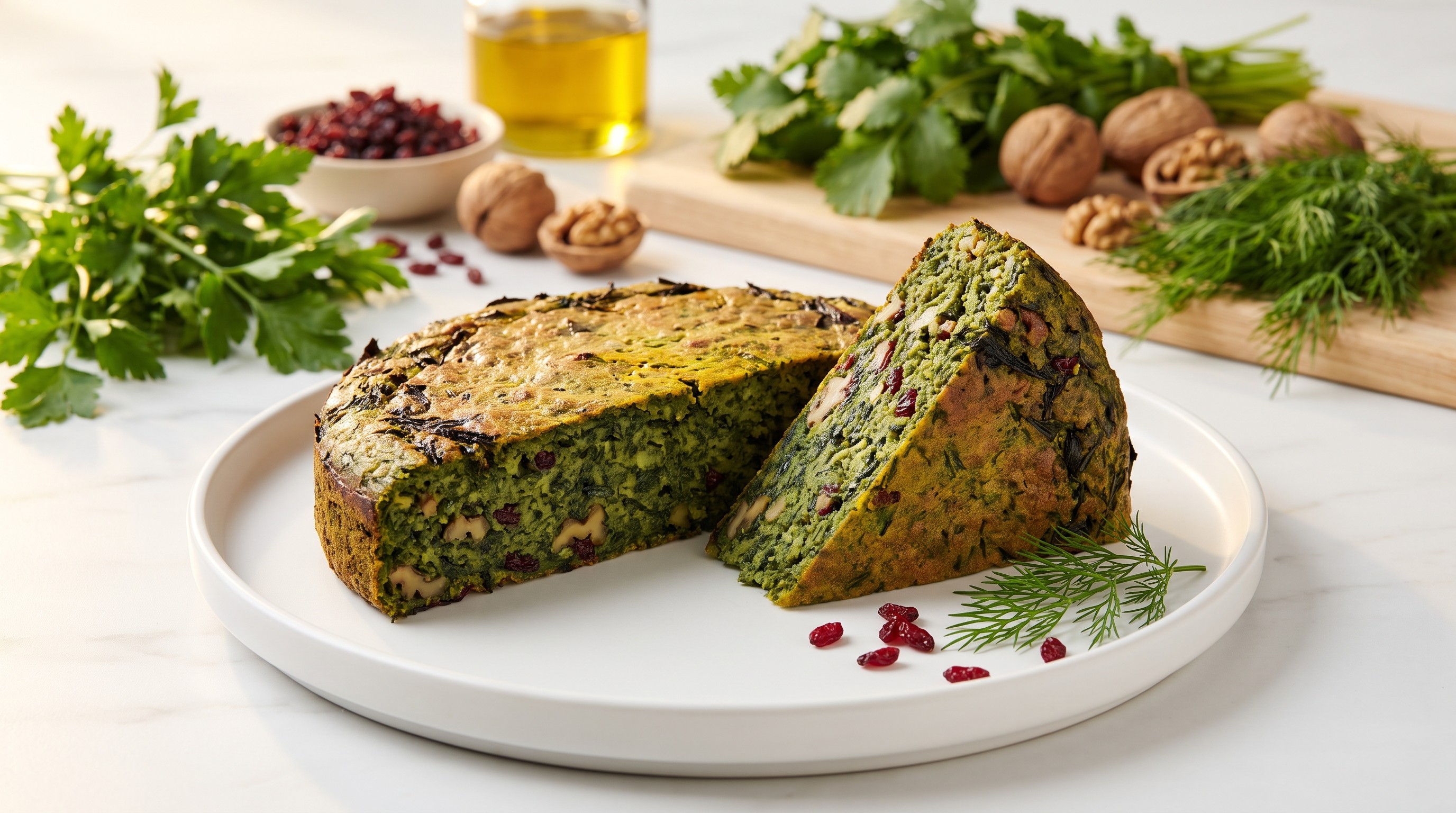
Kuku Sabzi (Persian Herb Cake with Walnuts and Barberries)
A vibrant Persian herb cake bound with eggs and studded with walnuts and tart barberries — naturally low-glycemic, high in protein, and rich in phytonutrients.
Kuku sabzi flips the Western omelette on its head: here, a mountain of fresh parsley, cilantro, dill, and scallions takes centre stage while eggs play a quiet supporting role as binder. The result is a dense, sliceable green wedge with a golden crust — aromatic, savoury, and almost impossibly light on the glycemic scale. Because the dish is built almost entirely from herbs, eggs, and nuts, its carbohydrate load is negligible and its glycemic impact is close to zero, making it an ideal centrepiece for anyone managing blood sugar.
Walnuts contribute heart-healthy omega-3 fatty acids and a satisfying crunch, while dried barberries — a staple of Persian cooking — add jewel-like pops of tartness along with anthocyanins that research has linked to improved insulin sensitivity. Be sure to source unsweetened, uncoated barberries, as some varieties are sold with a sugar coating that would raise the glycemic impact. Turmeric lends its characteristic golden hue and brings curcumin, a polyphenol studied for its anti-inflammatory and glucose-lowering properties. The generous volume of fresh herbs delivers fibre, folate, vitamin K, and a broad spectrum of antioxidants with virtually no effect on blood sugar.
For optimal glycemic management, serve kuku sabzi alongside a small salad dressed with olive oil and lemon — the additional fibre and acidity further slow glucose absorption. It works beautifully as a protein-rich breakfast, a light lunch with yoghurt on the side, or sliced into wedges as part of a mezze spread. Leftovers keep well in the fridge for two days and taste just as good cold, making this an excellent meal-prep option for steady energy throughout the week.
Blood Sugar Impact
Minimal blood sugar impact expected. With a glycemic load of just 1.1 and an estimated GI of 8, this herb-and-egg-based dish is very low in carbohydrates and rich in protein, healthy fats, and fiber, providing stable energy for 3-4 hours.
Blood Sugar Tips
- ✓ Pair with a side of non-starchy vegetables or a leafy green salad to add extra fiber and volume without raising blood sugar.
- ✓ If serving with rice or bread (traditional accompaniments), keep the starch portion small and eat the kuku sabzi first to blunt any glucose response from the carbs.
- ✓ Include a short 10-15 minute walk after the meal to further support stable blood sugar levels.
🥗 Ingredients
- 6 pcs Egg
- 100 g Flat-leaf parsley
- 80 g Cilantro
- 50 g Dill
- 100 g Scallion
- 30 g Walnut
- 15 g Dried barberry
- 2 tbsp Olive oil
- 0.5 tsp Ground turmeric
- 0.75 tsp Salt
- 0.25 tsp Black pepper
- 6 pcs Egg
- 3.5 oz Flat-leaf parsley
- 2.8 oz Cilantro
- 1.8 oz Dill
- 3.5 oz Scallion
- 1.1 oz Walnut
- 0.5 oz Dried barberry
- 2 tbsp Olive oil
- 0.5 tsp Ground turmeric
- 0.75 tsp Salt
- 0.25 tsp Black pepper
👨🍳 Instructions
- 1
Place the dried barberries in a small bowl and cover them with warm water. Let them soak while you prepare the remaining ingredients — about 10 to 12 minutes is enough to plump them up and soften their tartness. Confirm your barberries are unsweetened and uncoated; they should taste purely tart with no sticky sugar residue.
- 2
Preheat the oven to 180 °C (350 °F) and position a rack in the centre.
- 3
Wash the parsley, cilantro, and dill thoroughly, then dry them as completely as possible using a salad spinner or clean kitchen towels — excess moisture will make the kuku soggy. Once dry, finely chop all three herbs and transfer them to a large mixing bowl.
- 4
Thinly slice the scallions, including both white and green parts, and add them to the herbs. Roughly chop the walnuts into small, irregular pieces and set them aside.
- 5
Crack the eggs into a separate bowl and beat them well with the turmeric, salt, and black pepper until the spices are evenly distributed and the mixture is a uniform golden colour.
- 6
Drain the soaked barberries through a fine sieve and gently squeeze them dry with your hands. Add the barberries and chopped walnuts to the bowl of herbs and scallions. Pour the seasoned egg mixture over the top and fold everything together until the herbs are evenly coated — the bowl should look overwhelmingly green with only glimpses of egg.
- 7
Heat the olive oil in a 20 cm (8-inch) oven-safe skillet over medium heat for about a minute. Pour in the herb-egg mixture, spreading it evenly with a spatula and pressing it down gently. Cook undisturbed for 3 minutes until the base sets and begins to turn golden.
- 8
Transfer the skillet to the preheated oven and bake for 15 minutes, or until the top feels firm to the touch, the edges are lightly browned, and a knife inserted into the centre comes out clean. Let the kuku rest in the pan for 2 minutes, then slide it onto a cutting board and slice into wedges. Serve warm or at room temperature.
📊 Nutrition Per Serving
| Per Serving | Whole Dish | |
|---|---|---|
| Calories | 245 | 978 |
| Carbs | 7g | 28g |
| Sugars | 2g | 7g |
| Protein | 13g | 51g |
| Fat | 20g | 78g |
| Saturated Fat | 4g | 15g |
| Unsaturated Fat | 16g | 62g |
| Fiber | 3g | 12g |
| Soluble Fiber | 1g | 3g |
| Insoluble Fiber | 2g | 8g |
| Sodium | 578mg | 2311mg |
Predicted Glucose Response
What if you...
Estimated model — individual responses vary. Not medical advice.
🔄 Lower GI Swaps
Some commercially available barberries are coated in sugar syrup, which significantly raises their glycemic impact. Unsweetened barberries or unsweetened dried cranberries provide the same tart contrast without added sugars.
White flour has a high glycemic index (GI ~70) and adds unnecessary refined starch. This recipe uses eggs alone as the binder, but if you prefer extra structure, almond flour (GI ~1) or ground flaxseed (GI ~1) provide binding without raising blood sugar.
🔬 The Science Behind This Recipe
Kuku sabzi is exceptionally blood-sugar-friendly because its macronutrient profile is dominated by protein and fat with almost no digestible carbohydrate. Each serving (one wedge, approximately 150 g) contains roughly 4 g of net carbohydrates, yielding a glycemic load of just 1.1 — well below the threshold of 10 considered 'low.' The estimated glycemic index of 8 reflects the near-absence of starch or sugar in the dish.
Eggs provide a complete protein that triggers minimal insulin response while promoting satiety. The walnuts add monounsaturated and polyunsaturated fats — including alpha-linolenic acid (ALA), a plant-based omega-3 — which slow gastric emptying and blunt any residual glucose absorption. Research published in the Journal of Nutrition has shown that walnut consumption is associated with improved fasting glucose and insulin sensitivity.
Barberries (Berberis vulgaris) contain berberine, an alkaloid that has demonstrated glucose-lowering effects in clinical studies by activating AMP-activated protein kinase (AMPK), a key enzyme in cellular energy regulation. While the quantity in a single serving is modest, it contributes to the overall metabolic benefit of the dish.
Turmeric's active compound, curcumin, has been studied for its ability to reduce insulin resistance and lower fasting blood glucose. Its bioavailability improves significantly when consumed with fat — here provided by olive oil and walnuts — and with piperine from black pepper.
The large volume of fresh herbs provides insoluble fibre that further moderates any postprandial glucose response, while delivering chlorophyll, folate, and vitamin K without meaningful caloric or carbohydrate contribution.
Related recipes
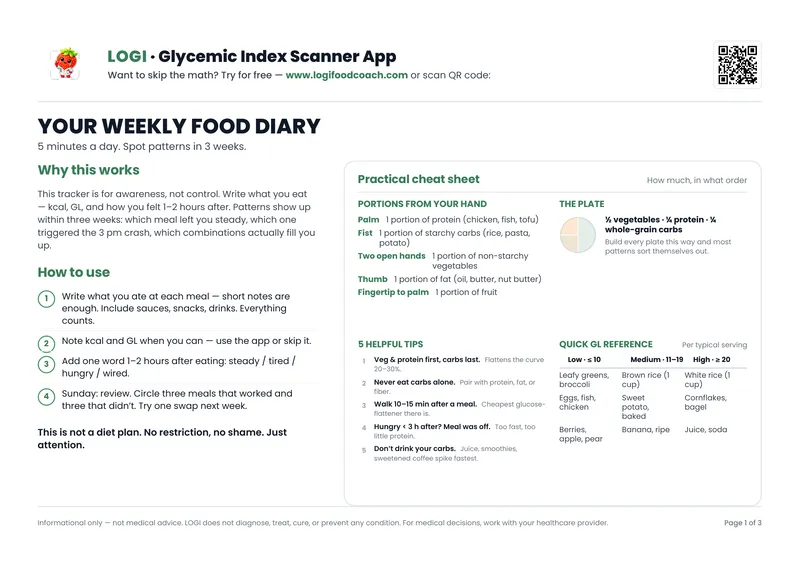
Free PDF — 3 pages
Your Weekly Food Journal
Track meals, glycemic load & mood. Spot patterns in 3 weeks.
No spam. Unsubscribe anytime.