Best PCOS Apps 2026: 9 Apps Compared, and What Each One Is Really For
There is no single “PCOS app”, and the App Store pretends otherwise. Search the term and you get four different products in one list: period trackers that added a PCOS toggle, symptom diaries, coaching subscriptions from a dietitian with a large Instagram following, and one genuinely academic education app that has not been updated in three years.
This is a comparison of the nine most-considered options — AskPCOS, Clue, Flo, Cysterhood, PCOS Polly, PCOS Pal, MyBody, Ovia and LOGI — plus a note on the telehealth services people confuse with apps. I work on LOGI, which is not a PCOS app at all but a glycemic-load app that a lot of people with PCOS use, so I have an obvious interest here. The way to make that survivable is to be specific about what we cannot do, and to say plainly where each competitor is better. Several of them are better than us at the thing they were built for.
Short version: for free, clinically grounded information about PCOS, AskPCOS is the best thing that exists and it costs nothing — start there, and accept that it is no longer actively maintained. For cycle tracking with irregular cycles, Flo’s PCOS mode handles anovulatory cycles better than a generic tracker. For coaching, community and structure, Cysterhood is the biggest of its kind and priced accordingly. For the food and insulin side specifically — the part where you want to know what a given plate does to your blood sugar — LOGI or a general glycemic tool. Most people end up with two apps, and that is a fair outcome, not a failure.
What the guidelines actually say, before you buy anything
Two facts from the 2023 International Evidence-Based Guideline for PCOS should shape what you expect from any app here, including ours.
No diet has been shown to be better than another for PCOS. The guideline is unusually blunt about it: there is no evidence supporting one type of diet composition over another for weight, metabolic, hormonal, reproductive or psychological outcomes. What it recommends instead is sustainable healthy eating you can actually keep. Any app promising the PCOS diet is ahead of the evidence.
Routine insulin testing is not recommended. Insulin resistance is a recognised mechanism in PCOS — it is very common, with studies putting it anywhere from about a third of cases to the large majority, rising with body weight, and it is not universal. But the guideline says clinically available insulin assays are of limited clinical relevance and should not be used in routine care. That is worth reading twice, because our own app has a HOMA-IR tracker in it. It is useful if your doctor ordered the labs. It is not a reason to go and order them yourself.
On low-glycemic eating specifically: some studies suggest it modestly helps metabolic and reproductive markers in PCOS, but when calories are matched between groups the difference largely disappears. Reasonable, evidence-informed, not proven superior. That is the honest version.
What a PCOS app can usefully do
- Handle cycles that do not behave. A tracker whose model assumes a 28-day cycle with ovulation on day 14 will be wrong for a large share of this audience, and confidently wrong is worse than silent.
- Track symptoms that matter to you — not just bleeding, but skin, hair, mood, energy, weight.
- Say something true about food. Which for most of these apps means: say less than they currently do.
- Be honest about who wrote it. A named clinician or an academic institution is worth more than a wellness brand’s word.
- Have a free tier you can evaluate. Almost none of them do; this is the single strongest pattern in the category.
The 9 apps
1. AskPCOS — free, academic, and standing still
Link: askpcos.org
What it does: evidence-based information about PCOS, a symptom tracker, a question-builder for medical appointments, and a moderated forum. Built by the Monash Centre for Health Research and Implementation at Monash University — the same institution that co-led the international PCOS guideline.
What is good: it is completely free with no in-app purchases, and it is the only app in this comparison with unambiguous academic authorship behind it. If you want to know what is actually established about PCOS rather than what sells, this is the one.
What is not good: the iOS version has not been updated since September 2023, which for a health app is a long silence. English only. And it does nothing about food beyond general guidance — no logging, no plans, no glycemic anything.
Best for: everyone, first, before you pay for anything else.
Pricing: free.
2. Flo — the cycle tracker that adjusts for PCOS
Link: flo.health
What it does: cycle and symptom tracking with a dedicated PCOS mode that changes how ovulation is predicted for anovulatory cycles, plus a very large health-content library.
What is good: it is by some distance the most localised app in this list — reported in around twenty languages, including Polish, German, Spanish, French and Italian — and the PCOS mode is a real algorithmic change, not a cosmetic label. For irregular cycles, that matters.
What is not good: PCOS support stops at cycle prediction and symptom tags. There is no glycemic load, no food analysis, no insulin-related tracking. The premium price we found varies between sources and we could not confirm a single 2026 figure from the store listing, so check it before you subscribe. And the volume of content can shade into anxiety-generating.
Best for: cycle tracking when cycles are irregular.
Pricing: free tier plus a paid Premium; verify the current price in-store.
3. Clue — the neutral, science-communication tracker
Link: helloclue.com
What it does: period and symptom tracking with a strong editorial and science-communication arm, from a Berlin company.
What is good: it is calm, well-designed, does not gamify menstruation, and its content is written more carefully than most of this category. It is widely localised. Some people strongly prefer it to Flo for exactly the reason that it promises less.
What is not good: there is no PCOS-specific module at all. You get generic symptom tags and a general tracker, which for PCOS means you are doing the interpretation yourself. Nothing about food, insulin or glycemic load. We could not confirm the current Clue Plus price from a primary source.
Best for: someone who wants a trustworthy general tracker and will handle the PCOS layer themselves.
Pricing: free tier plus a paid Clue Plus.
4. Cysterhood — coaching, community, and the highest price here
Link: available in the App Store
What it does: a diet-and-workout coaching programme with a large community, from a registered dietitian who has PCOS herself and a certified trainer.
What is good: the community is the product and it is genuinely large and active, which for a condition where people feel dismissed by their doctors is not a small thing. The founder’s dietitian credential is real. Workouts and meals sit in one place.
What is not good: it is the most expensive app in this comparison by a wide margin — roughly $28–30 a month, or somewhere between $150 and $215 a year depending on the offer you are shown. English only. It is a commercial coaching brand, not a clinical service, and its dietary approach is one position among several in a field where the guidelines say no diet has been proven superior. The App Store version has not seen a major update since 2024.
Best for: someone who wants belonging and structure and can afford it.
Pricing: about $28–30/month, roughly $150–215/year.
5. PCOS Polly — polished, and paywalled to the studs
Link: available in the App Store
What it does: food, symptom and cycle logging with habit tracking, actively updated through 2026.
What is good: it is the most recently and frequently updated PCOS-specific app we found, it is well made, and it was built by someone with the condition.
What is not good: the free experience is onboarding and then a paywall — essentially every feature that would let you evaluate it is behind the subscription. We found no named clinical or dietetic review behind the content. English only. Pricing varies by the offer shown: roughly $10–20 a month, or $60–80 a year.
Best for: someone who wants one modern app for logging and is comfortable paying before trying.
Pricing: roughly $10–20/month, $60–80/year.
6. PCOS Pal — lessons, meal plans and a food scanner
Link: available in the App Store
What it does: structured education lessons, meal plans and a food scanner, plus tracking.
What is good: the lesson format is the best teaching structure of the paid apps here — short, sequenced, less overwhelming than a content firehose. Having a scanner and plans in the same place is convenient.
What is not good: the app states its lessons were reviewed by an OB/GYN and an endocrinologist, but we could not verify who they are, and unverifiable clinical review is a claim rather than a credential. Pricing is aggressive and confusingly tiered — weekly options from about $4, monthly around $20, yearly around $70, and lifetime offers ranging from around $69 to $199. English only. There are two similarly named products on iOS and Android from different publishers, so check the developer before you buy.
Best for: someone who learns from structured lessons and wants the food side included.
Pricing: see above; check the tier you are actually offered.
7. MyBody — a general tracker with a PCOS course bolted on
Link: available in the App Store and Google Play
What it does: calorie, weight and habit tracking from a company whose main business is diabetes and weight loss, with a PCOS course as one of its content programmes.
What is good: it is the second-most localised app here — English, French, German, Italian, Norwegian, Polish and Spanish are all confirmed in the store listing — which for European users narrows the field considerably. Active development.
What is not good: it is not a PCOS product. PCOS is a course inside a generic tracker, and the tracker’s food database is thin compared with dedicated ones. Pricing is high for what it is: around $33 for a month, around $66 for a year, with several mid-length tiers in between that are worse value than either.
Best for: a non-English speaker who wants one tracker and will treat the PCOS material as a bonus.
Pricing: around $33/month, around $66/year.
8. Ovia Health — free basics, real backing, usually via an employer
Link: oviahealth.com
What it does: cycle, fertility and pregnancy tracking with condition programmes including PCOS, from a company owned by Labcorp.
What is good: the basic app is free to anyone, the corporate backing is real, and where your employer or health plan sponsors the full version, you get considerably more for nothing.
What is not good: the full experience is mostly distributed through employers and health plans, so what you can buy as an individual is unclear and mostly not the interesting part. PCOS is one condition programme among many rather than the focus. Nothing glycemic.
Best for: US employees whose benefits already include it.
Pricing: free basic app; full version usually sponsored.
9. LOGI — the food half, and only the food half
Link: App Store · Google Play · logifoodcoach.com
What it does: photograph a meal or type it, get an estimated glycemic load, macros, a predicted three-hour blood sugar curve and specific swaps. Builds one-to-fourteen-day low-glycemic-load meal plans for one to six people. Tracks HOMA-IR if you have the labs. Exports a PDF for a doctor. Runs in English, Polish, German, Spanish, French and Italian.
What is good: nothing else in this list computes glycemic load at the level of an actual plate, and for the insulin-related side of PCOS that is the number that corresponds to what you are trying to change. The meal planner is the only household-sized one here. Six languages puts us second to Flo on reach in this comparison.
What is not good, and it is a lot: we do not track your cycle. We do not log periods, symptoms, mood, skin or hair. There is no community and no coaching. If you want one app for PCOS, this is not it — every dedicated app above beats us on the parts of PCOS that are not food. Our HOMA-IR tracker sits awkwardly against a guideline that says routine insulin testing is not recommended; use it only if a doctor ordered the labs. The meal planner is behind a hard paywall, and the weekly price is bad value against the yearly.
Best for: pairing with a cycle tracker, when the food and insulin side is the part you cannot get right.
Pricing: $2.99/week, $39.99/year, 7-day trial.
Comparison table
| AskPCOS | Flo | Clue | Cysterhood | PCOS Polly | PCOS Pal | MyBody | Ovia | LOGI | |
|---|---|---|---|---|---|---|---|---|---|
| Cycle tracking | Basic | Yes, PCOS mode | Yes | Basic | Yes | Yes | No | Yes | No |
| Symptom tracking | Yes | Yes | Yes | Yes | Yes | Yes | Partial | Yes | No |
| Food logging | No | No | No | Yes | Yes | Yes | Yes | No | Yes |
| Meal-level glycemic load | No | No | No | No | No | No | No | No | Yes |
| Meal plans | No | No | No | Yes | No | Yes | No | No | Yes, 1–6 people |
| Community | Forum | Content | No | Large | No | No | No | No | No |
| Named clinical authorship | Monash University | Advisory board | Science team | RD founder | Not found | Claimed, unverified | No | Corporate | No |
| Languages | 1 | ~20 | Many | 1 | 1 | 1 | 7 | 1 | 6 |
| Genuinely usable free tier | Free, all of it | Yes | Yes | No | No | No | No | Yes | 10 scans |
| Yearly price | $0 | Varies | Varies | ~$150–215 | ~$60–80 | ~$70 | ~$66 | $0 basic | $39.99 |
Three more names you will meet. Allara Health is not an app but a US telehealth service — real doctors and dietitians, billed through insurance, no published flat price; if you want clinical care rather than software, that is the category you want. Nabta Health is a genuine women’s health platform in the Middle East, in English and Arabic, from about AED 49 a month on a twelve-month minimum. PCOS Tracker by Healthium is a generic wellness-app template with diet presets; we could not verify its pricing or find any clinical involvement, so we cannot recommend it either way.
Outside English, we found a French app (Solence) built with a named medical team, a German app (Fertia), and a small independent Italian one. We found nothing we could verify in Polish or Spanish — the results in both markets are informational sites and international apps wearing a translated store title.
Which app for which situation
“I was just diagnosed and I do not know what any of this means.” AskPCOS, free, today. Read it before you spend money on anything.
“My cycles are all over the place and I want to understand them.” Flo, for the PCOS mode. Clue if you prefer a quieter app.
“I want a community of people who get it.” Cysterhood, if the price is bearable. It is the largest of its kind.
“My doctor mentioned insulin resistance and told me to change how I eat.” LOGI, plus whichever cycle tracker you already use. We do the meals; we do not do the rest.
“I want one app for everything.” It does not exist. Pick a tracker and a food tool, or pay for coaching. Anyone selling you one app for all of PCOS is selling.
“I cannot pay for anything.” AskPCOS plus a free cycle tracker gets you most of the way. Do not let a paywall convince you that you are not managing your condition.
What the whole category does badly
The free tier is a trailer. Cysterhood, PCOS Polly, PCOS Pal and MyBody all gate the parts that would let you evaluate them. AskPCOS and Ovia are the exceptions, and both are backed by institutions rather than subscriptions.
Almost nobody shows their credentials. Two apps in this list have checkable clinical authorship. The rest ask you to trust a brand.
The diet claims run ahead of the evidence — ours included. The guideline says no diet composition has been shown superior for PCOS. Every app here, in its marketing, implies it has found the one that is. We compute glycemic load because it is a reasonable and measurable thing to act on, not because it has been proven to beat the alternatives.
Nobody connects the cycle to the food. The obvious product — a tracker that knows both where you are in your cycle and what your meals are doing to your blood sugar — does not exist. Flo does not do food; we do not do cycles. That gap is the most useful thing left to build in this category, and none of us has built it.
What to try first
- Install AskPCOS. It is free. Read the section on your own main symptom.
- Add one tracker for cycles, and give it two months before judging it.
- If insulin came up at your appointment, add a food tool and log one week honestly.
- Take the export to your next appointment and ask what to change.
Two apps and one honest week beats four apps and a subscription you resent.
Download LOGI on the App Store — Get LOGI on Google Play — More on logifoodcoach.com
Related recipes

One-Pan Halloumi & Harissa Bake
A vibrant Mediterranean bake featuring layers of roasted aubergine and halloumi in spiced tomato sauce—simple, satisfying, and naturally blood sugar friendly.

One-Pot Creamy Garlic Chicken & Brown Rice
A blood sugar-friendly one-pot meal featuring tender chicken, nutty brown rice, and vibrant greens in a luscious garlic-yogurt sauce.

Herb-Crusted Grilled Salmon with Lemon Pepper
Perfectly grilled salmon with aromatic herbs delivers omega-3s and protein without spiking blood sugar—ideal for balanced glucose management.
Take control of your blood sugar
Scan your meals, track glycemic load, and see your patterns — all in one app.
Start Free Trial →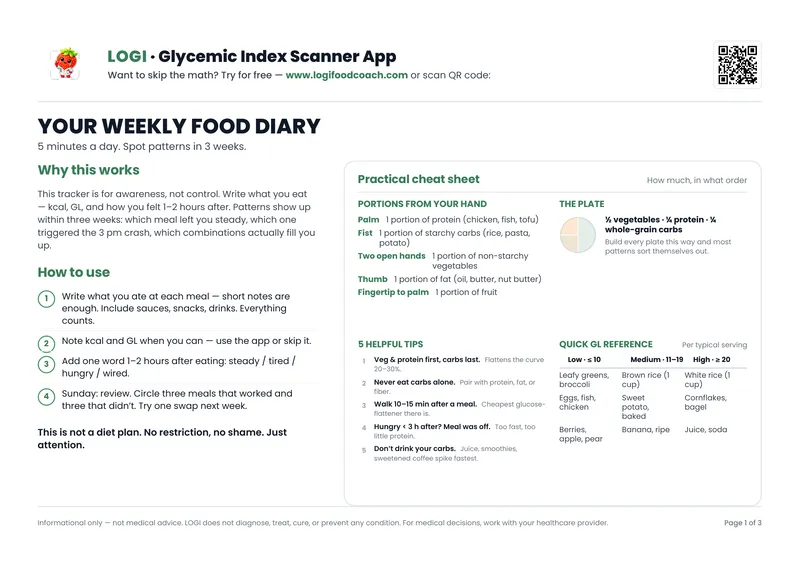
Free PDF — 3 pages
Your Weekly Food Journal
Track meals, glycemic load & mood. Spot patterns in 3 weeks.
No spam. Unsubscribe anytime.