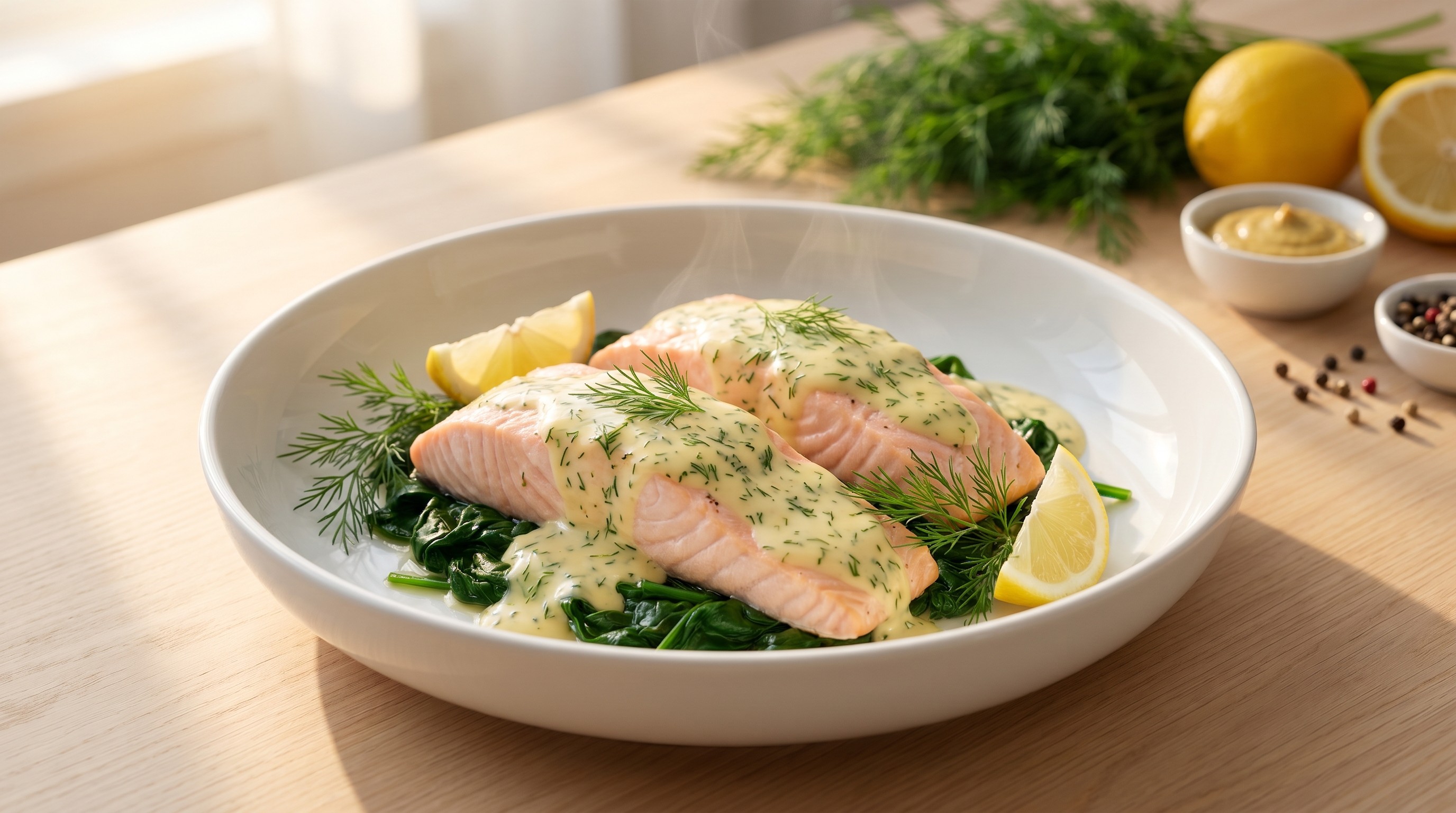
Swedish Poached Salmon with Dill Mustard Cream (Lax med Hovmästarsås)
Gently poached salmon draped in a tangy dill-mustard cream over wilted spinach — a naturally low-GI Scandinavian classic rich in omega-3s.
This elegant Swedish dish showcases salmon at its simplest and most blood-sugar-friendly. By poaching the fillets in a delicate aromatic broth of bay leaf, peppercorns, and lemon, the fish stays meltingly tender without any added fat from frying. The result is a clean, protein-rich centrepiece that produces virtually no glycemic response — exactly the kind of meal that keeps blood sugar steady for hours.
The hovmästarsås, Sweden's beloved mustard-dill sauce, comes together in moments: crème fraîche provides a velvety base, two types of mustard add complexity, and fresh dill ties everything to its Nordic roots. With just 30 grams of crème fraîche for the entire recipe, the sauce stays light while delivering satisfying richness. Paired with quickly wilted baby spinach — one of the most nutrient-dense greens available — the plate is packed with magnesium, iron, and vitamins that support healthy insulin function.
For optimal blood sugar management, consider eating the spinach first before moving to the salmon. The fibre and volume from the greens help slow gastric emptying, meaning any trace carbohydrates in the sauce are absorbed even more gradually. This dish pairs beautifully with a side of steamed broccoli or a small portion of cooled new potatoes (which develop resistant starch), but it is genuinely complete on its own. A weeknight dinner that feels like a dinner party — ready in just twenty minutes.
Blood Sugar Impact
Minimal blood sugar impact expected. This high-protein, high-fat meal with a glycemic load of only 1.0 should produce virtually no glucose spike and provide stable energy for 4-5 hours.
Blood Sugar Tips
- ✓ Add a side of non-starchy vegetables like steamed broccoli or a green salad to increase fiber and volume without raising blood sugar.
- ✓ If serving with potatoes or bread (traditional Swedish accompaniments), keep the portion small and eat the salmon and vegetables first.
- ✓ The healthy fats from salmon and crème fraîche naturally slow gastric emptying—enjoy this meal mindfully to maximize satiety signals.
🥗 Ingredients
- 2 pcs Salmon fillet
- 500 ml Water
- 1 pcs Bay leaf
- 5 pcs Black peppercorn
- 1 pcs Lemon
- 2 tbsp Crème fraîche
- 1 tsp Dijon mustard
- 1 tsp Wholegrain mustard
- 2 tbsp Dill
- 1 tsp Lemon juice
- 150 g Baby spinach
- 1 tsp Olive oil
- 1 tsp Salt
- 0.5 tsp White pepper
- 2 pcs Salmon fillet
- 2.1 cups Water
- 1 pcs Bay leaf
- 5 pcs Black peppercorn
- 1 pcs Lemon
- 2 tbsp Crème fraîche
- 1 tsp Dijon mustard
- 1 tsp Wholegrain mustard
- 2 tbsp Dill
- 1 tsp Lemon juice
- 5.3 oz Baby spinach
- 1 tsp Olive oil
- 1 tsp Salt
- 0.5 tsp White pepper
👨🍳 Instructions
- 1
Pour the water into a wide, shallow pan and add the bay leaf, black peppercorns, and lemon slice. Place over medium heat and bring to a gentle simmer — you want small bubbles breaking the surface, not a rolling boil.
- 2
While the poaching broth heats, pat the salmon fillets dry with kitchen paper and season lightly on both sides with a pinch of salt.
- 3
Once the broth is simmering, carefully lower the salmon fillets in skin-side down. Reduce the heat to low so the liquid barely trembles. Poach gently for 10 to 12 minutes until the flesh turns opaque throughout and flakes easily when pressed at the thickest part.
- 4
While the salmon poaches, prepare the hovmästarsås. In a small bowl, whisk together the crème fraîche, Dijon mustard, wholegrain mustard, chopped dill, and lemon juice until smooth. Season with a grinding of white pepper, taste, and adjust. Set aside at room temperature.
- 5
Heat the olive oil in a separate pan over medium heat. Add the baby spinach in batches if needed, turning with tongs for 1 to 2 minutes until just wilted but still vibrant green. Season lightly with salt and remove from the heat.
- 6
Divide the wilted spinach between two warmed plates, creating a bed in the centre of each. Using a slotted spoon or fish slice, lift the salmon from the poaching liquid, letting any excess broth drain away, and place each fillet skin-side down on the spinach.
- 7
Spoon the dill mustard cream generously over the top of each salmon fillet, allowing it to cascade down the sides. Scatter extra fresh dill over the plate.
- 8
Serve immediately with lemon wedges on the side for squeezing. For best blood sugar results, eat the spinach first — the fibre slows absorption of any carbohydrates that follow.
📊 Nutrition Per Serving
| Per Serving | Whole Dish | |
|---|---|---|
| Calories | 407 | 815 |
| Carbs | 6g | 12g |
| Sugars | 1g | 2g |
| Added Sugars | 0g | 0g |
| Natural Sugars | 1g | 2g |
| Protein | 36g | 72g |
| Fat | 27g | 54g |
| Saturated Fat | 8g | 16g |
| Unsaturated Fat | 19g | 39g |
| Fiber | 3g | 5g |
| Soluble Fiber | 1g | 1g |
| Insoluble Fiber | 2g | 3g |
| Sodium | 1184mg | 2369mg |
Predicted Glucose Response
What if you...
Estimated model — individual responses vary. Not medical advice.
🔄 Lower GI Swaps
Full-fat Greek yogurt has a lower glycemic index (GI ~11) than crème fraîche (GI ~15) and adds more protein, which further slows glucose absorption. Avocado-based cream adds healthy fats and fiber with virtually zero glycemic impact.
Increasing the acidity in the dish through additional lemon juice or vinegar has been shown to lower the overall glycemic response of a meal by slowing gastric emptying and carbohydrate digestion.
While spinach is already very low-GI, swapping in kale or broccoli adds more fiber per serving, which slows glucose absorption further and reduces the overall glycemic load of the meal.
Lower glycemic impact alternative with better blood sugar response for this recipe context.
🔬 The Science Behind This Recipe
Here's the science explainer section for this recipe:
---
This Swedish Poached Salmon is a remarkably blood sugar-friendly meal, and the science behind it is straightforward. With a glycemic load of just 1.0 per serving and an estimated GI of 17, this dish barely registers on your glucose radar. The reason? Salmon is pure protein and healthy fat — two macronutrients that have virtually no direct impact on blood sugar. Unlike carbohydrate-rich foods that break down into glucose during digestion, the omega-3 fatty acids and high-quality protein in salmon are metabolized through entirely different pathways. In fact, research suggests that omega-3s may actually improve how your cells respond to insulin over time, making this fish a double win for metabolic health.
The beauty of this recipe lies in what it doesn't contain rather than what it does. There are essentially no sugars or starches to spike your blood glucose. The poaching liquid — water, bay leaf, peppercorn, and lemon — adds flavor without adding any glycemic burden. This is a perfect example of why glycemic load matters more than glycemic index alone. Even if a food has a measurable GI, the actual amount of carbohydrate per serving (the "load") determines the real-world blood sugar impact. At a glycemic load of 1.0, you'd need to eat an enormous quantity before seeing any meaningful glucose response.
To maximize the metabolic benefits, consider pairing this salmon with a generous portion of non-starchy vegetables like asparagus or a leafy green salad eaten first. If you do add a carbohydrate side — such as new potatoes, which are traditional in Swedish cuisine — the protein and fat from the salmon will naturally slow down glucose absorption. A short 10-15 minute walk after your meal can further help your muscles absorb any circulating glucose, keeping your energy levels steady throughout the evening.
Related recipes
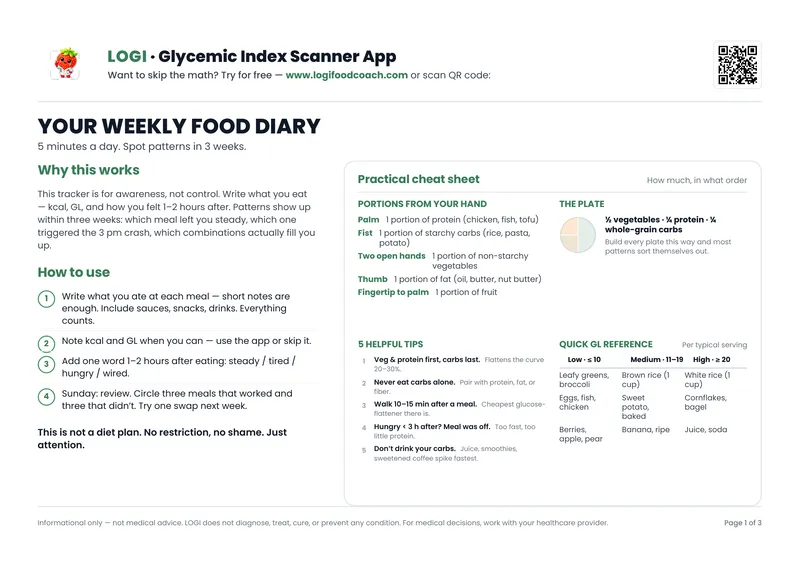
Free PDF — 3 pages
Your Weekly Food Journal
Track meals, glycemic load & mood. Spot patterns in 3 weeks.
No spam. Unsubscribe anytime.