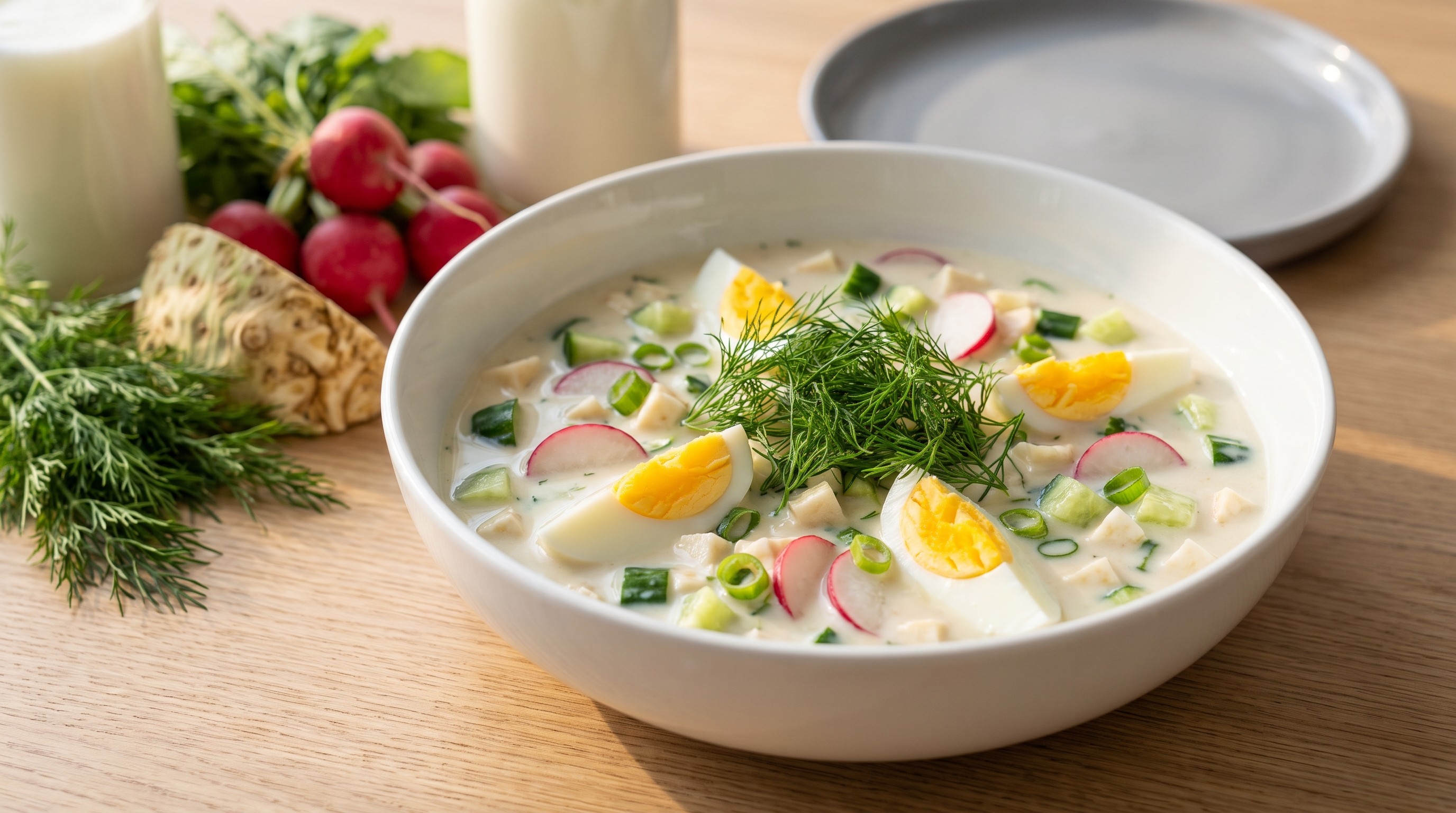
Low-GI Okroshka with Celeriac (Cold Kefir Soup)
Icy-cold kefir soup packed with crunchy vegetables, boiled eggs, and raw celeriac instead of potato — a fermented, fiber-rich bowl that barely nudges blood sugar.
Okroshka is one of Russia’s most refreshing summer traditions — a cold soup where crunchy raw vegetables and protein-rich boiled eggs float in a bath of tangy, chilled kefir. This low-glycemic adaptation stays true to the soul of the original while making one smart swap: raw celeriac replaces the traditional boiled potato. With a glycemic index of roughly 35 compared to potato’s 78, celeriac delivers a satisfying starchy bite alongside substantially more fiber, ensuring a much gentler rise in blood glucose after eating.
The real metabolic star here is the kefir base. As a fermented dairy product, kefir contains bioactive peptides and beneficial bacteria that have been shown to slow gastric emptying and improve insulin sensitivity. Combined with the protein from hard-boiled eggs and the high water and fiber content of cucumber and radishes, this soup creates a meal with an exceptionally low overall glycemic load. The Dijon mustard adds not just a peppery depth of flavor but also contains compounds linked to improved glucose metabolism.
For optimal blood sugar management, serve this soup as a complete light lunch or as a generous starter before a main course. The protein and fat from the eggs and full-fat kefir will help maintain satiety for hours without spiking glucose. If pairing with bread, choose a dense sourdough rye and eat the soup first — the fiber and fermented dairy will blunt the glycemic impact of any accompanying carbohydrates. With all the chopping done while the eggs boil, this nourishing bowl lands on the table in under 25 minutes.
Blood Sugar Impact
Very low blood sugar impact expected. The fermented kefir base provides probiotics that slow gastric emptying, while the low-GI celeriac and high-fiber vegetables keep the glycemic load modest at 11.6, promoting stable blood sugar for 3-4 hours.
Blood Sugar Tips
- ✓ Eat the chunky vegetables (egg, celeriac, radish) first before drinking the kefir broth to slow digestion and blunt any glucose response.
- ✓ Avoid pairing with bread or croutons, which are traditional accompaniments but would significantly raise the glycemic load.
- ✓ Serve well-chilled — cold foods tend to have a slightly lower glycemic response due to increased resistant starch and slower gastric emptying.
🥗 Ingredients
- 2 pcs Egg
- 500 ml Kefir
- 1 pcs Cucumber
- 100 g Celeriac
- 80 g Radish
- 2 pcs Spring onion
- 10 g Dill
- 1 tsp Dijon mustard
- 0.5 tsp Salt
- 2 pcs Egg
- 2.1 cups Kefir
- 1 pcs Cucumber
- 3.5 oz Celeriac
- 2.8 oz Radish
- 2 pcs Spring onion
- 0.4 oz Dill
- 1 tsp Dijon mustard
- 0.5 tsp Salt
👨🍳 Instructions
- 1
Place the eggs in a small saucepan and cover them with cold water by about 2 cm. Set the pan over high heat, bring the water to a full rolling boil, then reduce to a gentle simmer and cook for exactly 10 minutes.
- 2
Immediately transfer the eggs to a bowl of ice water using a slotted spoon. Allow them to cool completely for at least 5 minutes — this stops the cooking and makes peeling effortless.
- 3
While the eggs cool, peel the celeriac and cut it into neat 5 mm dice. Dice the cucumber to roughly the same size so the textures stay consistent throughout the soup.
- 4
Slice the radishes into thin half-moons and finely slice the spring onions, using both the white and green parts. Roughly chop the dill, setting aside a few whole fronds for garnishing at the end.
- 5
Pour the kefir into a mixing jug or bowl. Add the Dijon mustard and a generous pinch of fine salt, then whisk vigorously until the mixture is completely smooth and the mustard is evenly incorporated.
- 6
Taste the kefir base and adjust the seasoning — it should be pleasantly tangy with a subtle savory undertone from the mustard. Add a touch more salt if needed. Chill the base in the refrigerator if it is not already ice-cold.
- 7
Peel the cooled eggs and cut each one into quarters lengthwise. Divide the diced cucumber, celeriac, sliced radishes, and spring onions evenly between two deep serving bowls, then arrange the quartered eggs on top.
- 8
Pour the chilled seasoned kefir over the vegetables and eggs in each bowl. Scatter the chopped dill and reserved fronds over the surface and serve immediately while everything is ice-cold.
📊 Nutrition Per Serving
| Per Serving | Whole Dish | |
|---|---|---|
| Calories | 302 | 604 |
| Carbs | 28g | 56g |
| Sugars | 16g | 31g |
| Added Sugars | 0g | 1g |
| Natural Sugars | 15g | 30g |
| Protein | 19g | 38g |
| Fat | 12g | 24g |
| Saturated Fat | 5g | 10g |
| Unsaturated Fat | 7g | 13g |
| Fiber | 4g | 8g |
| Soluble Fiber | 1g | 3g |
| Insoluble Fiber | 3g | 6g |
| Sodium | 1197mg | 2393mg |
Predicted Glucose Response
What if you...
Estimated model — individual responses vary. Not medical advice.
🔄 Lower GI Swaps
Processed flavor concentrates often contain hidden sugars, maltodextrin, or starch-based carriers that elevate glycemic load. Fresh herbs and alliums contribute negligible carbohydrates and have a near-zero glycemic impact.
Celeriac has a GI of around 35 and is one of the more starch-dense vegetables in this recipe. Kohlrabi (GI ~15), daikon (GI ~15), and turnip (GI ~20) all provide a similar crisp texture with significantly less starch and a lower glycemic load per serving.
Standard dairy kefir contains roughly 4-6 g of lactose-derived sugar per 100 ml. Diluting with mineral water preserves the cold-soup consistency while cutting the sugar load per serving. Plant-based unsweetened kefirs typically have fewer residual sugars and a lower glycemic response.
Commercial Dijon mustard often includes white wine and small amounts of added sugar, contributing a minor but avoidable glycemic load. Mustard powder with vinegar delivers the same sharpness with zero sugar, while vinegar itself has been shown to blunt postprandial blood sugar spikes.
🔬 The Science Behind This Recipe
Here's the science explainer section:
---
Why This Recipe Works for Blood Sugar
This chilled okroshka is a naturally blood-sugar-friendly meal, and it starts with a smart swap: celeriac instead of potato. Celeriac has a much lower glycemic index than traditional potato, meaning it releases its energy slowly rather than flooding your bloodstream with glucose all at once. With an estimated GI of 41 and a glycemic load of just 11.6 per serving, this soup lands comfortably in the "low" category on both scales. Remember, glycemic load takes portion size into account — so it's not just about what you eat, but how much. A small glycemic load like this tells you the actual amount of carbohydrate hitting your system is modest and manageable.
Kefir is the secret powerhouse here. This fermented dairy brings a combination of protein, fat, and probiotics that naturally slows digestion. When protein and fat arrive in your stomach alongside carbohydrates, they act like a speed bump — your body breaks everything down more gradually, which means glucose trickles into your blood instead of surging. The eggs do the same job, adding a solid protein boost that helps keep the meal's overall blood sugar impact gentle and sustained. Meanwhile, cucumber and radish contribute fiber and water with virtually no glycemic impact at all.
To get the most out of this meal, try eating the vegetable-rich portions first before finishing the broth and any bread on the side. A short 10–15 minute walk after eating can also help your muscles absorb glucose more efficiently. The beauty of a dish like okroshka is that it naturally pairs all the right elements — protein, healthy fats, fiber, and fermented foods — so your body does the balancing work without you having to think about it.
Related recipes
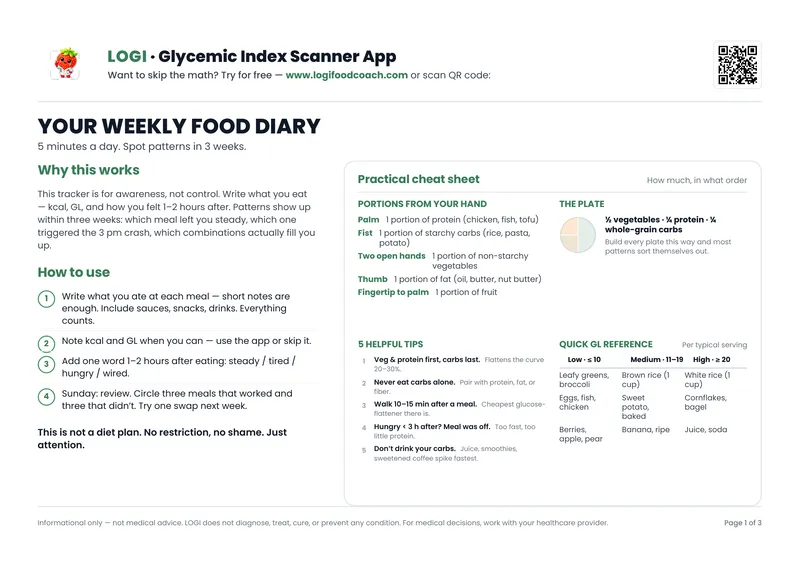
Free PDF — 3 pages
Your Weekly Food Journal
Track meals, glycemic load & mood. Spot patterns in 3 weeks.
No spam. Unsubscribe anytime.