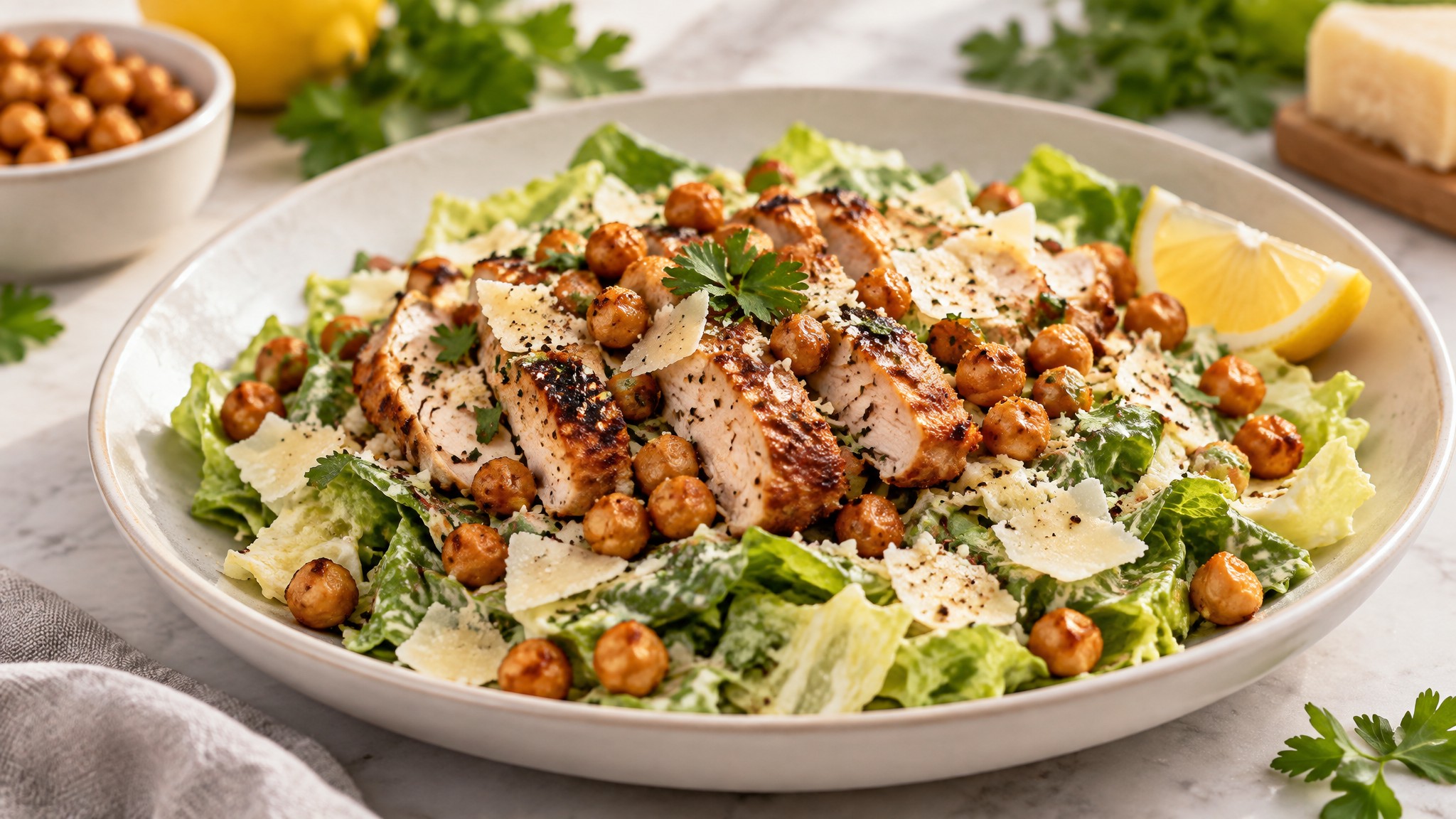
Low-GI Chicken Caesar Salad with Crispy Chickpeas
Crisp romaine, juicy seared chicken thigh and crunchy pan-fried chickpeas in a tangy yogurt-anchovy dressing. This Caesar salad helps keep your blood sugar steady.
This Caesar keeps what makes the classic good: cold, crunchy romaine, a salty, garlicky dressing and plenty of parmesan. Two swaps make it kinder to blood sugar. Crispy pan-fried chickpeas replace the white-bread croutons. White bread is a high-GI food that turns into glucose quickly. Chickpeas have a low GI, usually about 28 to 36, and they bring fiber, plant protein and slowly digested starch. You still get the crunch, but the carbs are released much more gently. The dressing uses full-fat Greek yogurt instead of a raw-egg-and-oil emulsion, which adds protein and a tangy creaminess. Anchovy, garlic, lemon and parmesan give it the savoury depth a Caesar needs.
The chicken thighs are seared in the same skillet as the chickpeas. Thighs stay juicy and are hard to dry out. Protein and fat slow down how fast your stomach empties, so the chickpea carbs reach your bloodstream more slowly. Romaine adds volume, water and fiber for almost no carbohydrate. That makes the salad filling enough for a full meal, without the energy crash that often follows a bread-heavy lunch.
Chickpeas are the main carb source here, so the portion matters. The recipe uses 240 g of drained, cooked chickpeas (about one 400 g can) for two people, which is roughly 120 g, or a generous 3/4 cup, per serving. At that amount the glycemic load stays around 10 per serving. Crispy chickpeas are easy to keep snacking on straight from the pan. Try not to, because larger portions push the glycemic load into the moderate range. If you use canned chickpeas, pick a brand with no added sugar and rinse them well.
To get the most out of this salad for glucose control, start with a few forkfuls of dressed romaine and chicken, then move on to the chickpeas. Eating vegetables and protein before starch can noticeably flatten the post-meal glucose curve. Drink water or unsweetened iced tea with it rather than juice or soda. If you can, take a 10-minute walk afterwards. Everything is cooked in one skillet in about 30 minutes, so it works as a weeknight dinner or a packed lunch. The dressing keeps for 2 to 3 days in a sealed container in the fridge, which makes it handy for meal prep. Store the dressing and the chickpeas separately so the chickpeas stay crunchy.
Blood Sugar Impact
Low impact. Protein from the chicken and Greek yogurt, fat from the olive oil and parmesan, and fiber from the chickpeas should keep blood sugar to a gentle rise and give steady energy for about 3-4 hours.
Blood Sugar Tips
- ✓ Eat some of the chicken and dressed greens before the crispy chickpeas, so protein and fat reach your stomach before the starchiest part of the meal.
- ✓ Keep chickpeas to about 1/2 cup cooked per serving, and don't add croutons or bread, which would raise the glycemic load a lot.
- ✓ Go for a 10-15 minute walk after eating to help your muscles use up the glucose from the chickpeas.
🥗 Ingredients
- 120 g Greek yogurt
- 4 pcs Anchovy fillet
- 1 pcs Garlic
- 1 tbsp Lemon juice
- 30 g Parmesan
- 0.5 tsp Black pepper
- 240 g Chickpeas
- 1.5 tbsp Olive oil
- 0.5 tsp Salt
- 300 g Chicken thigh
- 1 pcs Romaine lettuce
- 4.2 oz Greek yogurt
- 4 pcs Anchovy fillet
- 1 pcs Garlic
- 1 tbsp Lemon juice
- 1.1 oz Parmesan
- 0.5 tsp Black pepper
- 8.5 oz Chickpeas
- 1.5 tbsp Olive oil
- 0.5 tsp Salt
- 10.6 oz Chicken thigh
- 1 pcs Romaine lettuce
👨🍳 Instructions
- 1
Make the dressing. Finely grate 1 small garlic clove into a small bowl and add 4 anchovy fillets. Crush them together with the back of a fork into a smooth paste. Stir in 120 g Greek yogurt, 1 tbsp lemon juice, 15 g (half) of the grated parmesan and 1/2 tsp black pepper until creamy. Refrigerate while you cook. The dressing keeps for 2 to 3 days in a sealed container in the fridge.
- 2
Rinse 240 g drained cooked chickpeas (about one 400 g can, no added sugar) under cold water and drain well. Spread them on a clean kitchen towel, pat them thoroughly dry and remove any loose skins. The drier they are, the crispier they get. Toss them with 3/4 tbsp (half) of the olive oil and a small pinch from 1/2 tsp salt.
- 3
Heat a large skillet over medium-high heat. Add the chickpeas in a single layer and cook for about 8 minutes, shaking the pan often, until blistered, golden and crunchy. Move them to a plate and keep the skillet on the heat. This makes about 120 g per serving. Set them aside for the salad rather than snacking on them, because they are the main carb source and the portion keeps the glycemic load low.
- 4
Sprinkle 2 boneless, skinless chicken thighs (about 300 g total) with the rest of the salt and rub them with the remaining 3/4 tbsp olive oil. Lay them in the hot skillet and sear for about 5 minutes per side, turning once, until deeply browned and the thickest part reads 75 °C (167 °F) on a thermometer. Let them rest on a board for 2 to 3 minutes.
- 5
While the chicken rests, wash and dry 1 large head of romaine lettuce (about 250 g) and tear it into bite-size pieces. Then slice the chicken thinly against the grain.
- 6
Toss the romaine in a large bowl with the chilled dressing until every leaf is lightly coated. Divide between two plates and top each with half of the sliced chicken and half of the crispy chickpeas.
- 7
Finish with the remaining 15 g parmesan, shaved or grated, and serve right away while the chickpeas are still crisp. For a gentler glucose response, eat a few bites of the greens and chicken before the chickpeas. For meal prep, store the dressing, chickpeas, chicken and romaine separately and put the salad together just before eating.
📊 Nutrition Per Serving
| Per Serving | Whole Dish | |
|---|---|---|
| Calories | 790 | 1580 |
| Carbs | 41g | 81g |
| Sugars | 9g | 19g |
| Natural Sugars | 9g | 19g |
| Protein | 60g | 121g |
| Fat | 43g | 86g |
| Saturated Fat | 11g | 23g |
| Unsaturated Fat | 29g | 57g |
| Fiber | 11g | 22g |
| Soluble Fiber | 3g | 7g |
| Insoluble Fiber | 8g | 15g |
| Sodium | 1306mg | 2613mg |
Predicted Glucose Response
What if you...
Estimated model — individual responses vary. Not medical advice.
🔄 Lower GI Swaps
White-bread croutons are high-GI and raise blood sugar quickly. Chickpeas give the same crunch with a low GI and lots of fiber. Seeds or nuts add crunch with almost no carbohydrate if you want to lower the glycemic load even further.
Unsweetened coconut yogurt gives a dairy-free dressing with very little sugar. Leave out the parmesan or use nutritional yeast to keep it fully dairy-free. Skyr is thicker and has more protein than Greek yogurt, which slows digestion and helps flatten the glucose response. Whichever you choose, avoid sweetened or flavoured yogurts.
All of these are very low in carbohydrate and high in water and fiber. Little gem gives the same crisp Caesar texture as romaine, and kale adds more fiber and holds up better for meal prep.
Any lean or oily protein keeps the meal satisfying and slows the absorption of the chickpea carbs. Chicken breast cooks a little faster, so watch it closely and pull it at 75 °C (167 °F) to keep it juicy.
🔬 The Science Behind This Recipe
Classic Caesar salad gets most of its fast-acting carbohydrate from white-bread croutons, which have a high GI (around 70 or more) and are digested into glucose quickly. In this version, pan-crisped chickpeas take their place. Chickpeas have a low GI of about 28 to 36 because their starch is tightly packed with fiber and protein, and part of it is resistant starch that digests slowly. With about 120 g of cooked chickpeas per serving, the estimated glycemic load is around 10 and the estimated GI of the whole meal is around 25. Bigger chickpea portions would push the glycemic load into the moderate range of 11 to 19. The rest of the plate slows things down further. Protein from the chicken thighs, Greek yogurt and parmesan, plus fat from the olive oil, slows how quickly the stomach empties, so glucose enters the bloodstream gradually. Romaine adds fiber and volume with almost no carbohydrate. The dressing has no added sugar, and lemon juice adds acidity, which may slightly blunt the post-meal glucose rise. Eating the greens and chicken before the chickpeas takes advantage of food-order effects: vegetables and protein eaten first can lower the post-meal glucose peak.
Related recipes
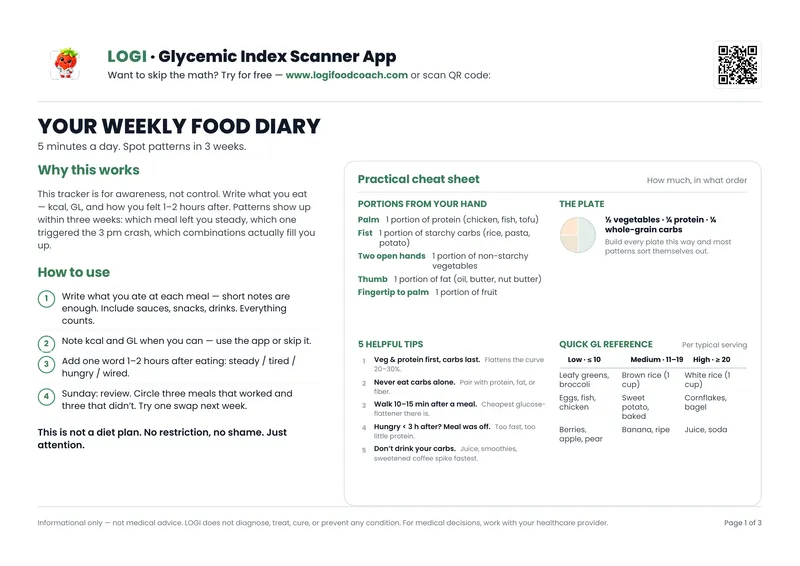
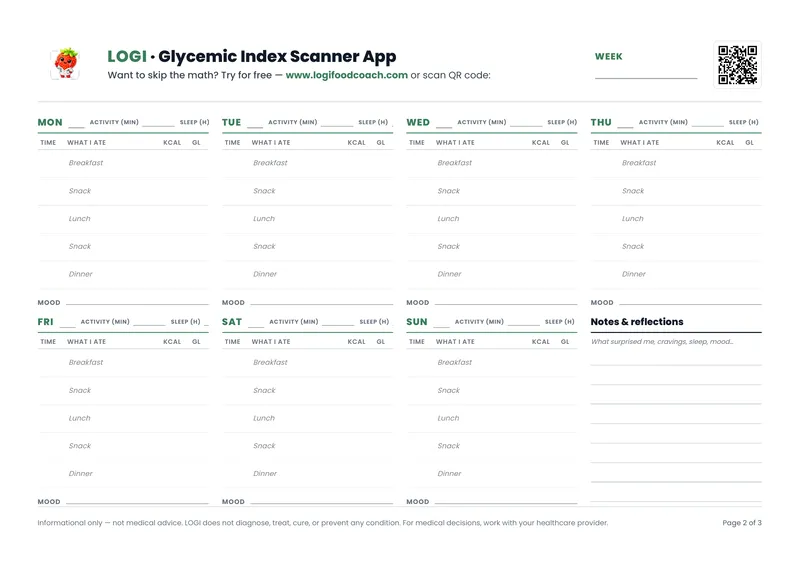
Free PDF — 3 pages
Your Weekly Food Journal
Track meals, glycemic load & mood. Spot patterns in 3 weeks.
No spam. Unsubscribe anytime.