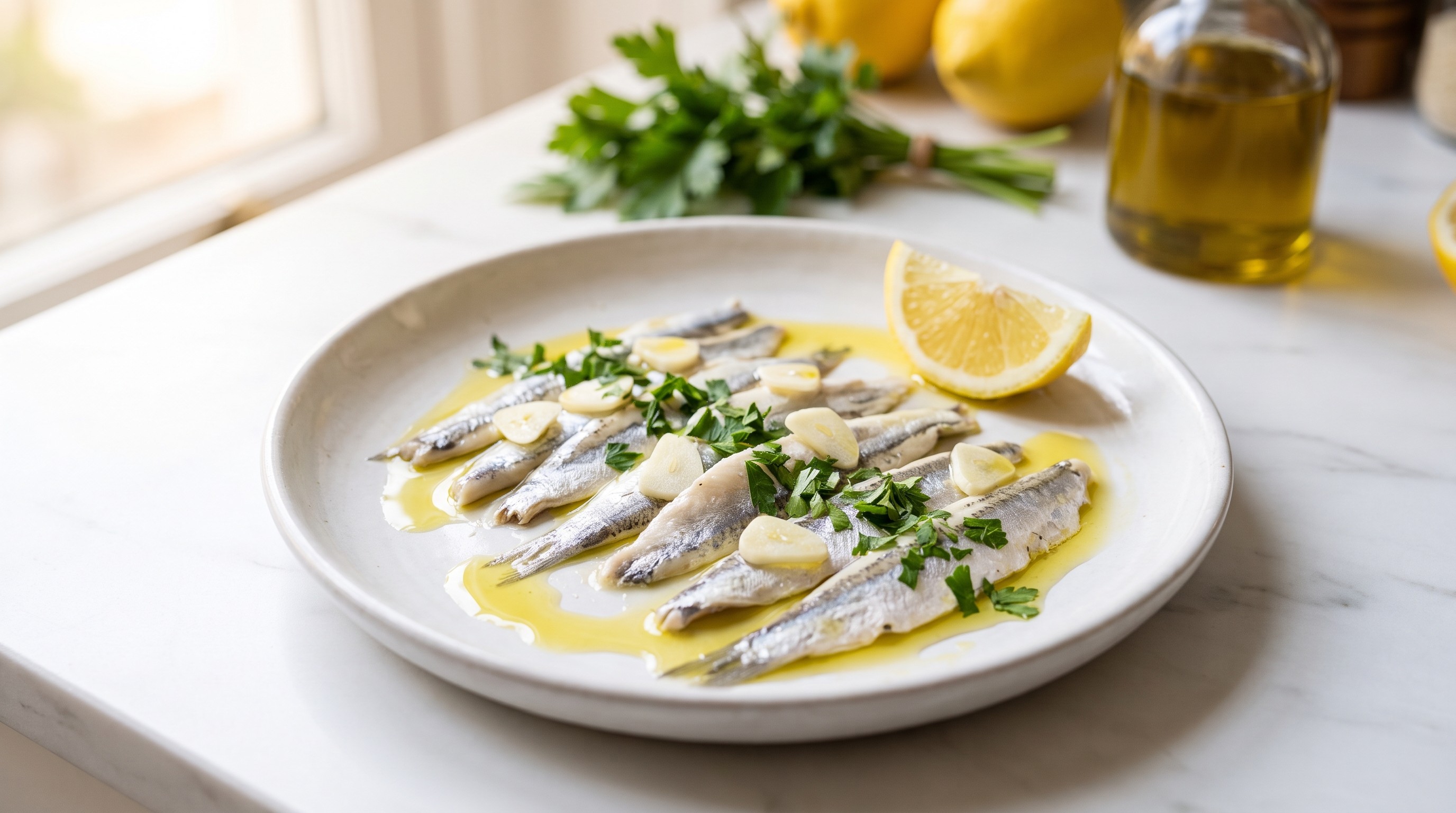
Boquerones en Vinagre (Vinegar-Cured Anchovies)
Spain's iconic zero-carb tapa: silky anchovy fillets cured in white wine vinegar, dressed with raw garlic, parsley, and olive oil — pure omega-3 goodness.
Boquerones en vinagre is a masterclass in how the simplest preparations can also be the most blood-sugar-friendly. Fresh anchovy fillets are cured in white wine vinegar until their flesh turns pearly white and firm, then finished with nothing more than sliced raw garlic, flat-leaf parsley, and a generous pour of extra virgin olive oil. The result is one of Spain's most beloved tapas — and one of the most naturally glycemic-safe dishes you will ever eat.
With virtually zero carbohydrates and no added sugars, this recipe scores at the very bottom of the glycemic index. Every component works in your favour: the acetic acid in the vinegar has been shown to slow gastric emptying and improve post-meal insulin sensitivity, while the omega-3 fatty acids in anchovies support cardiovascular health and reduce systemic inflammation. The extra virgin olive oil contributes heart-healthy monounsaturated fats and polyphenols that further aid glucose metabolism. Even the raw garlic plays a role — allicin, its active compound, has demonstrated modest blood-sugar-lowering effects in clinical studies.
Serve boquerones as the opening tapa of a larger meal to take advantage of the vinegar's glucose-moderating effect on whatever you eat next. Pair them with a slice of seeded sourdough or a small dish of marinated chickpeas for a complete, satisfying starter that keeps your blood sugar steady for hours. The five-hour cure is entirely hands-off, making this an ideal prepare-ahead dish for entertaining.
Blood Sugar Impact
Negligible blood sugar impact. With a glycemic load of just 0.6 and an estimated GI of 22, this protein-and-fat-dominant dish will cause virtually no glucose spike and should support stable blood sugar levels for several hours.
Blood Sugar Tips
- ✓ The vinegar in this dish already acts as a natural glucose moderator — enjoy it as a starter before any carb-containing courses to blunt their glycemic effect.
- ✓ Pair with a slice of sourdough or whole-grain bread rather than white bread to keep the overall meal's glycemic load low.
- ✓ Serve alongside a mixed green salad dressed with the olive oil and lemon to add fiber, further slowing any glucose absorption from accompanying foods.
🥗 Ingredients
- 300 g Anchovy
- 1 tsp Sea salt
- 150 ml White wine vinegar
- 2 pcs Garlic
- 10 g Flat-leaf parsley
- 2 tbsp Extra virgin olive oil
- 2 pcs Lemon
- 10.6 oz Anchovy
- 1 tsp Sea salt
- 10 tbsp White wine vinegar
- 2 pcs Garlic
- 0.4 oz Flat-leaf parsley
- 2 tbsp Extra virgin olive oil
- 2 pcs Lemon
👨🍳 Instructions
- 1
Rinse the whole anchovies under a gentle stream of cold water. Working one fish at a time, pinch the head just behind the gills and snap it off, pulling the attached guts away cleanly. Discard heads and innards.
- 2
Open each gutted fish flat and press your thumb firmly along the backbone from head end to tail, separating the flesh into two fillets. Lift out the spine and discard it. You should have roughly 150 g of clean, boneless fillets.
- 3
Lay the fillets skin-side down in a single, even layer across a shallow glass or ceramic dish — avoid metal, which can react with the vinegar. Sprinkle the fine sea salt evenly over the exposed flesh.
- 4
Pour the white wine vinegar over the fillets until they are fully submerged. Press down any that float to ensure complete contact. Cover the dish tightly with cling film or a fitted lid and transfer to the refrigerator.
- 5
Cure for a minimum of 5 hours — ideally up to 8 — checking once halfway through. The fillets are ready when the flesh has turned uniformly white and opaque throughout, with absolutely no translucent grey remaining in the centre.
- 6
Drain the fillets thoroughly, discarding all the vinegar. Lay them on a double layer of kitchen paper and gently pat both sides dry to remove residual moisture, which would dilute the final dressing.
- 7
Arrange the cured fillets neatly on a serving plate, slightly overlapping. Scatter the thinly sliced garlic and picked parsley leaves generously over the top, then drizzle with the extra virgin olive oil.
- 8
Serve immediately at cool room temperature with lemon wedges on the side. For best blood-sugar results, eat these boquerones as the first course of your meal — the residual acetic acid helps moderate the glucose response of foods that follow.
📊 Nutrition Per Serving
| Per Serving | Whole Dish | |
|---|---|---|
| Calories | 459 | 918 |
| Carbs | 3g | 5g |
| Sugars | 0g | 1g |
| Natural Sugars | 0g | 1g |
| Protein | 44g | 88g |
| Fat | 29g | 57g |
| Saturated Fat | 5g | 11g |
| Unsaturated Fat | 23g | 46g |
| Fiber | 1g | 1g |
| Soluble Fiber | 0g | 0g |
| Insoluble Fiber | 0g | 1g |
| Sodium | 6640mg | 13280mg |
Predicted Glucose Response
What if you...
Estimated model — individual responses vary. Not medical advice.
🔄 Lower GI Swaps
Apple cider vinegar has been shown in clinical studies to improve post-meal insulin sensitivity and slow gastric emptying, producing a more gradual blood sugar response than standard white wine vinegar. Red wine and sherry vinegars contain higher polyphenol concentrations that may further support glucose metabolism.
First cold-pressed extra virgin olive oil retains significantly more oleocanthal and hydroxytyrosol — polyphenols linked to improved insulin sensitivity and reduced post-prandial glucose spikes. A blend with flaxseed oil adds alpha-linolenic acid, which may further support glycemic regulation.
Ceylon cinnamon contains cinnamaldehyde, which has been shown to improve insulin receptor sensitivity and lower fasting blood glucose. Turmeric's curcumin supports healthy glucose metabolism. Both can be used as partial seasoning replacements to reduce sodium while adding blood-sugar-supportive compounds.
🔬 The Science Behind This Recipe
🔬 The Science Behind the Plate
This dish is a blood sugar champion, and it starts with the star ingredient: anchovies. As a pure protein-and-healthy-fat food, anchovies contain virtually zero carbohydrates, which means they have almost no direct impact on your blood sugar. Protein and omega-3 fats digest slowly, keeping you satisfied longer and preventing the energy crashes that often follow carb-heavy meals. When you eat protein first — before any bread or side dishes you might pair with this tapa — you give your body a head start on producing satiety signals, which naturally slows the pace at which any carbohydrates reach your bloodstream.
Then there's the vinegar, which does something genuinely fascinating. Research has shown that acetic acid — the active compound in white wine vinegar — can reduce the blood sugar response to a meal by slowing gastric emptying and improving how your muscles absorb glucose. In practical terms, vinegar-based dishes like boquerones act as a kind of metabolic buffer when eaten alongside higher-carb foods. This is why starting a Spanish meal with vinegar-marinated tapas before the bread basket arrives is not just delicious — it's a smart sequencing strategy your body will thank you for.
With a glycemic load of just 0.6 per serving and an estimated GI of 22, this recipe sits firmly in the "very low" category on both scales. Remember, glycemic load accounts for the actual amount of carbohydrate in a realistic portion — not just how fast a food raises blood sugar in theory. A GL under 10 is considered low, so at 0.6 this dish barely registers. To maximize the benefits, enjoy these anchovies at the start of your meal, pair them with a short 10-to-15-minute walk afterward, and let the combination of protein, healthy fats, and vinegar work together as your first line of support for steady, balanced energy throughout the day.
Related recipes
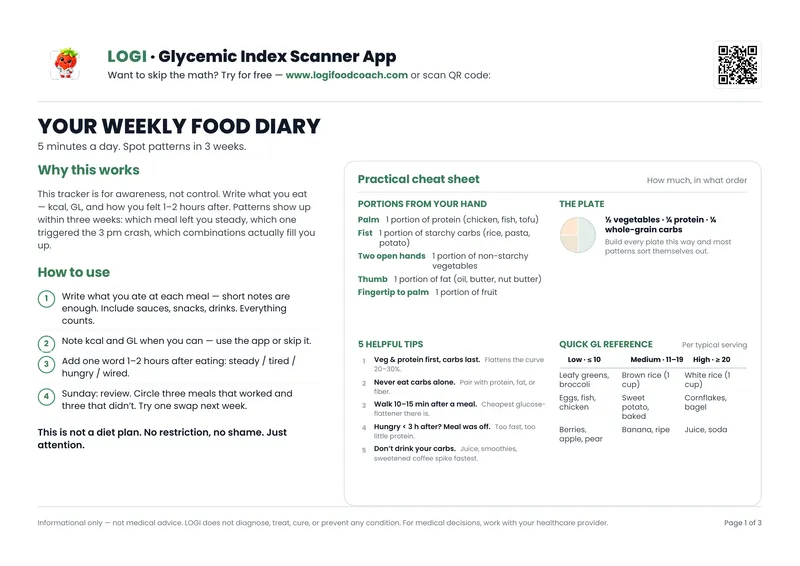
Free PDF — 3 pages
Your Weekly Food Journal
Track meals, glycemic load & mood. Spot patterns in 3 weeks.
No spam. Unsubscribe anytime.