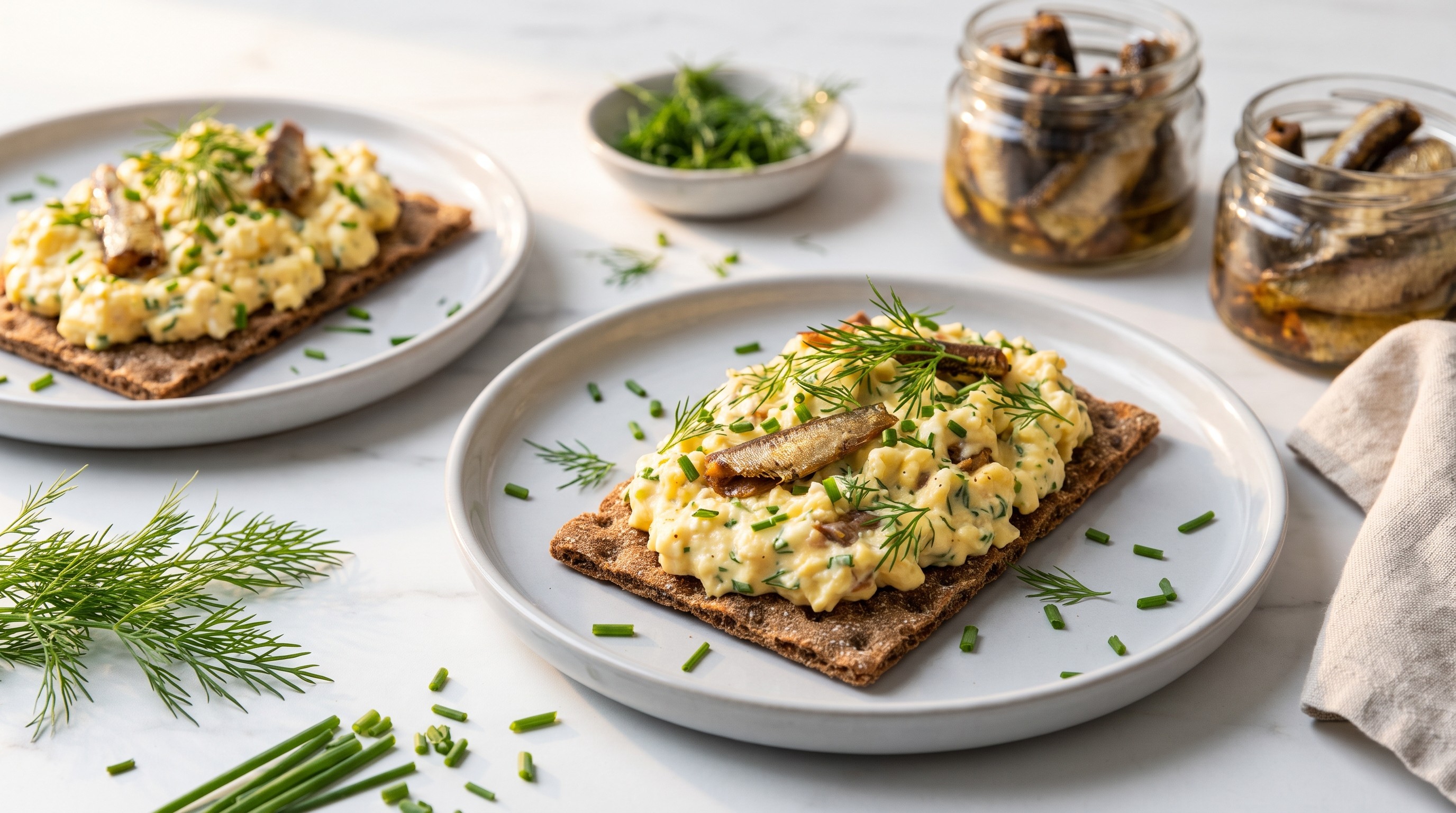
Gubbröra (Swedish Egg and Sprat Mix on Rye Crispbread)
A classic Swedish appetizer of chunky eggs and briny sprats folded with crème fraîche and fresh herbs, served on fiber-rich rye crispbread for steady blood sugar.
Gubbröra — literally "old man's mix" — is one of Sweden's most beloved appetizers, and it happens to be a near-perfect dish for blood sugar management. The generous base of hard-boiled eggs and omega-3-rich sprats delivers sustained protein and healthy fats that slow gastric emptying, keeping glucose absorption gradual and even. A spoonful of crème fraîche binds everything with creamy richness while contributing virtually no carbohydrates.
The only meaningful source of starch in this recipe is the rye crispbread, and it is one of the smartest choices you can make. Whole-grain rye scores in the medium-GI range and is exceptionally high in soluble fiber, which forms a viscous gel in the gut that physically slows the release of glucose into the bloodstream. Paired with the protein and fat in the topping, the total meal response stays remarkably flat — clinical studies consistently show that rye-based meals produce lower insulin peaks than wheat equivalents.
Preparation takes just twenty minutes and requires no special technique. Coarsely chop hard-boiled eggs so you keep satisfying, chunky texture, fold in chopped sprats, crème fraîche, red onion, and a shower of fresh chives and dill, then pile the mix onto crispbreads. The lemon juice lifts the richness and adds a gentle acidity that may further moderate postprandial glucose. For the best glycemic result, eat the topping first and save the crispbread bites for last — front-loading protein before carbohydrates is a well-documented strategy for flattening the glucose curve.
Blood Sugar Impact
Moderate-low impact — the rye crispbread provides slowly digested carbohydrates while the protein-rich eggs and sprats, along with the fat from crème fraîche, will blunt and flatten the glucose curve, delivering steady energy for 3-4 hours.
Blood Sugar Tips
- ✓ Eat the protein-rich components (egg and sprat mixture) before biting into the crispbread to slow gastric emptying and reduce the glucose spike from the carbs.
- ✓ Add a small side salad with vinegar-based dressing — acetic acid has been shown to lower postprandial glucose by up to 30%.
- ✓ Limit portion to 2-3 crispbreads per sitting; the GL of 14.8 is moderate, and additional servings would push it into the high range.
🥗 Ingredients
- 5 pcs Egg
- 1 pcs Swedish sprats
- 4 tbsp Crème fraîche
- 0.5 pcs Red onion
- 1 pcs Chives
- 1 pcs Dill
- 1 tbsp Lemon juice
- 6 pcs Rye crispbread
- 5 pcs Egg
- 1 pcs Swedish sprats
- 4 tbsp Crème fraîche
- 0.5 pcs Red onion
- 1 pcs Chives
- 1 pcs Dill
- 1 tbsp Lemon juice
- 6 pcs Rye crispbread
👨🍳 Instructions
- 1
Set the eggs in a single layer in a saucepan and pour in enough cold water to cover them by about 2 cm. Bring the water to a rolling boil over high heat.
- 2
Once boiling, reduce the heat slightly and cook the eggs for exactly 10 minutes. While they cook, prepare a bowl of ice water large enough to hold all the eggs.
- 3
Transfer the eggs immediately to the ice water using a slotted spoon and let them cool for at least 5 minutes. Peel under gently running water to remove any clinging shell fragments.
- 4
Drain the tin of sprats thoroughly, discarding the brine. Chop them into rough 1 cm pieces — they should hold some shape rather than turning into a paste.
- 5
Chop the peeled eggs coarsely with a large knife, keeping the texture deliberately chunky so distinct pieces of white and golden yolk remain visible throughout.
- 6
Finely dice the red onion. Snip the chives into small rings, reserving a pinch for garnish. Chop the dill fronds, setting aside a few sprigs for finishing.
- 7
Combine the chopped eggs, sprats, crème fraîche, diced red onion, most of the chives, chopped dill, and lemon juice in a mixing bowl. Fold gently with a spatula until just combined — avoid over-mixing so the texture stays rustic and chunky.
- 8
Spoon the gubbröra generously onto the rye crispbreads, mounding it slightly in the center. Scatter the reserved chives and dill fronds over the top and serve immediately.
📊 Nutrition Per Serving
| Per Serving | Whole Dish | |
|---|---|---|
| Calories | 495 | 990 |
| Carbs | 29g | 58g |
| Sugars | 4g | 8g |
| Natural Sugars | 4g | 8g |
| Protein | 29g | 58g |
| Fat | 28g | 56g |
| Saturated Fat | 11g | 22g |
| Unsaturated Fat | 17g | 34g |
| Fiber | 6g | 12g |
| Soluble Fiber | 2g | 4g |
| Insoluble Fiber | 4g | 8g |
| Sodium | 381mg | 762mg |
Predicted Glucose Response
What if you...
Estimated model — individual responses vary. Not medical advice.
🔄 Lower GI Swaps
Rye crispbread has a moderate-to-high GI (~65) and is the primary carbohydrate source driving the GL of this dish. Flaxseed crackers (GI ~1) and almond flour crackers (GI ~10) are extremely low-GI due to their high fat, fiber, and protein content with minimal starch. Cucumber rounds eliminate the glycemic load from the base entirely while adding a fresh crunch.
Creme fraiche has a low but nonzero carbohydrate content (~3g per 100g). Mashed avocado provides a similarly creamy texture with nearly zero glycemic impact, plus its healthy fats and fiber help slow glucose absorption from the overall meal. Full-fat Greek yogurt has a very low GI (~11) and adds protein, which further blunts the blood sugar response.
Red onion contains more natural sugars (~7g per 100g) than spring onion (~5g per 100g, and less is typically used). Spring onions deliver a similar sharp flavor with a smaller glycemic contribution. Pickled capers add briny flavor with virtually zero carbohydrates and no measurable glycemic impact.
🔬 The Science Behind This Recipe
Here's the science explainer section:
---
Why This Recipe Works for Your Blood Sugar
Gubbröra is a beautifully balanced dish where every ingredient plays a role in keeping your blood sugar steady. The eggs and sprats deliver a powerful combination of protein and healthy fats — two nutrients that naturally slow down digestion. When your body breaks down food more gradually, glucose trickles into your bloodstream instead of flooding it all at once. The omega-3 fatty acids in the sprats are especially helpful here, as they support your body's ability to respond to insulin effectively. Meanwhile, the crème fraîche adds another layer of fat that acts like a gentle brake on carbohydrate absorption.
The real star of this recipe, from a blood sugar perspective, is the rye crispbread base. Unlike refined white bread, rye is rich in soluble fiber that forms a gel-like barrier in your gut, physically slowing the rate at which sugars pass into your blood. With an estimated GI of 51, this dish sits comfortably in the low-glycemic range — but what matters even more is the glycemic load of 14.8 per serving, which accounts for the actual amount of carbohydrates you're eating, not just how fast they hit. Think of GI as the speed limit and glycemic load as the total distance — both need to be modest for a smooth ride.
To get the most from this meal, try eating the onion and chive garnish first, saving the crispbread bites for after. A short 10-15 minute walk after eating can further help your muscles absorb glucose naturally. The combination of protein-rich eggs, fatty sprats, and fiber-packed rye makes Gubbröra a textbook example of how traditional Scandinavian cooking naturally supports balanced energy — no substitutions needed.
---
Word count: 262 words. Structured in three clear paragraphs covering protein/fat synergy, the GI vs. glycemic load distinction, and practical tips for minimizing glucose spikes.
Related recipes
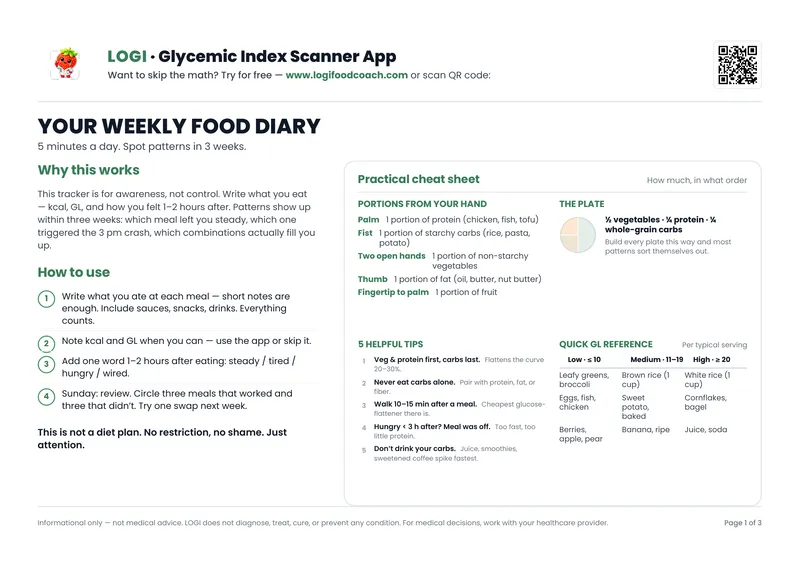
Free PDF — 3 pages
Your Weekly Food Journal
Track meals, glycemic load & mood. Spot patterns in 3 weeks.
No spam. Unsubscribe anytime.