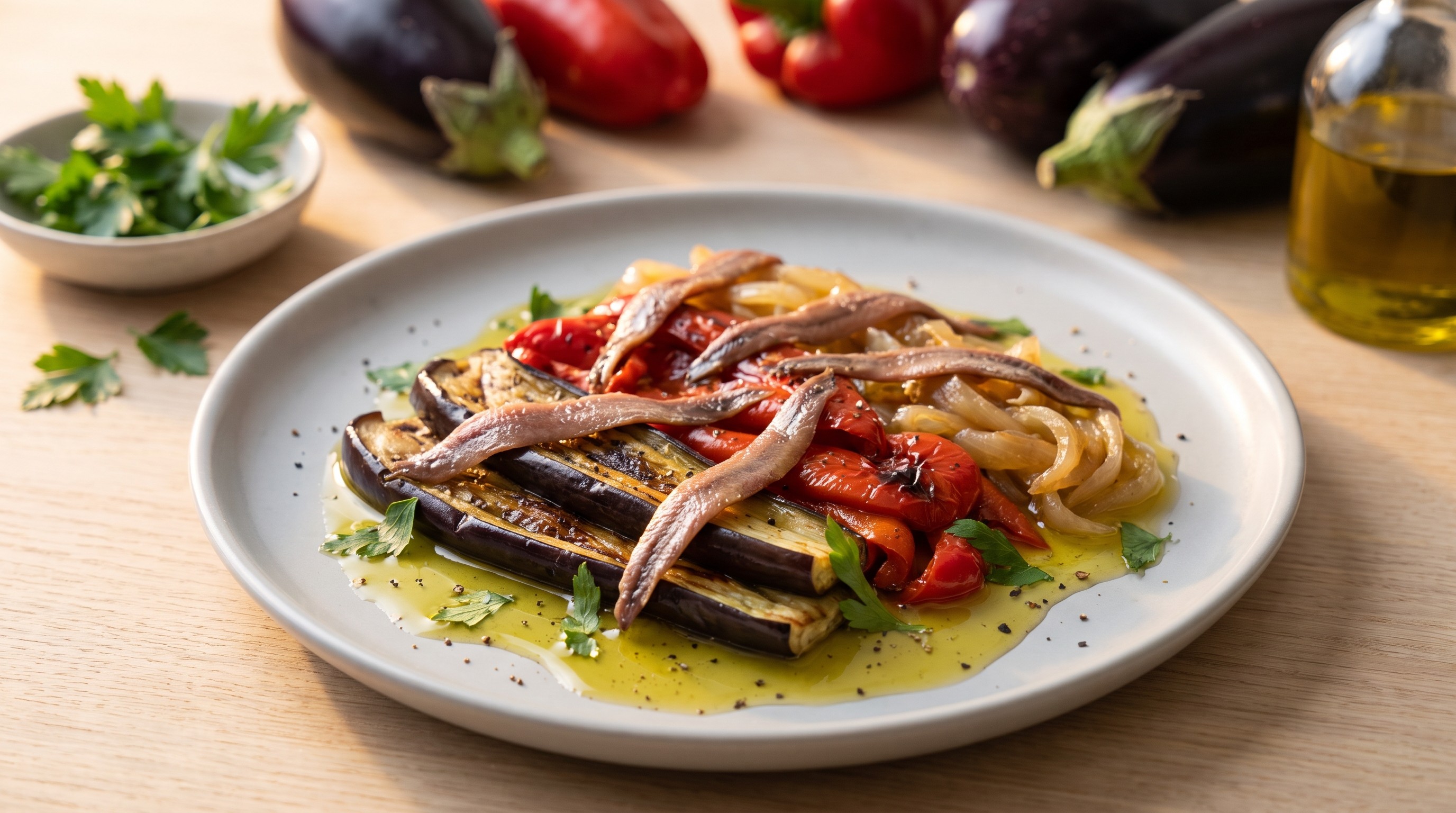
Escalivada (Catalan Smoky Roasted Vegetables with Anchovies)
Catalonia's elemental summer dish — whole vegetables roasted until silky-sweet, stripped by hand, and finished with anchovies, olive oil, and sherry vinegar.
Escalivada is one of those rare dishes that arrives naturally blood-sugar-friendly without a single swap or substitution. Whole aubergines, peppers, onions, tomatoes, and garlic are blackened in a blazing oven until their skins blister and the flesh beneath collapses into something smoky, jammy, and deeply sweet — sweetness born from slow caramelisation, not added sugar. The fibre in every vegetable stays intact, slowing glucose absorption, while the generous pour of extra-virgin olive oil adds monounsaturated fat that further flattens any post-meal blood-sugar curve.
Anchovy fillets draped across the top deliver protein and omega-3 fatty acids, turning what could be a simple side into a satisfying light meal. Sherry vinegar — a classic Catalan finishing touch — brings acidity that studies have linked to improved post-meal glycaemic response. Together, the fat, protein, fibre, and acid in this dish hit every lever that helps keep blood sugar steady.
Serve escalivada at room temperature, as tradition demands. It improves after resting, so make it an hour ahead if you can. Pair it with a handful of marcona almonds or a slice of seeded sourdough for added protein and slow-release carbohydrate. For optimal blood-sugar management, eat the vegetables before any accompanying bread — the fibre and fat create a buffer that blunts the glucose impact of whatever follows.
Blood Sugar Impact
Very minimal blood sugar impact expected. With a glycemic load of just 6.0 and an estimated GI of 18, this fiber-rich vegetable dish paired with healthy fats from olive oil and protein from anchovies will produce a slow, gentle rise in blood glucose and provide stable energy for 3-4 hours.
Blood Sugar Tips
- ✓ Enjoy the anchovies and olive oil alongside the vegetables rather than separately — the protein and fat slow gastric emptying and further blunt any modest glucose response from the roasted onions and tomatoes.
- ✓ If serving with bread or other starchy sides, eat the escalivada first to create a fiber-and-fat buffer that reduces the glycemic impact of the carbohydrates that follow.
- ✓ A short 10-15 minute walk after the meal will enhance glucose uptake by muscles and keep blood sugar especially flat.
🥗 Ingredients
- 1 pcs Aubergine
- 2 pcs Red bell pepper
- 1 pcs White onion
- 1 pcs Tomato
- 4 pcs Garlic clove
- 3 tbsp Extra virgin olive oil
- 2 tsp Sherry vinegar
- 6 pcs Anchovy fillet
- 0.5 tsp Flaky sea salt
- 0.25 tsp Black pepper
- 2 tbsp Flat-leaf parsley
- 1 pcs Aubergine
- 2 pcs Red bell pepper
- 1 pcs White onion
- 1 pcs Tomato
- 4 pcs Garlic clove
- 3 tbsp Extra virgin olive oil
- 2 tsp Sherry vinegar
- 6 pcs Anchovy fillet
- 0.5 tsp Flaky sea salt
- 0.25 tsp Black pepper
- 2 tbsp Flat-leaf parsley
👨🍳 Instructions
- 1
Set your oven to 230 °C (450 °F) and position a rack in the centre. Line a large baking tray with foil for easy cleanup.
- 2
Pierce the aubergine deeply in several places with a fork — this prevents it from bursting as steam builds inside. Cut the onion in half through the root, leaving the skin on to hold the layers together during roasting.
- 3
Arrange the whole aubergine, whole red peppers, onion halves (cut-side down), whole tomato, and unpeeled garlic cloves on the prepared tray. Space them so hot air can circulate around each piece.
- 4
Roast for 20 minutes, then use tongs to turn the aubergine and peppers. Return the tray to the oven and continue roasting for another 20 minutes until every surface is blistered and deeply charred and the vegetables feel soft and yielding when pressed.
- 5
Immediately transfer the peppers to a heatproof bowl and cover tightly with a plate or cling film. Let them steam for 10 minutes — the trapped moisture lifts the skins cleanly. Set the remaining vegetables aside until cool enough to handle.
- 6
Peel everything by hand: slide the skins off the peppers and tomato, scoop the aubergine flesh from its charred shell with a spoon, peel away the onion skin, and squeeze the garlic cloves from their papery husks. Tear all the vegetables into long, rough strips using your fingers — a knife gives too clean an edge and loses the rustic character. Let the collected juices run onto a flat serving plate.
- 7
Arrange the torn vegetable strips loosely across the plate, intermingling colours. Drape the anchovy fillets over the top, then drizzle generously with extra-virgin olive oil and sherry vinegar. Season with flaky sea salt and freshly ground black pepper.
- 8
Scatter torn parsley leaves over the surface and serve at room temperature. Escalivada benefits from resting — if time allows, dress it 30 minutes before serving so the flavours meld.
📊 Nutrition Per Serving
| Per Serving | Whole Dish | |
|---|---|---|
| Calories | 362 | 724 |
| Carbs | 34g | 67g |
| Sugars | 19g | 37g |
| Natural Sugars | 19g | 37g |
| Protein | 9g | 18g |
| Fat | 23g | 46g |
| Saturated Fat | 3g | 7g |
| Unsaturated Fat | 19g | 38g |
| Fiber | 11g | 22g |
| Soluble Fiber | 3g | 7g |
| Insoluble Fiber | 8g | 15g |
| Sodium | 1027mg | 2054mg |
Predicted Glucose Response
What if you...
Estimated model — individual responses vary. Not medical advice.
🔄 Lower GI Swaps
Red onions have a comparable GI but are richer in quercetin, which research links to improved insulin sensitivity. Spring onions and shallots contain fewer total carbohydrates per serving, contributing to a marginally lower glycemic load.
Red bell peppers are the ripest stage and contain roughly 4.2 g sugar per 100 g versus ~2.9 g in green peppers. Choosing less-ripe peppers slightly reduces the sugar load and overall glycemic impact of the dish.
Cherry tomatoes have a slightly higher fiber-to-sugar ratio than large slicing tomatoes, which slows glucose absorption. Green (unripe) tomatoes contain less natural sugar, further reducing the glycemic load per serving.
Apple cider vinegar has stronger clinical evidence for blunting post-meal blood sugar spikes due to its acetic acid concentration. Studies show consuming vinegar with a meal can reduce the glycemic response by up to 20-30%; ACV and red wine vinegar tend to deliver this effect more reliably than sherry vinegar.
🔬 The Science Behind This Recipe
Here's the science explainer section:
---
Why This Recipe Works for Blood Sugar
Escalivada is a dream for steady blood sugar, and the numbers tell the story: with a glycemic load of just 6.0 and an estimated GI of 18, this dish barely registers on your glucose radar. But what makes it so gentle? It starts with the star ingredient — eggplant. Eggplant is remarkably low in digestible carbohydrates and rich in soluble fiber, which forms a gel-like barrier in your gut that slows the absorption of sugars into your bloodstream. Pair that with the natural fiber in roasted bell peppers and onions, and you've got a meal that moves through your system at a pace your body can comfortably handle.
Here's a concept worth knowing: glycemic load. While glycemic index tells you how fast a food raises blood sugar, glycemic load factors in how much carbohydrate you're actually eating. A serving of this escalivada delivers so few net carbs that even though vegetables do contain natural sugars, the real-world impact on your blood sugar stays minimal. Think of it as the difference between a drizzle and a downpour — your body can easily manage a drizzle.
The anchovies and olive oil in this dish aren't just there for flavor — they're doing metabolic work. The protein from anchovies and the healthy fats from olive oil both slow gastric emptying, meaning your stomach takes longer to release food into your intestines. This creates a slower, flatter glucose curve rather than a sharp spike. For an extra edge, enjoy your escalivada before any bread or grain-based side, and consider a short 10-15 minute walk after eating — both are simple, evidence-backed strategies to keep your blood sugar even smoother.
Related recipes
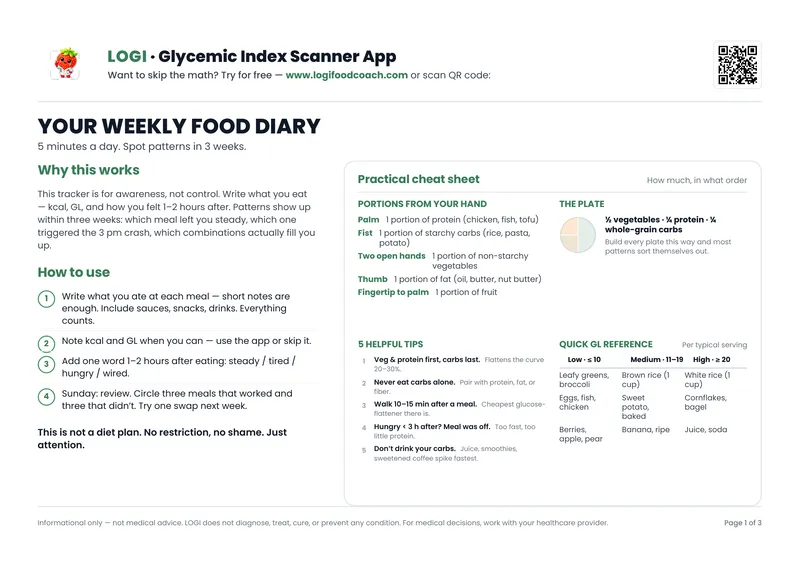
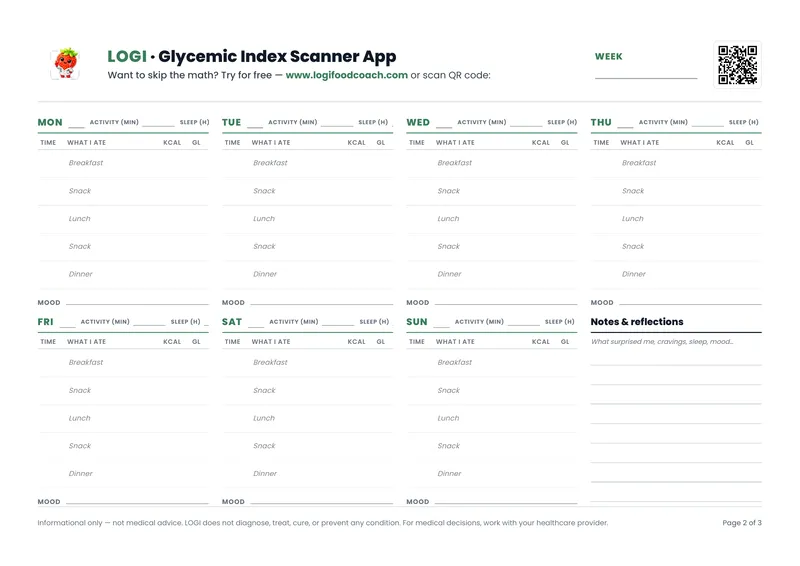
Free PDF — 3 pages
Your Weekly Food Journal
Track meals, glycemic load & mood. Spot patterns in 3 weeks.
No spam. Unsubscribe anytime.