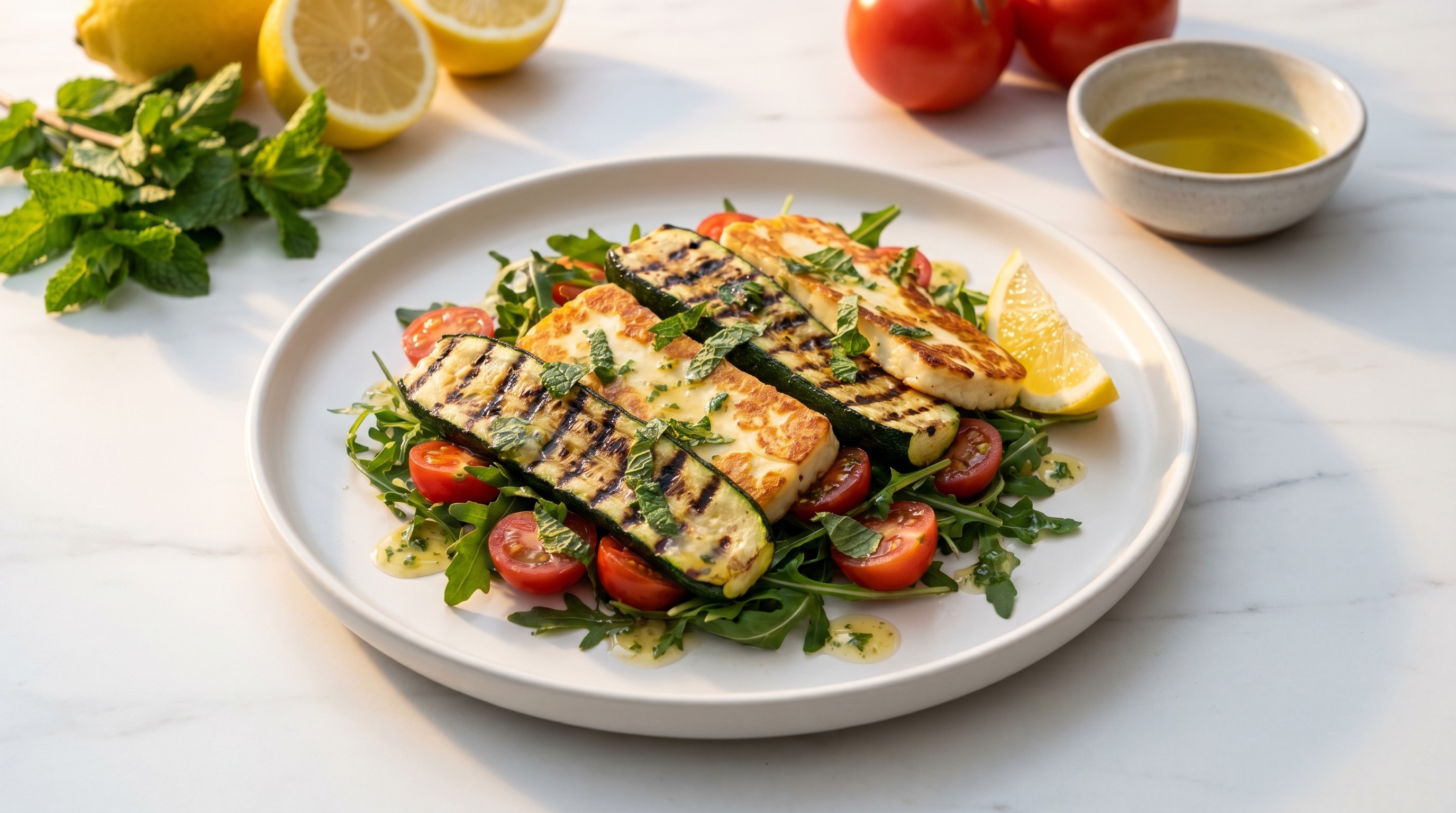
Grilled Courgette and Halloumi Salad with Lemon-Mint Dressing
Charred halloumi and courgette ribbons over peppery rocket with a bright lemon-mint dressing — high-protein, low-GI, and ready in just 22 minutes.
This grilled halloumi salad is a masterclass in low-glycemic eating that never feels like a compromise. Every component sits comfortably in the low-GI range: halloumi provides 22 grams of protein per serving with virtually no carbohydrate impact, while courgette ribbons deliver satisfying volume and fibre without the blood sugar spike you'd get from croutons or pasta-based salads. The cherry tomatoes and rocket add antioxidants and micronutrients, and the healthy fats from olive oil and pine nuts help slow glucose absorption even further.
The lemon-mint dressing deserves special attention. Built on extra virgin olive oil and fresh lemon juice with a touch of Dijon mustard, it's bright and sharp enough to balance the natural saltiness of halloumi — all without a single grain of added sugar. The raw garlic and torn mint add layers of flavour that make bottled dressings entirely unnecessary. This is a dressing you can use freely without worrying about hidden sweeteners.
For optimal blood sugar management, eat the rocket and tomato base first before moving on to the halloumi and courgette. The fibre from the greens creates a buffer that slows digestion of subsequent bites. Pair this salad with a glass of sparkling water with lemon, or serve it alongside a small portion of sourdough bread if you want additional carbohydrates — sourdough's fermentation process gives it a lower glycemic response than standard bread. This dish works beautifully as a standalone lunch or as a generous side at dinner.
Blood Sugar Impact
Very minimal blood sugar impact expected. With a glycemic load of only 3.4 and an estimated GI of 20, this meal's high fat and protein content from halloumi and olive oil will ensure slow, steady glucose absorption and stable energy for 3-4 hours.
Blood Sugar Tips
- ✓ Eat the rocket and courgettes first before the halloumi to front-load fiber and further blunt any minor glucose response.
- ✓ Enjoy the meal slowly — the healthy fats from olive oil and pine nuts already slow digestion, and mindful eating enhances this effect.
- ✓ Take a gentle 10-15 minute walk after eating to support glucose uptake by muscles, though this meal is unlikely to cause any meaningful spike.
🥗 Ingredients
- 250 g Halloumi
- 2 pcs Courgette
- 60 g Rocket
- 150 g Cherry tomato
- 1 tbsp Extra virgin olive oil
- 20 g Pine nut
- 2 tbsp Extra virgin olive oil
- 30 ml Lemon juice
- 1 tsp Dijon mustard
- 1 pcs Garlic
- 10 g Mint
- 1 tsp Black pepper
- 8.8 oz Halloumi
- 2 pcs Courgette
- 2.1 oz Rocket
- 5.3 oz Cherry tomato
- 1 tbsp Extra virgin olive oil
- 0.7 oz Pine nut
- 2 tbsp Extra virgin olive oil
- 2 tbsp Lemon juice
- 1 tsp Dijon mustard
- 1 pcs Garlic
- 0.4 oz Mint
- 1 tsp Black pepper
👨🍳 Instructions
- 1
Prepare the lemon-mint dressing by combining the 2 tablespoons of extra virgin olive oil, lemon juice, Dijon mustard, and finely grated garlic in a small bowl. Whisk until emulsified, then stir in the torn mint leaves and a generous grind of black pepper. Set aside to let the flavours meld.
- 2
Slice the halloumi into 1cm-thick slabs. Cut the courgettes lengthways into thin 5mm ribbons using a knife or mandoline. Halve the cherry tomatoes and set aside with the rocket.
- 3
Place a ridged grill pan or heavy cast-iron skillet over high heat and let it get properly hot for about 2 minutes — you want it nearly smoking. Brush the courgette ribbons lightly with the tablespoon of olive oil reserved for grilling.
- 4
Grill the courgette ribbons in batches, laying them flat without overlapping. Cook for 2 to 3 minutes per side until distinct char lines develop and the flesh is just tender but not limp. Transfer each batch to a plate as it finishes.
- 5
Using the same hot pan without adding any extra oil, lay the halloumi slices down and grill for about 2 minutes per side. Resist the urge to move them — the halloumi needs uninterrupted contact with the pan to develop a deep golden-brown crust. Remove once both sides are well coloured.
- 6
While the halloumi rests briefly, toast the pine nuts in a separate dry pan over medium heat. Shake the pan frequently and watch them closely — they go from golden to burnt in seconds. Once evenly toasted, about 2 minutes, tip them out of the pan immediately.
- 7
Divide the rocket between two plates and scatter the halved cherry tomatoes over the leaves. Arrange the charred courgette ribbons on top, then place the grilled halloumi slices over the courgette.
- 8
Spoon the lemon-mint dressing generously over each plate, scatter the toasted pine nuts on top, and serve immediately while the halloumi is still warm and slightly springy.
📊 Nutrition Per Serving
| Per Serving | Whole Dish | |
|---|---|---|
| Calories | 720 | 1440 |
| Carbs | 17g | 34g |
| Sugars | 10g | 19g |
| Added Sugars | 0g | 0g |
| Natural Sugars | 10g | 19g |
| Protein | 33g | 66g |
| Fat | 60g | 121g |
| Saturated Fat | 24g | 47g |
| Unsaturated Fat | 36g | 73g |
| Fiber | 5g | 9g |
| Soluble Fiber | 1g | 2g |
| Insoluble Fiber | 2g | 5g |
| Sodium | 1058mg | 2116mg |
Predicted Glucose Response
What if you...
Estimated model — individual responses vary. Not medical advice.
🔄 Lower GI Swaps
Cherry tomatoes have a moderate glycemic index (around GI 30). Cucumbers (GI ~15) and radishes (GI ~15) have a negligibly low glycemic index and glycemic load, further reducing the overall blood sugar impact of the salad.
While pine nuts are already low-GI, walnuts (GI ~15) and almonds (GI ~15) have a higher fiber and healthy fat content per serving, which can further slow glucose absorption and blunt any postprandial blood sugar rise. Pumpkin seeds also offer excellent chromium content, which supports insulin sensitivity.
Dijon mustard may contain small amounts of added sugar. Whole grain mustard retains more seed fiber, and a tahini-mustard blend adds healthy fats and protein that help moderate the glycemic response of the overall meal.
Halloumi is already low-GI, but firm tofu (GI ~15) and paneer have virtually no carbohydrates and thus near-zero glycemic load. Tofu also contains plant protein that has been shown to support more stable postprandial glucose levels compared to some dairy proteins.
🔬 The Science Behind This Recipe
Here's the science explainer section:
---
Why This Recipe Loves Your Blood Sugar
With a glycemic load of just 3.4 per serving and an estimated GI of 20, this salad is a standout for steady energy. But what makes it so gentle on your blood sugar? It starts with the courgettes — these summer squashes are mostly water and fiber, meaning they deliver very few digestible carbohydrates per bite. When carbs are wrapped in fiber, your body breaks them down more slowly, releasing glucose into your bloodstream at a gradual pace rather than all at once. That's the key difference between glycemic index (how fast a food raises blood sugar) and glycemic load (how much it actually raises it when you account for real-world portions). A low GL like 3.4 tells you this meal barely nudges the needle.
Halloumi plays a brilliant supporting role here. Its combination of protein and fat naturally slows digestion, acting like a speed bump for any carbohydrates you eat alongside it. When protein and fat arrive in your stomach together with carbs, they delay gastric emptying — meaning everything moves through more slowly and glucose trickles into your blood instead of flooding it. The extra virgin olive oil in the dressing amplifies this effect, adding heart-healthy monounsaturated fats that further smooth out your post-meal glucose curve.
Want to maximize the benefits? Start your meal with the rocket and tomatoes before moving to the halloumi — eating vegetables first has been shown to reduce post-meal glucose spikes. Even a short 10-15 minute walk after eating can help your muscles soak up circulating glucose more efficiently. With a recipe this naturally balanced, you're already doing most of the work just by choosing it.
Related recipes
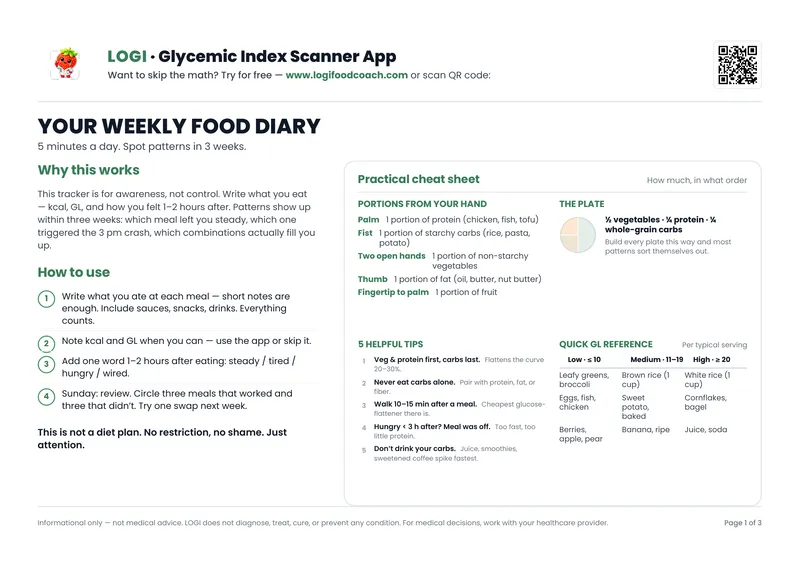
Free PDF — 3 pages
Your Weekly Food Journal
Track meals, glycemic load & mood. Spot patterns in 3 weeks.
No spam. Unsubscribe anytime.