Best Prediabetes Apps 2026: What You Can Actually Buy, and What Only Your Employer Can
The strongest evidence in diabetes prevention is not for an app. It is for an intensive, human-coached, multi-year lifestyle programme — and depending on where you live and who employs you, you may not be able to buy one at any price.
That is the fact that reorganises this whole category, and most “best prediabetes app” lists skip it. Half the well-known names — Omada, Lark, Vida, Virta, Noom’s prevention track — are not products you can subscribe to. They are benefits, distributed through US employers, health plans and Medicare. In the UK the equivalent is free but only by GP referral. Everywhere else, you are on your own with a consumer app.
So this page splits in two. First: what the programmes are, and how to find out whether you already have access to one. Second: an honest comparison of the eight apps you can actually download today — LOGI, mySugr, MyNetDiary, Glucose Buddy, Diabetes:M, Klinio, Carb Manager and Levels — plus the cheap sensors that changed this category. I work on LOGI, so every entry names real limitations, ours included, and where a competitor is better it says so.
Short version: check first whether your employer, insurer or national health service already gives you a coached prevention programme — if it does, take it, because the evidence for those is stronger than for anything you can buy. If not: for the food side, LOGI or MyNetDiary. For a doctor-facing logbook, mySugr, free, in more than thirty languages. For two weeks of seeing your own glucose, a Dexcom Stelo or an Abbott Lingo sensor. For a completely free start, mySugr’s free tier or MyFitnessPal, and know what neither of them does.
First, the boring part: what prediabetes even is
Two different bodies define it two different ways, and which one your doctor uses changes whether you have it.
| ADA (United States) | WHO / international | |
|---|---|---|
| Fasting glucose | 100–125 mg/dL (5.6–6.9 mmol/L) | 110–125 mg/dL (6.1–6.9 mmol/L) |
| 2-hour OGTT | 140–199 mg/dL (7.8–11.0 mmol/L) | Same |
| HbA1c | 5.7–6.4% | Not endorsed for this range |
The American criteria capture a substantially larger population at lower glucose levels. If you have been told “prediabetes” by an app, a home test or a US-based service, it is worth asking your own doctor which criteria they use before you reorganise your life around it.
What is not in dispute: two large randomised trials, one American and one Finnish, run independently, both found an intensive lifestyle programme cut progression to type 2 diabetes by roughly 58% over a few years in people with impaired glucose tolerance. That is about as strong and as replicated as evidence gets here. Both used intensive, in-person, multi-year coaching — not a phone app on its own. Digital versions of those programmes do show real benefit in trials, but it is smaller, shorter-term and less durable, and the prediabetes-specific digital evidence base is still being assembled.
Any app that implies it delivers the DPP result is overclaiming. Including, if we ever do it, ours.
The programmes you probably cannot buy
NHS “Healthier You” Diabetes Prevention Programme (UK). Nine months of structured lifestyle change, free, delivered by contracted providers such as Oviva, Liva Healthcare and Second Nature. It is not an app you download; it is a referral, usually after an NHS Health Check. If you are in England and have been told you have non-diabetic hyperglycaemia, ask your GP. This is the single best-value option in this article and it costs nothing.
Omada, Lark, Vida, Virta and Noom’s prevention track (US). All CDC-recognised or clinically run, all essentially sponsor-gated: you get in through an employer, a health plan or Medicare, not through a credit card. Noom’s prevention programme earned CDC’s highest recognition tier this year. Be careful not to confuse it with the consumer Noom Weight app, which anyone can buy for around $70 a month and is a different product with a different evidence base.
In Germany, the DiGA system reimburses prescribed health apps — Vitadio and HelloBetter Diabetes are permanently listed, with glucura, mebix and Una Health provisionally listed — but every one of them is indicated for diagnosed type 2 diabetes. None covers prediabetes, because the framework deliberately excludes prevention. In France, Spain, Italy and Poland we found no national prediabetes programme at all.
So for most readers of this page, the realistic question is: which consumer app.
What a prediabetes app has to do
- Work from food, not from a needle. You are not measuring four times a day. An app built around glucose readings will hand you an empty logbook.
- Understand carbohydrate quality, not just quantity. Two meals with the same carbohydrate count behave differently. Glycemic load is the number that captures the difference.
- Produce something a doctor will look at. Your next appointment is the real deadline.
- Cost less than the problem. People with prediabetes are, by definition, not ill yet. Motivation is finite and $200 a month is not a prevention strategy.
- Exist in your language. Prediabetes is a global condition and this category is overwhelmingly American.
The 8 apps you can download today
1. LOGI — the food side, measured per plate
Link: App Store · Google Play · logifoodcoach.com
What it does: photograph a meal or type it; get an estimated glycemic load, macros, a predicted three-hour blood sugar curve and specific swaps. Meal plans for one to fourteen days and one to six people. HOMA-IR tracking if you have the labs. PDF export for an appointment. English, Polish, German, Spanish, French, Italian.
What is good: it answers the actual prediabetes question — what did that meal do — without a sensor, a meter or a referral. The household meal planner is unique in this comparison. Six languages is second only to mySugr here. At $39.99 a year it is among the cheapest.
What is not good: we are not a diabetes prevention programme and we have no human coach, which is precisely the ingredient the strong trials had. We are not reimbursed anywhere, not CDC-recognised, and we have no published outcome data. We do not track HbA1c or estimate it. The predicted curve is a model, not a measurement — a cluttered plate gets misread. The planner sits behind a hard paywall and the weekly price is bad value against the yearly.
Best for: someone who wants to change how they eat, now, without waiting for a referral that may not come.
Pricing: $2.99/week, $39.99/year, 7-day trial.
2. mySugr — the free logbook your doctor already recognises
Link: mysugr.com
What it does: logs glucose, carbohydrates, medication and insulin; syncs with meters; exports PDF and Excel reports. Owned by Roche.
What is good: it is available in more than thirty languages, which is more than double anything else here, the free core is genuinely usable, and clinicians accept its reports without argument. PRO is free if you use an Accu-Chek meter. For a global audience this is the most accessible serious tool in the category.
What is not good: it is built for diagnosed diabetes. There is no glycemic load, no prediction, no meal analysis — you log a number and it charts it. With prediabetes you usually have no numbers to log, so a large part of the app sits empty and the workflow quietly assumes a disease you do not have.
Best for: anyone who has been given a meter, and anyone who needs a report in a language nobody else supports.
Pricing: free core; PRO $4.99/month or $39.99/year, free with an Accu-Chek meter.
3. MyNetDiary Diabetes Tracker — the best-organised food-first option
Link: mynetdiary.com
What it does: food and carbohydrate tracking against a well-curated database with a barcode scanner, plus glucose and HbA1c logging, and dedicated modes for type 1, type 2, prediabetes and gestational diabetes.
What is good: it is one of very few apps that treats prediabetes as its own mode rather than an afterthought, its food database is curated rather than crowd-dumped, and the carbohydrate accounting is the cleanest here.
What is not good: it tracks carbohydrates, not glycemic load, so it will not distinguish two meals with the same carbohydrate count and different behaviour. No photo scan, no prediction, no CGM by default. Premium is around $9–10 a month or $59.99 a year — more than us and more than mySugr.
Best for: someone who wants disciplined, accurate carbohydrate logging with a prediabetes mode.
Pricing: free tier; premium around $9–10/month or $59.99/year.
4. Glucose Buddy — the long-running logbook
Link: glucosebuddy.com
What it does: logs glucose, food, medication, weight, blood pressure and activity, with an A1C estimator and Dexcom integration in the paid tier.
What is good: it has been maintained for well over a decade and is still updated, it covers more metrics than most, and the A1C estimator is a feature people with prediabetes actually want.
What is not good: it is another logbook — nothing about glycemic load and nothing predictive. The A1C estimator needs glucose readings to estimate from. Its “number one for fifteen years” marketing is a claim, not a measurement. We could not confirm current premium pricing from a primary source, so check before subscribing.
Best for: someone who already tests and wants one place for all their numbers.
Pricing: free tier plus a paid premium; verify the current price.
5. Diabetes:M — powerful, and built for people on insulin
Link: diabetes-m.com
What it does: a deep logbook with a bolus calculator, carbohydrate counting, meter sync and PDF/Excel export, from a Bulgarian medical software company.
What is good: it is the most feature-dense logbook here and clearly built by people who know the domain. The export options are excellent. Premium is cheap: $4.99 a month or $49.99 a year.
What is not good: the centre of gravity is insulin dosing, which has nothing to do with prediabetes. You will be navigating around features you must not use. No glycemic load, no prediction.
Best for: not prediabetes. Listed because it keeps appearing on prediabetes lists and it should not.
Pricing: free tier; premium $4.99/month, $49.99/year.
6. Klinio — diabetes-branded meal plans
Link: klinio.com
What it does: generated meal plans aware of calories, macros and sugar, plus glucose, A1C, weight and medication logging.
What is good: the plan-first approach removes decisions, which is the thing that actually breaks adherence, and the app is clearly built for a diabetes audience rather than repurposed from weight loss.
What is not good: it is expensive for what it is — reported from around $16.50 a month — and its published outcome figure comes from its own uncontrolled internal data on a couple of hundred users, which is a marketing statistic and not evidence. No glycemic load, no prediction.
Best for: someone who wants a plan handed to them and does not care how the numbers are derived.
Pricing: from around $16.50/month.
7. Carb Manager — carbohydrate discipline, keto-shaped
Link: carbmanager.com
What it does: net-carb and macro tracking, barcode scanning, the largest recipe library in this comparison, active community.
What is good: the free tier is real, around $40 a year is fair, and if low-carb is your chosen route this is the best-built tool for it.
What is not good: it optimises net carbohydrates, not glucose response, and prediabetes advice does not require cutting legumes, oats or fruit. Per-ingredient glycemic index exists; meal-level glycemic load does not. The iOS listing is English only.
Best for: someone already committed to low-carb.
Pricing: free tier; premium around $40/year.
8. Levels — cheap app, expensive data
Link: levelshealth.com
What it does: scores meals and days for metabolic impact. Originally required a continuous glucose monitor; now works without one.
What is good: $15 a month or $80 a year for the app alone is inexpensive, and the education inside it is well written. If you later add a sensor, it is already set up.
What is not good: without a sensor it is doing the same modelling as us or January AI, without their food-scanning depth. With a sensor it is another $89 a month or $99 per two-pack. English only, US-centric.
Best for: someone who already wears a sensor and wants a good interpretation layer.
Pricing: app $15/month or $80/year; sensors separate.
And the sensors, which changed the maths
You can now see your own glucose for two weeks for less than the price of a monthly subscription. Dexcom Stelo is $99 for a two-pack covering 30 days, or $89 a month — US only, and worth knowing its App Store rating sits around 2.5 stars, which is unusually poor. Abbott Lingo is about $54 for a two-week plan including a sensor, and is available in both the US and the UK. Neither tells you what to eat. Both tell you, unambiguously, what your own breakfast does — which is information no prediction can give you.
If you can afford one fortnight of one of these, do that before subscribing to anything for a year.
Comparison table
| LOGI | mySugr | MyNetDiary | Glucose Buddy | Diabetes:M | Klinio | Carb Manager | Levels | |
|---|---|---|---|---|---|---|---|---|
| Photo meal scan | Yes | Attach only | No | No | No | No | Limited | No |
| Meal-level glycemic load | Yes | No | No | No | No | No | No | Score |
| Predicted glucose curve | Yes | No | No | No | No | No | No | No |
| Prediabetes-specific mode | Implicit | No | Yes | No | No | Partial | No | No |
| A1C tracking / estimate | No | Estimate | Yes | Yes | Yes | Yes | No | No |
| Meal plans | Yes, 1–6 people | No | No | No | No | Yes | Partial | No |
| Doctor-ready export | Yes | PDF + Excel | Yes | Yes | PDF + Excel | No | Reports | No |
| Human coach | No | No | No | Paid | No | No | No | No |
| Languages | 6 | 30+ | 1 | 1 | Several | Several | 1 | 1 |
| Free tier | 10 scans | Yes | Yes | Yes | Yes | No | Yes | No |
| Yearly | $39.99 | $39.99 | $59.99 | Varies | $49.99 | ~$198 | ~$40 | $80 |
A note on One Drop, which appeared on the previous version of this comparison: we could not verify its current status, ownership or pricing in 2026 from any primary source, and we saw a widely repeated acquisition claim we could not confirm. Rather than publish figures we cannot stand behind, we have left it out. If you are an existing user, check your own billing page.
Which one for which situation
“I am in England and my GP mentioned prediabetes.” Ask about the Healthier You programme before you spend anything. Free, coached, nine months.
“My employer has a health benefits portal I have never opened.” Open it. Omada, Lark, Vida and Noom’s prevention track are all things people pay for that you may already have.
“Nobody is offering me a programme and I want to start tonight.” LOGI or MyNetDiary. Us for meal-level glycemic load and the photo scan; them for cleaner carbohydrate accounting and a real prediabetes mode.
“I want to see real numbers, once, to know if this is serious.” Two weeks of Lingo, or a Stelo two-pack. Then go back to a food app with a much better idea of what matters for you.
“I have been given a meter and told to test.” mySugr, free, and take the PDF to your appointment.
“I want to spend nothing.” mySugr free tier plus one honest week of food logging in anything. It is not nothing — knowing what you eat is where every programme in this article starts.
What this whole category still gets wrong
The strongest evidence sits behind an eligibility check. The programmes with real trial data are, for most of the world, unbuyable. Consumer apps — ours included — are what is left, and they are not the same thing. Anybody who tells you otherwise is selling.
Prediabetes gets treated as small diabetes. Most apps here are diabetes logbooks with the threshold moved. The prediabetes problem is not measurement, it is a few hundred repeated food decisions, and only a minority of these tools address that.
Nobody handles the two definitions. Not one app we looked at asks which criteria your doctor uses, though it changes whether you are in the category at all.
Non-English support is thin. mySugr is the outlier at thirty-plus languages. Most of the rest are English only, in a condition that affects a large share of adults worldwide. Poland has a free national-university-backed app covering prediabetes and insulin resistance; Germany reimburses several diabetes apps but none for prevention. The gap between the US market and everywhere else is the single biggest unsolved thing here.
What to do this week
- Find out which criteria your diagnosis used, and what your actual number was.
- Check for a programme you already have access to. Take it if it exists.
- If not, log one week of food honestly — no changes yet.
- Change the meal that repeats most often, usually breakfast, and keep everything else.
- Bring the export to your next appointment.
Prevention is measured in years, and it is bought one repeated meal at a time.
Download LOGI on the App Store — Get LOGI on Google Play — More on logifoodcoach.com
Related recipes

Perfect Hard-Boiled Eggs
A protein-rich, zero-carb snack with virtually no glycemic impact—ideal for stable blood sugar and sustained energy throughout your day.

Low-Glycemic Olives with Cheese Cubes
A blood sugar-friendly Mediterranean snack pairing briny olives with protein-rich cheddar cheese—perfect for stable energy between meals.

Sesame-Spiced Pork Tenderloin with Aromatic Asian Herbs
Tender pork medallions coated in toasted sesame and warming spices create a blood sugar-friendly protein centerpiece that's ready in under 30 minutes.
Take control of your blood sugar
Scan your meals, track glycemic load, and see your patterns — all in one app.
Start Free Trial →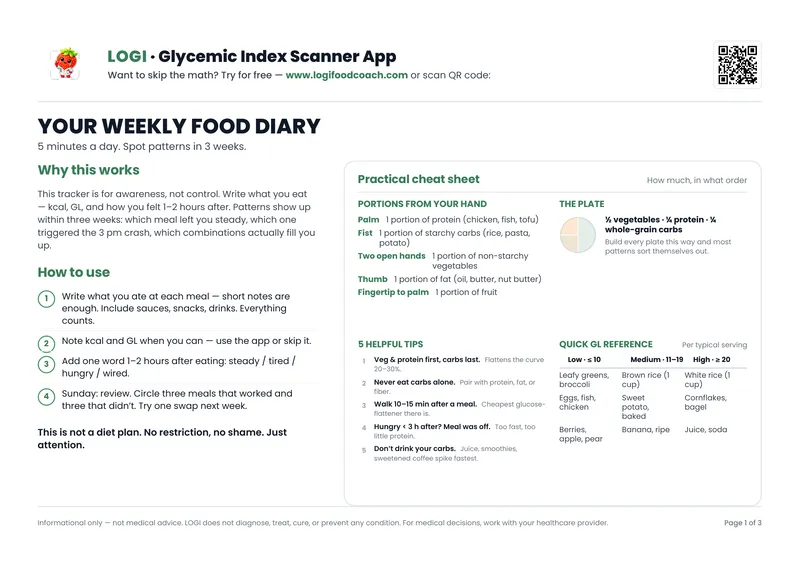
Free PDF — 3 pages
Your Weekly Food Journal
Track meals, glycemic load & mood. Spot patterns in 3 weeks.
No spam. Unsubscribe anytime.