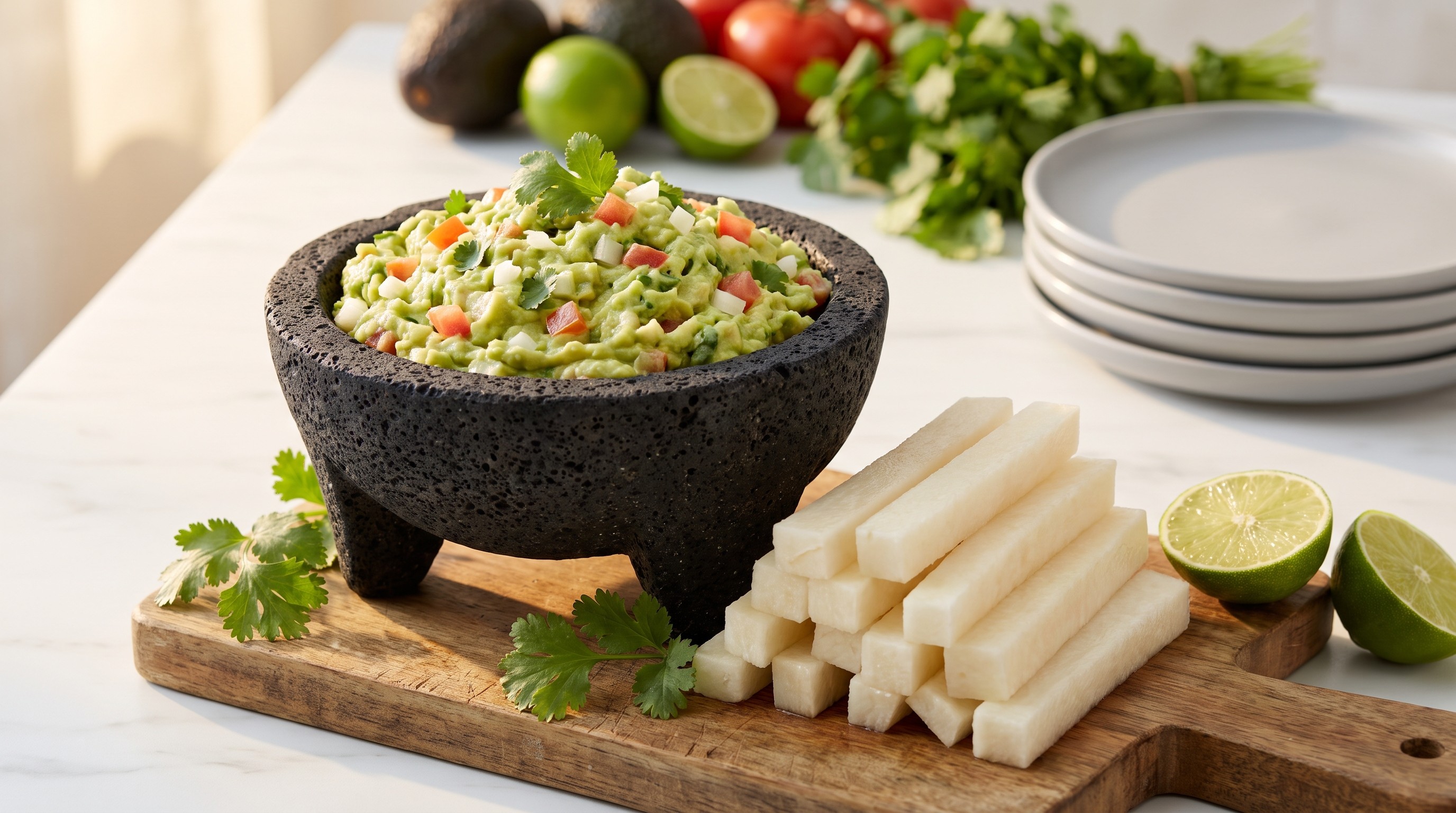
Guacamole with Jicama Sticks
Creamy chunky guacamole paired with crisp jicama sticks — a naturally low-glycemic snack rich in healthy fats, fiber, and virtually zero blood sugar impact.
This guacamole with jicama sticks is one of those rare recipes that needs no low-glycemic adaptation whatsoever — it is naturally blood-sugar-friendly from the first ingredient to the last. Avocados deliver heart-healthy monounsaturated fats that slow gastric emptying and blunt any glucose response from the meal, while jicama — a crisp, slightly sweet Mexican root vegetable — carries a glycemic index of roughly 12, thanks to its exceptional fiber and water content. Together they create a snack that satisfies without spiking.
The supporting cast pulls its weight too. Fresh lime juice adds acidity, which clinical research has shown can lower the glycemic impact of a meal by up to 30 percent. Red onion contributes trace chromium, a mineral involved in insulin signaling, and jalapeño brings capsaicin, which emerging studies link to improved insulin sensitivity. Even the Roma tomato sits comfortably in the low-GI range at around 15.
For best results, eat the jicama sticks loaded with guacamole as an afternoon snack or as a starter before a main meal — the combination of fat, fiber, and acid primes your metabolism for steadier blood sugar throughout the rest of the sitting. If you are pairing this with a larger spread, serve the guacamole and jicama first and wait five to ten minutes before moving on to any higher-carbohydrate dishes. This simple sequencing trick — vegetables and fats before starches — is one of the most effective and effortless strategies for flattening your post-meal glucose curve.
Blood Sugar Impact
Very minimal blood sugar impact expected. The combination of avocado's healthy fats and fiber with jicama's low-glycemic carbohydrates and a GL of only 3.6 should result in virtually no spike, providing stable energy for 3-4 hours.
Blood Sugar Tips
- ✓ Use this as a starter before higher-carb dishes — the healthy fats in avocado slow gastric emptying and blunt glucose absorption from subsequent foods.
- ✓ Enjoy generous portions of the jicama sticks, which are rich in prebiotic fiber (inulin) that feeds beneficial gut bacteria and further supports blood sugar stability.
- ✓ If serving with chips or tortillas, choose seed-based or almond flour crackers instead of corn chips to keep the overall glycemic load of the snack low.
🥗 Ingredients
- 2 pcs Avocado
- 250 g Jicama
- 1 pcs Roma tomato
- 30 g Red onion
- 1 pcs Jalapeño
- 15 g Cilantro
- 30 ml Lime juice
- 0.5 tsp Salt
- 2 pcs Avocado
- 8.8 oz Jicama
- 1 pcs Roma tomato
- 1.1 oz Red onion
- 1 pcs Jalapeño
- 0.5 oz Cilantro
- 2 tbsp Lime juice
- 0.5 tsp Salt
👨🍳 Instructions
- 1
Peel the jicama and slice it into sticks roughly 1 cm wide and 8 cm long. Place the sticks in a bowl of ice-cold water and set aside — this keeps them extra crisp while you prepare the guacamole.
- 2
Halve the avocados, remove the pits, and scoop the flesh into a wide mixing bowl. Use a fork to mash the avocado to a rough, chunky consistency — you want plenty of visible pieces, not a smooth purée.
- 3
Cut the Roma tomato into small dice, discarding excess seeds and liquid if the tomato is very juicy. Finely dice the red onion.
- 4
Slice the jalapeño in half lengthwise, scrape out the seeds and white ribs with a spoon, then mince the flesh finely. Adjust the amount to your heat preference — keeping a few seeds adds extra kick.
- 5
Roughly chop the cilantro, including the tender upper stems for added flavor. Squeeze the lime and measure the juice.
- 6
Add the diced tomato, red onion, minced jalapeño, chopped cilantro, and lime juice to the mashed avocado. Fold everything together gently with a spatula until just combined — avoid over-mixing so the guacamole keeps its rustic texture.
- 7
Season with the salt, then taste and adjust. Add more lime juice for brightness or an extra pinch of salt if needed. The acidity from the lime not only balances the richness of the avocado but also helps slow glucose absorption.
- 8
Drain the jicama sticks thoroughly and pat them dry with a clean towel. Arrange the sticks alongside the guacamole and serve immediately. For the best blood-sugar response, eat the jicama and guacamole before any other dishes in your meal.
📊 Nutrition Per Serving
| Per Serving | Whole Dish | |
|---|---|---|
| Calories | 279 | 558 |
| Carbs | 21g | 42g |
| Sugars | 5g | 9g |
| Natural Sugars | 5g | 9g |
| Protein | 5g | 9g |
| Fat | 23g | 46g |
| Saturated Fat | 3g | 6g |
| Unsaturated Fat | 20g | 39g |
| Fiber | 13g | 26g |
| Soluble Fiber | 4g | 8g |
| Insoluble Fiber | 9g | 18g |
| Sodium | 698mg | 1396mg |
Predicted Glucose Response
What if you...
Estimated model — individual responses vary. Not medical advice.
🔄 Lower GI Swaps
Jicama has a GI of around 32 and contains roughly 9g of carbs per 100g. Cucumber (GI ~15, ~2g carbs/100g), celery (~1.4g carbs/100g), and bell pepper (GI ~15, ~4g carbs/100g) all deliver a satisfying crunch with a meaningfully lower glycemic load per serving.
Roma tomatoes have slightly more sugar per weight than cherry tomatoes (which are used in smaller quantities and have a marginally lower GL per typical serving) or green (unripe) tomatoes, which contain less sugar due to incomplete ripening and thus contribute less to blood glucose.
Red onion has a GI of around 10 but contains ~7g of carbs per 100g, most of it sugar. Scallion greens and chives provide a similar flavor kick with only ~2-3g carbs per 100g, resulting in a lower glycemic load per serving.
While lime juice already has a very low GI, adding apple cider vinegar has been shown in clinical studies to improve post-meal insulin sensitivity and reduce blood sugar spikes by up to 20-30% when consumed with a meal, making it a functional upgrade for glycemic management.
🔬 The Science Behind This Recipe
Here's the science explainer section:
---
Why This Recipe Works for Blood Sugar
This guacamole with jicama sticks is a blood sugar-friendly powerhouse, and the numbers tell the story — with a glycemic load of just 3.6 and an estimated GI of 17, it barely registers on the glucose scale. The star here is avocado, which is loaded with heart-healthy monounsaturated fats and fiber. When you eat fat alongside any carbohydrates, it slows down the rate at which sugar enters your bloodstream. Think of it like a speed bump for glucose — your body gets a slow, steady trickle of energy instead of a sudden flood. That's why avocado-based dishes tend to keep you feeling satisfied and energized without the crash that comes from high-carb snacks.
The real genius of this recipe, though, is the jicama. Most dips get paired with tortilla chips, crackers, or bread — all of which can send blood sugar climbing. Jicama flips the script entirely. This crunchy root vegetable is rich in inulin, a type of soluble fiber that your body digests very slowly. It delivers that satisfying crunch you crave with a fraction of the available carbohydrates. By swapping out a high-glycemic dipper for jicama sticks, you're dramatically lowering the glycemic load of the entire snack. Remember, glycemic load accounts for both the quality and quantity of carbs on your plate — and here, both are working in your favor.
To get even more out of this dish, try eating it at the start of a meal before any heavier carbohydrates. Research suggests that eating vegetables and fats first can reduce post-meal glucose spikes by up to 30–40%. A short 10-minute walk after eating helps too — your muscles pull glucose from the bloodstream for energy, smoothing out any remaining rise. With a recipe like this, you're already starting from a great place.
Related recipes
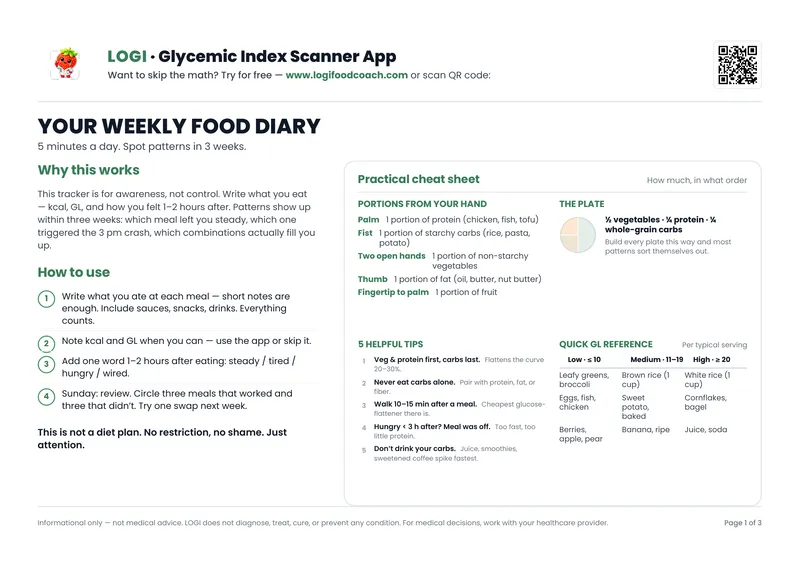
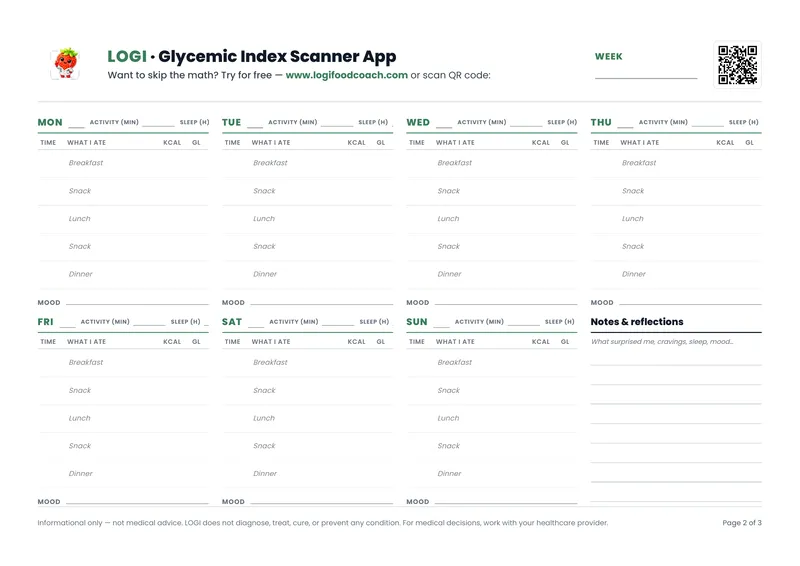
Free PDF — 3 pages
Your Weekly Food Journal
Track meals, glycemic load & mood. Spot patterns in 3 weeks.
No spam. Unsubscribe anytime.