Prediabetes Food Tracking Apps: 7 Compared, and Why Calorie Counters Miss the Point

Log a bowl of white rice and a bowl of lentils with the same calories and the same carbohydrate count into a normal food tracker, and it will tell you they are the same meal. Your pancreas disagrees, and with prediabetes your pancreas is the one keeping score.
That gap is why most food-tracking advice for prediabetes is wrong by default. The apps people are pointed at were built to count calories for weight loss, and the number that matters here — how much glucose a specific plate delivers, how fast — is not something they compute.
This compares seven apps you might actually use to log food with prediabetes: LOGI, MyFitnessPal, MyNetDiary, Carb Manager, Glycemic Snap, Fooducate and Klinio. I work on LOGI. That means every entry here has to carry a real “what is not good”, ours included, and where a competitor beats us it has to say so — which it does, more than once.
Short version: if you want to know what a meal does rather than what it contains, LOGI or Glycemic Snap, because they are the only two here that compute glycemic load for the actual plate and predict a curve. If you want the most accurate and disciplined carbohydrate accounting with a genuine prediabetes mode, MyNetDiary. If you want free, MyFitnessPal, and go in knowing it will never answer the glucose question. If you are already low-carb and it is working, Carb Manager and do not let this page talk you out of it.
What you are actually trying to log
With prediabetes the useful unit is not the food and not the day. It is the meal.
Glycemic index is a property of a single food eaten alone, in a lab, in a fixed portion. It is a useful concept and a bad daily tool. Glycemic load takes that number and scales it by the carbohydrate actually on your plate, which is why a slice of watermelon (high index, little carbohydrate) lands gently and a plate of pasta (moderate index, a lot of carbohydrate) does not.
Three things follow, and they are the criteria for everything below:
- A tracker that shows carbohydrates but not carbohydrate quality answers half the question. Half is better than nothing and considerably worse than it sounds.
- The logging has to be fast enough that you still do it in week three. Every accuracy advantage is wiped out by abandonment.
- The database has to contain your food. A US-centric database is a daily argument if you shop in Warsaw, Milan or Lyon.
The 7 apps
1. LOGI — logs the meal, then tells you what it does
Link: App Store · Google Play · logifoodcoach.com
What it does: photograph the meal or type it. You get an estimated glycemic load, macros, a predicted three-hour blood sugar curve and a specific swap. There is a meal planner for one to fourteen days and one to six people, HOMA-IR tracking, and a PDF export for an appointment. English, Polish, German, Spanish, French and Italian.
What is good: logging by photo is the fastest entry method in this comparison, and the output is the glucose answer rather than a calorie total. The database holds 7,158 ingredients built for this purpose. Six languages, and recipes in all of them, which for a European reader removes the daily database argument. $39.99 a year is the cheapest of the analytical apps here.
What is not good: the food database is far smaller than MyFitnessPal’s or MyNetDiary’s — we cover ingredients and dishes well and packaged supermarket products badly, so a barcode-heavy diet is a poor fit. The photo estimate is a model and a cluttered plate gets misread; correcting by text is often faster than re-shooting. Ten free scans and then a soft paywall, with the planner behind a hard one. And Glycemic Snap gives you three free scans every day, indefinitely — a better deal for a casual logger than our ten in total.
Best for: logging real cooked meals and finding out what they do.
Pricing: $2.99/week, $39.99/year, 7-day trial.
2. Glycemic Snap — the same idea, more languages, higher monthly
Link: glycemicsnap.com
What it does: photo scan a meal, get a 0–100 glucose impact score, a predicted curve with a peak time and a swap suggestion. Syncs with Dexcom, Libre and Apple Health, and exports a doctor’s report.
What is good: the closest thing to a direct alternative to us, on iOS, Android and the web, updated constantly. Fourteen interface languages — including Polish, German, Italian, Spanish, French, Dutch, Swedish, Portuguese, Turkish, Japanese and Korean — is more than double our six. Three free scans a day is a genuinely usable free tier.
What is not good: $9.99 a month is more than double what our yearly plan works out to. No meal planner and no household sizing. It is a smaller product, with a few hundred App Store ratings behind its food data.
Best for: photo logging plus a sensor sync, in a language we do not cover.
Pricing: $9.99/month, $39.99/year, three free scans daily.
3. MyNetDiary Diabetes Tracker — the most disciplined carbohydrate log
Link: mynetdiary.com
What it does: food and carbohydrate tracking against a curated database with barcode scanning, plus glucose and HbA1c logging, and separate modes for type 1, type 2, prediabetes and gestational diabetes.
What is good: a real prediabetes mode, not a relabelled diabetes one. The database is curated rather than crowd-sourced, which shows: fewer duplicate entries and fewer wrong ones than the free giants. If your goal is accurate carbohydrate numbers you can hand to a dietitian, this is the best tool here.
What is not good: it counts carbohydrates; it does not compute glycemic load, so the rice-versus-lentils problem remains. No photo scan, no prediction. Around $9–10 a month or $59.99 a year, which is more than us and more than several better-known apps. English only.
Best for: precise carbohydrate accounting with a prediabetes mode.
Pricing: free tier; premium around $9–10/month or $59.99/year.
4. MyFitnessPal — the biggest database, and the wrong question
Link: myfitnesspal.com
What it does: calorie and macro tracking against the largest consumer food database in the world, with barcode scanning, and this year an AI coach and a plan tab.
What is good: nothing else here comes close on database coverage or on languages — twenty of them. The free tier is real and always has been. If you genuinely do not know what you eat, this is the fastest, cheapest way to find out, and every serious plan starts from that baseline.
What is not good: it has never computed glycemic index or glycemic load, and it still does not. Two meals with identical macros and completely different glucose behaviour log identically. It is not a bad app; it is an app for weight, and prediabetes is not primarily a weight-logging problem. Premium at $19.99 a month or $79.99 a year is the most expensive food tracker in this comparison and none of what you pay for closes this gap.
Best for: two weeks of establishing a baseline, free, before you pick a glycemic tool.
Pricing: free tier; Premium $19.99/month or $79.99/year.
5. Carb Manager — the strongest low-carb tool, pointed one way
Link: carbmanager.com
What it does: net-carb and macro tracking, keto-first, barcode scanning, and the largest recipe library in this comparison with an active community.
What is good: the free tier is usable, around $40 a year is fair, and the recipe library is genuinely enormous. Low-carb eating does help many people with prediabetes, and this is the best-built app for doing it properly.
What is not good: net carbohydrates and glycemic load pull in different directions. Lentils, oats, plain yoghurt, barley and most fruit score badly here and well on glycemic load, and nothing about prediabetes requires cutting them. There is per-ingredient glycemic index data but no meal-level glycemic load. The iOS listing is English only.
Best for: someone who has chosen low-carb deliberately.
Pricing: free tier; premium around $40/year.
6. Fooducate — the simplest rule in the supermarket
Link: fooducate.com
What it does: scans barcodes and grades packaged foods A to D on a proprietary nutrition score, with light calorie tracking.
What is good: “buy A and B” is the easiest mental model in this article, and for someone who has never read a nutrition label it changes shopping behaviour on day one. Six languages, more than most here.
What is not good: it has not been meaningfully updated since early 2025, which for a food database is a long time and shows in coverage of newer products. It grades packages, not plates, so it says nothing about what you cook. And the grade hides its reasoning — convenient until you want to know why the yoghurt scored a C.
Best for: replacing packaged products, not tracking meals.
Pricing: free tier; paid Pro upgrade.
7. Klinio — a plan instead of a log
Link: klinio.com
What it does: generates diabetes-aware meal plans and logs glucose, HbA1c, weight and medication.
What is good: it removes decisions rather than adding a chore, which is the correct instinct — the reason people stop logging is that logging is work. Built for a diabetes audience rather than repurposed from weight loss.
What is not good: expensive for what it is, reported from around $16.50 a month. Its published result — an average HbA1c drop across a couple of hundred of its own users — is uncontrolled internal data, which is marketing, not evidence, and should be read as such. No glycemic load, no prediction.
Best for: someone who wants meals decided rather than measured.
Pricing: from around $16.50/month.
Comparison table
| LOGI | Glycemic Snap | MyNetDiary | MyFitnessPal | Carb Manager | Fooducate | Klinio | |
|---|---|---|---|---|---|---|---|
| Photo meal logging | Yes | Yes | No | Yes | Limited | No | No |
| Barcode scanning | Limited | Yes | Yes | Yes | Yes | Yes | No |
| Meal-level glycemic load | Yes | Yes | No | No | No | No | No |
| Predicted glucose curve | Yes | Yes | No | No | No | No | No |
| Prediabetes mode | Implicit | Implicit | Yes | No | No | No | Partial |
| HbA1c tracking | No | No | Yes | No | No | No | Yes |
| Database size | Small | Moderate | Large, curated | Largest | Large | Large | n/a |
| Meal plans | Yes, 1–6 people | No | No | Plan tab | Partial | No | Yes |
| Languages | 6 | 14 | 1 | 20 | 1 | 6 | Several |
| Free tier | 10 scans | 3 scans/day | Yes | Yes | Yes | Yes | No |
| Yearly | $39.99 | $39.99 | $59.99 | $79.99 | ~$40 | Free tier | ~$198 |
Which one for which situation
“I want to know what my breakfast is doing to me.” LOGI or Glycemic Snap. They are the only two here that answer that question at all.
“My dietitian wants accurate carbohydrate numbers.” MyNetDiary. Cleanest data, real prediabetes mode.
“I eat mostly packaged food and I scan barcodes.” MyFitnessPal or MyNetDiary. Our database is built around ingredients and cooked dishes and will frustrate you.
“I cook from scratch, in Polish, Italian or German.” LOGI or Glycemic Snap. Most of this category is English-only, and a food database in the wrong language is a daily tax.
“I want to spend nothing at all.” MyFitnessPal for two weeks. Then decide with a baseline instead of a guess.
“I keep starting and stopping.” Klinio or LOGI’s planner — not because either is magic, but because for some people the failure is decision fatigue, not information, and a plan fixes a different problem than a log.
What none of these do well
Nobody logs honestly, and every app pretends otherwise. Under-reporting is the best-documented finding in the whole nutrition-tracking literature, and not one app in this comparison accounts for it. Every summary you read is of what you told it.
Portion estimation is the weak joint, including ours. Photo scanning is fast and approximate. Weighing is accurate and nobody does it. The gap between those two is where most of the error in every one of these apps lives.
The databases are American. MyFitnessPal and Carb Manager are excellent if you shop in the United States and mediocre if you do not. This is the single most common reason European users abandon tracking in the first fortnight, and only a handful of products here take it seriously.
Prediabetes still gets treated as pre-weight-loss. Most of these tools quietly assume the goal is a smaller number on a scale. Sometimes it is. Often the goal is a flatter curve after lunch, and that is a different measurement entirely.
What to try this week
- Log five days without changing anything. You cannot fix a pattern you have not seen.
- Find the meal you eat most often — for most people it is breakfast.
- Look at what that one meal does, in whichever app you picked.
- Change that meal only, and keep it changed for three weeks.
- Take the export to your next appointment and ask what the numbers say.
One repeated meal, changed and kept, does more than a perfect log abandoned in a fortnight.
Download LOGI on the App Store — Get LOGI on Google Play — More on logifoodcoach.com
Related recipes

Blood Sugar-Friendly Vegetable-Packed Meatloaf
A protein-rich meatloaf loaded with fiber from lentils and vegetables, designed to provide steady energy without spiking blood glucose levels.

Mercimek Çorbası (Turkish Red Lentil Soup)
Velvety Turkish red lentil soup with a smoky paprika drizzle — naturally low-GI (≈26), high in fiber, and ideal for steady blood sugar.

Lentejas Estofadas (Spanish Braised Lentils with Vegetables)
A hearty Spanish lentil stew simmered with smoked paprika, carrots, and tomato — naturally low-GI, fiber-rich, and ideal for steady blood sugar.
Take control of your blood sugar
Scan your meals, track glycemic load, and see your patterns — all in one app.
Start Free Trial →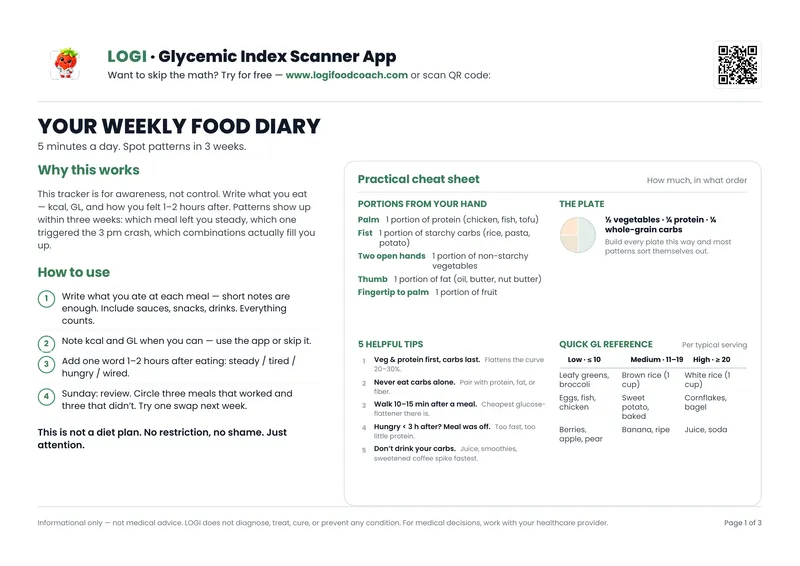
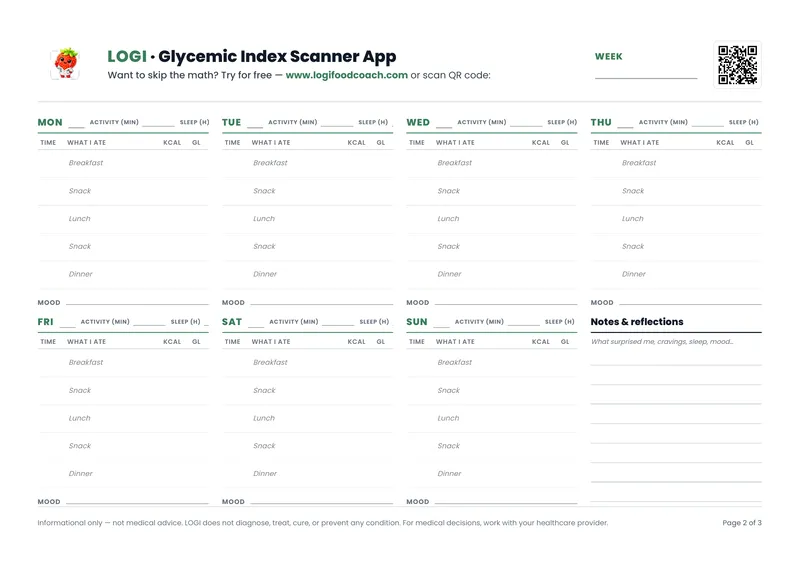
Free PDF — 3 pages
Your Weekly Food Journal
Track meals, glycemic load & mood. Spot patterns in 3 weeks.
No spam. Unsubscribe anytime.