Bread and Blood Sugar — Which Breads Spike, Which Stay Flat
Bread and Blood Sugar — Which Breads Spike, Which Stay Flat
Bread is one of the most studied foods in the glycemic-response literature. It is also one of the most confused. People who are watching their blood sugar tend to either avoid bread entirely or replace white with whole-wheat and assume the work is done. Both responses miss what the data actually shows.
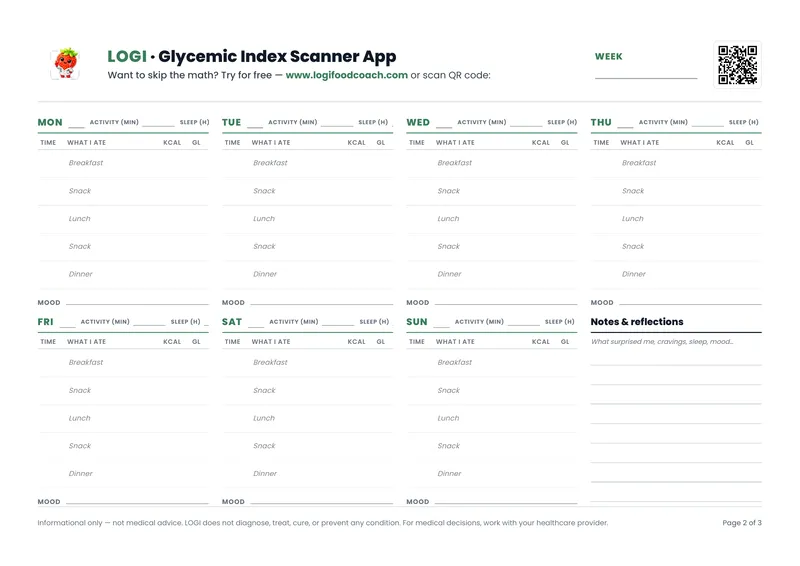
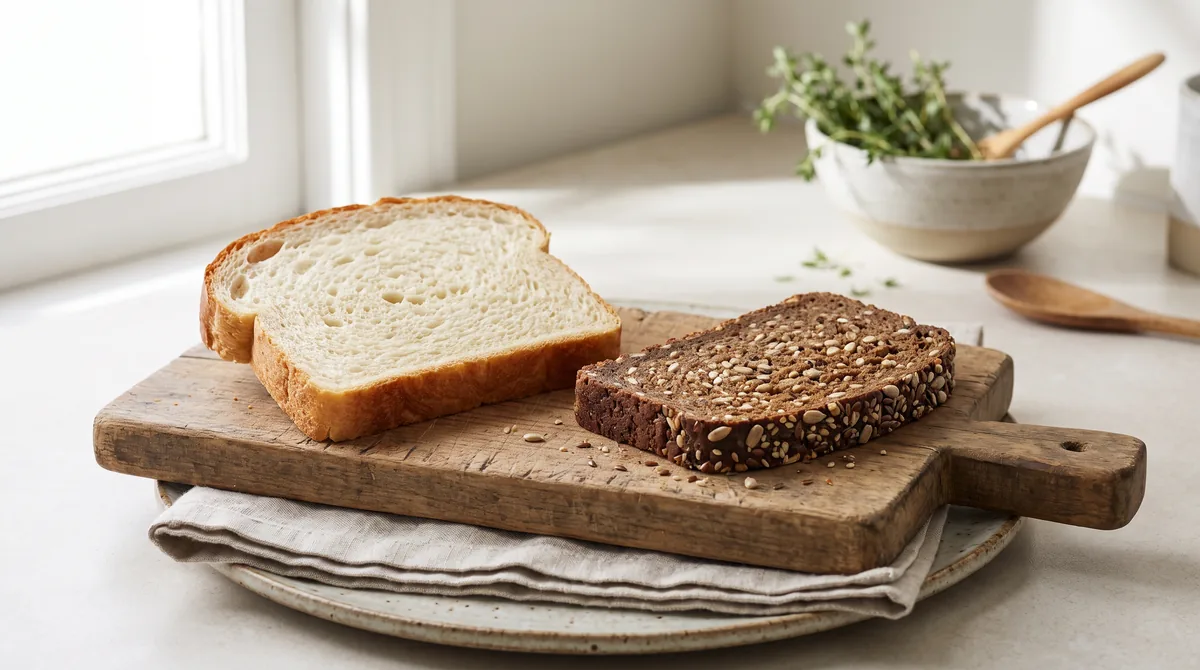
The blood sugar response to bread varies more than almost any other food category. White sandwich bread can produce a glucose spike larger than table sugar in some people. A dense German pumpernickel, eaten in the same quantity, produces a curve so flat it is hard to detect on a continuous glucose monitor. The difference is not whether the bread is “whole grain” on the label — it is structural, and once you understand the structure, choosing a bread becomes simple.
This piece walks through five common breads, what each one does to blood sugar and why, and how to use this when you are standing in front of a bakery shelf.
The mechanism — why bread spikes blood sugar in the first place
Bread is mostly starch. Starch is a chain of glucose molecules linked together. When you eat bread, digestive enzymes break those chains apart, releasing the glucose, which enters the bloodstream. How fast that happens determines the size of the blood sugar spike.
Five factors control the speed:
Particle size of the flour. Finely milled flour digests fast. Coarsely cracked grain digests slowly. This is the single biggest factor — bigger than fiber content, bigger than “whole grain” labeling. A whole-wheat sandwich loaf made from finely milled whole-wheat flour produces a glucose response almost identical to white bread. A coarse stone-ground rye, with visible grain pieces, produces a much smaller one.
Fiber content, especially soluble fiber. Fiber slows the enzymatic breakdown of starch. Beta-glucan from oats and rye, in particular, is very effective. Insoluble fiber (wheat bran) helps but less.
Fermentation time. Long-fermented bread — true sourdough, fermented 12-24 hours — has a lower glycemic load than fast-leavened bread. The bacteria pre-digest some of the starch and produce organic acids that slow gastric emptying. Two slices of well-fermented sourdough can produce a glucose response 25-30% lower than two slices of the same flour made with commercial yeast in two hours.
Fat and protein content of the bread itself. Most commercial bread is mostly carb. Some artisan breads include nuts, seeds, oils, or eggs, which slow absorption. A seeded multigrain with significant fat and protein per slice behaves better than a plain whole-wheat.
What you eat with the bread. This matters more than people realize. Bread eaten alone produces a much larger spike than the same bread with eggs, cheese, avocado, or olive oil. The fat and protein slow gastric emptying and blunt the curve.
With these five factors in mind, the variation between breads makes sense. Below is a walk through five common types.
White sandwich bread
The default commercial loaf in most of the English-speaking world. Made from refined wheat flour, fast-leavened with commercial yeast, often with added sugar, vegetable oil, and preservatives. Finely milled, low fiber (under 2g per slice), no fermentation to speak of.
Glycemic profile: glycemic index typically 70-75, glycemic load around 10-12 per two slices. The starch is essentially pre-broken for your enzymes — fast digestion, fast glucose release, sharp curve.
The two slice white-bread sandwich that most people eat for lunch is, glycemically, equivalent to drinking a glass of orange juice. In some studies it produces a slightly higher peak than glucose itself, because the finely milled flour absorbs water in the gut faster than dissolved sugar does.
What to do: this is the category to actively avoid if you are watching your curve. The replacements are not painful — see below.
Whole-wheat sandwich bread (commercial)
Almost everyone assumes this is the answer. It usually is not.
Most commercial whole-wheat bread is made from finely milled whole-wheat flour — meaning the bran and germ are included, but ground as small as the rest. The fiber content is higher (3-4g per slice) but the starch is still rapidly accessible to digestive enzymes. The fermentation is still short. The added sugar is often the same as in white bread.
Glycemic profile: glycemic index 65-75 (essentially the same band as white), glycemic load 9-11 per two slices. The variation between brands is enormous — read the label.
A useful rule: if the whole-wheat bread is soft, sliced, and looks like white bread but brown, treat it like white bread. If it is dense, with visible grain pieces, treat it more carefully — likely better.
What to do: not a free pass. If you are going to buy a sliced commercial loaf, look at the texture and density rather than the label.
Sourdough (true long-fermented, white or whole-wheat)
This is where bread starts to behave noticeably better.
True sourdough is leavened by wild yeast and lactobacilli over 12-24 hours of fermentation. The bacteria produce lactic and acetic acid, which lower the pH of the dough and slow starch digestion downstream. They also begin to break down some of the starch and gluten themselves. The crust is harder, the crumb is more open, and the bread keeps for days.
Glycemic profile: glycemic index 50-55 for white sourdough, 45-50 for whole-wheat sourdough, glycemic load 6-8 per two slices. A 25-30% reduction compared to the same flour made with fast yeast.
The catch — most “sourdough” sold in supermarkets is not actually fermented for 12+ hours. Many add commercial yeast to a brief sourdough starter and call the product sourdough. To tell the difference: real sourdough is dense, has a slightly tangy taste, has a dark crackling crust, and the ingredient list reads “flour, water, salt, sourdough starter” with no commercial yeast.
What to do: this is a good everyday bread. A bakery loaf, sliced thick (1.5-2 cm), is more satisfying than commercial sliced bread, lasts a week, and produces a much gentler glucose response.
Rye bread (genuine, dense German or Scandinavian style)
This is where the curve goes flat.
Genuine rye bread — the dense, dark, slightly sour rectangular loaf you find in German bakeries and Scandinavian shops — is structurally different from wheat bread. Rye has more soluble fiber (beta-glucan and pentosans). It is harder to grind finely, so the flour has larger particle size. It traditionally needs longer fermentation because rye starch behaves differently from wheat starch in dough. And many traditional recipes include whole rye kernels or cracked rye on top of the rye flour.
Glycemic profile: glycemic index 40-50, glycemic load 4-6 per two slices. Roughly half the glucose response of white bread.
In Finland, where rye bread is daily food, average post-meal glucose curves are noticeably flatter than in countries where wheat dominates. This is not a small effect. A slice of dense rye for breakfast with cheese and cucumber, in many people, barely registers on a glucose monitor.
The catch — much of what is sold as “rye bread” in non-rye-eating countries is actually wheat bread with a little rye flour added for color and flavor. Read the ingredient list. Real rye bread lists rye flour first, often with whole rye grains and rye sourdough.
What to do: if you can find genuine rye, make it your daily bread. The taste is strong at first; most people adapt within a week.
Pumpernickel (German Vollkornbrot)
The far end of the curve. True pumpernickel is made from coarsely cracked rye grain, fermented for 24-72 hours, then steamed (not baked) for 16-24 hours at low temperature. The result is the darkest, densest, most fiber-rich bread on the shelf. A 50g slice often has 4-5g of fiber and a meaningful amount of protein.
Glycemic profile: glycemic index 40-46, glycemic load 4-5 per two slices. In studies on people with insulin resistance, pumpernickel often produces the smallest glucose response of any common bread.
The taste is intense — slightly sweet, malty, almost like dark chocolate without the sugar. Two thin slices feel as filling as four slices of soft bread.
What to do: this is the bread for the days when you most want bread but least want a curve. It pairs well with strong cheese, cured meat, smoked fish, butter. Less suitable for sandwiches with sweet ingredients — the bread is too dense and the flavor too strong.
A simple way to choose at the bakery
Pick the bread up. Weigh it in your hand for its size. Heavier means denser, denser means slower digestion, slower digestion means a flatter curve. The lightness of soft commercial sandwich bread is the lightness of air bubbles created by fast yeast — almost the entire structural reason it spikes blood sugar.
Look at the crumb. Open texture with large irregular holes (good sourdough, ciabatta) is acceptable. Tight, uniform, soft texture (sandwich bread, hot-dog buns) is the problem.
Read the ingredients. The list should be short. Flour, water, salt, sourdough or yeast. Long lists with added sugar, oil, dough conditioners, preservatives, “vital wheat gluten” — these are signs of industrial bread, which spikes faster regardless of the flour.
Smell the bread. Sour, complex, slightly fermented — likely a long fermentation, likely a gentler curve. Sweet and bland — likely fast leavening, sharper curve.
What to eat with bread to flatten the curve further
Even good bread responds well to good company. A few combinations that consistently lower the glucose response:
Bread with eggs, cheese, or fish. The protein and fat slow gastric emptying. A slice of rye with smoked salmon and butter is a classic Nordic breakfast that produces a remarkably flat curve.
Bread with olive oil and a tomato. Classic Mediterranean. The fat from the oil and the acid from the tomato both blunt the glucose response.
Bread with avocado. The fat from the avocado does the same work as olive oil.
Bread with hummus or a bean spread. The soluble fiber from the legumes adds to the bread’s own fiber and slows absorption further.
Bread after a salad, not before. Eating bitter greens first — radicchio, arugula, watercress — and then the bread, produces a smaller spike than the same meal eaten in reverse order. This is well documented; the order of the bites matters.
What to do if you love bread and watch your blood sugar
A few practical notes.
Buy bread that is hard to find. The best bread for blood sugar is usually not in the supermarket bread aisle. It is in the bakery section, or in a separate ethnic bakery, or made by a small local baker. The shelf life is usually shorter — three to five days rather than two weeks — which is itself a sign of less industrial processing.
Eat less of it, but eat it slower. A thick slice of dense bread, eaten with toppings, often satisfies more than two thin slices of soft bread. The mouth-feel of dense bread takes longer to chew, which itself slows the meal.
Toast it. Toasting bread lowers its glycemic index slightly — the Maillard reaction creates compounds that slow starch digestion. Freezing and re-toasting works even better; the freeze creates resistant starch that the body digests more slowly.
Save the cake-like breads for special occasions. Brioche, croissants, sweet rolls, and most “artisan” breads with sugar or honey in the dough behave more like cake than bread on a glucose monitor. They are fine occasionally; they are not daily food if you are watching your curve.
The bigger picture
The bread question is, in a way, a microcosm of the whole low-glycemic conversation. People often look for shortcuts — replace this for that, eat the “healthy” version — and miss that the answer is usually structural rather than nominal. Whole-wheat is not automatically better than white. Sourdough is not automatically better than yeast. The label tells you almost nothing.
What matters is the physical structure of what you put in your mouth: how finely milled the grain is, how long it was fermented, how much fiber it contains, how dense the loaf is, what you eat with it.
Once you start choosing bread this way, two things happen. First, your glucose curves get flatter — sometimes dramatically so, if you are coming from a white-bread baseline. Second, you start to enjoy bread more, because the breads that work for blood sugar — dense rye, real sourdough, seeded multigrain, pumpernickel — also happen to be the breads with the most flavor and the longest history.
Bread is not the problem. Industrial bread is the problem.
Curious about the glycemic load of the bread you are eating? With Logi you photograph the slice on your plate — toast, sandwich, anything — and see the GL number in about sixty seconds. Two weeks free. Download Logi.
This article is for general nutrition education. It is not medical advice and does not replace consultation with a qualified healthcare professional. If you are managing a diagnosed condition, talk to your doctor or dietitian about how to fit bread into your eating pattern.
Take control of your blood sugar
Scan your meals, track glycemic load, and see your patterns — all in one app.
開始免費試用 →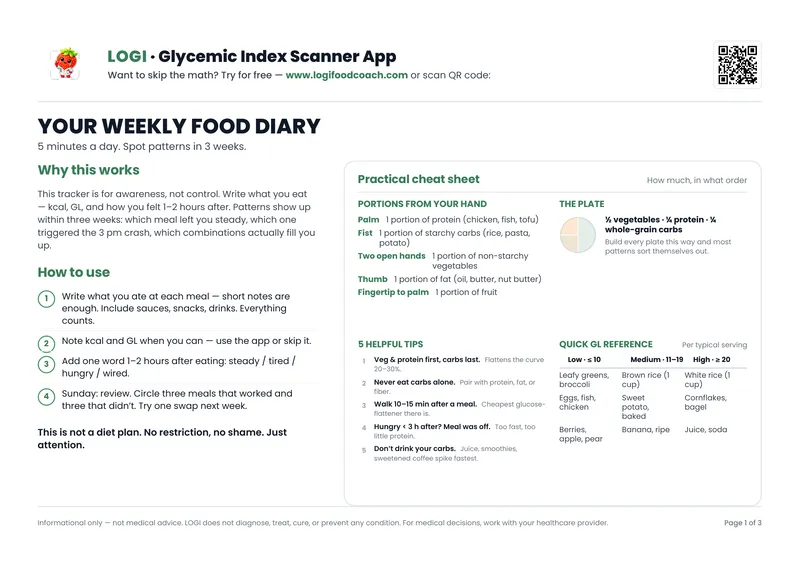
免費PDF — 3頁
每週飲食日誌
記錄飲食、升糖負荷與心情。3週內發現規律。
無垃圾郵件。隨時取消訂閱。