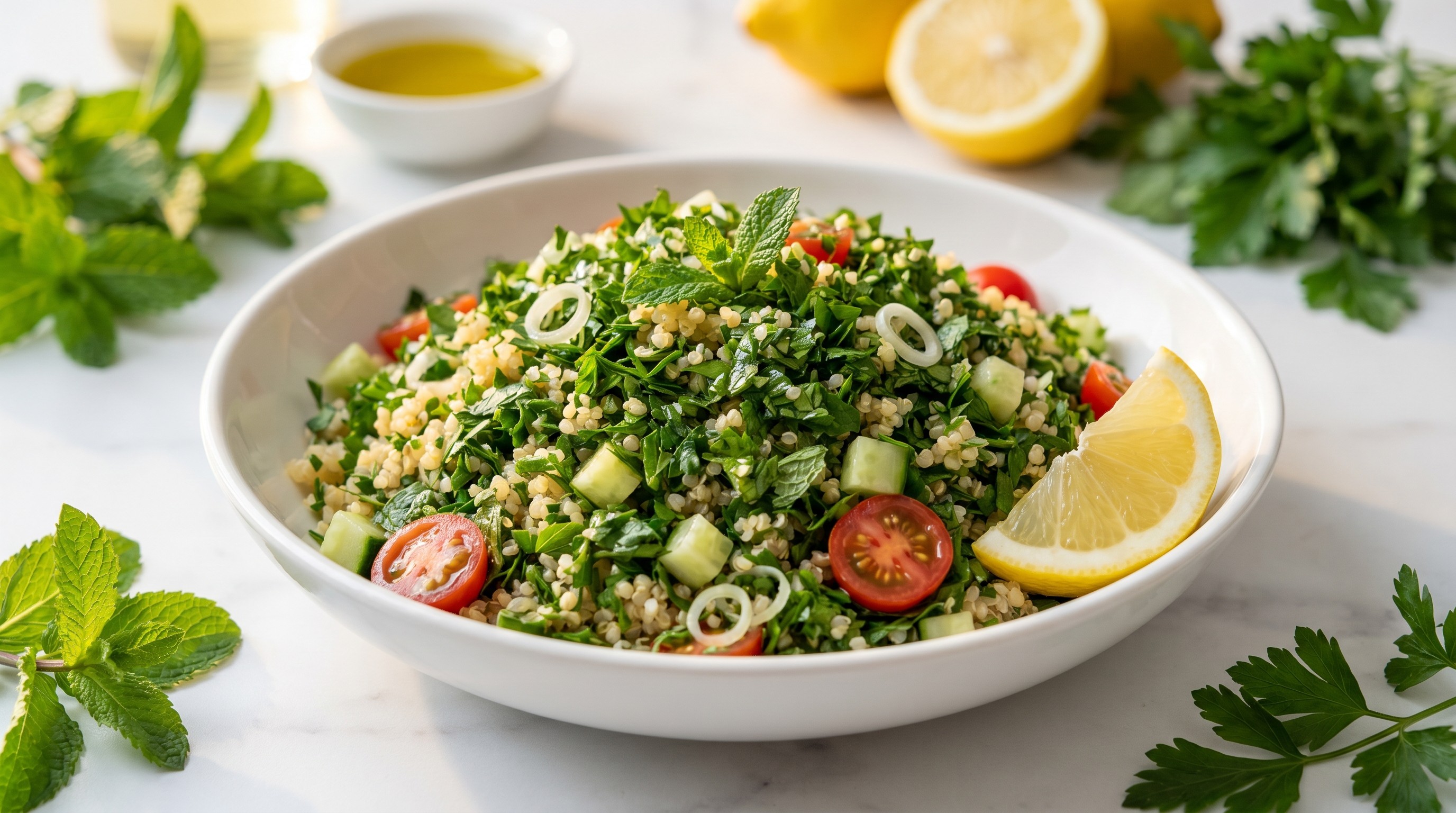
Spring Quinoa Tabbouleh with Cucumber and Mint
A herb-forward quinoa tabbouleh with cucumber, mint, and lemon — low glycemic, high in plant protein, and perfect for steady blood sugar.
This spring quinoa tabbouleh is a blood-sugar-friendly twist on the Middle Eastern classic. Traditional tabbouleh relies on bulgur wheat (GI ~48), but quinoa comes in even lower on the glycemic index (~53) while delivering all nine essential amino acids — a rare feat for a grain-like seed. The protein and fiber in quinoa slow glucose absorption, helping you avoid the energy dips that follow starchier salads.
The real secret to great tabbouleh is restraint with the grain and generosity with the herbs. Fresh flat-leaf parsley and mint make up the bulk of this dish, contributing almost no glycemic load while providing vitamins K, C, and A along with anti-inflammatory compounds. Cucumber and cherry tomatoes add volume and hydration with negligible impact on blood sugar, while the extra virgin olive oil delivers heart-healthy monounsaturated fats that further slow gastric emptying and glucose uptake.
For optimal blood sugar management, serve this tabbouleh as a side alongside grilled chicken, fish, or chickpeas — pairing it with additional protein and fat blunts any glucose response from the quinoa. Eating the vegetables and herbs first, then the quinoa-rich bites, can further flatten your post-meal glucose curve. This salad actually improves as it rests, making it an ideal meal-prep option: prepare it in the morning and enjoy steady, sustained energy all afternoon.
Blood Sugar Impact
Low impact expected. With a GI of 35 and glycemic load of 7.5, quinoa's slow-digesting complex carbohydrates combined with fiber-rich vegetables and healthy fats from olive oil should produce a gentle, sustained blood sugar rise with stable energy for 3-4 hours.
Blood Sugar Tips
- ✓ Start by eating the cucumber, tomato, and herb portions first to front-load fiber before the quinoa.
- ✓ Dress generously with olive oil and lemon juice — the fat and acid both slow gastric emptying and reduce the glycemic response.
- ✓ Follow the meal with a 10-15 minute walk to further blunt any modest blood sugar rise from the quinoa.
🥗 Ingredients
- 100 g Quinoa
- 200 ml Water
- 40 g Flat-leaf parsley
- 20 g Mint
- 1 pcs Cucumber
- 150 g Cherry tomato
- 3 pcs Spring onion
- 3 tbsp Extra virgin olive oil
- 3 tbsp Lemon juice
- 1 tsp Salt
- 3.5 oz Quinoa
- 14 tbsp Water
- 1.4 oz Flat-leaf parsley
- 0.7 oz Mint
- 1 pcs Cucumber
- 5.3 oz Cherry tomato
- 3 pcs Spring onion
- 3 tbsp Extra virgin olive oil
- 3 tbsp Lemon juice
- 1 tsp Salt
👨🍳 Instructions
- 1
Rinse the quinoa thoroughly under cold running water in a fine-mesh sieve for about 30 seconds. This removes the naturally occurring saponins that can give quinoa a bitter taste.
- 2
Place the rinsed quinoa in a small saucepan with 200ml of water and a pinch of salt. Bring to a boil over high heat, then immediately reduce to the lowest setting. Cover tightly and cook for 12–13 minutes, until all the water has been absorbed.
- 3
Remove the saucepan from the heat and keep it covered for 5 minutes — the residual steam finishes cooking the quinoa and gives it a fluffy texture. Uncover, fluff gently with a fork, and spread the quinoa on a large plate or rimmed baking sheet to cool to room temperature, about 10 minutes.
- 4
While the quinoa cools, prepare the herbs. Finely chop the flat-leaf parsley and mint leaves — aim for very fine pieces, almost the size of the quinoa grains. The herbs should feel like the main ingredient, not a garnish.
- 5
Dice the cucumber into small cubes of roughly 5mm. Quarter the cherry tomatoes lengthwise. Thinly slice the spring onions, using both the white and green parts.
- 6
In a large mixing bowl, combine the cooled quinoa with the chopped parsley, mint, diced cucumber, quartered tomatoes, and sliced spring onions. Toss gently to distribute evenly.
- 7
Drizzle the extra virgin olive oil and lemon juice over the salad. Season with salt and freshly ground black pepper. Toss thoroughly so every component is coated in the dressing. Taste and adjust the lemon, salt, or pepper to your preference.
- 8
Allow the tabbouleh to rest at room temperature for 15–20 minutes before serving. This resting time lets the quinoa absorb the dressing and the flavors meld together. For meal prep, refrigerate for up to 3 days — the flavors deepen overnight.
📊 Nutrition Per Serving
| Per Serving | Whole Dish | |
|---|---|---|
| Calories | 285 | 571 |
| Carbs | 22g | 43g |
| Sugars | 5g | 10g |
| Natural Sugars | 5g | 10g |
| Protein | 5g | 9g |
| Fat | 21g | 43g |
| Saturated Fat | 3g | 6g |
| Unsaturated Fat | 18g | 37g |
| Fiber | 5g | 9g |
| Soluble Fiber | 1g | 2g |
| Insoluble Fiber | 2g | 4g |
| Sodium | 996mg | 1992mg |
Predicted Glucose Response
What if you...
Estimated model — individual responses vary. Not medical advice.
🔄 Lower GI Swaps
Quinoa has a moderate GI (~53). Cauliflower rice has a negligible glycemic load due to very low carbohydrate content. Hulled barley (GI ~28) and black lentils (GI ~32) are among the lowest-GI grains and legumes, significantly reducing the overall glycemic load of the dish.
While cherry tomatoes have a low GI, replacing some or all with avocado adds healthy fats and fiber that slow glucose absorption. Zucchini and artichoke hearts are extremely low in carbohydrates, further reducing the dish's overall glycemic load.
Vinegar has been shown in studies to lower the postprandial glycemic response by up to 20-30% when consumed with a meal, thanks to acetic acid slowing gastric emptying and improving insulin sensitivity. Lemon juice has some of this effect, but vinegar provides a stronger blood-sugar-blunting benefit.
Spring onions contain slightly more sugar per serving than chives or celery. Chives deliver a similar mild allium flavor with fewer carbohydrates, and celery adds crunch with a very low glycemic load, helping keep the total GL of the dish minimal.
🔬 The Science Behind This Recipe
Here's the science explainer section:
---
Why This Recipe Works for Blood Sugar
Quinoa is one of the smartest grain swaps you can make when thinking about blood sugar. Unlike refined grains like white rice or couscous, quinoa is a complete protein — meaning it contains all nine essential amino acids — and delivers a solid dose of fiber (about 5 grams per cooked cup). That combination of protein and fiber slows down the rate at which your body breaks down carbohydrates into glucose, creating a gentler, more gradual rise in blood sugar rather than a sharp spike. With an estimated glycemic index of just 35, this dish sits firmly in the "low" category, and its glycemic load of 7.5 per serving tells us that the *amount* of blood-sugar-raising carbohydrate is modest too. Remember, glycemic load accounts for portion size — so even if a food has some carbs, eating a reasonable amount keeps the overall impact low.
Cucumber and the generous herbs in this tabbouleh aren't just flavor players — they're doing metabolic work too. Cucumber is extremely low in carbohydrates and high in water content, which effectively dilutes the carbohydrate density of the whole dish. Meanwhile, the large volume of parsley and mint adds fiber and bulk without adding sugars, helping you feel satisfied on less starchy food overall.
To get even more benefit from this meal, try eating the cucumber and herb portions first before finishing the quinoa — research suggests that eating vegetables before carbohydrates can reduce post-meal glucose spikes by up to 30%. Pairing this tabbouleh with a drizzle of olive oil or some grilled chicken adds healthy fat and extra protein, further smoothing out your blood sugar response. A short 10-15 minute walk after eating can also help your muscles absorb glucose more efficiently, keeping levels steady through your afternoon.
Related recipes
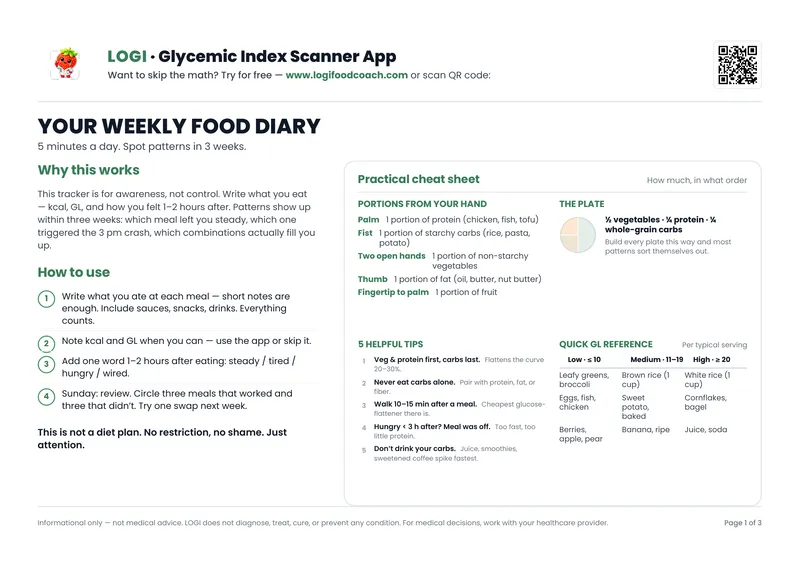
Free PDF — 3 pages
Your Weekly Food Journal
Track meals, glycemic load & mood. Spot patterns in 3 weeks.
No spam. Unsubscribe anytime.