What You Can Learn in Logi Academy — 31 Micro-Lessons on Blood Sugar, Insulin Resistance and Daily Food Choices
Most people who land in a metabolic clinic for the first time leave with two things: a stack of lab results and a vague instruction to “eat less sugar.” Then the questions start at home. Is fruit fine? What about brown rice? Why do I feel sleepy after lunch but not after dinner? Does it matter when I eat? Standard care does not have room to answer twenty questions per visit, and most online sources contradict each other.
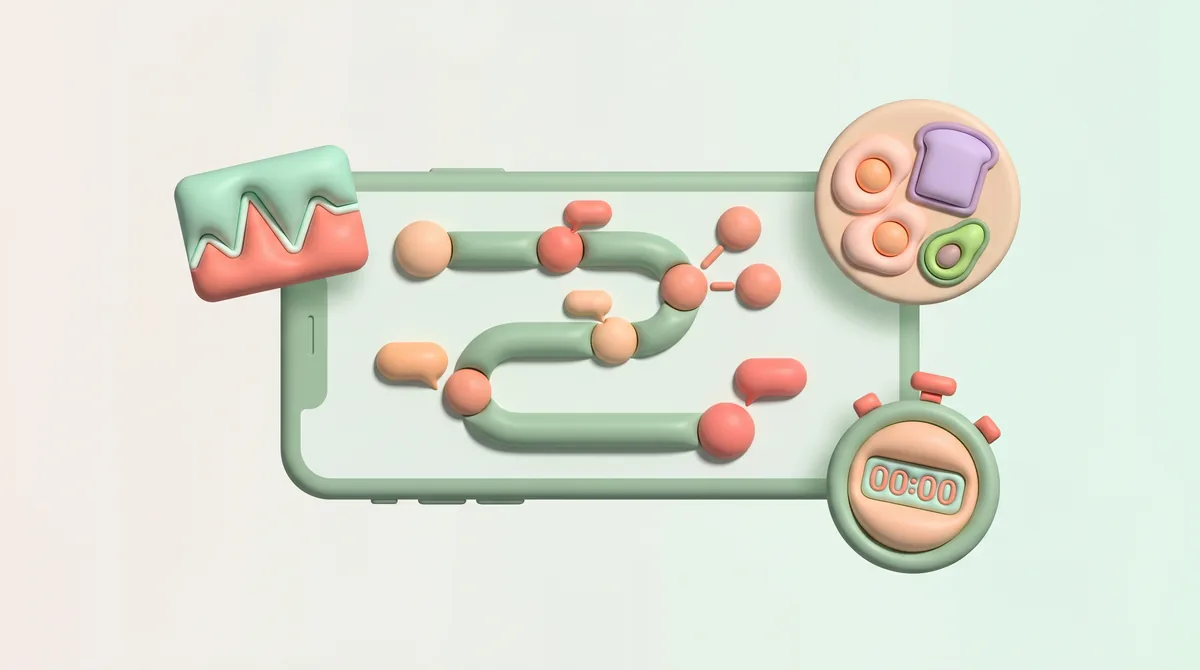
Logi Academy is the answer to that gap. It is the new in-app learning track, built like Duolingo for metabolic health — 31 short lessons, each under three minutes, that build a working understanding of how food, sleep and movement affect your blood sugar. You can do one in line at the grocery store. The aim is not to make anyone a clinician. The aim is that after thirty days you can walk through a regular menu and know what each dish is going to do to you, without guessing.
This is what is in there, why it is structured this way, and how to get the most out of it.
Why Micro-Lessons, Not Articles
If you have ever bookmarked a long article about insulin resistance and never finished it, you already know the problem. Long-form is great for one sitting on a slow Sunday. It is the wrong shape for learning a skill you need every day of your life.
Logi Academy uses a Duolingo-style pattern on purpose. Each lesson is one idea, one example, one small interaction — a question to answer, a label to drag, a meal to rate. You do not read about glycemic load. You see two breakfasts side by side and pick the one that will keep your blood sugar steadier, then the lesson tells you which one and why. The interaction is what makes it stick. Reading a definition five times is not the same as making the choice yourself and being right or wrong.
Three minutes is the upper limit. Most lessons are shorter. The completion rate on a three-minute lesson is roughly five times higher than on an eight-minute one, and what you want here is not depth in any single session. What you want is thirty completed sessions over a month. Compounding repetition beats one heroic study session.
The Four Tracks
The 31 lessons are organised into four tracks that build on each other. You can do them in order or jump in where your curiosity is.
Track 1: The Basics of Blood Sugar (lessons 1-8)
This is the foundation. What is glucose, why does the body care so much about keeping it stable, and what is insulin actually doing. You learn the difference between glycemic index and glycemic load — the single most useful distinction for daily food choices, and the one that most popular health content gets wrong. You learn why a small serving of a high-GI food can be fine, and why a large serving of a “healthy” medium-GI food can blow you up. You learn what a post-meal spike looks like on a continuous glucose monitor and what counts as normal versus what is worth paying attention to.
By lesson 8 you can read the GL number on any Logi food scan and know whether to eat it as is, eat half of it, or pair it with protein and fat to flatten the response.
Track 2: Insulin Resistance and Prediabetes (lessons 9-16)
This track is for people who have been told their fasting glucose is creeping up, their HbA1c is in the 5.7-6.4 range, or that they are insulin resistant. It explains what is actually happening in the muscle and liver cells, why the body starts producing more insulin years before glucose numbers move, and why “I am not even fat, how can I have this?” is one of the most common reactions — because lean people get insulin resistant too, and the mechanism is not what most people think.
You learn the four lab numbers that matter (fasting insulin, fasting glucose, HbA1c, triglyceride-to-HDL ratio) and how to read them together. You learn what HOMA-IR is and how to calculate it from a basic blood panel. You learn what conditions tend to travel with insulin resistance — PCOS, fatty liver, sleep apnoea, certain skin patterns — and why noticing them earlier matters.
This is the track where most people have their first proper “oh, this is what is going on” moment.
Track 3: Daily Food Choices (lessons 17-24)
This is the practical track. Breakfasts that do not crash you at 10 am. What to do about pasta and rice if you genuinely love them. How to read a restaurant menu in thirty seconds and know which item is going to be the cleanest choice. The role of fibre and protein in slowing absorption. Why the order of bites in a meal matters — vegetables and protein first, starch last — and the data behind that.
There is a lesson on alcohol and blood sugar that surprises most people. There is a lesson on fruit that calmly takes apart the idea that fruit is “natural sugar so it is bad.” There is a lesson on what to eat after a workout if you are trying to improve insulin sensitivity rather than fuel performance.
The track ends with a fifteen-minute “build your default day” exercise, where you put together a 24-hour eating pattern that fits your work schedule, your travel patterns, and the food you actually like.
Track 4: Beyond Food (lessons 25-31)
Food is the loudest lever but it is not the only one. Sleep, movement, stress and circadian rhythm all bend the same curve.
You learn why a bad night of sleep makes your morning coffee hit harder than usual. You learn what a ten-minute walk after a meal does to the post-meal spike, and why it works better than a longer walk before. You learn about the difference between cardio and resistance training for insulin sensitivity — both help, but in different ways and on different timeframes. You learn what consistent meal timing does for the hormones that regulate hunger and metabolism, and why eating the same number of calories at very different times of day does not produce the same metabolic result.
The last lesson is a one-page summary that you keep — what you control, what you do not, and the three things that will matter most over the next year.
What the Lessons Are Built On
Every lesson goes through the same review pipeline. We start from peer-reviewed sources — the standard textbooks of metabolic and endocrine medicine, current clinical guidelines from the major diabetes associations, and recent meta-analyses for any claim that is on the contested edge of the field. Where the evidence is strong, the lesson says so plainly. Where the evidence is good but not settled, the lesson says that too, in language that does not pretend to certainty.
There is no “one weird trick” framing in Logi Academy. There are no scare tactics about sugar being poison. There is no pretending that one diet works for everyone — the lessons are explicit that the same meal produces different glycemic responses in different people, and that the goal is to learn your own pattern, not to follow a universal rule.
If a piece of advice has only animal-study evidence, the lesson tells you that. If a recommendation is widely repeated online but the human data does not support it, the lesson takes the time to explain why the simple version is wrong.
How to Get the Most Out of It
Three suggestions, based on what we have seen work.
Do one lesson a day, not seven on Sunday. Spaced repetition is the engine here. A daily lesson followed by a regular food scan is roughly twice as effective for retention as a marathon session, and four times less likely to feel like a chore.
Apply the lesson the same day. After lesson 4 on glycemic load, scan your next meal and look at the GL number with the lesson fresh. After lesson 18 on post-meal walks, actually take a ten-minute walk after lunch. The application is the lesson. Reading without applying is how people end up with a head full of concepts and no behaviour change.
Re-take a lesson if you forget. There is no grade, no streak penalty for going backwards, no judgement. Pulling on a thread you forgot is worth more than pretending you remember.
What This Is Not
Logi Academy does not replace your doctor. If you are managing type 1 diabetes, on insulin, or pregnant, the standard advice in these lessons may need adjustment for your situation, and your clinician is the right person to make those calls. The track also does not cover medication management — that is intentionally out of scope. We stay where the evidence is strongest and the user has the most agency: food, movement, sleep and the daily choices that compound.
It is also not a quiz to game. There are no badges for speed, no shame for slowness. The point is that you finish the month with a working model of your own metabolism, not that you collect ribbons.
When You Are Done
If you complete all 31 lessons, you will be able to look at any plate of food and tell, within a minute, whether it is going to spike you. You will know which numbers in your blood panel to track, what they mean together, and which trends you actually want to move. You will have a default eating pattern that fits your life, and you will know which two or three habits outside of food are doing the most work for you.
That is the point. Not a degree, not a certificate, not a label. A working understanding of how your body responds to food, in the kind of detail that lets you make better choices without having to think hard about them every time.
Logi Academy is live in version 2.5.0 of the app. Open the Logi app, tap Learn, and start with Lesson 1. The first lesson is two minutes long. By the time you finish reading this post, you could already be done with it.
Logi is an AI metabolic health assistant for iPhone and Android. Scan food, get glycemic load and macros instantly, plan low-glycemic meals from one to fourteen days, and track the daily habits that improve insulin sensitivity. Available in 35 languages.
Related recipes

Kuku Sabzi (Persian Herb Cake with Walnuts and Barberries)
A vibrant Persian herb cake bound with eggs and studded with walnuts and tart barberries — naturally low-glycemic, high in protein, and rich in phytonutrients.

Low-Glycemic Buffalo Chicken Stuffed Bell Peppers
Protein-packed bell peppers filled with spicy buffalo chicken and topped with dairy-free ranch. A blood sugar-friendly dinner that's both satisfying and delicious with GI 26 and GL 1.4 per serving.

Herb-Crusted Grilled Chicken with Smoky Yellow Tomato Sauce
Tender grilled chicken coated in fresh herbs, topped with a vibrant roasted yellow tomato sauce that's naturally low in sugar and rich in antioxidants.
Take control of your blood sugar
Scan your meals, track glycemic load, and see your patterns — all in one app.
Start Free Trial →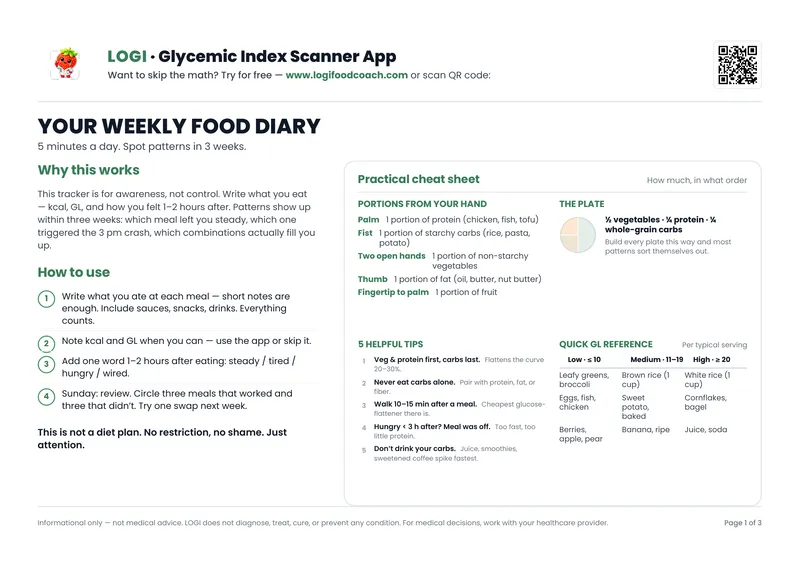
Free PDF — 3 pages
Your Weekly Food Journal
Track meals, glycemic load & mood. Spot patterns in 3 weeks.
No spam. Unsubscribe anytime.