Do Frozen Foods Raise Blood Sugar? A Category-by-Category Guide to the Freezer Aisle
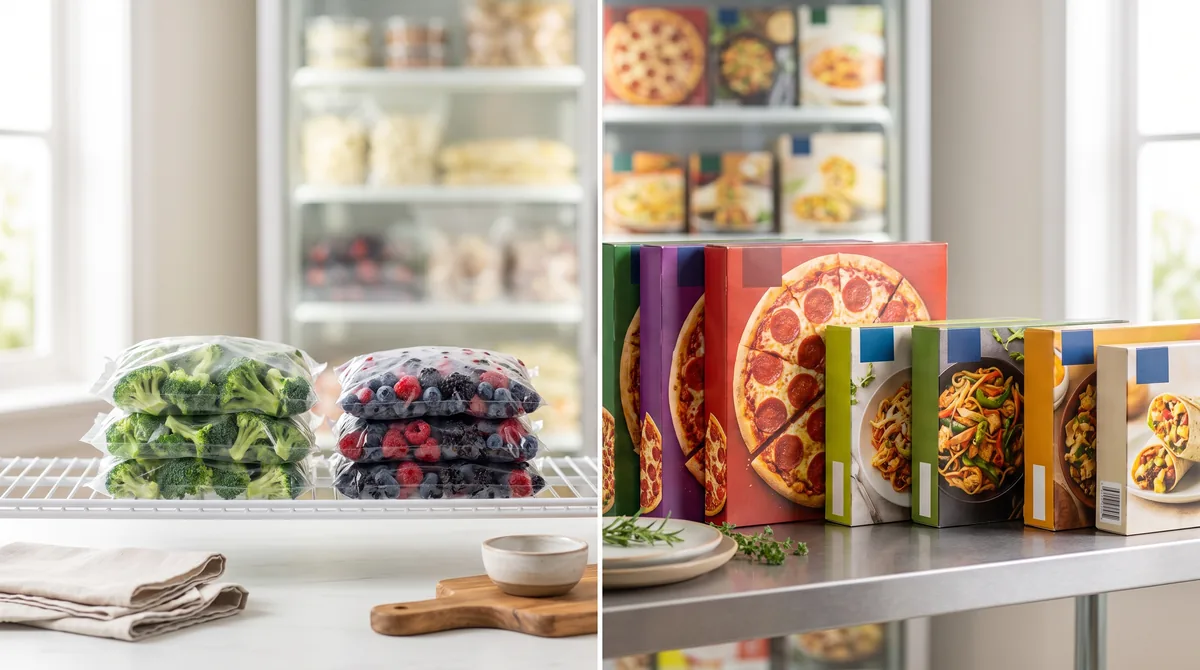
The freezer aisle is one of the most misunderstood parts of the grocery store when it comes to blood sugar. Frozen broccoli and a frozen pepperoni pizza sit two doors apart in the same freezer and produce almost opposite glucose curves. Frozen berries and a frozen sugar-glazed pastry share the same shelf and are not the same food in any nutritional sense.
The confusion is understandable. “Frozen” is a preservation method, not a food category — it tells you almost nothing about what is in the package. This piece walks through why freezing itself is not the glucose issue, what actually drives the response in the main frozen categories, and how to read the freezer aisle in a way that turns it from a mystery into one of the more useful parts of the store.
The mechanism — freezing is not the story, the ingredient is
Freezing does not meaningfully change the glycemic index of a food. A frozen raspberry produces the same glucose response as a fresh raspberry; a frozen potato produces the same response as a fresh potato cooked the same way. The freezing process itself is neutral to blood sugar.
What the freezer does change is convenience and format. A frozen ready meal is not glucose-different because it was frozen — it is glucose-different because it was engineered to be a complete meal in a tray, which usually means a large starch base (rice, pasta, mashed potato, bread), a smaller protein portion, and a sauce that often includes added sugar. The starch, protein, and sauce are what drive the response. The freezer only made them shelf-stable.
There is one small nuance worth naming. Freezing and refrigerating some starchy foods — cooked rice, cooked potato, cooked pasta — increases their resistant starch content, which slightly lowers the immediate glucose peak when the food is reheated. The effect is real but modest, and it applies to plain starches you cooked and cooled, not to frozen ready meals whose starch component is designed to reheat smoothly.
Once you separate “frozen” from what is in the tray, the freezer aisle stops being confusing. It splits into a few categories, each with its own glucose story.
Frozen vegetables and fruits — this is where the freezer earns its reputation
Plain frozen vegetables — broccoli, spinach, cauliflower, green beans, peas, edamame, kale, bell peppers, zucchini, brussels sprouts, mixed stir-fry vegetables — are among the cheapest low-glycemic foods available and are often more nutrient-dense than the fresh version, because they are picked ripe and frozen within hours instead of shipping and sitting for a week. All of these produce near-zero glucose response.
The one common trap is sauced or seasoned vegetables. A bag of plain frozen broccoli is a normal low-glycemic vegetable. A bag of “broccoli in cheese sauce” or “vegetable stir-fry with sweet ginger glaze” is not — the sauce is almost always sugar-forward and often turns a low-glycemic vegetable serving into a small dessert. Read the label; if there is more than two or three grams of added sugar per serving, it is a different food than the plain version.
Frozen fruits are the same story. Plain frozen berries, cherries, mango chunks, and peaches are the same food as the fresh versions and behave the same on the glucose curve. Sweetened frozen fruit (packed in syrup, or “with sugar added”) is a dessert ingredient.
The pattern is: single ingredient in the bag is a normal ingredient; multi-ingredient package with a sauce or coating deserves a label check.
Frozen ready meals — the tray meal is the highest-glucose category in the freezer
Frozen dinners — the tray with a starch, a protein, and a sauce — are the freezer’s high-glucose category, and they are high-glucose for the same reasons any other convenience meal is: refined starch base, moderate protein, sweet sauce.
The starch is usually rice, pasta, mashed potato, or a bread element. Portion sizes on the box tend to be generous by carbohydrate weight — a typical single-serve pasta tray carries 40-60 grams of carbohydrate, which is a full glucose event on its own. A rice-based dish is similar. Mashed potato sides are among the higher-GI starches on shelves.
The protein is usually adequate but small — a chicken breast piece, a few meatballs, a portion of ground beef. This protein moderates the glucose curve slightly but not enough to change the category.
The sauce is where the hidden sugar hides. Sweet-and-sour, teriyaki, orange chicken, honey barbecue, tomato-basil, and creamy-tomato sauces almost always include added sugar. The savory descriptor on the box — “Italian herb”, “Asian-style”, “smokehouse” — usually maps to some amount of sugar in the sauce.
The reasonable rule for tray meals: they behave like restaurant meals of the same category. A chicken teriyaki bowl from the freezer is glucose-similar to a chicken teriyaki bowl from a food court. This is not a reason to avoid them; it is a reason to treat them as a full meal, not a light option, and to eat a smaller portion or pair with a salad or a portion of protein on the side.
Frozen pizza — refined-flour crust with a sauce and a topping
Frozen pizza is essentially a slice-for-slice equivalent of restaurant pizza. The crust is refined flour, which produces a fast glucose peak; the sauce carries some sugar; the cheese and any protein toppings are near-zero glucose. The vegetable toppings do not meaningfully change the picture.
The realistic thing to know: a single serving of frozen pizza on the box is usually one-third or one-fourth of the pizza, which is a smaller portion than most people actually eat. Two servings of thin-crust frozen pizza with a large side salad is a reasonable meal for many people; four slices with garlic bread on the side is a large glucose event.
Thin-crust and cauliflower-crust versions do produce lower glucose responses than deep-dish or self-rising crusts, but the effect is modest — a thin crust is still a bread portion. The one meaningful lever is the crust type; the other levers are portion size and what you eat alongside it (protein and a vegetable side move the curve meaningfully).
Frozen fries, hash browns, and potato products — a straight potato story
Frozen French fries, tater tots, hash browns, potato wedges, and shoestring fries are all the same food story: they are potato, which is one of the higher-GI starches, in a form that is easy to eat in large portions.
The oven versus air-fryer versus deep-fryer question does not meaningfully change the glucose response. What air-frying changes is fat content and calorie load, both of which are useful. It does not change how quickly the potato converts to glucose.
The realistic frame for frozen potato products is: they are a starch side, not a vegetable side. A small portion alongside a protein and a real vegetable is a normal meal component; a large plate of fries as the main event is a large glucose peak with limited fiber or protein to slow it down.
The lower-GI substitute inside the same aisle is often frozen roasted vegetables — root vegetable mixes with carrot, parsnip, sweet potato and beetroot are typically lower on the glucose curve than potato-only sides, and frozen cauliflower “rice” is a near-zero-carbohydrate substitute for a rice or potato base.
Frozen desserts and pastries — designed to spike
Ice cream, frozen yogurt, sorbet, ice cream bars, frozen cakes, pies, pastries, waffles, pancakes, and frozen doughnuts are dessert foods; the “frozen” part is incidental. All of them are refined carbohydrate plus sugar, sometimes with fat that slightly slows the peak.
Ice cream is a specific note worth making. A small serving of full-fat ice cream produces a moderate glucose response — the fat and small protein content from the cream slow it down considerably compared with sorbet or low-fat frozen yogurt of the same sugar content. This is one of the counterintuitive findings in dessert research: the full-fat version is often the lower glucose peak per gram. It is still a dessert; a small portion behaves better than a large one.
Frozen breakfast items — waffles, pancakes, French toast, breakfast pastries, doughnuts — are among the sharper glucose peaks in the freezer aisle, especially when eaten with syrup or a sweetened topping.
The practical shortlist
If you want a mental shortcut for reading the freezer aisle:
- Almost always reasonable: plain frozen vegetables (any single-ingredient bag), plain frozen berries and other fruits, frozen fish fillets without breading, plain frozen shrimp, frozen edamame, frozen cauliflower rice, frozen chicken breast or thighs (not breaded), frozen turkey burgers, frozen lean beef, frozen herbs.
- Depends on choices: frozen pizza (as a portion, with protein and vegetable on the side), frozen soup (check the label for sugar and starch), frozen dumplings (each has some refined flour), frozen breakfast sausage or bacon (protein but check the sugar), frozen breaded fish or chicken (the breading is the story).
- Treat as a treat: frozen ready meals with sweet sauces, frozen desserts and pastries, frozen fries as the main event, breakfast waffles and pancakes with syrup, ice cream bars and popsicles, sweetened frozen yogurt.
The single most useful move for most people at the freezer aisle is to build meals around the plain single-ingredient bags — a bag of frozen vegetables, a bag of frozen shrimp or fish, a bag of frozen berries for breakfast — and to treat the tray meals and frozen desserts as their own category, chosen deliberately rather than by default.
The bigger picture
The freezer aisle carries a reputation for being uniformly worse than fresh food, and it is not deserved. Plain frozen vegetables are one of the best-value low-glycemic foods on the shelves — often fresher than the produce section, always cheaper per portion, always available. Frozen fish and lean protein cuts are convenient and produce the same low glucose response as their fresh counterparts. Frozen berries are one of the easier ways to eat a low-glycemic fruit portion every day of the year.
The freezer also carries a shelf of engineered convenience meals and dessert foods that produce large glucose events, and it is worth knowing which is which by reading rather than by category. The rule is not “avoid the freezer aisle”; it is “notice when the package has one ingredient and when it has thirty.”
The durable move is to treat frozen single-ingredient foods as your default for anything you cook regularly, and to treat frozen convenience meals as an occasional choice rather than a weekly staple. Done that way, the freezer becomes one of the more useful parts of a low-glycemic kitchen, not one of the more suspect ones.
If you want to check what a specific frozen meal or side does to your own glucose curve, Logi can scan the package or a photo of the plated meal and estimate its glycemic load in seconds — useful for the tray meals where the label is dense and the ingredient list is longer than the description.
This article is educational. It is not medical advice. Individual responses to any food vary widely; if you have diabetes, insulin resistance, or another metabolic condition, discuss dietary choices with your doctor or a registered dietitian.
Foods in this article
Related recipes

Air Fryer Onion Bhaji
Crispy Indian fritters made healthier with air frying instead of deep-frying. These spiced onion and carrot bhajis deliver authentic flavor with minimal oil.

Omega-Rich Green Power Bowl with Smoked Mackerel
A nutrient-dense salad combining omega-3 rich mackerel with fiber-packed greens and a tangy yogurt dressing—perfect for stable blood sugar levels.

Air Fryer Buffalo Chicken Wings with Low-GI Glaze
Crispy air-fried chicken wings with a blood sugar-friendly buffalo glaze. Perfect protein-packed snack with minimal glycemic impact when paired right.
Take control of your blood sugar
Scan your meals, track glycemic load, and see your patterns — all in one app.
Start Free Trial →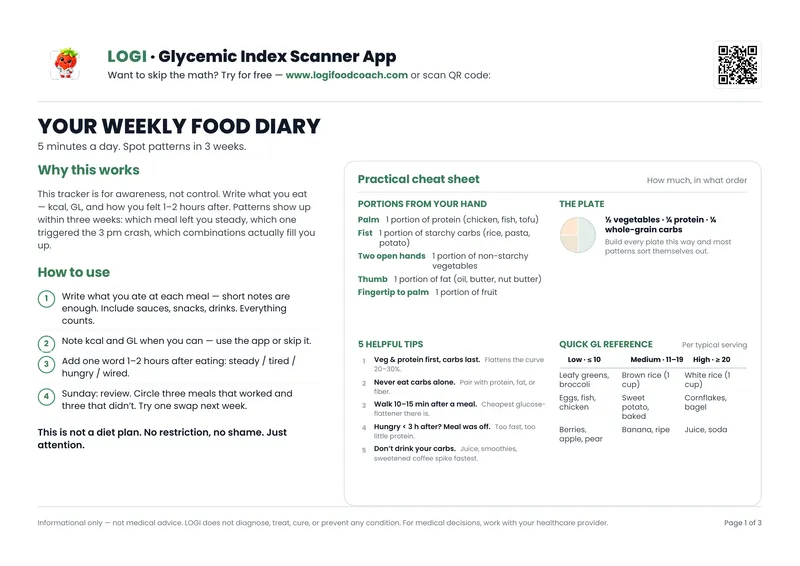
Free PDF — 3 pages
Your Weekly Food Journal
Track meals, glycemic load & mood. Spot patterns in 3 weeks.
No spam. Unsubscribe anytime.