Does Fast Food Raise Blood Sugar? A Practical Guide to Ordering Without the Crash
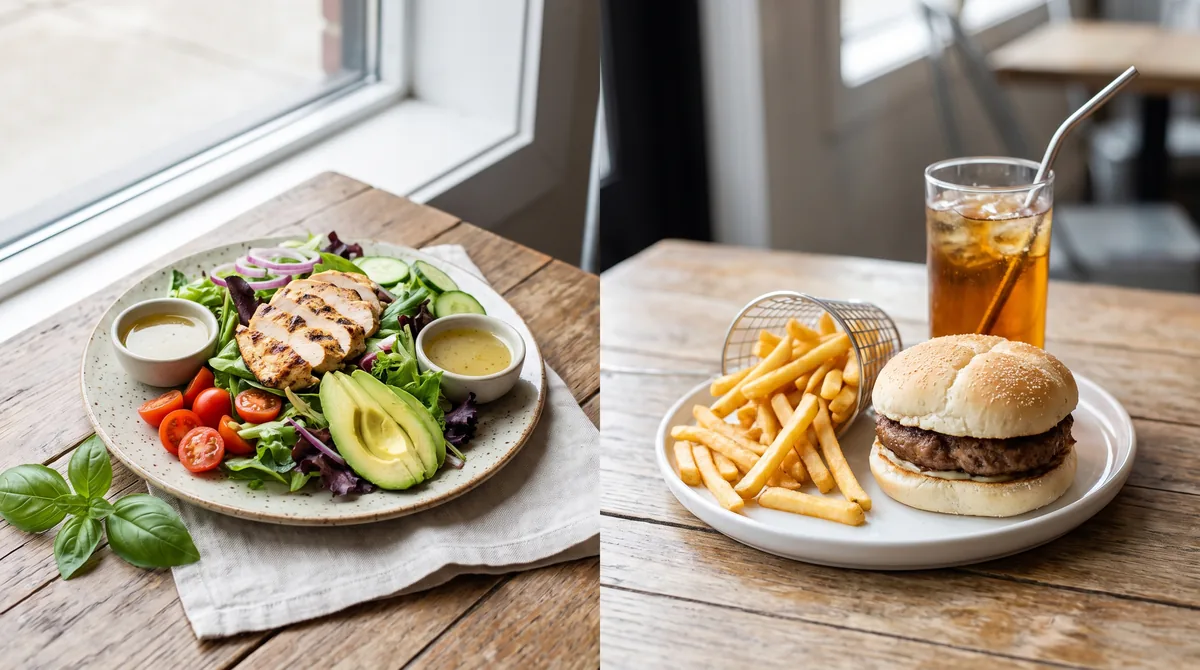
Fast food is not a monolith. The same drive-through can give you a meal that produces almost no glucose response or one that spikes hard for two hours, depending on choices that take about three seconds to make. A grilled chicken salad and a Big Mac with fries come from the same restaurant and produce completely different curves — one is a normal meal, the other is a bag of white bread, fried potato, and sugar-sweetened soda arriving in the bloodstream over the same forty minutes.
This piece walks through why fast food has the reputation it has, what actually drives the glucose response, and how to order at the main fast-food categories — burger chains, sandwich chains, chicken chains, mexican chains — in a way that does not sabotage the rest of the day.
The mechanism — four ingredients doing most of the damage
The glucose response to a typical fast-food meal is driven by four things stacking on top of each other. The first is the refined-flour bun or wrap or bread — a burger bun, a sandwich roll, a tortilla, a hot dog bun — all of which are made from white wheat flour and behave similarly to a slice of white bread on the glucose curve. A single bun is a meaningful glucose event; a footlong sub is closer to two.
The second is the fried potato. French fries, hash browns, tater tots, curly fries, potato wedges — the frying does not make them lower-glycemic, and a large fry from most chains is one of the fastest and biggest glucose peaks on the menu. Fried potato is essentially a portion of high-GI carbohydrate delivered warm and salty, which makes it easy to eat quickly and in large portions.
The third is the sugary drink. A large fountain soda contains roughly 60–90 grams of pure sugar with no fiber or fat to slow it down; it is the fastest, sharpest glucose peak in most fast-food meals, arriving before the meal has even reached the intestine. Sweetened iced tea, lemonade, and specialty coffee drinks are the same story in a different container. Diet soda and unsweetened tea produce no glucose response at all.
The fourth is the hidden sugar in the sauces and marinades — barbecue sauce, sweet chili, honey mustard, ketchup, teriyaki, the sweet coating on many chicken sandwiches, and the corn syrup in sandwich bread. Individually small; collectively meaningful, because they layer on top of the bun-fry-soda triangle.
The full “meal deal” — sandwich, fries, sugary drink — is what makes fast food hit so hard. Any single one on its own is manageable. All three together, in the portions typically served, is why most orders spike.
Burgers — the levers are the bun, the fries, and the drink
The burger itself is not the problem. Ground beef, cheese, lettuce, tomato, onion, pickle — all near-zero glucose response. A double cheeseburger without the bun would produce almost no glucose peak.
Every major burger chain will let you either skip the bun or order the burger “protein style” (wrapped in lettuce). Most also offer a side salad or apple slices as a substitute for fries. Any of these swaps turns a hard-spike meal into a normal meal.
The other burger-category traps to know. First, “signature sauces” on premium burgers — the special-sauce, the aioli, the sweet-onion glaze — usually carry some sugar. Not usually enough to matter on its own, but a note. Second, breakfast items with pancakes, syrup, hash browns, and orange juice can be higher-glucose than a lunch burger by a wide margin. Third, milkshakes are essentially a sugar-cream dessert served alongside a meal; a large milkshake will produce a bigger glucose event than the burger it accompanies.
The reasonable order at any burger chain: a single or double cheeseburger without the bun (or with just the bottom bun), a side salad or fruit substitute, and water or unsweetened iced tea. This is a meal, not a treat.
Sandwich chains — the bread is the problem, and it is negotiable
Subway, Jimmy John’s, Jersey Mike’s, Firehouse Subs, Panera — all of these are built around a large bread portion. A six-inch sub is roughly two slices of white bread by volume; a footlong is four. The fillings — turkey, ham, chicken, tuna, roast beef, cheese, vegetables — are near-zero glucose. The bread is the glucose story.
The main levers. First, “in a bowl” or “as a salad” is offered at most chains and turns the sandwich into a low-glycemic meal. Second, “wheat” bread at most chains is not what most people think it is — wheat bread that is still soft, fluffy, and pale is basically white bread with a small amount of whole grain added, and produces a similar glucose response to the white version. Actually low-glycemic bread is dense, dark, and heavier per slice. Third, the six-inch versus footlong choice is a straight doubling of the bread’s contribution.
At sandwich chains, the reasonable pattern is either a chopped salad or bowl version of what you’d normally order, or a six-inch sub on the darkest bread the chain offers with extra vegetables and half the meat portion swapped for double protein. Skip chips as the side; ask for apple slices or a broth-based soup.
Chicken chains — grilled versus breaded is the whole story
Chick-fil-A, Popeye’s, KFC, Raising Cane’s, Zaxby’s — the story at chicken chains is straightforward. Grilled chicken with vegetables is a low-glycemic meal. Breaded, fried chicken with a bun and fries is a high-glucose meal, driven by the breading on the chicken (refined flour), the bun, and the fries.
Chicken nuggets in particular deserve a specific note. Nuggets are chicken pieces coated in a substantial breading layer, and the carbohydrate contribution of the breading is larger than most people realize — a 10-piece order carries about 25–30 grams of refined-flour carbohydrate on top of any fries or dipping sauce.
The dipping sauces are a smaller version of the same problem as Chinese takeout sauces. Barbecue sauce, sweet-and-sour, honey mustard, sweet chili, polynesian sauce — most contain 6–15 grams of sugar per small tub. Ranch, buffalo, mayonnaise, and mustard are essentially sugar-free.
The reasonable order at a chicken chain: grilled chicken sandwich (or the grilled version of the wraps), a side of fruit or a side salad instead of fries, and water or unsweetened tea. Or the grilled bites/nuggets version with the sauce on the side.
Mexican chains — the tortilla and the rice are the main carbs
Chipotle, Qdoba, Moe’s, Taco Bell, Del Taco — the two carbohydrate drivers at mexican chains are the tortilla (or the tortilla chips) and the rice. The proteins (chicken, steak, carnitas, sofritas, ground beef, fish), the salsas, the guacamole, the cheese, the sour cream, and the vegetables are all near-zero glucose.
The lever that changes the meal most is “in a bowl” versus “in a tortilla.” A burrito bowl skips the ~50 grams of carbohydrate in a large flour tortilla in exchange for adding zero. Doubling protein and skipping the rice takes another 40 grams off the meal. A bowl with double chicken, no rice, black beans, salsa, cheese, and guacamole is a normal-sized, low-glycemic meal at any Mexican chain — you cannot order much better than this.
Tortilla chips are a specific trap. A single “personal” order of chips is roughly a half-portion of french fries in carbohydrate terms, and the chip basket at sit-down mexican restaurants is a full portion. Salsa on chips is near-zero carb; queso on chips is closer to a fondue.
The drinks — the fastest and biggest sugar peak on the menu
Sugary drinks deserve their own section. A large fountain soda from any chain is roughly the sugar content of a small candy bar dissolved in water, arriving as a fast liquid glucose peak before the meal has been digested. If nothing else on the menu changes, switching a large sugared drink to unsweetened iced tea, diet soda, or water removes the biggest single-source glucose event from the meal.
Specialty coffee drinks — frappés, blended mocha drinks, sweetened cold brews, seasonal syrups — are dessert served in a coffee cup. A large sweet blended coffee often contains more sugar than the accompanying pastry.
Milkshakes and slushies are the peak of this category. A large milkshake is a small ice-cream serving in liquid form and can produce a bigger glucose event than the entire rest of the meal combined.
The practical shortlist
If you want a mental shortcut for ordering fast food with blood sugar in mind:
- Almost always reasonable: grilled chicken (in any form, without the bun), a salad or bowl option, sub or wrap made into a chopped salad, burrito bowl with double protein and no rice, a small side salad or fruit substitute, water or unsweetened iced tea, black coffee.
- Depends on choices: a small burger with the bun swapped for lettuce, half a sub on darkest available bread, a small grilled chicken sandwich, a small serving of fries or a personal chip serving as a specific chosen carb.
- Treat as a treat: milkshakes, large sugared sodas, breakfast pancake platters, large french fries, chicken nugget meals with dipping sauces, breaded chicken sandwiches on brioche buns, quesadillas, most desserts, blended coffee drinks.
The single most useful move for most people is to swap the drink to water or unsweetened, order the “bowl” or “protein style” version of whatever entree they want, and either skip the fry or take the small size. That combination removes the great majority of the glucose load from a typical fast-food meal without giving up the meal.
The bigger picture
Fast food’s reputation as a “problem food” for anyone managing insulin resistance, prediabetes, or type 2 diabetes is partly earned. The default combinations — sandwich, fries, sugary drink — are engineered to be eaten quickly and in large portions, and they layer three fast-carbohydrate ingredients on top of each other. The result is one of the biggest single-meal glucose events most people experience regularly.
But the same restaurants also offer, on the same menu, a set of choices that produce almost no glucose response at all. Grilled chicken in a salad or bowl, a burger without the bun, a burrito bowl without the rice, water or unsweetened tea — these are ordinary items at every major chain, and any of them, alone, changes the meal completely.
Fast food is a good example of a category where the problem is not the cuisine — it is the default. The durable move is not to give it up but to change the default order to something the drive-through will happily make, that costs the same, and that leaves the afternoon intact.
If you want to see what a specific fast-food order does to your own glucose curve, Logi can scan a menu photo, a receipt, or an image of the meal and estimate its glycemic load in seconds — useful for the many menu items where the name gives no hint about the bread or sauce load.
This article is educational. It is not medical advice. Individual responses to any food vary widely; if you have diabetes, insulin resistance, or another metabolic condition, discuss dietary choices with your doctor or a registered dietitian.
Foods in this article
Related recipes

Low-Glycemic Butter Chicken with Aromatic Spices
Creamy coconut-based Indian curry with tender chicken and warming spices. This blood sugar-friendly version uses whole foods and healthy fats for sustained energy.

Herb-Roasted Chicken with Low-Glycemic Root Vegetables
Succulent roasted chicken paired with fiber-rich vegetables creates a blood sugar-friendly meal that's both satisfying and nutritious for diabetes management.

Blood Sugar-Friendly Apple Cranberry Galette
A rustic whole-grain tart featuring fiber-rich apples and antioxidant cranberries, designed to minimize glucose spikes while delivering maximum flavor.
Take control of your blood sugar
Scan your meals, track glycemic load, and see your patterns — all in one app.
Start Free Trial →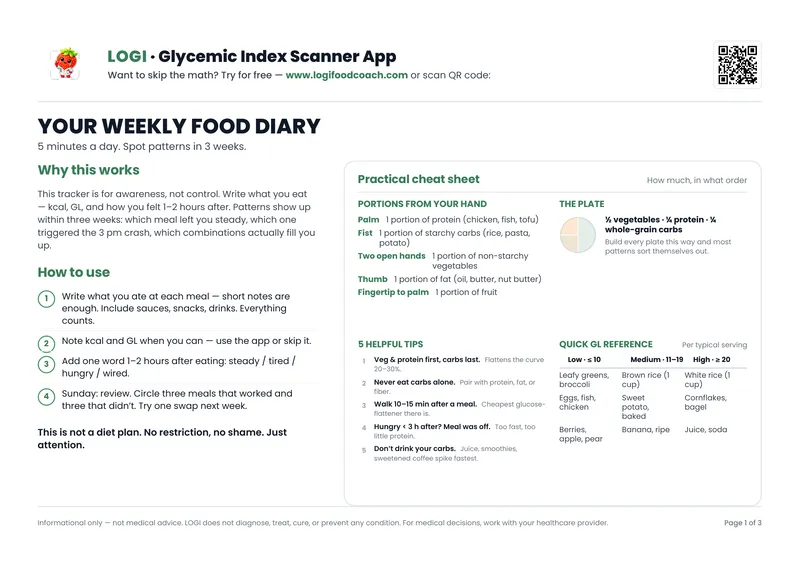
Free PDF — 3 pages
Your Weekly Food Journal
Track meals, glycemic load & mood. Spot patterns in 3 weeks.
No spam. Unsubscribe anytime.