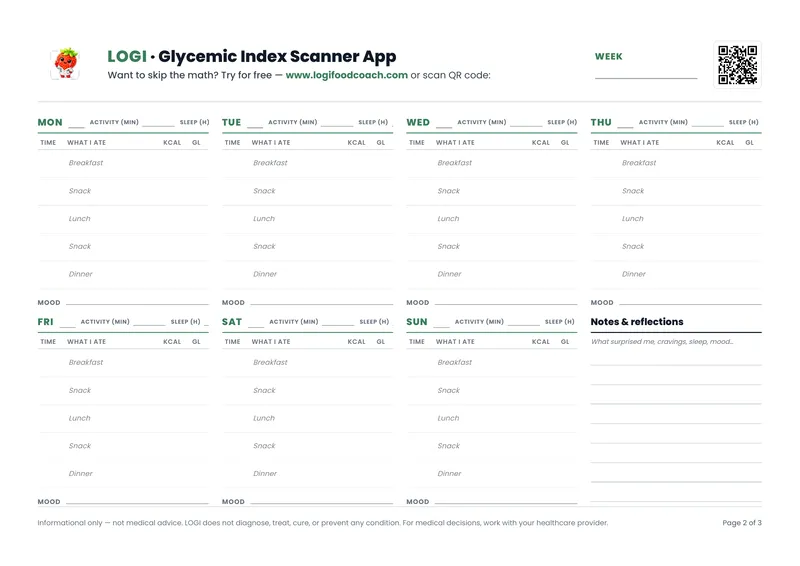
Best Insulin Resistance Apps 2026: 9 Apps Compared, Honestly

Insulin resistance is estimated to affect roughly one in three adults, and almost none of the apps sold for it were built for it. Search the App Store and you get three unrelated categories wearing the same label: diabetes logbooks made for people who already inject insulin, continuous glucose monitor subscriptions that cost more per month than a gym membership, and calorie counters with the word “insulin” in the store description.
This is a feature-level comparison of the nine tools people actually end up choosing: LOGI, Glycemic Snap, January AI, Insara, Levels, Nutrisense, Abbott’s Lingo, mySugr and Carb Manager. I work on one of them (LOGI), so the only way this page is worth your time is if I name real limitations of every app on it, mine first. Where a competitor beats us, it says so.
Short version: if you want meal-by-meal feedback without wearing a sensor, it is LOGI or Glycemic Snap — and Glycemic Snap now costs the same per year as we do and ships in more languages, so read both entries before you decide. If you want to see your own glucose rather than a prediction of it, buy a sensor: Lingo or Dexcom’s Stelo are the cheapest routes in, Levels and Nutrisense are the coached versions. If you already have a diagnosis and a glucometer, mySugr is a better logbook than anything here. If you want a free tool, there isn’t a good one, and you should know that before you start.
The long version — criteria, per-app reviews, a comparison table and a decision tree — is below.
What an insulin resistance app actually has to do
Insulin resistance is not diabetes, and that difference decides which features matter. You are not dosing insulin. You are not usually treating a number in the moment. You are trying to make a few hundred food decisions a month land differently. So:
-
Glycemic load at the meal level, not glycemic index from a table. GI is a property of a food eaten alone. Glycemic load is that number scaled by the carbohydrate actually on your plate, and it is the only one that survives contact with a real dinner. An app that tells you watermelon (GI 76) is worse than lentils (GI 32) is doing table lookups, not meal maths.
-
Feedback fast enough to change the next meal. A weekly summary changes nothing. A response you see before or right after eating changes the meal after it.
-
Something you can act on. “Reduce carbohydrates” is not advice. “Swap the jasmine rice for basmati and add the salad first” is.
-
A plan, if you are doing this for more than a week. Insulin-resistance eating is repetitive by design. If the app makes you re-invent breakfast every morning, you will quit in three weeks.
-
Your language. Most of this category is English-only. If nutrition vocabulary is not something you handle comfortably in English, half the market is unusable to you regardless of features.
Three apps below clear all five. Most clear two.
The 9 apps
1. LOGI — photo scan, predicted curve, meal planner, six languages
Link: App Store · Google Play · logifoodcoach.com
What it does: photograph the meal or type what you ate; the app returns an estimated glycemic load, macros, a predicted three-hour blood sugar curve and specific swaps. The meal planner builds one to fourteen days of low-glycemic-load meals for one to six people, four meals a day. There is HOMA-IR tracking, streaks, timezone-aware reminders and a PDF export for a doctor’s appointment.
What is good: it is the only app in this comparison with a full meal planner, and one of three with a predicted curve and no hardware requirement. The ingredient database holds 7,158 items. App and content site run in six languages — English, Polish, German, Spanish, French and Italian — which is unusual here. The yearly price, $39.99, is the joint lowest of the prediction-based apps.
What is not good: paying weekly is bad value ($2.99/week works out around $12.99/month) and the soft paywall lands after ten free scans, with the meal planner behind a hard one. The prediction is a model, not a measurement — cluttered plates get misread and a quick text correction is often faster than fighting the photo. And Glycemic Snap now matches our yearly price and supports fourteen languages to our six; if your language is Dutch, Swedish, Turkish, Japanese or Portuguese, they cover you and we do not.
Best for: managing insulin resistance through food, without a sensor, especially outside the English-speaking world.
Pricing: $2.99/week, $39.99/year, 7-day trial in the app.
2. Glycemic Snap — the closest competitor, and it moved
Link: glycemicsnap.com
What it does: photo scan a meal, get a 0–100 glucose impact score, a predicted curve with a peak time, and a swap. It syncs with Dexcom, Libre and Apple Health if you do wear a sensor, and exports a “Doctor’s Report”.
What is good: the core feature set is genuinely close to ours, it is on iOS, Android and the web, it is updated constantly, and it now ships in fourteen languages including Polish, German, Italian, Spanish, French, Dutch, Swedish and Turkish. Three free scans a day is a more generous free tier than ours.
What is not good: $9.99/month is more than double what our yearly plan works out to per month, and there is no meal planner, no HOMA-IR tracking and no multi-person planning. It is a smaller product overall — a couple of hundred App Store ratings — so there is less accumulated feedback behind the food database.
Best for: someone who wants meal scanning plus a CGM sync, does not need a planner, and is happy to pay monthly.
Pricing: $9.99/month, $39.99/year, three free scans per day.
3. January AI — glucose prediction from a very large food database
Link: january.ai
What it does: predicts your glucose response to food without a sensor, using a food database the company puts above 50 million items, with photo, barcode and voice logging, plus lab-result import and wearable data.
What is good: this is the most credible pure “prediction instead of hardware” product in the category, it is cheap, and it is still very much alive in 2026 — it appeared in Medicare’s app library this year, which is not nothing. If you want to log by talking to your phone, nobody else does it as well.
What is not good: the accuracy of the prediction is the company’s own claim, and we have not seen it independently checked. It is English only. The Apple ecosystem is clearly the priority — iPhone, Mac and Vision Pro are all listed, Android less clearly. There is no meal planner.
Best for: an English-speaking iPhone user who wants prediction, a huge food database, and the lowest price of the prediction apps.
Pricing: free with a 7-day trial; premium roughly $5–10/month or $40–60/year depending on the plan you are shown.
4. Insara (formerly Lilli Health) — insulin resistance with the hormonal side attached
Link: insara.com
What it does: meal planning and education built specifically around insulin resistance and PCOS, plus symptom tracking (weight, mood, skin, hair) and cycle tracking.
What is good: it is one of the very few products that treats insulin resistance as a whole clinical picture rather than a nutrition problem, and the symptom-plus-cycle combination is genuinely useful if your insulin resistance came with a PCOS diagnosis.
What is not good: no glucose prediction, no CGM integration, no HOMA-IR calculator — so despite the name, there is no feedback loop on individual meals. English only. And be careful with its search-engine footprint: the “top 10 insulin resistance apps” article that ranks well and puts Insara first is published by Insara.
Best for: women managing PCOS-related insulin resistance who want structure and symptom tracking more than meal-level numbers.
Pricing: free tier, then $14.99/month or $155.99/year.
5. Levels — the CGM app that stopped requiring a CGM
Link: levelshealth.com
What it does: scores meals and days for metabolic impact, originally on top of a continuous glucose monitor. The app now works without one.
What is good: the pivot made it cheap. Fifteen dollars a month, or $80 a year, for the app alone is the lowest price of any serious metabolic-health product here, and if you later add a sensor the app is already set up for it. The writing and education inside it are good.
What is not good: unbundling means the advertised price is not the price you pay if you actually want sensor data — a Stelo is another $89/month or $99 for a two-pack. English only. And an app that scores meals without a sensor is doing the same modelling as LOGI, January AI or Glycemic Snap, without the meal-planning or food-scanning depth those built first.
Best for: someone who already wears a sensor, or plans to, and wants a well-made interpretation layer.
Pricing: app $15/month or $80/year; sensors sold separately.
6. Nutrisense — CGM plus a human dietitian
Link: nutrisense.io
What it does: pairs a continuous glucose monitor with a coaching app and a real dietitian you message.
What is good: real glucose data plus a human reading it is the most effective version of this that money buys, and the app is genuinely sensor-agnostic — Stelo, Dexcom G6 and G7, Libre 2 and 3, and Abbott’s Lingo all work.
What is not good: $149–$215 a month is a different category of spending, and most people with insulin resistance do not need continuous data — they need better meals. There is an app-only tier at $39/month if you bring your own sensor, but at that point you are paying more than any prediction app for an interpretation layer. English only.
Best for: a diagnosed, motivated case where hard glucose data is worth several hundred dollars a quarter, or a short diagnostic sprint of one to three months.
Pricing: $149–$215/month with sensors; $39/month app-only.
7. Abbott Lingo — the cheapest way to actually see your glucose
Link: hellolingo.com
What it does: a 14-day biosensor and an app that scores “glucose spikes”, explicitly sold as a wellness product rather than a medical device.
What is good: it is the cheapest legitimate entry point to real measurement — around $54 for a two-week plan with a sensor included — and it is one of the very few of these products available in both the US and the UK. Abbott is the company behind FreeStyle Libre, so the hardware is not a startup experiment.
What is not good: you are buying consumables. Two weeks of wear is two weeks of data and then a decision about whether to buy again. No meal planner, no HOMA-IR, no food database worth the name, English only, and it will not tell you what to eat next — only what just happened.
Best for: two weeks of finding out how your own body responds, before committing to a food-based tool.
Pricing: from about $54 for a two-week plan; retail bundles $49–$249.
8. mySugr — the best logbook here, and not an insulin resistance app
Link: mysugr.com
What it does: logs glucose readings, carbohydrates, insulin doses and medication, syncs with meters, exports PDF and Excel reports.
What is good: it is the most widely localised app in this entire comparison — thirty-two languages — it is owned by Roche, doctors accept its reports without argument, and PRO is free if you use an Accu-Chek meter. As a logbook it is better than anything else on this page.
What is not good: it computes no glycemic load, predicts nothing, and assumes you are measuring. If you have insulin resistance and no glucometer, it will hand you an empty logbook and a workflow designed for a disease you do not have.
Best for: diagnosed type 1 or type 2 diabetes with a meter. Not for undiagnosed insulin resistance.
Pricing: free core; PRO $4.99/month or $39.99/year, free with an Accu-Chek meter.
9. Carb Manager — a keto app that people use for this anyway
Link: carbmanager.com
What it does: net-carb tracking with a keto-first philosophy, a very large recipe library, barcode scanning and an active community.
What is good: the recipe library is the biggest here, the free tier is usable, and around $40 a year is fair. If you have already decided on low-carb, the friction is low.
What is not good: it is built around carbohydrate counts, not glucose responses — there is per-ingredient GI data but no meal-level glycemic load and no prediction. Its iOS listing is English only. And low-carb is one strategy for insulin resistance, not the strategy: legumes, fruit and intact whole grains do well on glycemic load and badly on net carbs, and this app will argue with you about them.
Best for: someone already committed to keto who wants carbohydrate discipline.
Pricing: free tier; premium around $40/year.
Comparison table
| LOGI | Glycemic Snap | January AI | Insara | Levels | Nutrisense | Lingo | mySugr | Carb Manager | |
|---|---|---|---|---|---|---|---|---|---|
| Photo meal scan | Yes | Yes | Yes | No | No | No | No | Attach only | Limited |
| Meal-level glycemic load | Yes | Yes | Yes | No | Score | Via sensor | Via sensor | No | No |
| Predicted glucose curve | Yes | Yes | Yes | No | No | Real data | Real data | No | No |
| Meal planner (1–14 days) | Yes | No | No | Yes | No | Coached | No | No | Partial |
| HOMA-IR / lab tracking | Yes | No | Lab import | No | No | Coached | No | No | No |
| Needs hardware | No | No | No | No | Optional | Yes | Yes | Meter | No |
| Human coach | No | No | No | No | No | Yes | Yes | No | No |
| Doctor-ready export | Yes | Yes | Unclear | No | No | Yes | No | Yes | Reports |
| App languages | 6 | 14 | 1 | 1 | 1 | 1 | 1 | 32 | 1 |
| Monthly | $12.99 (weekly plan) | $9.99 | ~$5–10 | $14.99 | $15 | $149–215 | ~$54/2 wks | $4.99 | ~$8 |
| Yearly | $39.99 | $39.99 | ~$40–60 | $155.99 | $80 | — | — | $39.99 | ~$40 |
| Free tier | 10 scans | 3 scans/day | 7-day trial | Yes | No | No | No | Yes | Yes |
Two entries that used to belong here are gone, and it is worth knowing why. Veri, the Finnish CGM app, was acquired by Ōura and no longer accepts new customers. ZOE removed the glucose sensor from its programme entirely and now predicts responses algorithmically — a reasonable business decision, but it means the CGM-derived credibility it was sold on no longer describes the product you would buy.
Which one for which situation
“I think I have insulin resistance. No diagnosis, no sensor, no budget for one.” LOGI or Glycemic Snap. Both predict; both work from a photo. Pick us for the meal planner or if you want the app in Polish, German, Spanish, French or Italian; pick them for the more generous free tier or if you need one of the eight other languages we do not have.
“I want to know what my own glucose actually does.” Buy two weeks of Lingo or a Stelo two-pack. A month of real data teaches more than a year of arguing with predictions, and it is cheaper than a year of Nutrisense.
“My doctor said prediabetes and wants to see something at the next appointment.” LOGI or mySugr, for opposite reasons — us for the meal-level data and the PDF, mySugr if you have been given a meter and told to use it.
“PCOS, and insulin resistance is part of it.” Insara if you want symptoms and cycle in the same place; LOGI if the meals are the part you cannot get right.
“I do not want a subscription.” There is no good answer, and you should hear that plainly. The nearest thing is Carb Manager’s free tier or mySugr’s, and both will leave the glycemic-load question unanswered.
What the whole category still gets wrong, us included
Nobody shows their uncertainty. Every prediction app, ours included, draws a clean curve. Real curves are noisy and differ between people eating the same plate. The honest output is a range and a confidence, and no one ships it.
“Insulin resistance app” is mostly a store keyword. Of the nine here, three were designed for this problem. The rest were designed for diabetes, keto or biohacking and relabelled.
Almost nothing exists outside English. We looked for a dedicated insulin-resistance app in Italian, German, Polish, French and Spanish and could not verify a single shipping local product in any of those markets. What ranks locally is usually one multilingual international app wearing a translated store title. Thirty-two languages from mySugr and fourteen from Glycemic Snap are the exceptions that prove the rule.
What to try first
Two minutes, tonight:
- Open LOGI or Glycemic Snap.
- Photograph the meal you were about to eat anyway.
- Look at the predicted curve, and at the suggested swap.
- Eat the swapped version tomorrow and compare.
Do this for a week. If one meal a day changes, the app has paid for itself. If nothing changes, it is the wrong tool for you — and finding that out in a week for free is a good outcome too.
Download LOGI on the App Store — Get LOGI on Google Play — More on logifoodcoach.com
Related recipes

Simple Scrambled Eggs
Perfectly soft scrambled eggs cooked low and slow in butter — a high-protein, low-GI breakfast that keeps blood sugar steady all morning.

Low-Glycemic Cloud Eggs with Protein-Rich Variations
Fluffy, protein-packed cloud eggs that won't spike blood sugar. Ready in 15 minutes with five delicious low-carb variations perfect for stable energy all morning.

Herb-Crusted Seared Scallops with Mediterranean Aromatics
Perfectly seared sea scallops with a fragrant rosemary-thyme crust deliver lean protein with minimal impact on blood sugar—a sophisticated low-GI entrée.
Take control of your blood sugar
Scan your meals, track glycemic load, and see your patterns — all in one app.
Start Free Trial →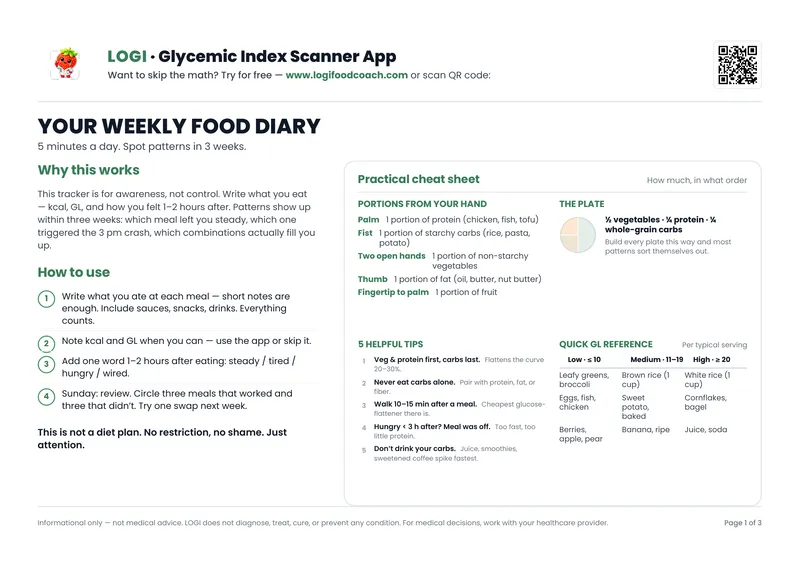
Free PDF — 3 pages
Your Weekly Food Journal
Track meals, glycemic load & mood. Spot patterns in 3 weeks.
No spam. Unsubscribe anytime.