Barley Glycemic Index: Why the Grain and the Flour Are Not the Same Food
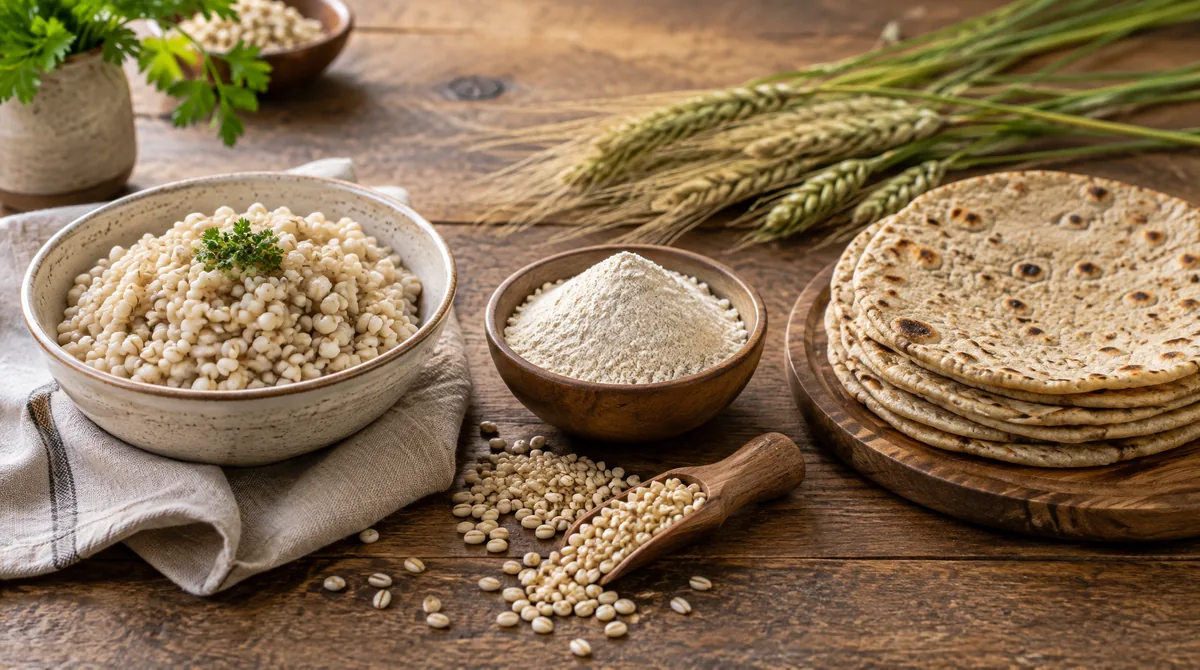
Barley has one of the best reputations of any grain among people watching their blood sugar, and for once the reputation is earned. Cooked whole barley genuinely sits near the bottom of published glycemic index tables — below oats, below most rices, below every common wheat product.
The problem is what happens to that reputation when the grain goes through a mill. “Barley is low GI” is a fact about a boiled kernel. It gets carried, unchanged, onto barley flour, barley atta, barley roti and barley bread — where it holds up far less well. Most people searching for a barley number are searching for one of those flour forms, which is exactly the case the headline number does not cover.
The numbers, honestly stated
Whole and pearl barley, boiled, is commonly reported in the mid-20s to mid-30s on published glycemic index tables, with some measurements running into the 40s depending on cultivar, cooking time and how the test meal was prepared. Even the upper end of that spread is low. This is the number barley’s reputation rests on, and it is a real one.
Barley flour and barley-flour products are reported considerably higher — commonly in the 50s to 70s, with the spread driven by how finely the flour is milled, whether it is wholemeal or refined, and what else is in the product. A barley flatbread and a bowl of boiled pearl barley are, glycemically, not the same food, even though the grain in them is identical.
Barley roti made from barley atta typically lands in the middle of that flour range and moves with two things: how coarse the flour is, and whether it is blended with wheat atta, which most home cooking does. Barley bread varies more widely still, because commercial “barley bread” is usually mostly wheat flour with some barley in it.
Two cautions belong in the same breath as those figures rather than in a footnote. First, all of them are bands, not values — barley is tested less often than rice or wheat, so the published spread is wide and individual studies disagree. Second, the glycemic load of what you eat depends on portion, and barley’s portions differ enormously between a side of pearl barley and three rotis.
The mechanism: beta-glucan, and the mill
Two things make barley behave the way it does, and they pull in opposite directions.
Beta-glucan is why barley starts low. Barley is unusually rich in beta-glucan, a soluble fibre that dissolves into a viscous gel in the gut. That gel slows gastric emptying and physically impedes the contact between digestive enzymes and starch. It is the same fibre that gives oats their reputation, and barley generally contains more of it.
There is a detail here that explains something otherwise puzzling. In oats and wheat, most of the useful outer-layer material sits in the bran, so removing the bran removes the benefit. In barley, beta-glucan is distributed throughout the endosperm — the starchy interior — not just the outer layers. That is why pearl barley, which has had its bran polished off, still measures low. The fibre doing the work was never only on the outside.
Milling is why the flour does not stay low. Grinding a grain into flour destroys the intact cell walls and the physical structure of the kernel, and multiplies the surface area available to amylase. Particle size is one of the strongest single predictors of a starchy food’s glycemic response, and it operates independently of what the grain is. Fine flour digests fast whether it came from barley, wheat, or anything else.
Beta-glucan survives milling as a chemical, so barley flour still holds an advantage over refined wheat flour. What it loses is the structural half of the protection — and structure was carrying more of the load than most people assume.
Put the two together and the rule is short: with barley, the form you eat it in matters more than the fact that it is barley.
Barley roti and barley atta
A large share of the people looking up barley’s glycemic index are looking for it in the context of roti, and the general advice usually stops at “barley atta is better than wheat atta”. That is true, and it is not the whole picture.
What actually moves the number:
- Coarseness of the flour. Coarser-ground barley atta digests more slowly than fine flour. If you can get a coarse grind, or have grain milled coarse, it is the single easiest improvement available.
- The blend. Most barley rotis are made with a proportion of wheat atta for workability, because barley has little gluten and handles awkwardly on its own. The more wheat, the closer the result to a wheat roti. Knowing your actual ratio is worth more than knowing barley’s index.
- What goes with it. A roti eaten with dal, vegetables and yoghurt is a very different meal from two rotis eaten alone with pickle. Protein, fat and acidity all slow the whole meal down, and this effect is large enough to matter more than the choice of flour.
- How many. This is the unglamorous one and usually the biggest. The index describes a fixed quantity of carbohydrate; the number of rotis decides how much carbohydrate there is.
Pearl, pot and hulled barley
The names are used loosely, and the differences are smaller than the labels suggest.
- Hulled barley (sometimes “dehulled”) has only the inedible outer hull removed and keeps its bran. It is the least processed form, takes the longest to cook, and measures lowest.
- Pot barley is lightly pearled — some bran removed, some kept. Intermediate in every respect.
- Pearl barley is polished until the bran is gone. It is by far the most widely sold, cooks fastest, and — for the beta-glucan reason above — still measures low.
The practical consequence is reassuring: if pearl barley is what your shop sells, that is fine. The gap between hulled and pearl barley is much smaller than the gap between any of them and barley flour.
Cooking, cooling and the things that actually change the number
- Cook it firm. Barley that keeps some bite has absorbed less water and gelatinised less starch than barley cooked to mush. Overcooked barley in a long-simmered soup will behave worse than barley cooked to al dente for a salad.
- Cool it. Cooked barley that has been chilled forms resistant starch — starch that has re-crystallised into a form digestive enzymes handle poorly. Cold barley salad is a genuinely better option than the same barley eaten hot, and reheating keeps part of the benefit.
- Soaking shortens cooking time but does not appear to change the glycemic picture much on its own. Soak for convenience, not for blood sugar.
- Barley in liquid — soups, stews, barley water, roasted barley drinks — behaves according to how much dissolved and gelatinised starch ends up in the liquid. A thick barley soup that has simmered for hours is not the same as barley served alongside.
One thing worth stating plainly for a different reason: barley contains gluten. It is not an option for anyone with coeliac disease or a diagnosed gluten disorder, whatever its glycemic index says.
Practical guidance
- Choose the whole grain over the flour when the meal allows it. This is the largest single decision available here, and it is bigger than the difference between barley and any other grain.
- If you eat barley flour, buy it coarse and know your blend ratio. Both are more actionable than the published index.
- Pearl barley is not a compromise. Buy the one you will actually cook.
- Cook firm, and cook extra to eat cold. Two portions, one of them improved for free.
- Portion before variety. A large serving of barley will out-spike a small serving of a worse grain.
- Barley is a genuine swap candidate. Where a recipe calls for rice or couscous, whole barley substitutes directly in soups, salads and pilafs — one of the few grain swaps that changes the glycemic picture meaningfully without changing the meal much.
- If you use a continuous glucose monitor, test the flour forms rather than the grain. The boiled-grain result is predictable; roti and bread are where individual responses diverge, and where a personal reading tells you something a table cannot.
The bigger picture
Barley is a clean illustration of a mistake that runs through most everyday nutrition advice: we attach numbers to ingredients when the numbers actually belong to forms.
A glycemic index value is measured on one specific preparation of one specific food. Whole boiled barley was tested, scored low, and the score became a property of “barley” — as if it travelled with the grain into flour, into a roti, into a loaf. It does not. Grinding is not a neutral operation; it is one of the more aggressive things you can do to a carbohydrate, and it undoes a large part of what made the intact grain slow.
The same error is everywhere once you look for it. Oats are low GI, and instant oat powder is not oats. Fruit is fine, and fruit juice is a different food. Whole wheat is better than white, and finely milled wholemeal flour recovers less of that advantage than the label implies.
The useful question is never “is this food low GI”. It is “what happened to this food between the field and my plate, and how much of its structure survived”. For barley the answer is unusually favourable — provided the answer is “not much happened at all”.
Barley shows up in soups, salads and flatbreads where the portion is genuinely hard to eyeball, and the flour forms behave nothing like the grain. Logi scans a photo of the plate and estimates the glycemic load of the whole meal — the barley, what it was cooked into, and everything served beside it — so the question gets answered at the table rather than from a table.
This article is educational. It is not medical advice. Individual responses to any food vary widely; if you have diabetes, insulin resistance, or another metabolic condition, discuss dietary choices with your doctor or a registered dietitian.
Foods in this article
Related recipes

Low-Glycemic Almond Flour Mug Bread
Quick 90-second microwave bread made with blood sugar-friendly almond and coconut flours. Perfect for diabetic-friendly breakfasts and sandwiches!

Low-Glycemic Mushroom & Pearl Barley Soup
A blood sugar-friendly vegetarian soup packed with fiber-rich barley and umami mushrooms that keeps you satisfied without the glucose spike.

Pearl Barley Risotto with Slow-Roasted Tomatoes and Fresh Herbs
Creamy pearl barley risotto featuring caramelized roasted tomatoes and aromatic herbs. A fiber-rich, low-glycemic alternative to traditional rice risotto.
Take control of your blood sugar
Scan your meals, track glycemic load, and see your patterns — all in one app.
Start Free Trial →
Free PDF — 3 pages
Your Weekly Food Journal
Track meals, glycemic load & mood. Spot patterns in 3 weeks.
No spam. Unsubscribe anytime.