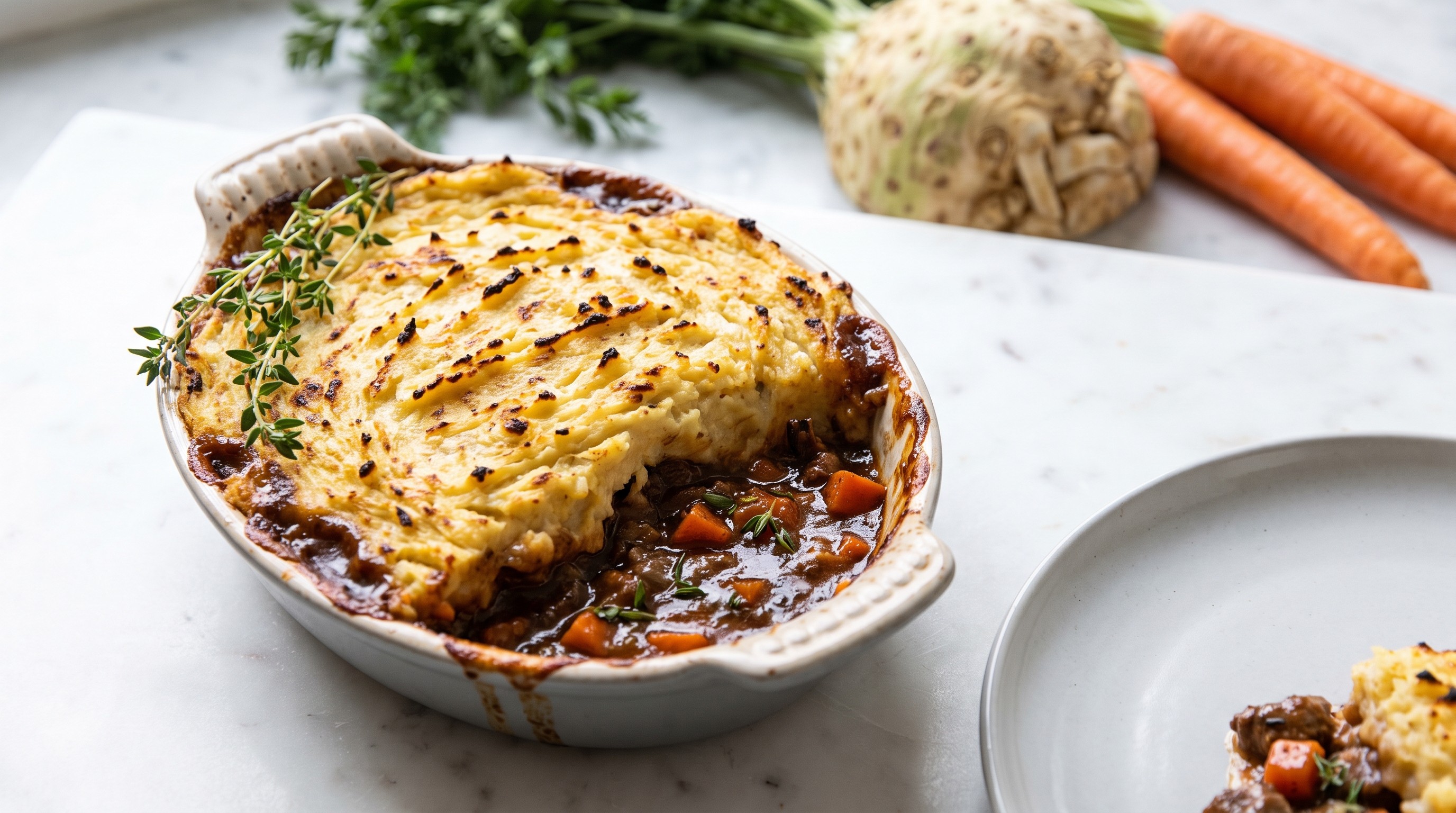
Low-GI Shepherd's Pie with Celeriac Mash
Savoury lamb mince simmered in a rich tomato-thyme gravy, topped with creamy celeriac mash and grilled golden — all low-GI comfort, no blood sugar spike.
This shepherd's pie proves that comfort food and steady blood sugar can coexist on the same plate. By replacing the traditional potato topping with celeriac — a root vegetable that contains roughly a quarter of the digestible carbohydrate of potato and carries a glycemic index around 35 — you slash the glycemic load of the dish without sacrificing the creamy, fork-peaked crown that makes a shepherd's pie irresistible. Celeriac brings its own subtle celery-like sweetness that pairs beautifully with lamb.
The filling follows a classic British soffritto: onion, carrot, and garlic softened into well-browned lamb mince, then deepened with tomato paste, Worcestershire sauce, and a splash of beef stock. Simmered until thick and glossy, this base is packed with protein and healthy fats that further slow glucose absorption, while the fibre from the vegetables adds bulk and satiety. A final flash under the grill caramelises the mash peaks and bubbles the edges, giving you all the golden-topped appeal of the original.
For the best blood sugar response, serve a small side salad dressed with vinegar or lemon juice and eat the vegetables first — the acetic acid and additional fibre prime your digestive system to handle the meal's carbohydrates more gradually. Pair with a glass of still water rather than juice or beer, and aim to eat this as a lunch or early dinner rather than a late-night meal, when insulin sensitivity tends to be lower.
Blood Sugar Impact
With a GI of 38 and a glycemic load of 11, this meal will produce a gentle, gradual rise in blood sugar. The celeriac mash is significantly lower-GI than traditional potato, and the lamb provides protein and fat that further slow glucose absorption, supporting stable energy for 3-4 hours.
Blood Sugar Tips
- ✓ Eat a small side salad or steamed greens before the shepherd's pie — the extra fiber primes your gut to absorb glucose more slowly.
- ✓ Allow the dish to cool slightly before eating; cooling starchy foods increases resistant starch content, which lowers the glycemic response.
- ✓ Take a 10-15 minute walk after the meal to help your muscles take up blood glucose and blunt any modest post-meal rise.
🥗 Ingredients
- 300 g Celeriac
- 250 g Lamb mince
- 1 pcs Onion
- 1 pcs Carrot
- 2 pcs Garlic
- 1 tbsp Tomato paste
- 2 tsp Worcestershire sauce
- 150 ml Beef stock
- 15 g Butter
- 1 tbsp Olive oil
- 4 pcs Thyme
- 0.5 tsp Salt
- 10.6 oz Celeriac
- 8.8 oz Lamb mince
- 1 pcs Onion
- 1 pcs Carrot
- 2 pcs Garlic
- 1 tbsp Tomato paste
- 2 tsp Worcestershire sauce
- 10 tbsp Beef stock
- 0.5 oz Butter
- 1 tbsp Olive oil
- 4 pcs Thyme
- 0.5 tsp Salt
👨🍳 Instructions
- 1
Peel the celeriac, cut it into roughly 2 cm cubes, and drop them into a pot of generously salted boiling water. Cook at a steady boil for about 15 minutes, or until the cubes are completely tender when pierced through the centre with a knife — they should offer no resistance at all, as under-cooked celeriac will not mash smoothly.
- 2
While the celeriac simmers, place an oven-safe skillet over high heat and add the olive oil. Once the oil is shimmering, scatter in the lamb mince in a single layer. Let it sear undisturbed for about 3 minutes so a deep brown crust develops on the underside, then break the meat apart with a wooden spoon and continue cooking for another 2 minutes until no pink remains. This browning step builds the savoury backbone of the filling.
- 3
Lower the heat to medium. Add the diced onion, carrot, and minced garlic to the skillet with the lamb. Stir everything together and cook for about 4 minutes, until the onion turns translucent and the carrot starts to soften at the edges.
- 4
Stir the tomato paste and Worcestershire sauce into the lamb mixture, coating the meat and vegetables evenly. Add the stripped thyme leaves and pour in the beef stock. Bring to a gentle simmer and cook uncovered for 10 minutes, stirring occasionally, until the liquid has reduced by roughly half and the filling looks thick, glossy, and rich. Remove from heat and set aside.
- 5
Drain the celeriac thoroughly in a colander — excess water is the enemy of a good mash. Return the drained cubes to the warm pot, add the butter and half a teaspoon of salt, and crush with a potato masher or the back of a fork until you have a smooth mash that still holds a little rustic texture. Avoid using a blender or food processor, as celeriac releases starch and turns gluey when over-worked.
- 6
Preheat your oven's grill (broiler) to 220 °C (425 °F). Spoon the celeriac mash evenly over the lamb filling in the skillet, spreading it all the way to the edges to seal in the juices. Drag the tines of a fork across the surface in wavy lines to create rough peaks — these ridges will catch the heat and turn beautifully golden.
- 7
Place the skillet under the grill on an upper rack and cook for 8 to 10 minutes, watching closely, until the mash peaks are golden brown and the filling is bubbling up around the edges. The interior is already cooked, so this step is purely about colour and texture on top.
- 8
Remove from the grill and let the pie rest in the skillet for 3 to 4 minutes — this allows the filling to settle and makes serving much easier. For the best blood sugar response, serve alongside a small green salad dressed with lemon juice or vinegar, and eat the salad first before digging into the pie.
📊 Nutrition Per Serving
| Per Serving | Whole Dish | |
|---|---|---|
| Calories | 605 | 1211 |
| Carbs | 29g | 58g |
| Sugars | 11g | 21g |
| Added Sugars | 1g | 2g |
| Natural Sugars | 10g | 20g |
| Protein | 27g | 54g |
| Fat | 43g | 86g |
| Saturated Fat | 18g | 36g |
| Unsaturated Fat | 24g | 48g |
| Fiber | 10g | 21g |
| Soluble Fiber | 3g | 6g |
| Insoluble Fiber | 7g | 14g |
| Sodium | 1073mg | 2146mg |
Predicted Glucose Response
What if you...
Estimated model — individual responses vary. Not medical advice.
🔄 Lower GI Swaps
Regular mashed potato has a GI of 75–90 and roughly 17 g net carbs per 100 g. Celeriac (GI ~35, ~5 g net carbs) gives the same creamy, fork-peaked topping at a fraction of the glycemic load. Cauliflower and swede are additional low-GI alternatives if celeriac is unavailable.
Carrot is already a low-GI vegetable (GI 39–47) and works well in this recipe as-is. However, if you want to reduce the total carbohydrate content even further, courgette or green beans are lower-carb alternatives that still add body and colour to the filling.
Shop-bought beef stock can contain added sugars and high sodium. Homemade bone broth provides collagen and minerals with no hidden sweeteners, while low-sodium vegetable stock is a lighter option that keeps the glycemic impact minimal.
🔬 The Science Behind This Recipe
Traditional shepherd's pie is built on a thick layer of mashed potato, which has a glycemic index between 75 and 90 depending on the variety and preparation. That high-GI topping can cause a rapid spike in blood glucose followed by a steep crash, leaving you hungry and sluggish within a couple of hours.
Celeriac changes the equation dramatically. With a glycemic index of roughly 35 and only about 5 g of net carbohydrate per 100 g (compared to around 17 g for potato), it delivers the same creamy, mashable texture while keeping the glycemic load of the entire dish at just 11 per serving — well within the low range.
The lamb filling adds another layer of blood sugar protection. Protein and fat both slow gastric emptying, meaning the carbohydrates from the celeriac and vegetables enter your bloodstream more gradually. The tomato paste and carrots contribute soluble fibre, which forms a gel-like matrix in the gut that further moderates glucose absorption.
Serving the pie alongside a vinegar-dressed salad and eating the greens first is a well-studied strategy: acetic acid has been shown to reduce post-meal blood sugar by up to 30 percent by temporarily inhibiting the enzyme that breaks starch into glucose. Combined with the fibre from the salad, this simple sequencing trick primes your body to handle the meal's carbohydrates at a steadier, more manageable pace.
Related recipes
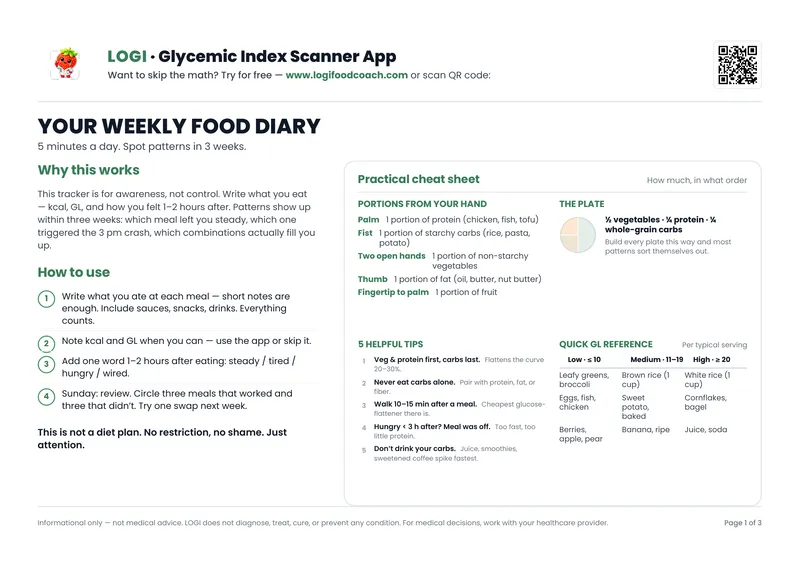
Free PDF — 3 pages
Your Weekly Food Journal
Track meals, glycemic load & mood. Spot patterns in 3 weeks.
No spam. Unsubscribe anytime.