Potatoes and Blood Sugar — Boiled, Mashed, Baked, Fried, and Cold

The potato has a problem no marketing department has solved: it is a whole, unprocessed vegetable, rich in potassium and vitamin C, cheap, filling, grown in the ground — and it behaves in the bloodstream like white bread. Sometimes worse.
People tracking their glucose are often more surprised by potatoes than by any dessert. A plate of mashed potatoes, eaten plain, can produce one of the sharpest curves an everyday food can generate. Yet the same potato, cooked differently, cooled, or paired well, lands remarkably softly. No common staple changes its glycemic behavior as much between preparations.
This piece walks through the versions people actually eat — boiled, mashed, baked, roasted, fried, sweet potato, and the underrated cold potato — what each one does to blood sugar and why, and how to keep potatoes on the table if you are watching your curve.
The mechanism — why potatoes hit fast
Potato starch is unusually easy to digest once cooked, for three reasons.
Starch structure. Potato starch granules are large and, after cooking, almost fully gelatinized — swollen with water and wide open to digestive enzymes. There is no protein matrix around them, as in pasta, and little fiber woven through them, as in intact grains. Cooked potato is about as accessible as food starch gets.
Almost no built-in brakes. A plain potato brings barely any protein, essentially no fat, and only a modest amount of fiber, most of it in the skin. Nothing in the food itself slows gastric emptying or enzymatic breakdown. Whatever slowing happens has to come from the rest of the meal.
Cell damage from preparation. Every step that breaks potato cells — mashing, ricing, pureeing, over-boiling — releases starch and speeds digestion further. This is why preparation, not variety, dominates the potato’s glucose story.
The result: most hot, plain potato preparations land in the high-glycemic range. But the spread between the gentlest and harshest version is enormous, and it is entirely under your control.
Boiled potatoes — the moderate baseline
Whole potatoes, boiled in their skin and served intact, are the mildest of the hot preparations. The cells stay largely unbroken, the skin keeps its fiber, and waxy varieties (the firm, yellow salad types) hold together better than floury ones — which matters, because intact cells digest slower.
Still high-ish on its own, but a reasonable baseline. Boiled potatoes also carry one of the best satiety-per-calorie profiles of any food, which is worth something: a food that stops hunger for hours does quiet metabolic work that a glucose curve alone does not show.
Practical version: waxy potatoes, boiled whole in the skin, slightly firm, served with something containing protein and fat.
Mashed potatoes — the sharpest curve on the plate
Mashing is deliberate, thorough cell destruction. Every fluffy spoonful is pre-digested starch, and the glucose response shows it: plain mashed potato reliably tests at the top of the potato family, in fully high-glycemic territory, with a fast, tall spike.
Ironically, the traditional way of making mash — with generous butter, cream, or milk — softens the curve somewhat, because fat slows gastric emptying. The “light” mash made with nothing is the glycemically harshest version. If mash is on the menu, the old-fashioned kind, in a modest portion, next to meat and vegetables, behaves better than a large plain scoop.
Instant mashed potato flakes are the extreme end: industrially pre-gelatinized, dried, and reconstituted. Fast in every sense.
Baked and roasted — hotter, drier, faster
A long, hot oven fully gelatinizes potato starch, and a plain baked potato tests high — routinely at or above white bread. The fluffy interior of a big baked russet is essentially a starch delivery system.
Roasted potatoes in fat behave slightly better: the oil slows things down, and crisped edges have lost some water. But the improvement is partial, and the portions tend to grow. Two practical notes rescue the category. First, eat the skin — that is where the fiber lives. Second, the classic loaded-baked-potato instinct is glycemically sound: protein and fat on top of the potato (cheese, Greek yogurt, chili, fish) meaningfully flatten the response compared to the naked version.
Fries and chips — slower curve, bigger load
Deep-frying wraps every piece of potato in fat, which delays gastric emptying and stretches the glucose curve out — the peak is often less sharp than mash. That is the end of the good news. The total carbohydrate load still arrives, now accompanied by a large calorie load, and the curve tends to run long rather than tall, keeping glucose elevated further into the afternoon.
Fries also come with the portion problem: they are engineered to be eaten fast and continuously. A small portion of good fries next to a protein-centered meal is a manageable indulgence. A large bag as the meal is a long, heavy glucose event — the slow-motion version of the mash spike.
Sweet potatoes — better, with an asterisk
Sweet potato earns its reputation only partially. It carries more fiber than white potato and its starch digests somewhat more slowly, so like-for-like it is the gentler choice — boiled sweet potato in particular lands in the moderate range.
The asterisk is preparation, again. Long baking breaks sweet potato starch down into sugars — that caramelized softness is the starch converting — and pushes the response up substantially, closing much of the gap to white potato. Boiled or steamed sweet potato, firm, is the version that deserves the health halo. A long-roasted, syrupy one is closer to dessert, pleasant as that is.
The cold potato — the trick that changes the category
Here is the most useful fact in the whole potato story: when cooked potatoes cool, a meaningful share of their starch retrogrades into resistant starch — a form human enzymes largely cannot digest. It never becomes blood glucose at all; it travels to the colon and feeds gut bacteria instead.
Boiled potatoes, cooled overnight in the fridge, have a substantially gentler glucose impact than the same potatoes hot. Gentle reheating preserves much of the effect. This is not an exotic hack — it is potato salad, one of the oldest preparations in Europe, and the vinegar in a classic potato salad helps further, since acid slows starch digestion on its own.
Practical translation: cook potatoes once, eat them tomorrow. Cold potato salad with vinegar, herbs, and eggs or fish is arguably the most blood-sugar-friendly way to eat potatoes that exists.
How to keep potatoes in a low-glycemic life
The rules that fall out of the mechanics:
- Cook, cool, then eat — the fridge is the best glycemic tool in the potato kitchen.
- Prefer boiled and intact over mashed and fluffy. The less cell destruction, the slower the starch.
- Choose waxy over floury varieties when you have the choice, and keep the skin.
- Never eat a potato alone. Protein, fat, and vegetables alongside are what turn a spike into a slope. Vegetables and protein first, potato last, helps further.
- Add acid. Vinegar-dressed potato salad, a squeeze of lemon, pickles on the plate — acid measurably slows the starch.
- Watch the portion, not just the preparation. Two or three egg-sized potatoes as a side dish is a different event from a plate where potato is the main.
- Treat long-roasted sweet potato and all fried forms as occasional, not default.
The bigger picture
Potatoes make the strongest case in the everyday diet that preparation beats identity. The same tuber can be one of the harshest common foods on your glucose — plain mash, big baked russet, a large fries — or a genuinely moderate one: boiled waxy potatoes, cooled overnight, dressed with vinegar and eaten next to protein. Nothing about the potato changed. Everything about the structure did.
That is good news for anyone with insulin resistance, prediabetes, or PCOS who grew up on potatoes and has no intention of giving them up. You do not have to. You have to cook them like your grandmother did — and eat yesterday’s batch.
Curious what your potato dish actually does to your glucose? With Logi you photograph the plate — mash, fries, potato salad, anything — and see the estimated glycemic load in about sixty seconds. Two weeks free. Download Logi.
This article is general nutrition education, not medical advice. If you are managing diabetes, insulin resistance, or another condition, discuss dietary changes with your doctor or a registered dietitian.
Foods in this article
Related recipes

Low-GI Cassoulet — French White Bean Stew Without the Blood Sugar Spike
A rustic French cassoulet built on low-GI white beans, chicken thighs, and pork sausage — hearty comfort food that keeps blood sugar steady.

Golden Sweet Potato Fritters with Almond Flour and Fermented Pickles
Protein-packed fritters with reduced sweet potato, almond flour, and flaxseed create a blood-sugar friendly meal. Crispy, satisfying, and perfectly balanced.

Blitva — Dalmatian Chard with Celeriac and Potato
A blood-sugar-friendly Dalmatian classic: Swiss chard, celeriac and potato crushed with raw garlic and olive oil for a gentle, mineral-rich side.
Take control of your blood sugar
Scan your meals, track glycemic load, and see your patterns — all in one app.
Start Free Trial →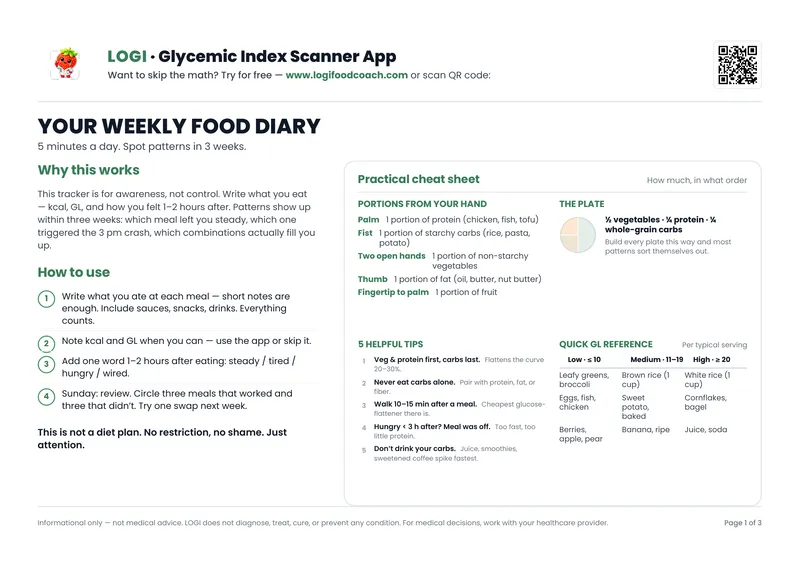
Free PDF — 3 pages
Your Weekly Food Journal
Track meals, glycemic load & mood. Spot patterns in 3 weeks.
No spam. Unsubscribe anytime.