Insulin Resistance Diet Apps: 7 Meal Planners Compared
Most people with insulin resistance do not quit because they cannot track. They quit because it is Wednesday, it is 18:40, nobody has decided what dinner is, and the honest answer is pasta.
That is a planning problem, not a measurement problem — and it is a different question from “which app measures my blood sugar best”. This page compares the apps that will actually tell you what to eat this week: LOGI, Insara, Mira Health, Carb Manager, MyFitnessPal, ZOE and Fooducate. I work on LOGI, so every entry here includes what the app does badly, ours included, and where a competitor is better it is written plainly.
Short version: if you want a generated weekly plan built around glycemic load, LOGI and Mira Health are the only two here that produce one, and Mira is cheaper if you pay monthly. If your insulin resistance sits inside PCOS, Insara is built for that combination and neither of us is. If you are already low-carb and just want structure, Carb Manager’s recipe library is the biggest in this comparison. If you want a free food tracker, MyFitnessPal is the best of them and will not answer the glycemic question at all.
What a diet app for insulin resistance has to get right
The evidence here is less dramatic than the marketing. Lowering the glycemic load of your meals is a reasonable, evidence-informed strategy for insulin resistance, but it is not a cure and it is not the only diet that works. What separates a useful app from a wallpaper one is more boring than the diet argument:
-
The plan has to be for your actual household. A single-person meal plan is useless if you cook for three. This is the single most common reason people abandon a planner in week two.
-
It has to work at the meal level. A food may be low glycemic index and still land badly in the portion you eat. A plan built on food lists rather than plate maths will drift.
-
It has to allow carbohydrates. Insulin-resistance eating is not keto. Legumes, intact grains, dairy and most fruit belong in it, and an app whose whole scoring system punishes them will push you into a diet you did not choose and cannot keep.
-
The shopping has to be sane. Fourteen recipes with fourteen disjoint ingredient lists is a plan that dies in the supermarket.
-
It has to be in a language you cook in. Recipe instructions are the one part of a health app you read under time pressure with your hands full.
The 7 apps
1. LOGI — a generated plan, sized to the people who eat it
Link: App Store · Google Play · logifoodcoach.com
What it does: builds one to fourteen days of low-glycemic-load meals for one to six people, four meals a day, and pairs the plan with a scanner — photograph anything you ate off-plan and get its estimated glycemic load, macros and a predicted three-hour curve. There is also HOMA-IR tracking and a PDF export for a doctor.
What is good: the household sizing is the part almost nobody else does — the plan scales to six people rather than assuming you eat alone. The plan and the tracker share one glycemic-load model, so an off-plan meal is measured on the same scale as a planned one. Recipes and the app run in six languages: English, Polish, German, Spanish, French and Italian.
What is not good: the planner is behind a hard paywall, so you cannot evaluate the main feature before paying, and paying weekly at $2.99 is poor value against $39.99 a year. There is no cycle or symptom tracking, so if your insulin resistance is part of PCOS this is only half the app you need. Recipe variety is smaller than Carb Manager’s by a wide margin — we generate plans from a curated set, they have a community library.
Best for: someone who wants a weekly plan they did not have to think about, cooked for a household, in their own language.
Pricing: $2.99/week, $39.99/year, 7-day trial.
2. Mira Health — recipes and plans for insulin resistance, with a dietitian on call
Link: mira.health
What it does: meal plans and recipes aimed specifically at insulin resistance and PCOS, with the option to book a real dietitian or coach separately.
What is good: it is one of very few products that names insulin resistance as its subject rather than implying it, the entry price is the lowest in this comparison, and the option to escalate to a human being for a single consultation — rather than a locked-in coaching subscription — is a sensible model that nobody else here offers.
What is not good: no glucose prediction, no CGM support and no HOMA-IR tracking, so there is no feedback loop telling you whether the plan is working other than the scale. Consultations are charged per session on top of the subscription. Interface languages are English and Hungarian. And be careful searching for it: there is an unrelated US company using the same name, and they are not this product.
Best for: someone who wants a plan cheaply and the option of a human check-in, and does not need meal-level feedback.
Pricing: from about $4.49/month, with plans running up to around $399/year; dietitian consultations around $99 each.
3. Insara (formerly Lilli Health) — the PCOS-and-insulin combination
Link: insara.com
What it does: meal planning and education for insulin resistance and PCOS together, plus symptom tracking — weight, mood, skin, hair — and cycle tracking.
What is good: it treats insulin resistance as one thread in a hormonal picture rather than a nutrition problem in isolation, which for a large share of the people reading this is simply more accurate. Symptom and cycle logging in the same app as the meal plan is genuinely useful when your appetite and adherence move with your cycle.
What is not good: no meal-level glycemic load, no prediction, no lab tracking — so the plan is a plan, with no measurement attached. English only. And one thing worth knowing before you trust the search results: the well-ranking “top 10 insulin resistance apps” listicle that puts Insara first is published by Insara.
Best for: PCOS-related insulin resistance where symptoms matter as much as meals.
Pricing: free tier, $14.99/month or $155.99/year.
4. Carb Manager — the biggest recipe library, pointed the wrong way
Link: carbmanager.com
What it does: net-carb and macro tracking with a keto-first philosophy, a very large community recipe library, barcode scanning and meal-plan features.
What is good: the recipe library is far bigger than anything else here, the free tier is genuinely usable, and around $40 a year is fair for what you get. If you already eat low-carb, the friction is zero and the community is active.
What is not good: it optimises net carbohydrates, not glycemic load, and those pull in different directions. Lentils, oats, plain yoghurt and most fruit score badly on net carbs and well on glycemic load; an insulin-resistance plan should contain them and this app will nudge you away from them. There is per-ingredient glycemic index data but no meal-level glycemic load. The iOS listing is English only.
Best for: someone who has already chosen keto and wants recipes and discipline.
Pricing: free tier; premium around $40/year.
5. MyFitnessPal — the best free tracker, and no help at all on glycemia
Link: myfitnesspal.com
What it does: calorie and macro tracking against an enormous food database, barcode scanning, and since this year an AI coach and a plan tab.
What is good: the database is the largest consumer food database in the world, the free tier is real, and it runs in twenty languages — more than any other planner here. If your problem is that you genuinely do not know what you are eating, this is the fastest way to find out.
What is not good: it does not compute glycemic index or glycemic load, and it never has. Calories and macros are not the same question as blood sugar response: a 400-calorie bowl of white rice and a 400-calorie bowl of lentils log identically and behave nothing alike. It is not a bad app; it is an app for a different problem.
Best for: establishing what you actually eat, before you try to change how it behaves.
Pricing: free tier; Premium $19.99/month or $79.99/year.
6. ZOE — a personalised programme that stopped using sensors
Link: joinzoe.com
What it does: scores foods and meals for you personally and coaches you toward a way of eating, now using a predictive algorithm rather than a continuous glucose monitor.
What is good: the underlying research programme is real and published, the food scoring is well presented, and the current price — about £9.99 a month or £119.88 a year in the UK — is far below what the programme used to cost.
What is not good: ZOE was sold for years on the strength of measuring your own glucose responses with a sensor, and it no longer does that. What you buy now is a prediction, which is the same category of product as LOGI, Glycemic Snap or January AI, without their meal-scanning depth. It is English only, and pricing differs enough between the UK and US sites that you should check the one that applies to you.
Best for: someone in the UK who wants a guided programme with a strong research story and does not need a household meal plan.
Pricing: about £9.99/month or £119.88/year in the UK; different figures on the US site.
7. Fooducate — grades, and a product that has stopped moving
Link: fooducate.com
What it does: scans barcodes and grades packaged foods A to D on a proprietary nutrition score, with light calorie tracking.
What is good: the grade is the easiest mental model in this whole comparison — “buy A and B” is advice a beginner can follow in a supermarket aisle without learning anything. It supports six languages, more than most here.
What is not good: it has not been meaningfully updated since early 2025, which for a food database is a long time. It grades packaged products, not meals, so it says nothing about the plate you cook. And a grade hides its own reasoning, which is convenient right up until you want to know why.
Best for: a beginner replacing packaged products, not a person planning meals.
Pricing: free tier with a paid Pro upgrade.
Comparison table
| LOGI | Mira Health | Insara | Carb Manager | MyFitnessPal | ZOE | Fooducate | |
|---|---|---|---|---|---|---|---|
| Generated meal plan | Yes, 1–14 days | Yes | Yes | Partial | Plan tab | Guided | No |
| Plans for 2–6 people | Yes | No | No | No | No | No | No |
| Meal-level glycemic load | Yes | No | No | No | No | Score | No |
| Feedback on off-plan meals | Photo scan | No | No | Logging | Logging | Scoring | Barcode |
| Symptom / cycle tracking | No | No | Yes | No | No | No | No |
| Human coaching | No | Paid per session | No | No | No | Included | No |
| Recipe library size | Curated | Moderate | Moderate | Largest | Large | Moderate | n/a |
| Languages | 6 | 2 | 1 | 1 | 20 | 1 | 6 |
| Cheapest yearly | $39.99 | from ~$54 | $155.99 | ~$40 | $79.99 | ~£120 | Free tier |
| Usable free tier | 10 scans | No | Yes | Yes | Yes | No | Yes |
One more name you will meet in search results: DietSensor advertises itself as the only app that computes a meal’s overall glycemic index. We could not verify that claim from any independent source, and it competes directly with what we sell, so treat our silence on it as caution rather than judgement — check it yourself if it appeals.
Which one for which situation
“I need dinner decided for the whole family, not just me.” LOGI. The household sizing is the reason to pick it, and nothing else here does it.
“I want the cheapest plan that is actually about insulin resistance.” Mira Health. Lowest entry price of anything in this comparison that names the condition.
“My insulin resistance came with a PCOS diagnosis.” Insara, or LOGI plus a separate cycle tracker. Insara has the symptom picture; we have the meal maths. Neither of us has both.
“I do not know what I eat yet.” MyFitnessPal for two weeks, free. Then come back and pick a glycemic tool once you have a baseline.
“I am already keto and it is working.” Carb Manager, and do not let anyone talk you out of a thing that is working.
What none of these do well yet
Nobody plans around a real fridge. Every planner here writes a shopping list as if your kitchen is empty. The useful version — “you have chickpeas and spinach, here are three dinners” — does not exist.
Adherence is unmeasured. Every one of these apps can tell you what the plan was. None can tell you honestly how much of it you ate, and all of them quietly assume the answer is “all of it”, ours included.
The evidence gets oversold, by all of us. Lower-glycemic eating is a defensible, evidence-informed approach to insulin resistance. It is not proven superior to every alternative, and any app — including ours — that implies otherwise is selling past the data.
What to try this week
- Generate one week of plan in whichever app you pick.
- Cook three of the meals, not seven. Three is a habit; seven is a project.
- Log one off-plan meal honestly and look at what it did.
- Decide at the end of the week whether the plan removed a decision from your day.
If it did, keep paying. If it did not, cancel — a planner that you override every evening is a subscription to guilt.
Download LOGI on the App Store — Get LOGI on Google Play — More on logifoodcoach.com
Related recipes

Low-Glycemic Chicken Burrito Bowl Meal Prep
A blood sugar-friendly burrito bowl with seasoned chicken, fiber-rich black beans, and brown rice that keeps you energized without the glucose spike.

Handful of Pecans
A perfectly portioned pecan snack that delivers healthy fats and fiber with minimal impact on blood sugar—nature's ideal low-glycemic energy boost.

Herb-Crusted Grilled Salmon with Mediterranean Flavors
Omega-3 rich salmon topped with fresh herbs and garlic creates a blood sugar-friendly meal that supports heart health and sustained energy without glucose spikes.
Take control of your blood sugar
Scan your meals, track glycemic load, and see your patterns — all in one app.
Start Free Trial →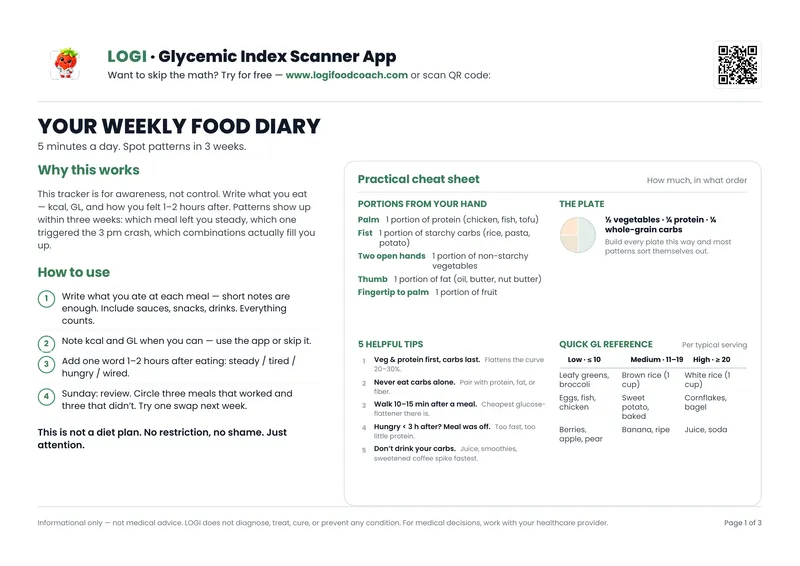
Free PDF — 3 pages
Your Weekly Food Journal
Track meals, glycemic load & mood. Spot patterns in 3 weeks.
No spam. Unsubscribe anytime.