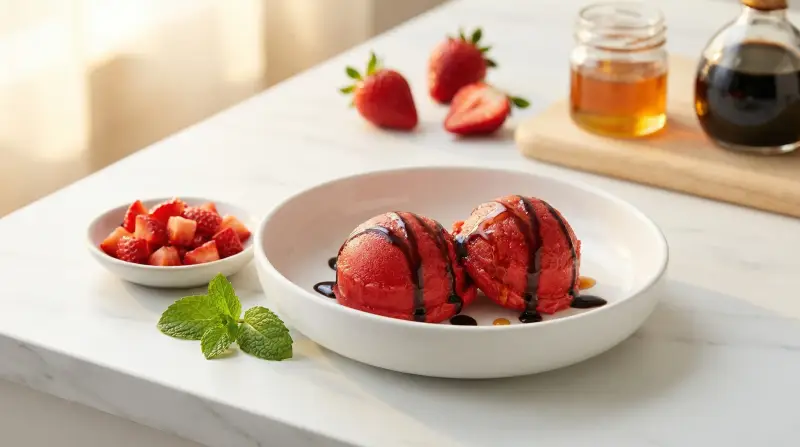
Laagglycemische aardbeien-balsamicosorbet
Een van nature zoet bevroren toetje dat je bloedsuiker niet laat pieken, met verse aardbeien verrijkt met oude balsamicoazijn en een beetje honing.
Deze elegante Italiaans geïnspireerde sorbet transformeert verse aardbeien in een verfijnd bevroren toetje dat opvallend bloedsuikervriendelijk is. In tegenstelling tot commerciële sorbets vol geraffineerde suiker, vertrouwt dit recept op de natuurlijke zoetheid van rijpe aardbeien, versterkt door de complexe gekarameliseerde tonen van gereduceerde balsamicoazijn en slechts een beetje donkere honing.
Aardbeien zijn een uitstekende keuze voor glycemische gezondheid, met een lage GI van ongeveer 40 en een hoog vezelgehalte dat de glucoseopname vertraagt. De balsamicoazijnreductie voegt diepte toe zonder suiker, terwijl de kleine hoeveelheid honing (ongeveer een halve theelepel per portie) net genoeg zoetheid biedt om de zuurheid in balans te brengen. De vezels uit de aardbeien helpen de glycemische impact van de honing te matigen.
Voor optimaal bloedsuikerbeheer kun je deze sorbet het beste na een maaltijd met eiwitten en gezonde vetten eten in plaats van op een lege maag. De koude temperatuur vertraagt ook de spijsvertering, wat de glycemische impact verder vermindert. Dit toetje bewijst dat het beheren van je bloedsuiker niet betekent dat je smaak of elegantie moet opofferen—het is een schuldvrije verwennerij die de natuurlijke zoetheid van vers fruit viert.
Bloedsuikerimpact
Lage tot matige impact met een geleidelijke stijging van de bloedsuiker door de lage glycemische belasting en natuurlijke fruitsuikers in balans met vezels uit aardbeien. De balsamicoazijn kan helpen de suikeropname te vertragen, wat voor 2-3 uur stabiele energie zorgt.
Bloedsuikertips
- ✓ Eet deze sorbet na een maaltijd met eiwitten en gezonde vetten in plaats van op een lege maag om de glycemische respons verder af te zwakken
- ✓ Houd de portiegrootte op één portie en eet langzaam zodat je lichaam de tijd heeft om de natuurlijke suikers te verwerken
- ✓ Overweeg om het te combineren met een handvol noten of zaden om eiwitten en vetten toe te voegen die de bloedsuikerspiegel stabiliseren
🥗 Ingrediënten
- 177 ml balsamicoazijn
- 600 g verse aardbeien, gekrond en gehalveerd
- 60 g verse aardbeien, grof gehakt voor garnering
- 15 ml donkere honing
- 12 tbsp balsamicoazijn
- 1.3 lb verse aardbeien, gekrond en gehalveerd
- 2.1 oz verse aardbeien, grof gehakt voor garnering
- 1 tbsp donkere honing
👨🍳 Instructies
- 1
Giet de balsamicoazijn in een kleine roestvrijstalen of niet-reactieve steelpan. Zet op middelhoog vuur en breng aan de kook. Laat de azijn langzaam inkoken tot ongeveer de helft van het oorspronkelijke volume, ongeveer 5 minuten. De reductie moet de achterkant van een lepel bedekken. Haal van het vuur en laat volledig afkoelen op kamertemperatuur.
- 2
Terwijl de balsamicoreductie afkoelt, maak je de aardbeien schoon door de kroontjes te verwijderen en ze doormidden te snijden. Doe de gehalveerde aardbeien in een krachtige blender of keukenmachine. Mix op hoge snelheid tot het mengsel volledig glad is en er geen brokjes meer zijn, ongeveer 1-2 minuten.
- 3
Zet een fijnmazige zeef op een grote mengkom. Giet de aardbeipuree in de zeef en gebruik een rubberen spatel of de achterkant van een houten lepel om het mengsel erdoorheen te drukken, waarbij je al het gladde sap extraheert terwijl je de pitjes en pulp achterlaat. Gooi de vaste stoffen die in de zeef achterblijven weg.
- 4
Voeg de afgekoelde balsamicoreductie, donkere honing, gefilterd water en verse citroensap toe aan de gezeefde aardbeipuree. Klop grondig tot alle ingrediënten volledig zijn opgenomen en het mengsel uniform van kleur en consistentie is. De balsamico voegt een prachtige diepte en lichte zuurheid toe om de natuurlijke zoetheid van het fruit in balans te brengen, terwijl het citroensap de frisheid versterkt en helpt de kleur te behouden.
- 5
Dek de kom af met plasticfolie of doe over in een luchtdichte container. Zet minstens 2-3 uur in de koelkast of tot het mengsel goed gekoeld is tot 4°C of lager. Deze stap is cruciaal voor de juiste vriestextuur en zorgt ervoor dat de ijsmachine efficiënt kan werken.
- 6
Giet het gekoelde aardbeimengsel in je ijsmachine en draai volgens de instructies van de fabrikant, meestal 20-25 minuten, tot het een softijs-consistentie heeft. De sorbet moet glad en romig zijn maar nog niet stevig. Het draaiproces mengt lucht erdoor voor een lichtere textuur zonder suiker toe te voegen.
- 7
Doe de gedraaide sorbet over in een vriezerbestendige container met een goed sluitend deksel. Druk een stuk bakpapier direct op het oppervlak om te voorkomen dat er ijskristallen ontstaan. Vries minstens 3-4 uur tot het stevig genoeg is om te scheppen maar nog steeds romig van textuur.
- 8
Laat de sorbet als je klaar bent om te serveren 3-5 minuten op kamertemperatuur staan om iets zachter te worden voor makkelijker scheppen. Verdeel in gekoelde serveerschaaltjes met een standaard ijslepel (ongeveer 80ml of 1/3 kopje per portie). Garneer met de grof gehakte verse aardbeien. Serveer direct voor de beste textuur en geniet binnen 2 dagen voor optimale smaak en glycemische voordelen.
📊 Voeding per portie
| Per portie | Hele gerecht | |
|---|---|---|
| Calorieën | 72 | 433 |
| Koolhydraten | 17g | 99g |
| Suikers | 13g | 77g |
| Natuurlijke suikers | 13g | 77g |
| Eiwitten | 1g | 5g |
| Vet | 0g | 2g |
| Onverzadigd vet | 0g | 1g |
| Vezels | 2g | 13g |
| Oplosbare vezels | 1g | 4g |
| Onoplosbare vezels | 2g | 9g |
| Natrium | 8mg | 49mg |
Voorspelde glucoserespons
Wat als je...
Geschat model — individuele reacties variëren. Geen medisch advies.
🔄 Lager GI alternatieven
Deze nul-glycemische zoetstoffen bieden zoetheid zonder de bloedsuiker überhaupt te verhogen, vergeleken met honing dat een GI van 58 heeft en glycemische belasting aan het recept toevoegt
Frambozen en bramen hebben iets lagere glycemische belastingen dan aardbeien (rond de 2-3 per 100g versus 3-4) door een hoger vezelgehalte en lagere natuurlijke suikerconcentratie
Hoewel balsamicoazijn restsuikers kan bevatten die de GL iets verhogen, bieden deze alternatieven zuurheid zonder suikergehalte, wat de algehele glycemische impact verder vermindert
🔬 De wetenschap achter dit recept
Waarom deze sorbet je bloedsuiker niet laat pieken
Deze aardbeien-balsamicosorbet is een briljant voorbeeld van hoe doordachte ingrediëntencombinaties een typisch hoogglycemisch toetje kunnen transformeren in een bloedsuikervriendelijke traktatie. Aardbeien hebben van nature een lage glycemische index (rond de 40), dankzij hun hoge vezelgehalte en relatief lage suikerbelasting vergeleken met ander fruit. De vezels in aardbeien—ongeveer 3 gram per kopje—vertragen de opname van natuurlijke fruitsuikers in je bloedbaan, waardoor de snelle glucosepiek die je van bewerkte zoetigheden zou krijgen wordt voorkomen. Nog beter, aardbeien zitten vol polyfenolen, plantenstoffen waarvan onderzoek suggereert dat ze de insulinegevoeligheid kunnen verbeteren en je cellen helpen effectiever op glucose te reageren.
De balsamicoazijn in dit recept is niet alleen voor de smaak—het is een metabolische gamechanger. Studies hebben aangetoond dat azijn bloedsuikerpieken na de maaltijd met wel 30% kan verminderen door de maaglediging te vertragen en de insulinerespons te verbeteren. Wanneer je azijn met koolhydraten consumeert, verandert het letterlijk hoe je lichaam die suikers verwerkt. De kleine hoeveelheid honing biedt net genoeg zoetheid om de zuurheid in balans te brengen, maar omdat het minimaal wordt gebruikt en gecombineerd met vezelrijk fruit en zure azijn, wordt de impact op de bloedsuiker aanzienlijk afgezwakt.
Met een glycemische belasting van slechts 5,3 per portie valt deze sorbet in de categorie "laag" (alles onder de 10 wordt als laag beschouwd). Dit betekent dat de werkelijke hoeveelheid koolhydraten en het verwachte effect op je bloedsuiker minimaal is. Ter vergelijking: een klein bolletje gewoon ijs heeft doorgaans een glycemische belasting van 5,3-20. Om de bloedsuikerstabiliteit te maximaliseren, kun je deze sorbet het beste na een uitgebalanceerde maaltijd met eiwitten en gezonde vetten eten, in plaats van op een lege maag. Je lichaam zal de natuurlijke suikers dan nog geleidelijker verwerken, waardoor je energie stabiel blijft en je trek onder controle blijft.
Gerelateerde recepten
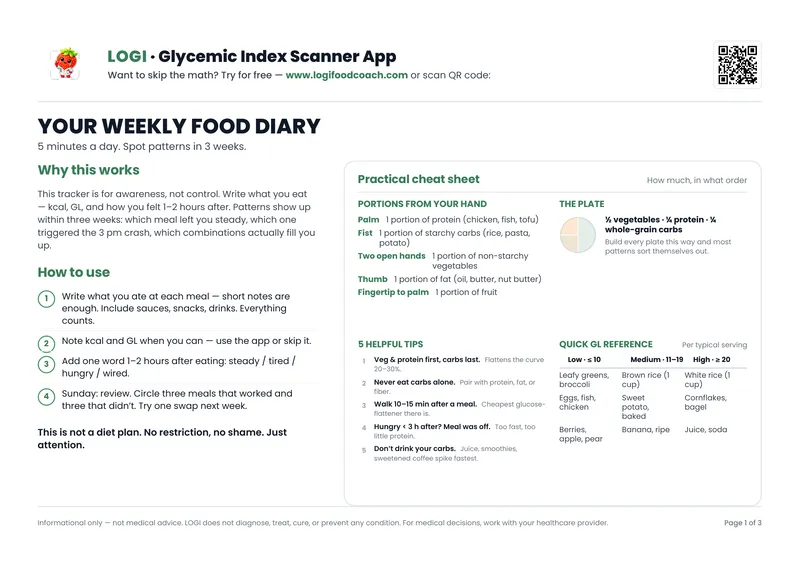
Gratis PDF — 3 pagina's
Je wekelijks voedingsdagboek
Noteer maaltijden, glycemische lading & stemming. Ontdek patronen in 3 weken.
Geen spam. Altijd opzegbaar.