Best Glycemic Index App 2026: 7 Apps Compared for Real Blood Sugar Control
If you type “best glycemic index app” into the App Store or Google today, you will get roughly forty results. Most of them are food databases from 2016 with four screens of hard-coded fruit lists. A handful are real, modern tools. Only two actually predict what your blood sugar will do before you eat the meal.
This guide is an honest, feature-level comparison of the seven apps most people actually consider when they start tracking glycemic index: LOGI, Glycemic Snap, Carb Manager, Glycemic Index & Load Tracker, Fooducate, mySugr, and Nutrisense. I built one of them (LOGI) — so to keep this useful, I will name concrete limitations of every app, including mine, and tell you which one to pick for which situation.
Short version: if you want a photo-based tracker with glucose prediction and no CGM, it is LOGI or Glycemic Snap. If you want a database-only reference app, pick Glycemic Index & Load Tracker. If you are already using a CGM and want premium coaching, it is Nutrisense or Zoe.
The long version — with a side-by-side feature table, pricing breakdown, and a decision tree — is below.
What a glycemic index app actually needs to do in 2026
Before we rank anything, it is worth being explicit about what “tracks glycemic index” even means in a useful way. Three of the seven apps below technically satisfy the phrase but are not useful tools.
The minimum bar is:
-
Glycemic load, not just glycemic index. GI is the number you see in textbooks — watermelon GI 76, lentils GI 32. Glycemic load is the same number multiplied by the carbs actually on your plate. A slice of watermelon has a GL of 4. A plate of lentils is a GL of 13. If an app tells you watermelon will spike you harder than lentils, delete it — that is GI-only thinking and it is wrong at the meal level.
-
A sensitivity profile that changes. Your glucose response to oats at 7am is not your response to oats at 9pm. Good apps learn this over a few weeks. Static databases cannot.
-
Swap suggestions that are specific. “Eat less carbs” is not a feature. “Swap jasmine rice for basmati to reduce the peak by ~25%” is a feature.
-
A meal planner, if you are managing this seriously. Insulin resistance diets are repetitive by nature. If you have to manually re-plan breakfast every day for fourteen days, you will stop.
-
Multilingual, if English is not your first language. This sounds obvious but is rare — most GI apps are US-only.
Three apps below meet all five criteria. The others fail on at least two.
Which Glycemic Index App Is Best for Insulin Resistance?
This is the question about half of the people reading this actually have. Insulin resistance, prediabetes, PCOS-related IR, and gestational diabetes all benefit from glycemic-load awareness — but the app needs to be built for meals, not glucose readings.
If you are IR, the apps ranked top-to-bottom for your use case specifically:
- LOGI — photo scanning, 3-hour glucose curve prediction, meal planner, PDF export for your endocrinologist, HOMA-IR tracking.
- Glycemic Snap — photo scanning and glucose prediction but no meal planner, English-only.
- Carb Manager — keto bias, but the GL data is solid and the community is large.
- Glycemic Index & Load Tracker — pure reference database; useful if you want to look up foods, useless as a daily tool.
mySugr is excluded from this list on purpose — it is built for people who already have a glucometer and a Type 1 or Type 2 diagnosis. It is a great diabetes app. It is not a GI app.
The 7 apps reviewed
1. LOGI — photo scanning + glucose prediction + meal planner in 6 languages
Link: App Store · Google Play · logifoodcoach.com
What it does: take a photo of your meal or type what you ate, and the app returns a glycemic-load estimate, macro breakdown, a 3-hour predicted blood sugar curve, and specific swap suggestions. The meal planner will build 1 to 14 days of low-GL meals for 1–6 people with four meals a day. There is HOMA-IR tracking, a streaks system, timezone-aware push reminders, and a PDF export designed to hand to a doctor.
What is good: it is the only app on this list with a full meal planner. The ingredient database covers 7,158 items. The full app and the content site are in six languages (English, Polish, German, Spanish, French, Italian), with more rolling out. Yearly pricing is the lowest of the prediction-based apps.
What is not good: effective monthly pricing is higher than Glycemic Snap if you pay weekly ($2.99/wk ≈ $12.99/mo) — though yearly at $39.99 is cheaper than the competitor yearly. Soft paywall after 10 free scans; meal planner is behind a hard paywall. The AI is not infallible — plate composition in cluttered photos can be misread, so a quick text correction is sometimes faster.
Best for: anyone with IR, prediabetes, PCOS-related blood sugar issues, or simply “I want to eat without spiking”. Particularly good for non-English speakers — most competitors are English-only.
Pricing: $2.99/week, $39.99/year (≈ $3.33/month effective), 7-day free trial available inside the app.
2. Glycemic Snap — the closest direct competitor
Link: glycemicsnap.com · App Store id 1522964184
What it does: photo scan a meal, get a Glucose Impact Score (0–100), see a predicted blood sugar curve with peak time, and get a swap suggestion. There is a follow-up chat where you can ask questions about the meal you just logged.
What is good: feature set is close to LOGI. Monthly price is the lowest among prediction-based apps at $4.99. The app has been around longer and has more App Store reviews.
What is not good: English only. No meal planner. No PDF export. No HOMA-IR or sleep tracking. Yearly pricing $59.88 is actually higher than LOGI’s $39.99, despite the lower monthly.
Best for: US-based English speakers who want the cheapest month-to-month prediction-based GI app and do not need a meal planner.
Pricing: $4.99/month, $59.88/year, free trial varies by campaign.
3. Carb Manager — the keto-community app that also tracks GI
Link: carbmanager.com
What it does: carb and net-carb tracking with a keto-first philosophy, a very large recipe database, barcode scanning, and an active community. Glycemic load is available on food items but is not the primary framing.
What is good: the recipe library is enormous, the community is active, and the free tier is actually usable. Premium features include photo recognition (less mature than LOGI/Glycemic Snap but improving).
What is not good: the app is designed around keto macros, not blood sugar curves. If you are aiming at glycemic-load rather than strict low-carb, the UI fights you. No glucose prediction. The ads in the free tier can be intrusive.
Best for: someone already committed to keto or very-low-carb who wants GI data as a bonus layer. Not the right choice if you are specifically targeting IR meal patterns that include legumes, fruit, and higher-carb whole grains.
Pricing: free tier with ads, premium around $8.99/month.
4. Glycemic Index & Load Tracker — the classic reference app
Link: App Store id 1630678596 · glycemic-index.net
What it does: a searchable GI and GL database with personal food lists, a basic blood sugar log, and a clean reference UI.
What is good: the database is well-sourced and the authority signals on the web version are strong (years of backlinks). If you want to answer “what is the GL of sourdough?” in two taps, this is fine.
What is not good: no photo scanning, no AI, no meal-level prediction, no meal planner, no language support beyond English. It is a lookup tool, not a daily companion.
Best for: nutrition students, dietitians, and people who want a reference they can trust without subscribing to an AI app.
Pricing: one-time purchase plus optional in-app upgrades.
5. Fooducate — grades and gentle nudges
Link: fooducate.com
What it does: scans barcodes and assigns foods an A–D grade based on a proprietary nutrition score. Glycemic awareness is light but present in the grading logic.
What is good: the grading system is intuitive for people new to nutrition. Barcode scanning is fast and the community-submitted database is huge.
What is not good: the grade hides more than it shows. There is no glucose prediction, no GL math on mixed plates, and the app optimizes “general healthiness” rather than the specific blood sugar question you have.
Best for: a beginner who wants a simple rule — “stick to A and B foods” — without learning GI/GL math.
Pricing: free tier with a premium upgrade around $4.99/month.
6. mySugr (owned by Roche) — diabetes logging, not GI
Link: mysugr.com
What it does: logs fingerstick glucose readings, carbohydrates, insulin doses, and syncs with several glucose meters.
What is good: it is the gold standard of diabetes logging if you have Type 1 or Type 2 and a glucometer. Works with CGMs. Doctors take its exports seriously.
What is not good: it does not compute glycemic load on meals and has no glucose prediction. If you have IR but are not diabetic, this is the wrong app — it will nudge you toward a diabetic workflow you do not need.
Best for: diagnosed diabetics who want a clean log.
Pricing: free core, optional pro tier.
7. Nutrisense — CGM-first premium coaching
Link: nutrisense.io
What it does: pairs a continuous glucose monitor (CGM) patch with a coaching app and dietitian support.
What is good: real-time, real-glucose data is the ground truth. If you can afford it, it is the closest thing to a feedback loop that actually changes behavior in 30 days.
What is not good: $350+ per month for the CGM plus app, requires a prescription in many regions, and most people do not need a continuous sensor to manage IR — they need meal-level decisions.
Best for: biohackers, athletes, or severe IR/prediabetes cases where direct glucose data is worth the cost.
Pricing: $350/month and up, depending on plan.
Side-by-side comparison table
| Feature | LOGI | Glycemic Snap | Carb Manager | GI Tracker | Fooducate | mySugr | Nutrisense |
|---|---|---|---|---|---|---|---|
| Photo meal scan | Yes | Yes | Yes (limited) | No | Barcode | No | No |
| 3h glucose prediction | Yes | Yes | No | No | No | No | Real CGM |
| Glycemic load (meal) | Yes | Yes | Yes (data) | Yes (data) | No | No | Via CGM |
| Meal planner 1–14 days | Yes | No | Partial | No | No | No | Coached |
| HOMA-IR tracking | Yes | No | No | No | No | No | Coached |
| PDF export for doctor | Yes | No | Yes | No | No | Yes | Yes |
| Languages | 6 (EN/PL/DE/ES/FR/IT) | EN | EN | EN | EN | 10+ | EN |
| Needs a CGM | No | No | No | No | No | Optional | Yes |
| Monthly price | $12.99 (weekly plan) | $4.99 | $8.99 | One-time | $4.99 | Free | $350+ |
| Yearly price | $39.99 | $59.88 | ~$90 | One-time | ~$48 | Free | ~$4200 |
| Free trial | 7 days | Yes | 7 days | Demo | Free tier | Free tier | 2 weeks CGM |
Which app for which user
“I suspect I have insulin resistance but no diagnosis yet.” LOGI or Glycemic Snap. You need prediction-based feedback on meals, not a glucometer log. LOGI if you speak anything other than English or want meal planning; Glycemic Snap if you want the cheapest month-to-month.
“I have PCOS and my doctor told me to watch my insulin.” LOGI. PCOS-related IR benefits from meal-planning because hormonal cycles affect hunger cues — the planner reduces decision fatigue during worse weeks.
“I have been diagnosed with prediabetes and my A1C is 6.0.” LOGI or Nutrisense. LOGI if you want to manage with food and do not want to wear a patch; Nutrisense if your doctor wants hard glucose data before you step up to medication.
“I have Type 2 diabetes and use insulin.” mySugr for logging, plus LOGI as a meal decision aid. They do different jobs. Do not use a GI app as your only diabetes tool.
“I am on keto and want to also understand glycemic load.” Carb Manager. It is the least friction if you are already in that community.
“I want a free reference app, I do not want to subscribe.” Glycemic Index & Load Tracker.
What we wish every app in this category would do better
Three things are still badly covered by the whole category, including LOGI:
-
Honest confidence scores on predictions. Every prediction app returns a smooth curve. Real curves are jagged, noisy, and variable between people. The honest output is “we are 70% confident this meal will peak between 140 and 165 in about 45 minutes” — but no one ships that yet.
-
Real meal-level validation. Even if you wear a CGM with Nutrisense, the app cannot know exactly what was on your plate without you telling it. Photo + CGM fusion is the right direction and nobody is shipping it well.
-
Family-aware meal planners. IR often runs in families. A planner that lets one person optimize for strict low-GL while the spouse just wants “reasonable dinners” is rare. LOGI’s 1–6 person planner gets closer than most but is still not there.
What to try first
If you are reading this on a phone, the fastest two-minute test is:
- Open LOGI or Glycemic Snap.
- Photograph whatever you were about to eat.
- Look at the predicted 3-hour curve.
- Try the suggested swap.
Do this for a week. If the app changes one meal decision per day, it has earned its price. If it did not, it is the wrong app for you — and that is useful information too.
Download LOGI on the App Store — Get LOGI on Google Play — Read more on logifoodcoach.com
Take control of your blood sugar
Scan your meals, track glycemic load, and see your patterns — all in one app.
Mulai Uji Coba Gratis →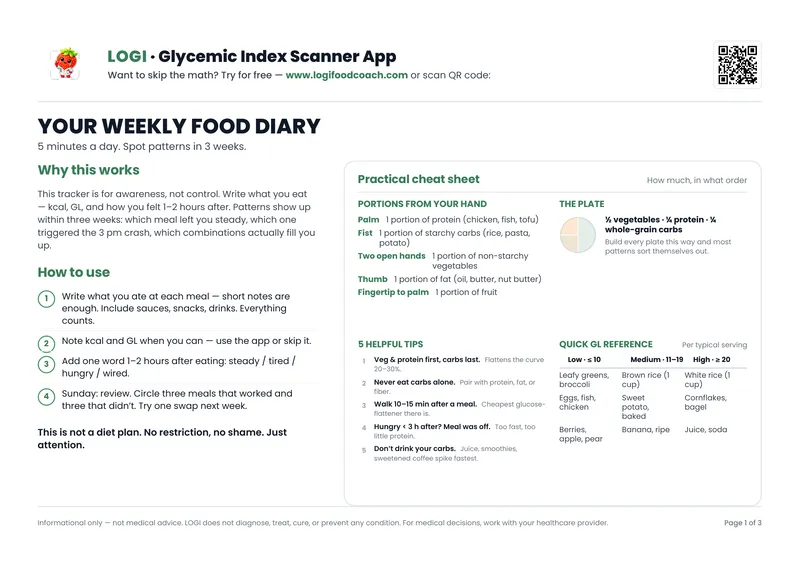
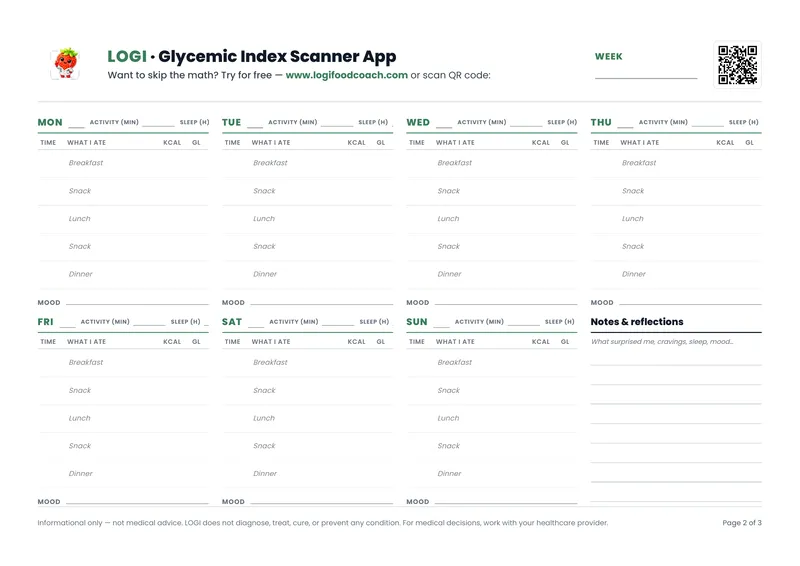
PDF gratis — 3 halaman
Jurnal makanan mingguan
Catat makanan, beban glikemik & suasana hati. Temukan pola dalam 3 minggu.
Tanpa spam. Berhenti kapan saja.