Coffee and Blood Sugar — Why the Same Cup Can Behave Differently

Coffee and Blood Sugar — Why the Same Cup Can Behave Differently
Coffee is one of the most confusing entries in the blood sugar conversation. It has essentially no carbohydrate. The bean itself does not spike glucose. And yet people who wear continuous glucose monitors regularly see a bump after a plain black cup — small, sometimes not so small — and the internet fills up with contradictory advice about whether coffee is fine, terrible, or fine only if you are one of the mystery groups it is fine for.
The confusion comes from mixing two different things: what caffeine does to your hormones, and what everything else in the cup does to your glucose. A shot of espresso and a caramel latte are, biochemically, almost different beverages. This piece walks through the coffee and tea drinks people actually order — black coffee, coffee with milk, sugary chain drinks, iced coffee, decaf, and the main teas — what each one does to blood sugar, and what a person watching their curve can reasonably keep drinking.
The mechanism — caffeine, cortisol, and the “coffee bump”
Plain black coffee contains almost no carbohydrate, so any glucose response is not coming from the coffee itself as food. It is coming from what caffeine does to your body’s hormones.
Caffeine mildly triggers the stress axis. Cortisol and adrenaline nudge upward, and both of those hormones raise blood sugar by telling the liver to release stored glucose and by making cells temporarily less responsive to insulin. In insulin-sensitive people this shows up as a small, short bump that clears within an hour or two. In people with insulin resistance or type 2 diabetes, the same nudge lands on a system that already handles glucose poorly, and the bump tends to be larger and last longer.
This is what people mean when they say “black coffee spikes my blood sugar.” It is not the coffee delivering sugar; it is the caffeine delivering a stress signal that briefly pulls sugar out of storage. Regular coffee drinkers develop some tolerance to this effect over time, so the bump generally shrinks with consistent daily use.
Second, timing matters. Coffee on an empty stomach lands on a body that is already secreting cortisol naturally (cortisol peaks in the first hours after waking). Stacking caffeine on top can produce a bigger glucose bump than the same cup drunk with breakfast. Many people find their morning glucose behaves better when the first cup follows the first meal rather than replacing it.
Third, chronic coffee drinking looks different from an acute cup. Long-term epidemiology consistently links regular coffee consumption — three to four cups a day of either caffeinated or decaf — with lower rates of type 2 diabetes. The likely reasons are the polyphenols (chlorogenic acid especially) and the trace nutrients, not the caffeine. So the same drink can produce a small acute bump and still fit into a metabolically healthy diet over the long run.
Black coffee — a small bump you may or may not notice
An unsweetened espresso, americano, or brewed black coffee has effectively zero glycemic load from the coffee itself. Any response comes from the caffeine mechanism above.
For most insulin-sensitive people this is a non-event: a rise of a few mg/dL that never crosses into anything worth caring about. For people with insulin resistance, prediabetes, or type 2 diabetes, the response is often larger and worth watching — especially on an empty stomach and especially in the morning.
Practical read: black coffee is not “bad” for blood sugar, but if you monitor and you consistently see a meaningful bump, moving the cup to after breakfast usually softens it. Decaf preserves the polyphenol benefits with much less of the caffeine-driven bump — a useful option for a second or third cup.
Coffee with milk — the second variable enters
Add milk, cream, or a plant milk, and you have added actual food. That changes the arithmetic.
Whole milk and cream bring fat and protein, which slow gastric emptying and typically flatten the glucose response of anything eaten with them. A splash of milk in coffee is glycemically close to a rounding error.
A latte or cappuccino is a different order of drink. A standard latte contains around 200–350 ml of milk depending on the size, which delivers real carbohydrate as lactose — roughly a teaspoon of sugar equivalent per 100 ml. It is a low-to-medium glycemic load on its own, and the fat and protein in the milk keep the curve reasonably gentle. As a stand-alone drink it usually produces a moderate, slow rise.
Plant milks vary widely. Unsweetened almond milk and unsweetened soy are close to negligible carbohydrate. Oat milk is the outlier: the enzymatic processing that gives oat milk its flavor also breaks the oat starch down into maltose, which the body handles almost as quickly as glucose itself. A large oat-milk latte behaves less like a milk drink and more like a small starchy snack. We covered this in more detail in the milk piece; the short version is that “unsweetened oat milk” is not glycemically neutral.
Practical read: espresso with a splash of milk is close to a free drink. A latte is a small meal — worth counting once, then treated as one of your morning carbohydrate slots. An oat-milk latte on an empty stomach is the version most likely to produce a noticeable rise.
Sugary chain drinks — mostly dessert with coffee in it
The drinks that top the menu at large chains — flavored lattes, frappés, cold brews with syrup, seasonal specials — are engineered to taste good, which means engineered to contain a substantial amount of sugar. A large flavored latte can carry 30–60 grams of added sugar, and a blended frappé can go higher. In glycemic terms these are closer to a large glass of soda with a coffee accent than to a coffee drink.
The response is exactly what a large sugar load would produce: a fast, high spike, often followed by a rebound low that leaves the drinker hungry an hour later. Milk, ice, and coffee slow it modestly but do not change the category.
If a sweet coffee drink is a regular part of your week, the highest-impact change is usually not “switch to a smaller size” but “switch to a fundamentally different order.” Espresso with a splash of milk, an americano, or an unsweetened latte will get you the coffee ritual without the sugar load. If the sweetness is what you want, sugar-free syrups (using non-nutritive sweeteners) largely remove the glucose event; the tradeoffs of those sweeteners are their own conversation, but for glucose specifically they are far gentler than syrup.
Iced coffee and cold brew — colder, sometimes sweeter
Temperature does not change the glycemic behavior of what is in the cup. Iced black coffee is black coffee. Cold brew is black coffee.
Where iced drinks tend to differ is dose. Iced-coffee cups are usually larger, and they are easier to add sweetener to without noticing — a couple of pumps of syrup in a 24-oz cup adds up quickly. Iced lattes and iced flavored coffees follow the same pattern as their hot equivalents, scaled to the larger cup.
Practical read: check the size and check whether syrup is going in. An unsweetened iced americano is glycemically the same as a hot one; a sweetened iced venti anything is a dessert drink.
Decaf — most of the coffee, almost none of the bump
Decaffeinated coffee keeps the polyphenols and the flavor and loses most of the caffeine, which removes most of the mechanism behind the acute glucose bump. For people whose blood sugar reacts noticeably to caffeine, decaf is the simplest workaround: same drink, gentler curve.
Long-term studies consistently associate both caffeinated and decaf coffee with lower type 2 diabetes risk, so decaf is not a downgrade for metabolic health. If your monitor tells you your body dislikes caffeine, this is the answer with the fewest side effects.
Tea — a smaller cousin with fewer surprises
Plain tea — black, green, oolong, white — has almost no calories and almost no carbohydrate. The caffeine content is generally lower than coffee (matcha and strong black tea sit closer to coffee than most other varieties), so the acute glucose bump from caffeine is smaller.
Green tea in particular contains catechins that appear to have modest favorable effects on glucose handling over time; the effect size is small and easy to over-claim, but the direction is helpful. Herbal “teas” that are actually infusions (chamomile, mint, rooibos) have no caffeine and typically no measurable glucose impact.
The same rules apply to what you add: unsweetened is a free drink; heavily sweetened iced tea from a bottle is a soft drink. Sweetened bubble tea deserves its own category — the sweetened syrups plus the tapioca pearls (nearly pure starch) produce a large, prolonged glucose response.
Practical patterns that keep coffee working for you
- Prefer coffee after breakfast rather than before it. The morning cortisol curve plus caffeine plus an empty stomach is the combination most likely to produce a noticeable bump.
- Espresso, americano, or a splash-of-milk cup for the routine. These are essentially free glycemically.
- Count the latte as a small carb serving, not as a drink. A 300 ml latte is real food; drinking two before lunch is closer to eating than to hydrating.
- Watch oat milk specifically. If you like it, know that it behaves less gently than other plant milks and cow’s milk. Unsweetened soy or unsweetened almond are steadier options.
- Sweet chain drinks are dessert. Move them from “daily” to “occasional” and swap the daily one for an unsweetened version; that single change usually flattens the morning curve dramatically.
- If caffeine consistently bumps your glucose, alternate with or switch to decaf. You keep the ritual and most of the health benefits.
- Sugary bottled iced teas are soft drinks. Freshly brewed unsweetened tea is not.
The bigger picture
Coffee is a good illustration of why glycemic thinking has to look past the food label. Black coffee has no sugar, but the caffeine in it can raise blood sugar through hormones alone. A latte has real sugar (as lactose) that behaves gently because of the fat and protein around it. A flavored frappé and a plain espresso share almost nothing beyond the word “coffee” on the menu.
The way to keep coffee working for you is to notice which cup you are actually holding. A plain or lightly milked cup, drunk after food, is one of the easiest habits to keep in a low-glycemic life — and the epidemiology suggests regular drinkers, caffeinated or not, are metabolically better off than abstainers. The versions that get people in trouble are the sweetened, oversized ones marketed as coffee but built like dessert. Order the coffee, skip the dessert, and there is very little left to worry about.
Curious what your favorite coffee order actually does to your glucose? With Logi you photograph the cup (or the plate around it) and see the estimated glycemic load in about sixty seconds. Two weeks free. Download Logi.
This article is general nutrition education, not medical advice. If you are managing diabetes, insulin resistance, or another condition, discuss dietary changes with your doctor or a registered dietitian.
Take control of your blood sugar
Scan your meals, track glycemic load, and see your patterns — all in one app.
Ingyenes próba indítása →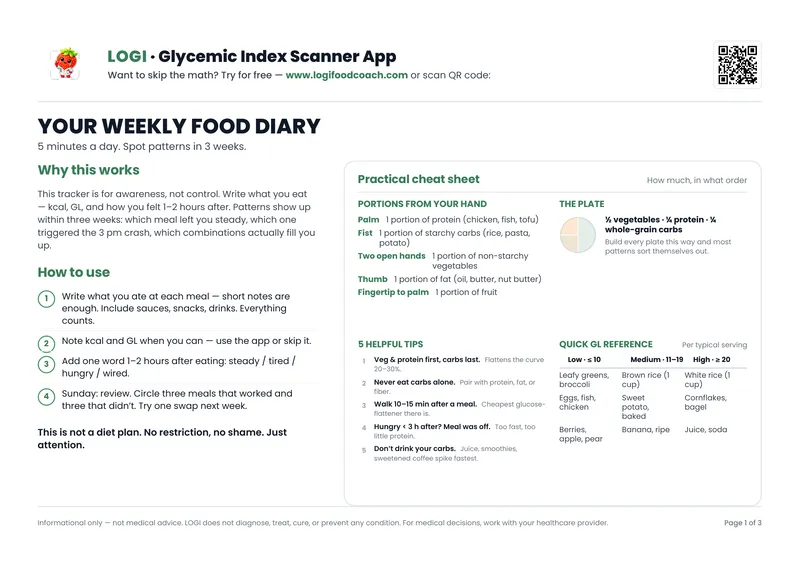
Ingyenes PDF — 3 oldal
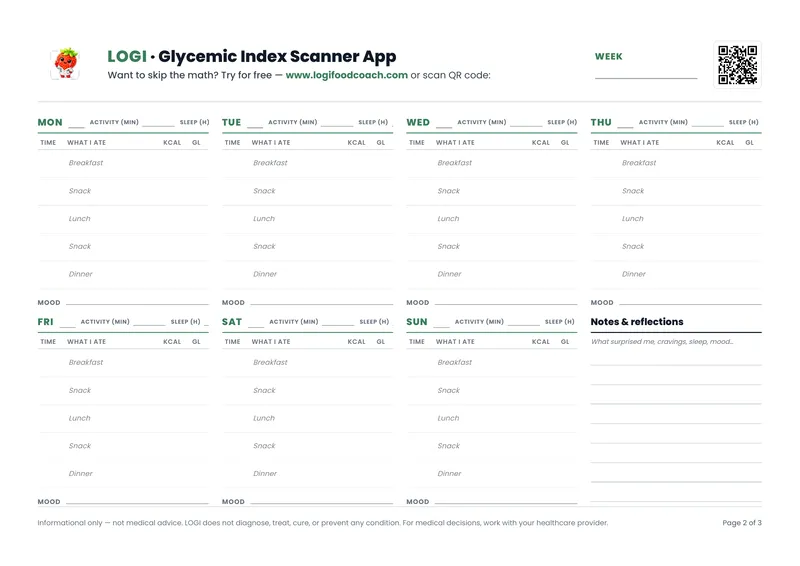
Heti étkezési naplód
Kövesd az étkezéseket, a glikémiás terhelést és a hangulatot. 3 hét alatt felismered a mintákat.
Nincs spam. Bármikor leiratkozhatsz.