Sweet Baked Goods and Blood Sugar — Apple Pie, Marshmallows, Croissants, and What Actually Happens

Bite into a warm apple pie and within twenty minutes your blood sugar tells a story. Most people sense the after-effect — energy drop, foggy thinking, sometimes a craving for more sugar an hour later. They don’t always connect it to the food. This piece walks through what happens, why some sweet baked goods spike harder than others, and the small adjustments that change the curve without giving up the food.
We use apple pie, marshmallows, croissants, donuts, and a few cookies as worked examples because they are popular globally and people search “[food name] + blood sugar” specifically. The mechanism is universal — refined flour, refined sugar, fat, low fiber, fast eating. What changes is how each food combines those four factors.
The four factors that drive the spike
Sweet baked goods share a chemistry that makes them rise fast on the glucose curve.
Refined flour. White wheat flour is starch with almost no fiber and minimal protein. Once it hits saliva and stomach acid, it breaks down to glucose in minutes. A slice of pie crust is functionally similar to a small portion of pure starch in blood-sugar terms.
Refined sugar. Sucrose splits into glucose and fructose. Glucose drives the spike directly. A piece of apple pie may have 25–35 grams of added sugar plus the apple’s own sugar, plus the starch from crust. Marshmallows are 80% sugar and gelatin — almost pure fast carbs.
Fat slows but doesn’t prevent. Croissants and donuts have a lot of butter or fried oil. Fat slows gastric emptying, which moves the spike from 30 minutes to 60-90 minutes and may flatten the peak slightly. But the total glucose load still arrives. The fat also adds substantial calories without slowing the carbohydrate absorption proportionally.
Low fiber, fast eating. Most baked goods are designed to be soft and palatable, which means little chewing and fast consumption. A 100-calorie cookie eaten in 90 seconds delivers carbs faster than the same calories in apples eaten in 10 minutes.
Worked examples — what the data actually shows
Approximate glycemic load per typical serving. These are rounded estimates; brands and recipes vary widely.
Apple pie, one slice (1/8 of a 9-inch pie). Around 40-50g total carbs. Glycemic load roughly 20-25. The combination is crust starch (refined flour), filling sugar (~25g added), apple sugars (~10g), butter. The fat in crust slows things slightly but the total load is high.
Marshmallow, 4 large pieces (~30g). Around 24g carbs, almost all sugar. Glycemic load around 18-20. No fat, no fiber. Fast spike. Even small portions add up — a “handful” is often 6-8 pieces and can deliver 30g+ sugar.
Croissant, plain butter (~60g). Around 26g carbs, 12g fat. Glycemic load around 13-15. Lower than pie because there is no added sugar in the dough itself. The chocolate or jam versions push it back up to 20+.
Glazed donut (~60g). Around 25g carbs, 14g fat. Glycemic load around 14-16. The fried dough plus glaze gives a sharp spike with a fat-flattened curve — typically peak at 60-75 minutes.
Chocolate chip cookie, one medium (~30g). Around 18g carbs. Glycemic load around 10-12. Small portion means small absolute load, but most people don’t eat just one.
Cinnamon roll (~80g). Around 35-45g carbs. Glycemic load around 22-28. Refined flour plus heavy sugar glaze plus minimal fiber.
For context, a low-glycemic meal target is a glycemic load under 12 per serving. Most sweet baked goods at typical portions exceed that.
Why marshmallows feel different from apple pie
People often ask why marshmallows, which seem lighter, can spike as hard as a piece of cake. Two reasons.
First, the carbohydrate density. Marshmallow is essentially sugar foam — 80% of its weight is fast-absorbing sucrose. Apple pie has a similar sugar amount per slice but spread across crust, filling, and apple, which means slightly slower release.
Second, the fat absence. Apple pie has crust butter and sometimes a scoop of ice cream beside it. That fat extends the time-to-peak. Marshmallows have zero fat, so the sugar hits the bloodstream nearly unmoderated. The peak comes faster and feels sharper, even if the total area under the curve is similar.
This is why “low fat” isn’t always lower in blood-sugar impact. Fat-free sweets often spike harder than their full-fat versions.
Four adjustments that change the curve
You don’t need to give up these foods to manage their effect. Small structural changes shift the response.
Eat protein or fat first. Ten grams of protein (Greek yogurt, cottage cheese, hard cheese, eggs) eaten 5-10 minutes before the sweet baked good blunts the peak meaningfully. The protein slows gastric emptying and triggers an early insulin response that meets the glucose more efficiently. Apple pie after a protein-rich meal hits very differently than apple pie on an empty afternoon stomach.
Smaller portion, slower pace. A half slice of pie eaten over fifteen minutes produces a different curve than a full slice eaten in three. The total sugar matters, but speed matters too. Cutting portion in half is often more practical than trying to eat slowly.
Walk after eating. Twenty minutes of light walking within an hour of eating can blunt the post-meal glucose peak. The muscle takes up glucose without needing as much insulin. This is well-studied and works across food types.
Choose timing. Sweet baked goods at the end of a meal that already had protein, fat, and fiber will produce a smaller spike than the same food eaten alone. Standalone dessert mid-afternoon, on an empty stomach, with coffee, tends to produce the sharpest curve.
What about “diabetic-friendly” baked goods
Many products marketed as low-carb or diabetic-friendly use sugar alcohols (erythritol, maltitol, xylitol), inulin, or flour substitutes (almond flour, coconut flour). Some of these reduce the glycemic load meaningfully — almond flour and erythritol both have minimal blood-sugar impact. Others, like maltitol, do raise glucose, just less than sugar.
If you reach for these products, check the label. Real reduction comes from replacing refined flour with nuts/seeds and replacing sugar with erythritol or allulose. Modest reduction comes from replacing sugar with maltitol or honey. No reduction comes from labeling alone — “diet” or “light” doesn’t necessarily mean lower glycemic.
Cultural context — apple pie in different countries
Apple pie shows up in many cuisines with different structural choices. American apple pie tends to be sweeter with thicker crust. French tarte aux pommes uses less sugar, thinner crust, and often no top crust — naturally lower glycemic load. German Apfelstrudel uses thin pastry layers and less added sugar than American pie. Japanese apple pie (アップルパイ) varies — some bakeries make a denser, sweeter version, others lean French-style.
The point isn’t that one is “better” — it’s that recipe structure matters more than the name on the menu. If you’re managing blood sugar, a thinner-crust, less-sweet pie at half portion will treat you very differently than a sweeter, thicker version at full portion.
Weight management context
If sweet baked goods are appearing often and weight is a concern, the conversation is rarely about willpower. Three things to look at together:
Food patterns. Frequent sweets often respond to under-protein meals. Adding 20-30g of protein to breakfast and lunch tends to reduce the afternoon sweet craving without conscious effort.
Sleep. Short sleep increases hunger hormones and reduces glucose tolerance. The same cookie hits harder on five hours of sleep than on eight.
Movement. Daily walking helps both glucose control and weight management. It doesn’t have to be intense — consistency matters more than intensity.
If weight is affecting your physical or mental health, talk to a doctor. This article is general information, not a treatment plan.
Bottom line
Sweet baked goods spike blood sugar because they combine refined flour, refined sugar, low fiber, and fast eating. Marshmallows spike fast because they’re nearly pure sugar with no fat. Apple pie spikes slower but harder in total because of the combined load. Croissants and donuts have lower added sugar but high refined flour. None of these need to be eliminated. Protein first, smaller portion, slower pace, a walk after — the small structural moves matter more than the food itself.
Tracking glycemic load and blood sugar response per food is what the Logi app is built for — scan a meal, see the load, see the predicted three-hour curve. If you want to understand which baked goods affect you personally, photographing them is the simplest way to learn the pattern. This article shares general nutrition knowledge and is not a substitute for medical advice. If you have diabetes, prediabetes, or are concerned about glucose patterns, consult a healthcare professional.
Take control of your blood sugar
Scan your meals, track glycemic load, and see your patterns — all in one app.
Započnite besplatno probno razdoblje →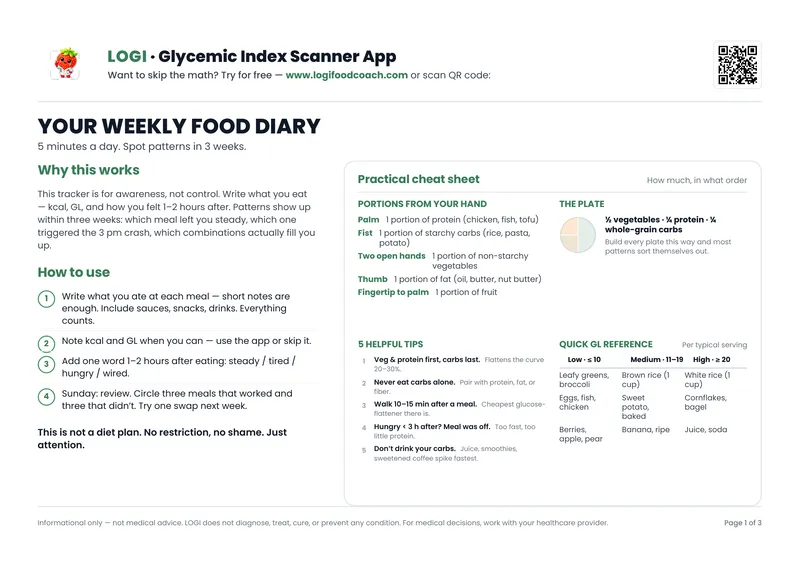
Besplatan PDF — 3 str.
Tvoj tjedni dnevnik prehrane
Bilježi obroke, glikemijsko opterećenje i raspoloženje. Uoči obrasce za 3 tjedna.
Bez spama. Odjavi se kad želiš.