Smoothies and Blood Sugar — Why Blending Fruit Isn't the Same as Eating It
Smoothies and Blood Sugar — Why Blending Fruit Isn’t the Same as Eating It
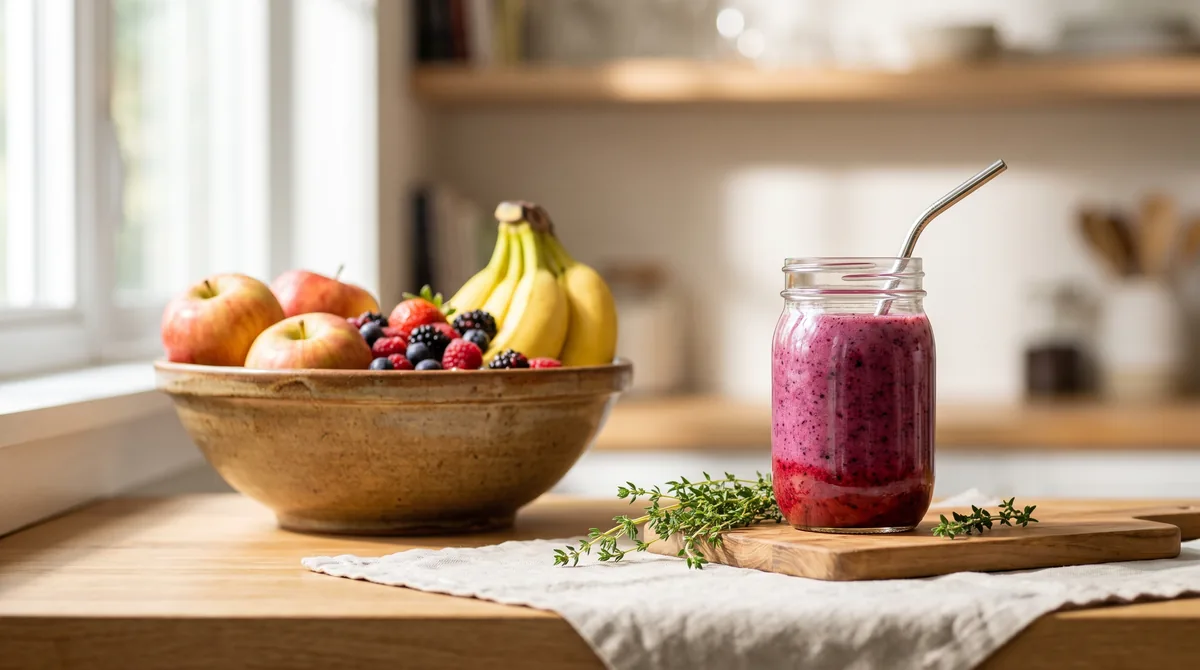
Smoothies live in an odd corner of the “healthy eating” conversation. They look virtuous — fruit, greens, maybe some protein — and they replace processed snacks in a lot of daily routines. But on a glucose monitor, a lot of smoothies produce a curve that looks nothing like eating the same ingredients in whole form. The apple, banana, and berries you would eat over ten minutes as a fruit bowl behave very differently once a high-power blender has broken every cell wall in them and turned them into a liquid you can drink in ninety seconds.
None of this makes smoothies bad. It makes them a specific kind of food with specific rules. This piece walks through why blending changes the metabolic story, which smoothie patterns hold up well for insulin resistance and which don’t, and how to build a smoothie that actually behaves the way you want it to.
The mechanism — what a blender does to a fruit
Whole fruit contains sugar (mainly fructose and glucose, some sucrose) suspended in a matrix of fiber, water, and cell walls. That matrix has three metabolically important properties.
First, it slows chewing. Eating a whole apple takes a few minutes. That time itself paces glucose absorption — the sugar reaches your bloodstream in a slow trickle rather than a wave.
Second, intact cell walls make the sugar physically less accessible. Even after you’ve swallowed a piece of apple, the sugars remain partly locked inside plant cells and are released as digestive enzymes and stomach acid gradually break the walls open. This is why glycemic index measurements of whole fruits are usually low-to-moderate, even for fruits that are quite sweet.
Third, soluble fiber in the fruit slows gastric emptying and blunts the peak of any glucose spike that does occur. This is one of the main mechanisms behind fiber’s blood-sugar-friendly reputation.
A high-power blender undoes most of the first two effects. The blades pulverize the cell walls into microscopic fragments. The fiber is still there, but its physical structure is destroyed — it’s now suspended in the liquid rather than acting as a wall around the sugar. And a smoothie is drunk fast, not chewed. What was a slow, matrix-buffered glucose release in whole fruit becomes a fast, mostly-unbuffered sugar delivery in smoothie form.
The result is that the same weight of fruit, blended, typically produces a taller and faster glucose peak than eaten whole. Not always — the difference varies with the fruit, the amount of soluble fiber that survives blending, and what else is in the smoothie — but the direction is consistent.
Straight fruit smoothies — the highest-risk category
A pure fruit smoothie, especially one built around bananas, mangoes, pineapple, and orange juice, is close to a liquid dessert on a monitor. A typical smoothie of this kind contains 40–60 grams of sugar in a form that hits your bloodstream fast. For someone managing insulin resistance, this is functionally similar to drinking a can of soda in glucose terms, just with more vitamins and a better story attached.
The “sugar is natural, it’s from fruit” framing is metabolically empty. Your body has no way of knowing where fructose came from. What matters is dose, matrix, and speed of arrival — and a fruit smoothie delivers a large dose, no matrix, and high speed.
The category isn’t hopeless. A small (200–300 ml) berry-heavy smoothie, made with lower-sugar fruits (berries, kiwi, small green apple) and drunk slowly, can behave reasonably. But the classic “large blender full of tropical fruit” pattern is one of the flatter routes to a big glucose spike disguised as a health food.
Green smoothies — better, but often not by as much as people think
Adding leafy greens to a smoothie is a real improvement — spinach, kale, and cucumber contribute almost no carbohydrate and add fiber. But green smoothies commonly still contain 1–2 bananas, a cup of orange juice or apple juice, some berries, and possibly a date or two for sweetness. The greens make the color impressive and the marketing convincing, but the fruit and juice underneath are still doing the glycemic work.
A useful mental model: subtract the greens (they don’t move blood sugar) and look at what remains. If a “green smoothie” is one cup of spinach plus a banana, a mango, and orange juice, it is a fruit smoothie with vitamins added, not a low-glycemic drink.
A genuinely green smoothie — spinach or kale, half an avocado, a small handful of berries, unsweetened almond milk, maybe a scoop of protein powder — sits in a very different metabolic category and can be genuinely low-glycemic. The distinction is which ingredients dominate the total sugar count, not which ingredient shows up first in the color.
Protein smoothies — the mechanism-driven fix
The single largest change you can make to any smoothie’s glycemic profile is adding a substantial protein source. Twenty grams of whey, casein, or a plant-protein blend slows gastric emptying, extends the digestion timeline, and blunts the peak of any glucose response from the other ingredients.
This works because protein triggers cholecystokinin release, which slows the rate at which the stomach empties into the small intestine. Sugars from fruit are then absorbed more gradually, and the glucose curve flattens noticeably. The effect is not subtle — a plain fruit smoothie and the same smoothie with a scoop of whey can produce peaks 30–40% apart on the same person.
The protein choice matters less than the amount. Whey, casein, soy, pea, or a blend all work; unflavored is fine and dodges the added sugar that flavored powders often carry. If protein powder isn’t for you, Greek yogurt or cottage cheese (yes, blended into a smoothie) contribute similar amounts of protein and similar mechanical effects. Two heaped tablespoons of nut butter or a quarter cup of chia seeds contribute additional fat and fiber that also flatten the curve, though not as dramatically as a full protein dose.
Practical rule: every smoothie should contain at least 15–20 grams of protein, ideally more if the smoothie is a meal replacement. Below that threshold you are drinking sugar water with vitamins.
Fiber additions — modest help, not a full fix
Chia seeds, flax seeds, psyllium husk, and oat bran added to a smoothie contribute soluble fiber, which does slow glucose absorption and lengthen satiety. The effect is real but usually smaller than a protein addition. A tablespoon of chia adds about 5 grams of fiber, which is meaningful but not transformative.
The best use of these ingredients is alongside protein, not instead of it. Protein plus fiber plus a moderate carb load is the general shape of a smoothie that behaves well on a monitor.
Juices, syrups, and hidden sugar
Many popular smoothie recipes call for a base of fruit juice — orange juice, apple juice, pineapple juice, coconut water. These are the invisible sugar bombs. Half a cup of orange juice adds about 12 grams of sugar with essentially no fiber; a cup adds 24. Recipes that stack fruit juice as a base under whole fruit as toppings routinely reach 60–70 grams of sugar per serving without anyone thinking of the drink as sweet.
Swapping the base to unsweetened almond milk, unsweetened coconut milk, unsweetened soy milk, plain water, or plain kefir/yogurt removes 20–30 grams of sugar from a typical recipe without touching the rest of the ingredient list. This is usually the highest-leverage change you can make to a smoothie recipe you already like.
Similarly, watch for honey, maple syrup, agave, and dates as sweeteners. Each of these acts like the sugar it is — a tablespoon of honey adds roughly 17 grams of sugar. If the underlying fruit doesn’t make the smoothie sweet enough, that is a signal to change the fruit ratio rather than to add sugar.
The whole-fruit reference case
The cleanest way to think about smoothies is to imagine eating the same ingredients whole and comparing. A smoothie with one apple, a banana, and a cup of orange juice replaces two whole fruits and a glass of juice. The glucose response, adjusted for the loss of matrix and the drinking speed, is worse than the equivalent whole meal — the same total sugar delivered faster and higher.
A smoothie with two cups of spinach, half an avocado, a small handful of berries, unsweetened almond milk, and 25 grams of whey protein replaces a spinach salad with berries and a small piece of avocado and a glass of milk with protein. That smoothie will behave close to the whole-food version — modestly worse due to blending, but within a range that’s fine for insulin resistance.
If your smoothie’s whole-food equivalent would be a large fruit salad plus a glass of juice, it will spike you. If it would be a green salad plus a protein source, it will not.
Bigger picture — smoothies are a format, not a food
There is no universal answer to “are smoothies good for insulin resistance?” because a smoothie can be a 60-gram-sugar dessert or a low-glycemic meal, and the two are the same word. The format itself is metabolically neutral — a blender is a tool, not a nutrition profile.
Two practical rules cover most of the territory. First, protein-first: no smoothie without a substantial protein source (20 grams as a minimum). Second, subtract the fruit juice, and count the whole-fruit sugar as it is — not “natural” and therefore free, just sugar.
Once those two rules are in place, smoothies can be a genuinely useful pattern for people who struggle to fit protein into a busy morning or who want a fast, portable meal that doesn’t leave them ravenous an hour later. The blender is a fine tool. It just doesn’t do the metabolic work for you — it does the opposite, unless you compensate with the rest of the ingredient list.
If you want a personal read on how your own smoothie recipes behave on your glucose — versus their whole-food equivalents — Logi analyzes what you eat and answers directly whether a specific drink fits your goals, using continuous glucose data if you have it and a hunger/energy log if you don’t.
This article is general nutrition education, not medical advice. If you have diabetes, take insulin or sulfonylureas, or have any medical condition that affects how your body handles food, discuss changes to your diet with your doctor or a registered dietitian.
Take control of your blood sugar
Scan your meals, track glycemic load, and see your patterns — all in one app.
मुफ्त ट्रायल शुरू करें →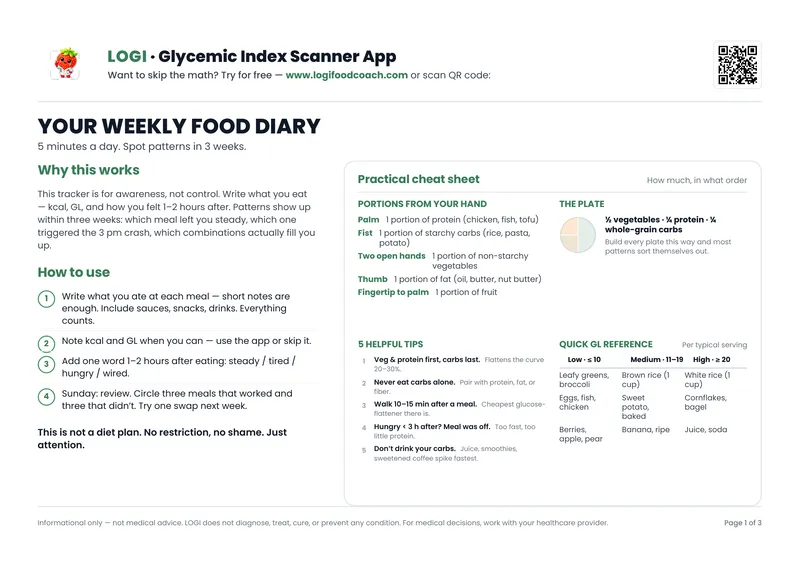
मुफ़्त PDF — 3 पेज
साप्ताहिक फ़ूड जर्नल
भोजन, ग्लाइसेमिक लोड और मूड ट्रैक करें। 3 हफ़्तों में पैटर्न पहचानें।
कोई स्पैम नहीं। कभी भी सदस्यता रद्द करें।